

What if a money reading could clarify your next question without predicting your next paycheck? When bills, debt, or a major purchase leave you uncertain, it’s natural to want a clear answer. But tarot for financial guidance works best as a reflective framework, not a forecast or a substitute for sound financial advice. The cards can help surface assumptions, fears, and priorities that may be shaping how you see the situation.
This guide will show you how to frame focused money questions, choose a spread that fits the concern in front of you, and interpret each card as a prompt rather than a guarantee. You’ll also learn how to turn a reading into responsible next steps: review your budget, verify practical details with reliable sources, and consult a qualified financial professional when the stakes call for it. We’ll move from question design to spread structure, interpretation, and action, giving intuition a useful place in your process without asking it to make the decision for you.
Key Takeaways
- Use tarot for financial guidance to examine your beliefs and priorities, not to predict outcomes or make financial decisions for you.
- Match the spread to the scope of your concern, from a single point of reflection to a more layered money question.
- Read spread positions as connected prompts, and consider how different cards add symbolic emphasis without treating them as fixed instructions.
- Prepare a focused question, record your interpretation, and resist drawing cards repeatedly to seek a preferred answer.
- Turn insights into questions to verify, then choose whether self-guided reflection, digital tarot, or qualified financial support best fits your need.
What Tarot for Financial Guidance Can, and Cannot, Help You Explore
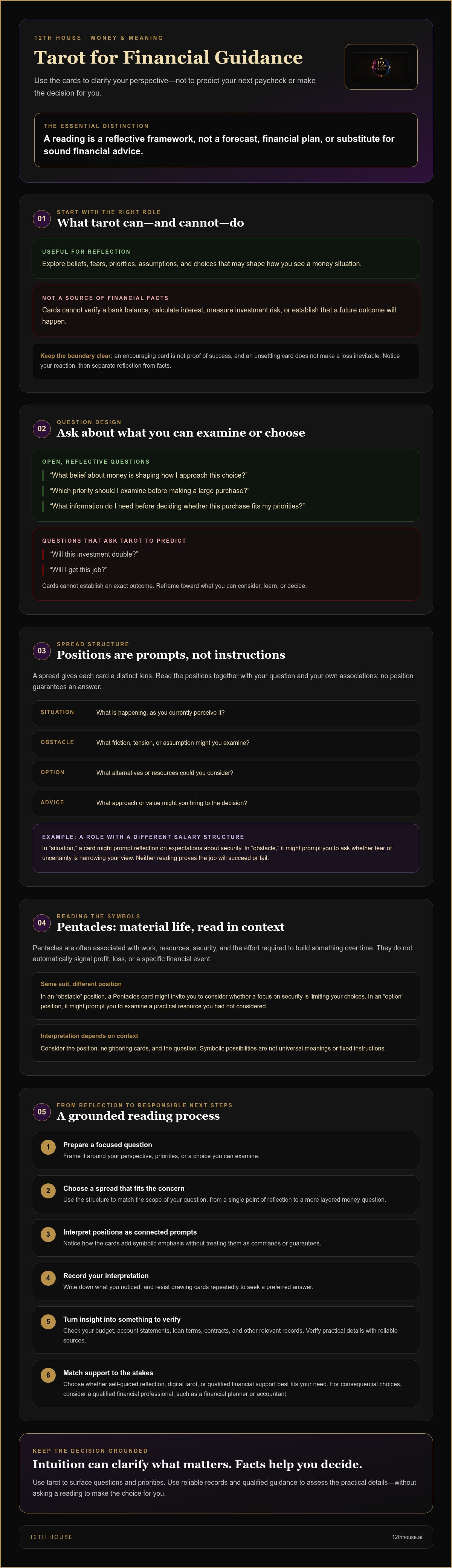
Tarot for financial guidance is a symbolic reflection practice that uses card meanings and spread positions to explore your beliefs, priorities, and choices about money, not to predict outcomes or create a financial plan.
Money uncertainty can feel intensely personal. A debt balance, unstable income, or major purchase may bring up fear as well as practical questions. A reading can offer a calm structure for examining your perspective, without pretending that a card can resolve the numbers. Tarot’s history of tarot includes its development from playing cards into a tool used for divination; in a financial reading, treat its symbols as prompts for thought, not evidence about what will happen.
What questions can a financial tarot reading explore?
Frame the question around your perspective and decisions. For example: “What belief about money is shaping how I approach this choice?” or “Which priority should I examine before making a large purchase?” These open questions leave room to notice assumptions, values, and options you may have overlooked.
By contrast, “Will this investment double?” or “Will I get this job?” asks the cards to establish a future event or exact outcome. They can’t do that. Keep the inquiry focused on what you can assess or choose: “What should I consider before applying for this role?” or “What information do I need before deciding whether this purchase fits my priorities?”
Where tarot’s guidance ends
Symbolic interpretation cannot verify a bank balance, calculate interest, or measure investment risk. A card that feels encouraging isn’t proof that a job, purchase, or investment will succeed. Likewise, an unsettling card doesn’t establish that a loss is inevitable. Notice your reaction, then separate the reflection from the facts.
Use a reading to identify what you want to investigate. Then check account statements, loan terms, contracts, and other relevant records. For consequential choices, consult a qualified financial professional, such as a financial planner or accountant, as appropriate. Tarot may help you clarify what matters to you; it shouldn’t replace reliable information or professional guidance.
How Tarot Cards and Financial Spreads Organize a Money Question
A spread gives a reading its architecture. Spread positions shape a financial tarot reading by assigning each card a distinct question to consider, not a guaranteed answer to accept. A “situation” position invites you to examine what’s happening; an “obstacle” position directs attention to friction; an “option” or “advice” position can help you reflect on possible responses. The card’s meaning emerges through that prompt, your question, and your own associations.
This structure can help you notice how emotion and assumptions influence financial choices. Behavioral economics explores the psychological factors behind decisions, including choices that may not seem rational in hindsight. Tarot can offer a symbolic route into similar self-inquiry, but it doesn’t measure risk or establish which choice is objectively best.
What does the suit of Pentacles mean in a money reading?
Pentacles are often associated with material life: work, resources, security, and the effort required to build something over time. In a money reading, a Pentacles card might invite reflection on stability, earning, practical priorities, or your relationship with what you have. It doesn’t automatically signal profit, loss, or a specific financial event.
Read the card in context. Its position, neighboring cards, and the question all matter. A Pentacles card in an “obstacle” position might prompt you to consider whether a focus on security is limiting your choices; in an “option” position, it might lead you to examine a practical resource you haven’t considered. These are interpretive possibilities, not universal meanings.
How do card positions change the reading?
Positions create different lenses. “Situation” describes the issue as you currently perceive it. “Obstacle” highlights a tension or assumption to examine. “Option” opens a space to consider alternatives, while “advice” asks what approach or value you might bring to the decision. The positions guide your attention; they don’t dictate an outcome.
Illustrative example: Suppose you’re considering whether to apply for a role with a different salary structure, and the same card appears in two positions. In “situation,” you might reflect on your current expectations about security. In “obstacle,” you might ask whether fear of uncertainty is narrowing your view. Neither interpretation proves the job will succeed or fail. It helps you identify what to investigate next.
Use tarot for financial guidance as a tool for framing reflection, then test any practical conclusion against facts. If a structured digital reading would support your continued exploration, you can learn about digital tarot readings as one option.
Which Financial Tarot Spread Fits Your Question Best?
Choose a spread by the size of the question, not by how serious the decision feels. A narrow concern usually benefits from a simple layout that keeps attention on one issue. A question with several dimensions may need more positions to separate the factors you want to examine. A larger spread does not make a prediction more certain; it only gives you more prompts to interpret.
Use these layouts as flexible frameworks. You can adjust position labels to fit your question, as long as each position has a distinct purpose.
| Spread | Positions | Suitable question | Limitation |
|---|---|---|---|
| One card | One focus or reflection prompt | “What assumption about this purchase should I examine?” | Offers one angle, not a full analysis. |
| Three cards | Situation, overlooked factor, possible response | “What should I consider before changing my savings approach?” | May simplify a complex decision. |
| Four positions | Situation, opportunity, risk, advice | “What aspects of this financial choice deserve closer attention?” | Prompts investigation; it can’t assess facts or quantify risk. |
When should you use a one-card or three-card spread?
Use one card when you can express the inquiry in a single, focused prompt, such as identifying an assumption or considering a next step. Choose three cards when you want a little more structure: what’s happening, what you may be overlooking, and what response you could consider. These labels aren’t fixed rules. Keep the underlying question specific so the reading doesn’t sprawl into unrelated money concerns.
When is a financial situation-and-risk spread useful?
A four-position layout can help when your question has several parts. Read “opportunity” as something to explore, not a promise of gain; read “risk” as a reason to investigate, not proof that harm will occur. For example, a reading about taking on a new expense might prompt you to review flexibility, timing, or your priorities. It can’t replace a budget review, checking the relevant terms, or a qualified professional’s assessment.
For tarot for financial guidance, let the spread organize your reflection, then take only the practical questions it raises into your real-world research. If you’re new to reading, start with one or three cards. Add positions only when each one helps clarify a different part of the inquiry.
Tarot Reading for Financial Guidance: Step by Step
A steady process keeps the reading reflective rather than reactive. Set aside a quiet moment, choose a spread that fits one concern, and keep a journal or notes page nearby. If you feel pressured to draw until you see a reassuring answer, pause. Repeated pulls can blur the question instead of clarifying it.
How should you phrase a financial tarot question?
Keep one decision or concern in focus. Replace “Will I earn more money?” with “What priorities should I consider as I explore ways to increase my income?” Avoid asking the cards to choose investments, diagnose debt, or promise income. Ask what you can examine, decide, or learn instead.
- Define the question. Write it in one sentence before drawing. Make it open-ended and centered on your perspective or choices.
- Choose your spread. Select positions that help examine this specific concern. Don’t add extra cards simply because the first interpretation feels uncomfortable.
- Prepare calmly. Take a moment to settle and notice your expectations. You don’t need to force a particular mood or outcome.
- Record the draw. Note the date, question, spread positions, and cards in the order they appear.
- Interpret in layers. For each card, record its symbolism, your first impression, and at least one alternative interpretation. Then ask whether your reading reflects evidence, a personal assumption, or fear about the situation.
- Separate reflection from facts. Keep verified details, such as account records or written terms, distinct from card symbolism and interpretation. A reading can suggest what to check; it can’t confirm a balance or determine a financial outcome.
- Choose one grounded next action. Make it low-risk and relevant, such as reviewing a statement or listing questions to ask a qualified professional.
How do you interpret cards without overreading them?
Leave room for uncertainty. A card may bring a useful theme to mind, but that doesn’t make the theme a fact about your finances. Ask, “What supports this interpretation, and what else could this card mean in this position?” If you can’t separate a practical observation from a prediction, return to the records and information you can verify.
How can you keep a useful tarot journal?
Track the original question and date, then keep the interpretation, action taken, and later outcome in separate notes. Review entries over time for recurring themes in your beliefs or decision-making, not as proof that the cards caused or predicted an event. A journal is a record for reflection, not a substitute for financial documentation.
Turn a reading into a cautious action by treating its message as a question to verify, then choosing a practical next step based on reliable information. For continued self-guided exploration, explore digital tarot readings as one resource within 12th House’s digital membership platform.
Use Tarot for Financial Guidance as Reflection, Then Choose Your Next Step
A useful reading doesn’t end with an instruction. It ends with a clearer question to verify. Treat the interpretation as a lens on your priorities, then decide what evidence or practical input you need before acting. That boundary keeps tarot for financial guidance in its proper role: a reflective practice, not a financial decision-maker.
What should you do after a money-focused tarot reading?
Translate each strong impression into something you can check. If the reading raises a concern about affordability, review your budget and recent account records. If it brings up uncertainty about borrowing, consult the loan terms and repayment schedule. If it points toward an opportunity, verify the relevant details rather than assuming the card confirms it.
- Identify the question to verify. What fact, assumption, or condition would change your understanding?
- Choose a proportionate next step. Gather information or seek clarification before making a major commitment.
- Pause when the stakes are high. For complex decisions or consequences that could substantially affect your finances, seek guidance from a qualified financial professional.
Self-guided reading can help you explore your own reactions and values. A structured digital tarot resource can support ongoing reflection. Qualified financial support serves a different purpose: assessing practical circumstances and helping you understand consequential choices. Choose the resource that matches the task.
How can digital tarot fit into ongoing self-reflection?
12th House offers tarot readings as part of a digital membership platform that also includes access to its metaphysical library. This can be one option for continued self-guided exploration; it doesn’t replace checking financial records or consulting a qualified professional. For more on developing a considered tarot practice, read this professional tarot clarity guide.
Digital spiritual guidance can take different forms. Ask Lala is an AI spiritual guidance assistant, while the platform’s tarot readings are a separate offering. Explore the AI astrology assistant guide for broader context on digital guidance without conflating it with tarot interpretation.
Keep the sequence simple: reflect, verify, then choose. To explore digital tarot and the metaphysical library as resources for continued reflection, explore 12th House.
Let Reflection Inform Your Next Money Decision
Use tarot for financial guidance to clarify what you think and feel, not to outsource a decision. A focused question and suitable spread can reveal assumptions or priorities worth examining. The cards can’t verify financial facts or guarantee an outcome, so treat each insight as a prompt to check records, gather reliable information, and seek qualified financial support when the decision is complex or consequential.
Keep the process grounded: note what the reading brings up, identify what needs verification, and choose a proportionate next step. You remain responsible for the choice. That’s where reflection becomes useful, not as a command, but as a clearer starting point for thoughtful action.
For continued self-guided exploration, 12th House offers tarot readings and membership access to a metaphysical learning library. Ask Lala AI spiritual guidance is a separate platform offering, not a tarot interpretation service. Explore 12th House as one option for ongoing spiritual study. Let curiosity guide your reflection, and let verified information shape your financial decisions.
Frequently Asked Questions
Can tarot help with financial decisions?
Tarot can help you examine your assumptions, priorities, and emotional responses to a money question, but it can’t determine which financial choice is best. Use tarot for financial guidance as a reflection prompt, then compare useful insights with reliable records, such as account statements or loan terms. For decisions with complex or significant consequences, consider speaking with a qualified financial professional before acting.
What is the best tarot spread for financial guidance?
The best spread depends on the scope of your question. A one-card draw can focus attention on a single reflection prompt. A three-card spread might explore the situation, an overlooked factor, and a possible response. A four-position layout can add opportunities and risks. Choose the simplest spread that addresses your concern; extra cards don’t make a prediction more certain or provide a financial assessment.
Can tarot predict whether I will become wealthy?
No. Tarot can’t reliably guarantee wealth, income, or any specific financial outcome. Cards offer symbolic material for reflection, not verified forecasts. If a reading brings an idea or concern into focus, identify what evidence could support or challenge it before acting. Don’t make investments, borrowing decisions, or major purchases solely on a card interpretation; check reliable information and seek qualified guidance when appropriate.
How do I ask tarot about money without getting a yes-or-no answer?
Ask about your priorities, choices, or information you may be overlooking. Keep one concern in focus and frame the question around your perspective rather than a promised outcome. Instead of asking, “Will this purchase work out?” try, “What should I consider before making this purchase?” Then compare your reflections with your budget, obligations, and the purchase terms before deciding.
What does the suit of Pentacles mean in a financial tarot reading?
Pentacles are commonly associated with material life, including work, resources, and security. In a money reading, consider how the card’s position, imagery, and surrounding cards shape its possible meaning. Don’t assume a Pentacles card predicts income or financial success. Treat it as a prompt to reflect on your actual circumstances, then check any practical conclusions against reliable information.
Should I make an investment based on a tarot reading?
No. A tarot reading isn’t a substitute for investment research or qualified financial guidance. It may help you notice hopes, concerns, or assumptions worth examining, but it can’t establish an investment’s risks or likely returns. Review reliable information about the investment and consider speaking with an appropriate financial professional before making a consequential decision. Don’t invest solely because a card seems encouraging.
Can an online tarot reading give financial guidance?
An online tarot reading may provide a structured way to reflect on a money-related question, depending on the service and how it presents its interpretations. Check what the reading can and can’t establish, and don’t treat symbolic meanings as verified financial recommendations. Use any insight to identify questions for further research, budgeting, or discussion with a qualified financial professional. Keep consequential decisions grounded in facts.


