

What if a planet landing in your partner’s house describes where the connection is felt, not whether you’re destined to be together? If you’ve searched for synastry chart overlays explained, you may have found interpretations that sound absolute or contradictory. The key is to read the placement as a symbolic interaction: the planet person brings a particular kind of energy, and the house person experiences it in a specific area of life.
This guide shows you how to map planet-in-house overlays, why the house person may notice the activation more directly, and why both charts deserve attention. You’ll also learn how overlays differ from planetary aspects, which describe how two energies interact, and composite charts, which represent the relationship as its own chart. Read each direction in context, and an overlay becomes a useful lens for reflection, not a verdict on compatibility.
Key Takeaways
- Synastry chart overlays explained: each person’s planets are mapped into the other person’s houses, creating two distinct views of the connection.
- Read an overlay step by step by locating the planet, identifying the house it falls in, and considering both symbols together.
- Compare the planet person’s expression with the house person’s experience, without assuming one person is always more affected.
- Use house topics, broader chart context, and lived experience to keep interpretations nuanced rather than treating a placement as a guarantee.
- Turn the chart into reflection: ask what a placement may illuminate about communication or shared experience, not whether it proves lasting love.
Synastry Chart Overlays Explained: What Planets in a Partner’s Houses Show
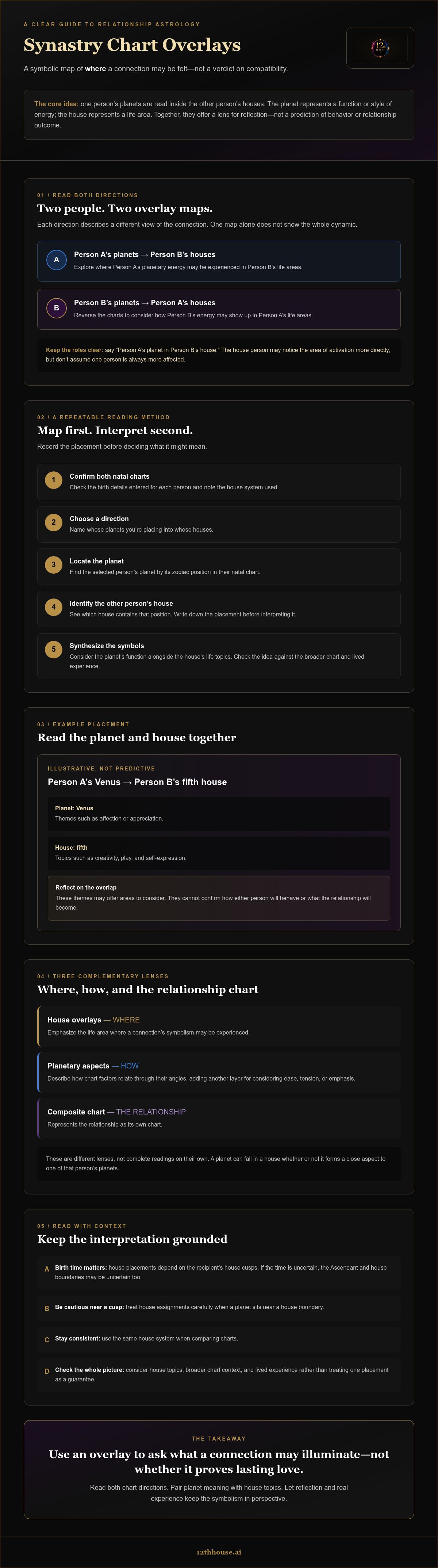
A synastry chart overlay places one person’s natal planets into the house framework of another person’s chart to show which areas of life may be emphasized in their interaction. The planet describes a function or style of energy; the house describes a life area. Read the charts in both directions to get two distinct overlay maps, not a single shared result.
For example, if one person’s Mercury falls in another person’s third house, Mercury’s themes of thinking and communication are read through that house’s topics, such as conversation and learning. This offers a symbolic way to explore how the two people may engage around those subjects. It doesn’t establish what either person will do or determine the relationship’s outcome. Synastry, the relationship-comparison branch of astrology, is outlined in Astrological compatibility (synastry).
How do you identify a planet-in-house overlay?
Start with one person’s natal chart and note a planet’s zodiac position. Then locate that position in the other person’s chart to see which house contains it. Keep track of the direction: Person A’s planets in Person B’s houses form one map; Person B’s planets in Person A’s houses form another. Interpret the planet and house together, rather than as isolated symbols.
House placement depends on the recipient’s house cusps, so accurate birth data matters, especially birth time. If the time is uncertain, the Ascendant and house boundaries may be uncertain too. Treat house assignments cautiously, particularly when a planet sits near a cusp, and use the same house system consistently when comparing charts.
How are overlays different from synastry aspects?
Overlays emphasize where a connection’s symbolism may be experienced: the life area associated with the house. Aspects describe how chart factors relate through their angles, offering another layer for considering ease, tension, or emphasis. A planet can fall in a person’s house whether or not it forms a close aspect to one of their planets.
Neither technique is a complete relationship reading. An overlay can highlight a life topic without explaining the full quality of the interaction, while an aspect doesn’t by itself show which house area is involved. For a broader framework for comparing charts, explore birth chart compatibility. Use overlays and aspects as complementary parts of a symbolic reading, not as tests that deliver a final verdict.
How to Read Synastry Chart Overlays Step by Step
A repeatable method keeps chart placement separate from interpretation. First identify where a planet falls; then consider what that planet and house symbolize together. This is the practical core of synastry chart overlays explained, and it helps prevent one placement from becoming a conclusion about the relationship.
- Step 1: Confirm both natal charts. Check the birth details entered for each person and note the house system used.
- Step 2: Choose a direction. Decide whose planets you’re placing into whose houses. Name both people clearly.
- Step 3: Locate the planet. Find the selected person’s planet by its zodiac position in their natal chart.
- Step 4: Identify the other person’s house. Locate where that planet’s position falls in the other person’s house framework. Record the placement before interpreting it.
- Step 5: Synthesize the symbols. Consider the planet’s function alongside the house’s life topics, then check whether the interpretation fits the broader chart and lived experience.
Illustrative, not predictive: Imagine Person A’s Venus falls in Person B’s fifth house. First, record the placement. Then consider Venus themes such as affection or appreciation alongside fifth-house topics such as creativity, play, and self-expression. This may suggest areas to reflect on, but it can’t confirm how either person will behave or what the relationship will become.
Which chart goes on the inside when reading synastry?
Chart software may place one chart inside another, but that display choice doesn’t make one direction the only valid one. State the roles each time: “Person A’s planet in Person B’s house.” Then reverse the charts and map Person B’s planets into Person A’s houses. The two views answer different questions, so don’t assume one reveals the whole dynamic.
What birth details and chart settings matter?
House placements depend on birth time because it helps determine the Ascendant and house cusps. Record each person’s birth details and the house system selected, then keep settings consistent as you compare. If a birth time is uncertain, treat house-overlay conclusions as less reliable, especially for planets near a house boundary. Astrology has developed through changing traditions and methods, as outlined in Britannica’s history of astrology.
Once you’ve mapped both directions, personalized chart questions can help you explore possible meanings without treating them as outcomes. 12th House offers astrology chart analysis and guided chart questions as tools for reflection.
Who Feels a Synastry Overlay More? Compare Both Chart Directions
Who feels an overlay more? In traditional interpretation, the house person may notice the activation more directly because the planet lands in an area of their chart. But that’s a starting point, not a rule for ranking whose experience matters most. The planet person may recognize their own planetary function in how they approach the relationship, while the house person may experience it through the life topics associated with that house.
For a balanced reading, name both roles and ask how they might interact. The question behind synastry chart overlays explained isn’t simply who feels more, but what each person may bring to and perceive in the shared dynamic.
| Chart role | Interpretive question |
|---|---|
| Planet person | How might this planet’s function be expressed in the relationship? |
| House person | How might the house’s life area shape their experience of that expression? |
What does the planet person bring to the overlay?
The planet symbolizes a function, such as communicating, asserting, bonding, or imagining. Its placement in another person’s house offers a way to consider where that function may become noticeable. For instance, if Person A’s Mars falls in Person B’s tenth house, you might reflect on whether A’s initiative or drive intersects with B’s ambitions, public role, or career concerns.
That doesn’t mean Person A will push Person B toward a particular choice. Ask what the planetary function looks like in the actual relationship, and leave room for other chart factors and personal behavior to shape the answer.
How might the house person experience the placement?
The house describes the context through which the interaction may be interpreted. In the example, Person B might experience Person A’s energy in relation to goals or public responsibilities. Person A, however, may simply experience themselves as acting with their usual Mars qualities, without noticing the same house context. Awareness can differ, and neither person’s account automatically cancels out the other’s.
Reverse the chart and read the second overlay on its own terms. It may emphasize different life areas or add another layer to the story. Don’t label one direction stronger, better, or more meaningful by default. Compare both perspectives, then consider whether the symbolism resonates with what each person actually experiences.
For another reflective lens on relationship questions, explore AI love readings. Treat any interpretation as a prompt for thoughtful questions, not a prediction about what your partner feels or what the relationship will become.
How to Interpret Synastry House Overlays Without Overreading Them
An overlay is a symbolic perspective, not a scientific test of a relationship. It can help you consider where another person’s presence may feel noticeable or personally relevant, but it can’t establish their intentions, predict what will happen, or prove compatibility. Even a vivid placement is only one part of a larger chart comparison.
To interpret it with care, hold four elements together: the planet’s symbolic function, the house’s life topics, whose chart is being activated, and what both people experience in real life. The phrase synastry chart overlays explained should lead to a method of reflection, not a fixed label such as “good,” “bad,” “romantic,” or “fated.” The same house can hold different meanings for different people, and one placement can feel layered or change in significance across situations.
What can one overlay tell you, and what can it not?
An overlay can prompt a useful question: “Where does this person’s energy seem to intersect with my life?” It may offer language for noticing a recurring theme. It cannot tell you what someone intends, whether they’ll act in a particular way, or whether the relationship will succeed.
Test an interpretation against the full synastry chart and the relationship as it’s actually lived. Notice whether the idea fits both people’s perspectives, and stay open to evidence that complicates it. A chart can support reflection, but it doesn’t replace honest communication, observed behavior, or personal judgment.
How do aspects and the composite chart add context?
Overlays emphasize the house areas associated with a planet’s placement in another person’s chart. Aspects describe angular relationships between chart factors, adding a different view of how their symbolic functions may interact. A composite chart is another technique: it creates a separate chart used to explore the relationship as a unit. These methods answer different questions, so one shouldn’t be treated as a substitute for the others.
Keep the layers distinct. An overlay might focus attention on a life area; aspects may add relational texture; a composite chart offers a relationship-centered frame. None independently settles what a couple’s experience means. If you want to explore the broader chart context, an AI astrology assistant can offer another reflective avenue.
For a personalized way to explore chart questions, ask questions about your astrology chart and compatibility. Use any interpretation as a prompt for inquiry, not a guarantee about the relationship.
Use Synastry Chart Overlays as a Starting Point for Deeper Reflection
A chart placement becomes more useful when it leads to a thoughtful question rather than a fixed conclusion. Use this checklist to keep your reading grounded. This is the practical next step in having synastry chart overlays explained: connect the symbols to the relationship you actually experience.
- Placement: Which person’s planet falls in which person’s house?
- House topic: What life area does that house represent in this reading?
- Both perspectives: How might the planet person express the planet’s function, and how might the house person experience it?
- Chart context: What else in the charts adds nuance or raises a different question?
- Lived experience: Does the interpretation match observed interactions, or does it come mainly from a description you read online?
Keep notes as questions, not declarations. For example: “Do we communicate differently when this house topic comes up?” or “How do we each experience this part of our shared life?” These invite observation and conversation. “Does this placement guarantee love?” asks a chart to settle something it can’t prove.
Which questions help turn an overlay into useful reflection?
Start with the house topic that feels most relevant, but don’t assume both partners experience it in the same way. Ask what you’ve actually noticed, what your partner might describe differently, and what information could challenge your first interpretation. Record those questions beside the placement and revisit them alongside the rest of the chart, rather than letting one online description define the connection.
How can personalized chart guidance support your next step?
If you want to examine a specific placement, 12th House offers astrology birth chart and transit analysis. Lala, an AI assistant within the platform, can answer personalized questions about charts and compatibility. You might ask how a planet-in-house placement can be explored alongside other chart factors. Treat AI guidance as a tool for organizing reflection, not as a human consultation, a prediction, or a replacement for your own judgment.
Keep the chart in its proper role: a symbolic framework for inquiry. If you’d like to explore personalized chart questions, Explore 12th House as an optional next step.
Carry Your Overlay Reading Into Deeper Reflection
Having synastry chart overlays explained means more than matching a planet with a house. It means tracking whose planet is placed in whose chart, then considering how the planet’s function and the house’s life area might meet. Read both directions, since each chart offers a distinct perspective.
Keep the interpretation open. An overlay can give you language for noticing a relationship theme, but it can’t establish someone’s intentions or decide whether a relationship will succeed. Let aspects, broader chart context, and your lived experience inform the questions you ask.
If you’d like to explore a placement in your own chart context, 12th House offers astrology birth chart and transit analysis. Lala, an AI assistant, can answer personalized questions about astrology charts and compatibility, offering another way to explore possibilities without treating them as predictions. Explore personalized chart questions with 12th House.
Use the symbols as prompts, not verdicts. Your observations and conversations remain central as you build a clearer understanding of the connection.
Frequently Asked Questions
What does a planet overlay mean in a synastry chart?
A planet overlay shows where one person’s natal planet falls in the other person’s house framework. The planet represents a symbolic function, such as communicating or asserting, while the house points to a life area where that function may become noticeable. The phrase synastry chart overlays explained describes this mapping process, not a guaranteed outcome. Read the charts in both directions to see how each person’s planets fall into the other’s houses.
How do you read synastry chart overlays step by step?
First, confirm both charts’ birth details and record the house system. Choose a direction, such as Person A’s planets in Person B’s houses. Locate a planet in Person A’s chart, then identify which house contains that position in Person B’s chart. Record the placement before interpreting it. Finally, consider the planet’s symbolism alongside the house topic and real-life context. Reverse the charts to create the second overlay map.
Who feels a house overlay more: the planet person or the house person?
The house person may notice the overlay through the life area associated with their house, while the planet person may express the function represented by their planet. Neither person is automatically more affected in every placement. Their awareness and experience can differ. For example, one partner may see a recurring theme in a particular area, while the other may experience their own behavior as ordinary. Consider both accounts rather than assigning a universal ranking.
Are synastry overlays more important than aspects?
Neither overlays nor aspects are universally more important; they describe different layers of synastry. An overlay emphasizes the house area where a person’s planet falls in the other person’s chart. An aspect describes the angular relationship between chart factors, adding information about how their symbolism may interact. Read them together when possible, alongside the broader charts. A prominent overlay alone doesn’t explain the full quality or experience of a relationship.
Can a synastry overlay predict whether a relationship will last?
No. A synastry overlay is an astrological symbol for reflection, not a reliable test or guarantee of relationship duration. It can suggest a life area to examine, but it can’t establish someone’s intentions, determine compatibility, or predict what either person will choose. Consider the full chart as one interpretive framework, then give greater weight to communication, consistent behavior, shared values, and how the relationship feels in lived experience.
What happens if one person’s birth time is unknown?
If the birth time is unknown, that person’s Ascendant and house cusps may be uncertain, making house-overlay placements less dependable. A planet could appear in a different house depending on the actual time, so avoid treating a specific overlay as settled. You can still explore chart factors that don’t rely on houses, but label any house-based interpretation cautiously. Don’t substitute an assumed time and present the resulting house map as precise.
Are synastry overlays the same as a composite chart?
No. Synastry overlays place one person’s planets in the other person’s house framework, and the charts can be read in both directions. A composite chart is a separate technique that creates a chart to represent the relationship as a unit. The methods offer distinct symbolic perspectives: overlays focus on how each person’s chart connects with the other’s, while the composite focuses on themes associated with the relationship itself.


