

What if the tarot card for new beginnings in your reading isn’t the one that looks most hopeful? The Fool may signal a leap into unfamiliar territory, while Death can point to an ending that makes room for change. Neither card guarantees what will happen. Interpret it in light of your question, its spread position, and the cards around it.
If you’re unsure whether a card points to opportunity, transition, or something to release, that uncertainty makes sense. Tarot meanings aren’t fixed keywords to memorize; symbols take shape in context. A striking card like Death isn’t a prediction of literal loss or misfortune. It can invite you to notice what may be ready to shift.
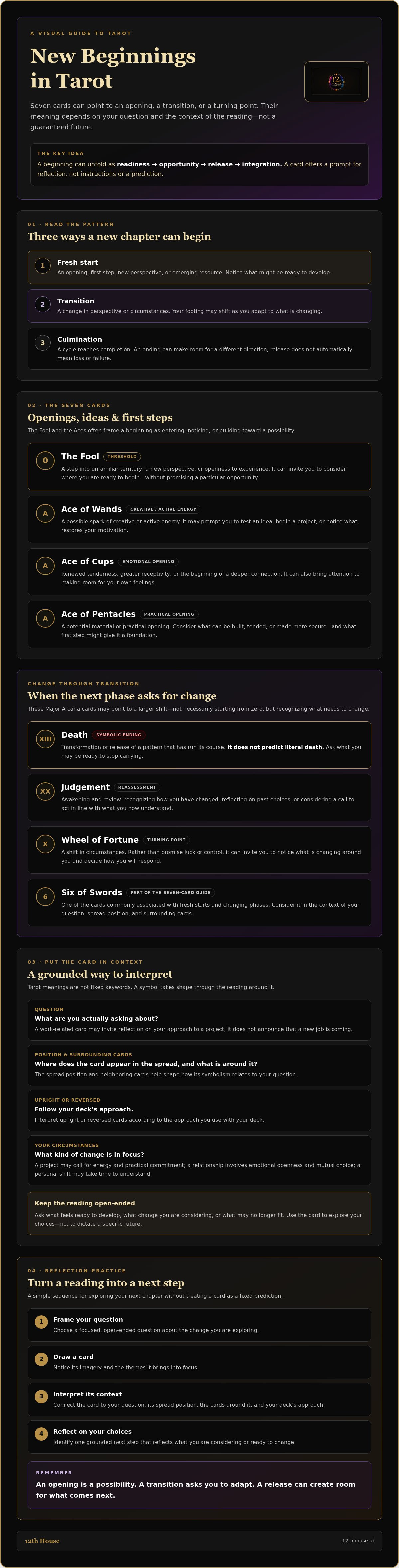
This guide explores seven cards commonly associated with fresh starts and changing phases: the Fool and the Aces, along with Death, Judgement, the Wheel of Fortune, and the Six of Swords. You’ll learn how context shapes an interpretation and use a simple reflection practice to identify a grounded next step. Think of a beginning as a sequence: readiness, opportunity, release, and integration.
Key Takeaways
- A tarot card for new beginnings can signal an opening, a transition, or a change in direction, not a guaranteed outcome.
- Distinguish cards that suggest fresh energy from those that point to release or a turning point.
- Interpret upright or reversed cards according to your deck’s approach, then consider how the spread position shapes the message.
- Use a focused, open-ended question to explore your next chapter rather than asking tarot to dictate a specific future.
- Turn a reading into a grounded next step: frame your question, draw a card, interpret its context, and reflect on your choices.
What Does a Tarot Card for New Beginnings Actually Mean?
A new beginning in tarot is a symbolic opening: a transition, a shift in direction, or the first movement toward a different way of living. It might reflect an emerging possibility, a choice you’re preparing to make, or a chapter that can begin only after something else has ended. The card doesn’t guarantee an event or issue instructions. Instead, it offers a prompt to examine what’s changing and how you might respond.
Tarot symbols draw on traditions that have developed over time. For background on how the cards moved from playing-card origins into divination, explore this overview of the history of tarot. That history can add perspective, but no single interpretation applies to every reading. A card’s meaning takes shape through its symbolism, its position in the spread, and the question you bring to it.
Can tarot cards point to a fresh start?
They can point toward a fresh start as a possibility, not confirm a future event. A card’s imagery and traditional symbolism may bring themes such as initiative, renewal, or transition into focus. Use those themes to reflect: What feels ready to develop? What change are you considering? Then connect the card to the question you actually asked. A card drawn about work may prompt you to examine your approach to a project, not announce that a new job is coming.
Why one beginning can look different from another
A fresh start depends on what’s changing. A new project may call for energy and practical commitment. A relationship beginning involves emotional openness and mutual choice. A shift in identity or a new personal chapter may require time to understand what no longer fits. These are different patterns, so the same card can prompt different reflections in each situation.
Some beginnings arrive as an opening; others start with a deliberate decision or a necessary ending. Release doesn’t automatically mean loss or failure. It can mean making room for a direction that better reflects your present needs. As you explore the cards ahead, consider which pattern your reading may be mapping: an opportunity to notice, a choice to make, or a transition to work through.
7 Tarot Cards That Can Signal a New Beginning
Not every new chapter starts with the same kind of movement. Some cards suggest a first step or a fresh resource; others point to a turning point that asks you to adapt. The cards below are grouped by the pattern of change they may represent, not ranked by importance. A fresh start opens a possibility, a transition changes your footing, and a culmination completes a cycle.
The Fool and the Aces: openings, ideas, and first steps
The Fool belongs to the Major Arcana and often marks a threshold: a willingness to enter unfamiliar territory without knowing every step in advance. The Aces are Minor Arcana cards, linking beginnings to everyday areas of life through their suits. Read the suit alongside your question to identify what kind of opening may be in focus.
- The Fool: A step into the unknown, a new perspective, or openness to experience. In a career reading, it might prompt you to consider where you’re ready to begin, rather than promise a particular opportunity.
- Ace of Wands: A possible spark of creative or active energy. It may invite you to test an idea, start a project, or notice what restores your motivation.
- Ace of Cups: An emotional opening, such as renewed tenderness, greater receptivity, or the beginning of a deeper connection. It can also prompt you to consider what would help you make room for your own feelings.
- Ace of Pentacles: A potential material or practical opening. Consider what can be built, tended, or made more secure, and what first step would give the possibility a foundation.
Death, Judgement, and Wheel of Fortune: change through transition
These Major Arcana cards often describe a larger shift in perspective or circumstances. Their message may be less about starting from zero and more about recognizing what must change before the next phase can take shape.
- Death: A symbolic ending, transformation, or release of a pattern that has run its course. It doesn’t predict literal death. In a reading about personal growth, it may prompt you to ask what you’re ready to stop carrying.
- Judgement: Reassessment and awakening. This card may surface when you’re reviewing past choices, recognizing how you’ve changed, or considering a call to act in line with what you now understand.
- Wheel of Fortune: A shift in circumstances or a turning point. Rather than promise luck or control, it can invite you to notice what’s changing around you and decide how you’ll respond.
For a personal question, you can use 12th House tarot readings as one way to explore the symbols and consider what kind of change your draw may be bringing into focus.
How to Interpret New-Beginnings Cards Without Taking Them Literally
A card associated with change doesn’t carry one fixed message into every reading. Before interpreting it, identify the question you asked, the spread’s structure, and whether you read reversals. These details form the framework around the image. A card that suggests possibility in one position may describe hesitation or a later development in another.
What if a new-beginnings card appears reversed?
Not every reader uses reversed cards, and those who do may interpret them differently. A reversal might suggest a theme turned inward, delayed, or difficult to express, but it doesn’t automatically mean the card’s upright meaning is blocked or negative. Choose a method that fits your practice and apply it consistently, rather than changing the rules to match a hoped-for answer.
For example, a reversed Ace of Wands might prompt you to consider whether an idea needs more time, whether your energy is divided, or whether you’re reluctant to act. Treat these as questions to investigate, not verdicts. Notice what fits the situation, and leave room for interpretations that don’t.
How surrounding cards and spread positions add context
Start with the position. In a past position, a card may describe an earlier opening or turning point. In the present, it can highlight what’s active now. An advice position frames the card as a perspective to consider, while an outcome position may suggest one possible direction if current patterns continue. An outcome isn’t a guarantee.
Then read neighboring cards for context. They may show what supports a change, where tension lies, or what practical conditions deserve attention. For instance, Death in an obstacle position might invite you to examine resistance to an ending or transition. Beside a card associated with resources, the spread could raise questions about what would make the next phase feel more grounded. Neither combination proves what will happen.
Death does not predict literal death. In tarot, it’s commonly read symbolically through themes of ending, transformation, and making space for what follows. If the image unsettles you, return to the question and position before reaching for the most frightening interpretation.
When a tarot card for new beginnings appears, don’t isolate its keyword from the reading. Ask: What role does this card play here? What do the surrounding symbols add? What real-world choice or condition can I examine? That sequence keeps interpretation thoughtful, personal, and grounded.
A Simple Tarot Reading to Explore Your Next Chapter
A useful reading doesn’t need a large spread or a definitive forecast. It needs a clear question and enough structure to help you notice what the cards bring into focus. Use this four-step process to turn a tarot card for new beginnings into a reflection you can apply to your own choices.
Choose a grounded question and a simple spread
1. Frame. Ask an open-ended question about your next chapter, such as, “What should I notice as I begin this new phase?” Avoid questions that demand a specific outcome, like whether a particular job or relationship will definitely succeed. Record your question before drawing so you can return to it while interpreting.
2. Draw. For a concise reading, draw one card for “What should I notice?” For more structure, draw three cards and assign each a position: What is ending? What is emerging? What can support my progress? Write down the positions before you pull the cards. This keeps each card’s role clear.
Reflect on the card and choose a next step
3. Interpret. First, note your immediate emotional response and describe the image’s visible details. Then consider the card’s traditional associations alongside your question and the spread position. Ask what interpretation fits your actual circumstances. Don’t force a positive answer or assume an unsettling image predicts misfortune.
4. Reflect. Translate the card’s themes into one modest action or observation. If it brings up preparation, you might list a resource you need. If it points toward release, notice one commitment or habit you’re ready to reconsider. Keep the step small enough to take without treating the card as an order. Record your reflection, then revisit it after you’ve gained more perspective.
A tarot reading should clarify your choices, not replace them; leave room for your agency and for circumstances to change. Its value lies in the questions it helps you ask and the grounded response you choose to make.
If you’d like a guided way to explore a personal question, try a 12th House tarot reading as one option for reflection.
Bring a New-Beginnings Reading Into Your Own Practice
A reading can become more useful over time when you treat it as part of an ongoing practice, not a final answer. Observe what the symbols bring to mind, reflect on how your circumstances develop, and make your own choices. A tarot card for new beginnings may feel different after you’ve taken a first step or learned something new. That change in perspective is worth recording, too.
Build a personal record of recurring tarot themes
Keep a journal entry for each reading. Note the date, the question you asked, the card or cards drawn, each spread position, and your interpretation at the time. Add what stood out in the imagery and how you felt before settling on a meaning. When a symbol or card appears again, record the connection without treating repetition as proof of a prediction. Review entries later to see how your understanding has changed and which interpretations still feel relevant.
Explore guided tarot reflection at your own pace
Self-guided practice can be complemented by digital tools when you want another framework for considering a personal question. 12th House offers tarot readings and Ask Lala AI Spiritual Guidance as optional ways to explore and reflect. Ask Lala is an AI guidance tool, not a live human consultation, and neither tarot nor AI guidance can guarantee what will happen. Keep your judgment and choices at the center of the process.
For broader foundations in reading cards, continue with the Tarot Mastery guide. It can help you build a wider interpretive framework alongside the reflection practice you’re developing.
If digital guidance would be useful as you explore a question, you can explore 12th House at your own pace. Return to the cards with curiosity, keep track of what shifts, and let reflection inform your next step without making the decision for you.
Carry Your Next Chapter Forward
The Fool, the Aces, Death, Judgement, and the Wheel of Fortune each describe a different pattern of possibility or change. No single tarot card for new beginnings predicts exactly what comes next. Its meaning depends on your question, the spread, and the choices available to you.
Use the cards as a framework for reflection. Notice what may be opening, what might need to shift, and what small step feels grounded in your circumstances. A reading can offer perspective, but you remain the author of your next move.
If you’d like to explore a personal question with digital spiritual tools, 12th House offers tarot readings and Ask Lala AI spiritual guidance. Explore tarot guidance with 12th House as an optional aid to your reflection.
Let curiosity lead, keep your judgment clear, and give your next chapter room to unfold through the choices you make.
Frequently Asked Questions
Which tarot card is most associated with new beginnings?
The Fool is the tarot card most commonly associated with new beginnings. It often represents openness, possibility, and stepping into unfamiliar territory without having every detail settled. The card doesn’t guarantee that an opportunity will appear. Consider what new direction you’re contemplating, then read The Fool alongside its spread position, surrounding cards, and your question to understand whether it reflects readiness, uncertainty, or a call to explore.
Does The Fool always mean a new beginning in tarot?
No, The Fool doesn’t always mean a new beginning. Depending on the question and spread position, it may point to spontaneity, inexperience, risk-taking, or a willingness to approach a situation with fresh eyes. In an advice position, it might invite you to stay open while still considering practical realities. Look at the surrounding cards and ask how The Fool’s themes connect to the situation you actually asked about.
Can the Death tarot card mean a fresh start?
Yes. Death can suggest a fresh start through symbolic ending, release, or transformation. It doesn’t predict literal death. In a reading about a life transition, consider what pattern, role, or expectation may be ready to change, and what that shift could make possible. The card’s position and neighboring cards matter: they can help clarify whether the focus is on letting go, resisting change, or moving through a transition.
What does an Ace mean in a tarot reading about a new chapter?
An Ace often represents the seed of a new possibility, with its suit suggesting the area of life involved. Wands can point to creative or active energy; Cups to emotional openness; Swords to a new idea or perspective; and Pentacles to a practical or material opportunity. Treat the Ace as potential rather than proof that something will happen. Ask what effort or conditions might help that possibility develop.
Do reversed tarot cards still suggest new beginnings?
They can, depending on the reader’s method. Some readers don’t use reversals, while others may read a reversed card as an inward process, delay, or difficulty expressing its theme. These aren’t universal definitions. For example, a reversed Ace could prompt reflection on whether an idea needs time or clearer focus. Choose a consistent approach, then interpret the reversal in relation to the question and spread position.
How do I do a tarot reading for a fresh start?
Begin with an open-ended question, such as, “What should I notice as I enter this next chapter?” Draw one card, or use three positions: what’s ending, what’s emerging, and what supports progress. Record the question and positions before drawing. Note your first response to the imagery, then consider traditional meanings and the reading’s context. Finish by choosing one small, practical step or observation, rather than treating the cards as instructions.
Can tarot predict what will happen when I start over?
Tarot can’t guarantee what will happen when you start over. A reading offers symbols and prompts for reflection, not a certain forecast. It may help you examine hopes, concerns, choices, or conditions that could shape your next steps. Ask what you can learn from the cards, then weigh that insight alongside real-world information and your own judgment. Your decisions remain yours, and circumstances can change after the reading.


