

What if the map that seems to point you toward a new home is better understood as a starting point than a verdict? An astrocartography calculator uses your birth date, birth time, and birthplace to map planetary lines across the world. It can show where those lines fall, but the map alone cannot tell you what a place will bring or whether you should move there.
It is natural to want a clear answer, especially when your birth time is uncertain or the lines seem to cross places you are considering. This guide explains which birth details matter, how a map is created, and what planetary lines and chart angles traditionally represent. You will also learn how to compare locations without treating a symbolic reading as a prediction. Start with the most reliable information you can find, check the calculator’s legend, and weigh the map alongside practical details about each place.
Key Takeaways
- An astrocartography calculator plots planetary angles across locations. Its map offers an astrological framework, not a scientifically validated location prediction.
- Accurate birth details matter. An uncertain birth time can shift chart angles and the planetary lines shown on the map.
- Learn the traditional symbolic themes linked to Sun, Moon, Venus, Mars, Jupiter, and Saturn lines before comparing places.
- Review each location in a consistent order: check your inputs, identify the line and angle, consider the symbolism, then weigh real world context.
- Explore 12th House’s digital astrocartography mapping alongside its astrology analysis, Ask Lala AI Spiritual Guidance, and metaphysical library.
What an Astrocartography Calculator Generates, and What It Does Not
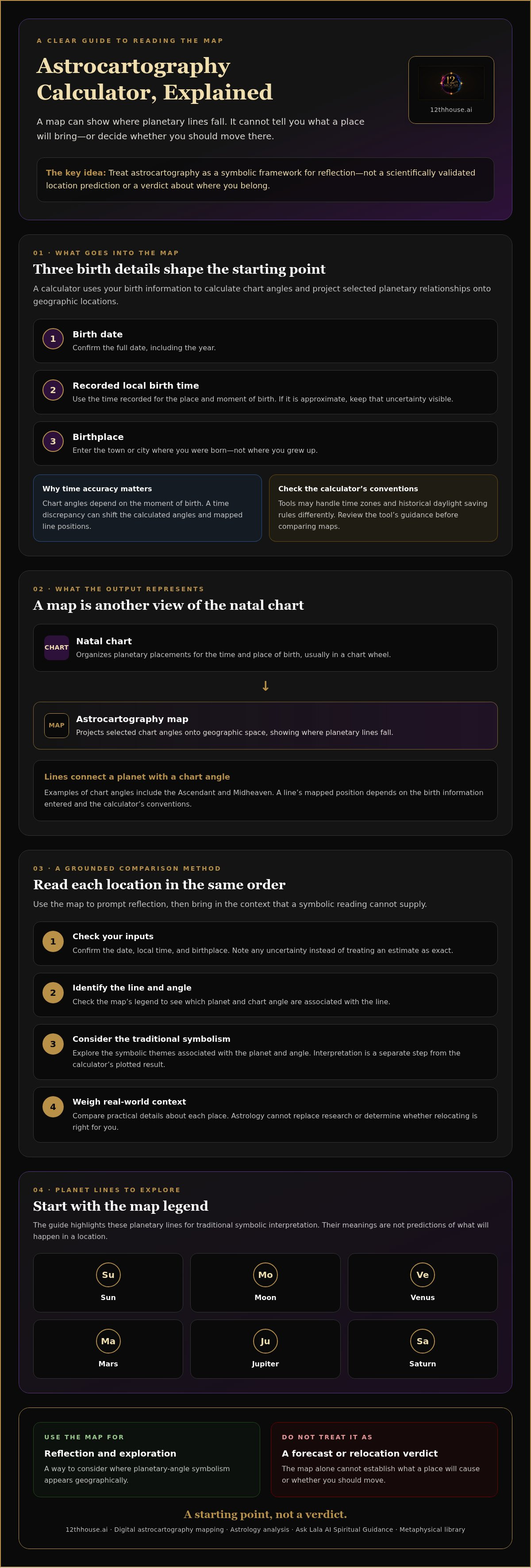
An astrocartography calculator plots natal chart planetary angles across geographic locations. The result is a world map with lines that connect planets to specific chart angles. It offers a symbolic astrological framework, not a scientifically validated prediction of what will happen if you visit or live in a place.
Astrocartography maps where a person’s natal planets align with key chart angles around the world, offering symbolic themes for reflection rather than deterministic forecasts. A calculator generates the lines from birth details and its own calculation conventions. Interpreting what a line might mean is a separate step. Deciding whether to relocate also requires practical research that astrology cannot replace.
What does an astrocartography calculator calculate?
At birth, planets occupy positions in the sky relative to the horizon and meridian. Astrocartography projects selected angular relationships onto geographic space. Each planetary line is associated with a planet and a chart angle, such as the Ascendant or Midheaven. Its mapped position depends on the birth information entered and on how the calculator handles time and location.
This distinction matters: a calculator can show where a line falls, but it cannot establish that a place will cause a particular experience. Astrological traditions associate planets and angles with themes, but those associations are not verified effects. For an overview of the wider practice and its techniques, see Locational astrology.
How is an astrocartography map different from a natal chart?
A natal chart organizes planetary placements for the time and place of birth, usually in a chart wheel. Astrocartography takes selected angles from that chart and projects them onto a world map. The natal chart shows the underlying placements; the map helps you explore where those angular relationships appear geographically.
Think of the map as another view of the same underlying chart, not a replacement for it. A city near a line may prompt reflection on a planetary theme, but the line alone does not provide a complete personal interpretation. For a deeper look at the spatial framework, read Astrocartography: Mapping the Architecture of Your Spatial Intelligence.
Reliable birth information is an important starting point. A mistaken time can change chart angles and shift mapped line positions. Calculators may also use different conventions, so check how a tool handles time zones and location data before comparing maps. Treat the output as something to investigate, not a verdict about where you belong.
How an Astrocartography Calculator Uses Your Birth Details
A useful result starts before you open the map. An astrocartography calculator uses your birth date, local birth time, and birthplace to calculate chart angles and project them onto geographic locations. If any detail is uncertain, the map may not represent the chart you intended to examine.
Which birth details should you prepare?
Gather the information as it was recorded at birth, rather than relying on a later conversion or an estimate:
- Birth date: Confirm the full date, including the year.
- Local birth time: Use the time recorded for the place and moment of birth.
- Birthplace: Enter the town or city where you were born, not where you grew up.
Check a birth certificate or a reliable family record if one is available. If the time is approximate, keep a note of that uncertainty. Do not enter a guessed minute as if it were exact. You can still explore a map, but avoid drawing precise conclusions from uncertain input.
Why do time zones and birth-time accuracy matter?
The local time needs to be interpreted in relation to the location and date. A calculator may handle time zone conversion and historical daylight saving rules automatically, or it may use different conventions. Review the tool’s guidance instead of assuming every calculator processes these details in the same way.
Chart angles depend on the moment of birth, so a discrepancy can shift the calculated angles and mapped line positions. The sensitivity of a result to a time difference varies. There is no universal margin that makes an uncertain time harmless. If your record is unclear, note the uncertainty and compare results cautiously rather than treating one map as definitive.
Dependable input data supports more dependable calculations, but it does not turn an astrological map into a guaranteed forecast.
Use this sequence to move from records to map:
- Gather: Confirm the birth date, recorded local time, and birthplace.
- Review: Check how the selected tool handles time zones and historical daylight saving changes.
- Enter: Input the details carefully and select the correct birthplace from the tool’s options.
- Inspect: Review the generated map and note any uncertainty in your source information.
For a structured digital starting point, explore 12th House’s astrocartography mapping. Check the tool’s specific input and calculation details before relying on its map.
How to Compare Astrocartography Calculator Results and Planetary Lines
A map is easier to use when you compare its symbols systematically. In traditional astrology, planetary lines are associated with themes, not guaranteed events. Treat those meanings as prompts for reflection, then consider how they relate to your priorities and the wider birth chart.
What do common planetary lines traditionally symbolize?
The associations below are symbolic interpretations, not verified effects. A line’s angle label can shape its traditional emphasis, and calculators may differ in which planets and angles they display. Check the map legend before comparing locations.
| Planetary line | Traditional symbolic themes |
|---|---|
| Sun | Identity, visibility, and self-expression |
| Moon | Emotional life, familiarity, and home |
| Venus | Connection, affection, and aesthetic interests |
| Mars | Initiative, drive, and assertion |
| Jupiter | Growth, learning, and expansion |
| Saturn | Structure, responsibility, and sustained effort |
None of these themes makes a place universally favorable or difficult. A Saturn line might invite reflection on structure or responsibility, but it does not prove a location will bring hardship. Venus symbolism does not guarantee romance.
How should you compare two places on the map?
Use the same map settings for both locations. Compare like with like: the same planet and angle, viewed in the same calculator and legend. Then clarify what you want to understand. A place you are considering for work may raise different questions from one you are exploring for rest, relationships, or creative interests.
- Identify the line: Record the planet and angle shown near each location.
- Check proximity: Distance from a line is an interpretive convention, not a universal boundary. Review the calculator’s guidance on how close a location must be to count as near.
- Consider context: Compare the symbolism with your priorities and, where possible, the wider birth chart instead of isolating one line.
If a city sits near more than one line, note the overlap without turning it into a simple ranking. The map can help organize your questions, but it cannot weigh daily life factors such as work options, cost, community, or personal obligations. Use the lines to frame questions, then assess each place on its real world merits.
How to Use an Astrocartography Calculator Without Overreading the Map
A map can sharpen a question, but it cannot make a location decision for you. Use an astrocartography calculator as a reflective framework, then test any symbolic reading against the realities of daily life. A line associated with career themes, for example, does not tell you whether a particular city offers suitable work, affordable housing, or a supportive community.
What if your birth time is unknown or approximate?
Uncertainty matters because astrocartography uses chart angles, and an imprecise birth time can make angle based interpretations less dependable. Check a birth certificate or another trustworthy record if one is available. If the time remains uncertain, state that clearly. Avoid false precision, such as treating a line’s exact placement as conclusive when the input is only an estimate.
Can a planetary line determine where you should live?
No. Astrology cannot establish a guaranteed outcome for a location. Read a planetary line as a prompt for questions: What kind of work do I want? Where might I feel settled? What would I need from a community? Then assess practical conditions independently, including finances, safety, employment, healthcare, and relationships.
Astrocartography offers symbolic guidance for reflection, not evidence based relocation advice or a reliable guarantee of what life in a place will be like.
Use this checklist before acting on a reading:
- Confirm the inputs: Note whether your birth time and birthplace are reliable.
- Identify the line: Check the planet and chart angle shown, along with the map’s legend.
- Read the symbolism: Treat traditional meanings as interpretive themes, not predicted events.
- Compare the context: Weigh your priorities against practical facts about each location.
- Keep your agency: Let the map suggest avenues to explore, not command you to move or travel.
For a deeper look at how place and chart symbolism connect, explore the astrocartography mapping guide. To continue your exploration with a digital mapping tool, explore 12th House astrocartography mapping.
Explore Astrocartography Mapping with 12th House
Once you understand what a map can and cannot establish, digital astrocartography mapping can offer a structured way to explore place based astrological symbolism. Use it to frame questions about a location in relation to your interests, priorities, and chart learning process. The value is in thoughtful exploration, not in treating a mapped line as a guaranteed forecast.
What can a digital astrocartography map help you explore?
A map can help you examine how traditional astrological themes relate to places you are curious about. You might reflect on what you want from a location, whether that is a stronger sense of home, new creative possibilities, or a different relationship with work. Then consider how the symbolism fits alongside your own experience and practical research.
12th House offers astrocartography mapping as part of a broader digital metaphysical platform. Other offerings include astrology birth chart and transit analysis, Ask Lala AI Spiritual Guidance, and access to a metaphysical library. These are distinct parts of the platform. Check the details of a specific feature before assuming it includes a particular map interpretation or connection to the AI.
What to check before choosing a calculator
Look for clear explanations before entering personal birth details or drawing conclusions from a map. A useful tool should help you understand what information it uses and how to read the output. Check:
- Birth details: Which date, time, and birthplace fields are required, and how should uncertain information be handled?
- Calculation conventions: Does the tool explain its time zone handling and other relevant calculation choices?
- Map contents: Which planetary lines and chart angles appear, and are they identified in a clear legend?
- Interpretive limits: Does the explanation distinguish symbolic associations from established predictions?
These checks make it easier to compare an astrocartography calculator’s output carefully. If a tool does not explain a setting or symbol, pause before treating its result as precise. Keep practical questions about finances, safety, work, and community in view as you explore.
For a digital starting point within a wider environment for metaphysical learning, Explore 12th House. Let the map support your inquiry while you weigh its symbolism against your circumstances.
Use Your Map as a Starting Point for Discovery
A useful astrocartography calculator gives structure to your exploration, but the map is only one part of the process. Begin with the most accurate birth details you can find, check how the tool calculates and displays its lines, then read planetary themes as symbolic associations rather than fixed outcomes. Your questions, circumstances, and practical research matter just as much as the map.
Astrocartography can help you reflect on how different places connect with your interests, but it cannot decide where you should live or travel. Consider what you want from a place, then weigh everyday factors such as work, finances, safety, and community.
12th House offers digital astrocartography mapping within a broader platform that includes astrology analysis, Ask Lala AI Spiritual Guidance, and a metaphysical library. Explore these resources as you continue your independent research, without assuming one tool provides every interpretation you need. Explore 12th House and continue your research with curiosity and care.
Frequently Asked Questions
Is an astrocartography calculator accurate?
An astrocartography calculator can calculate a map from the birth details and conventions entered, but its output depends on the quality of those inputs and the tool’s calculation method. Astrology is an interpretive practice, not a scientifically established way to predict what will happen in a place. Treat the map as a symbolic framework for reflection, and check the calculator’s settings and explanations before comparing locations.
What information do I need for an astrocartography calculator?
Most calculators ask for your birth date, birth time, and birthplace. Time matters because chart angles depend on the moment of birth, while birthplace helps establish geographic coordinates and local time context. Check the tool’s instructions, enter the local birth time as recorded, and confirm that you selected the correct place. If your time is approximate, say so rather than presenting it as exact.
Can I use an astrocartography calculator without my exact birth time?
You may be able to generate a map using an estimated birth time, but angle based results and line positions may be less dependable. First, look for a reliable birth record, such as a birth certificate or family document. If you cannot confirm the time, label the result as approximate. Avoid highly specific conclusions, since a different time may shift the chart angles and mapped lines.
How do I read the lines on an astrocartography map?
Identify the planet and chart angle associated with each line, then consult the calculator’s explanation of its traditional symbolism. Compare the lines in light of your question, such as what you are seeking in work or relationships, rather than ranking them as universally good or bad. These meanings are symbolic interpretations. A line by itself cannot establish how a particular place will affect your life.
What does a Venus line mean in astrocartography?
In traditional astrological interpretation, Venus is associated with connection, aesthetics, pleasure, and values. A Venus line is often explored through those symbolic themes, but it does not guarantee romance, popularity, or ease in a location. Consider the line’s chart angle, the wider birth chart, your personal circumstances, and the calculator’s interpretive framework. Use the symbolism to form questions, not to assume a specific outcome.
Can astrocartography tell me where I should move?
No. Astrocartography cannot determine the right place for you or guarantee what will happen there. Use its symbolism as one lens for reflecting on a location, then assess practical factors independently. Consider work opportunities, cost of living, health needs, safety, relationships, community, and personal preference. A map may help you develop questions, but independent research and real world planning should guide a relocation decision.
Is an astrocartography calculator the same as a birth chart calculator?
No. They use related birth information but organize it differently. A birth chart calculator typically lays out planetary placements for the moment and place of birth. An astrocartography calculator projects selected chart angles onto a world map to explore their geographic symbolism. The natal chart presents the underlying chart structure; the astrocartography map emphasizes how selected relationships are represented across locations.


