

What if a manifestation symbol works best not as a promise, but as a reminder of the intention you’re ready to act on? If you’ve searched for a sigil creator for manifestation and found tools that show a design without explaining the thinking behind it, it’s reasonable to wonder what the symbol is meant to represent. A useful sigil connects to an intention you understand, not just a result delivered by a button.
You can build that connection by clarifying what you want to focus on, then shaping the words into a design that feels meaningful to you. This guide explains how to create a personal sigil, compare a self-guided process with a digital route, and use the finished symbol as part of a reflective ritual. The aim isn’t to guarantee an external outcome. It’s to make an intention easier to hold in mind and pair with deliberate action.
We’ll walk through a common way to turn an intention into a symbol, explain what to check when choosing a digital tool, and suggest ways to work with your design. 12th House offers a Seal Creator as one digital option. Approach the practice with curiosity, clear boundaries, and room for your own judgment.
Key Takeaways
- Write an intention that is clear and personally meaningful before turning it into a symbol.
- Compare DIY, digital, and commissioned approaches by how much creative control and process guidance you want.
- Use a flexible sequence to shape and review your design; no single sigil-making method is the only valid one.
- Choose a sigil creator for manifestation as a tool for symbolic reflection, not a guarantee of external results.
- Explore 12th House’s Seal Creator as a digital option, or make a sigil independently if you prefer to guide each step yourself.
What Is a Sigil Creator for Manifestation, and What Can It Actually Do?
A sigil is a symbol that someone connects with a particular intention. A sigil creator for manifestation can mean a personal process, a digital tool, or a service that helps shape that symbol. Practices vary across traditions and individuals, so there is no single method everyone follows. For background on the varied historical and modern uses of sigils, see What Is a Sigil.
Keep the purpose grounded. A sigil can give an intention a visual form and serve as a prompt for focus or reflection. It can’t control other people, guarantee an outcome, or replace practical choices. Treat it as a symbolic part of your practice, not proof that a desired event will happen.
How does a manifestation sigil relate to an intention?
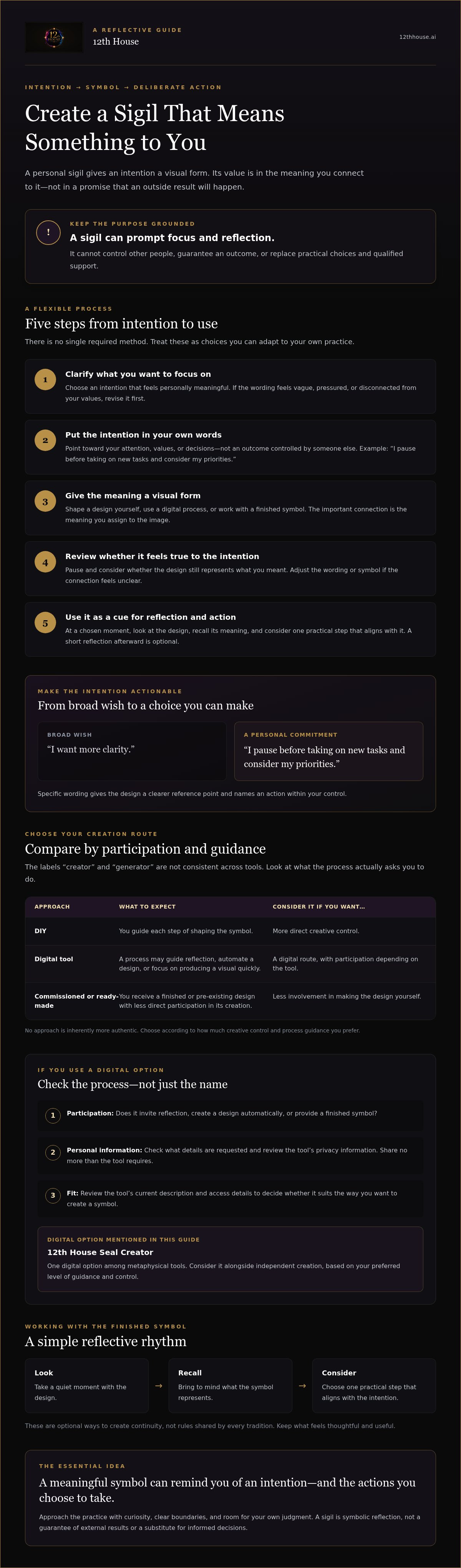
The intention is the meaning you assign to the symbol. A broad wish such as “I want more clarity” can be made more specific by connecting it to a choice you control: “I pause before taking on new tasks and consider my priorities.” That wording gives the design a clearer reference point and identifies an action you can take.
The finished design can remind you to return to that commitment at a chosen moment. Its significance comes from the connection you make between the image and your intention. It isn’t proof of a result. If the wording feels vague, pressured, or disconnected from what you value, revise it before you make the symbol.
Is a sigil creator different from a sigil generator?
Online labels aren’t consistent. One site may call itself a creator while offering an automated design; another may use “generator” for a guided process. Look at the steps, not just the name. Does the tool ask you to reflect on your intention, produce a design automatically, or provide a finished symbol? Each option involves a different level of participation and creative control.
A guided process may help you clarify meaning, while an automated tool may focus on producing a visual quickly. A commissioned or ready-made design involves less direct participation in the creation. None is inherently more authentic. Choose based on whether you want to make the design yourself, receive help shaping it, or simply work with an existing symbol.
Before entering personal details into a digital tool, check what information it requests and review its privacy information. A name or private intention may feel sensitive, and you don’t need to share more than the tool requires. 12th House offers a Seal Creator among its digital metaphysical tools. Review the tool’s current description and access details to decide whether it suits the way you want to create a symbol.
How Sigil Creation Works: Intention, Symbol, and Ritual
Think of sigil creation as a sequence of choices, not a universal formula. Practitioners and traditions may differ in how they phrase an intention, construct a symbol, or use it afterward. A common structure is to clarify what the symbol represents, give that meaning a visual form, and then choose whether and how to return to it through reflection or ritual.
A sigil is a personally meaningful symbol used to represent an intention; making or using one does not guarantee that the intention will manifest. This distinction keeps the practice clear-eyed. You can treat the symbol as a spiritual object, a creative prompt, or both, without assuming it determines events beyond your influence.
What makes an intention specific enough to work with?
Choose language that points toward your own attention, values, or decisions. Rather than focusing on an outcome controlled by someone else, describe a quality you want to practice or a choice you can make. For example: “I make space to listen before I respond.” The wording should feel relevant and considered, not like a demand that reality must obey.
Keep the scope appropriate. A symbolic exercise isn’t medical, financial, or professional advice, and it shouldn’t replace qualified support or informed decisions in those areas.
How do symbols and ritual give the practice structure?
Once you have an intention, a visual mark can act as a cue that brings its meaning back to mind. Neuroscience News reports on university research into how people remember symbols, offering context for the idea of a Symbol With Intention. That research concerns memory and symbols, not proof that sigils cause external events.
A ritual can be as simple as taking a quiet moment to look at the design, recall what it represents, and consider one practical step that aligns with it. You might write a short reflection afterward. These are optional ways to create continuity, not rules shared by every tradition. Keep the steps that feel thoughtful and useful to you.
In practice, the sequence can stay simple:
- Clarify: Name the intention in language that reflects your own choices.
- Shape: Draw, combine, or otherwise develop a mark that represents it to you.
- Engage: Decide whether a pause, reflection, or other personal ritual helps you revisit its meaning.
If you’d like a digital route for symbolic creation, 12th House’s Seal Creator is one option to explore. Review the tool’s description and decide whether it supports the kind of reflection you want.
DIY Sigil or Digital Sigil Creator: How to Choose a Method
The right method depends on what you want to shape: the symbol itself, the process behind it, or simply a design to work with. Historical uses of symbols and ritual vary across cultures; the University of Pennsylvania Museum offers context on how practitioners of magic used words, symbols, and ritual in the ancient world. That history can inform your curiosity, but it doesn’t establish one universal method for making a modern manifestation sigil.
Use this comparison to identify what matters to you. Before choosing a sigil creator for manifestation, consider how much control you want over the design, whether you want guidance, and whether the process lets you revise the result.
DIY
Process: You develop the intention and design yourself.
Creative control: High. You decide each step.
Explanation: You supply the method, so note why you made each choice.
Digital creation
Process: Depends on the specific tool. Check what it asks you to do and what it produces.
Creative control: Varies. Confirm which choices are yours and whether you can revise the result.
Explanation: Look for a clear account of the process, not just a polished symbol.
Commissioned design
Process: Someone else creates a design for you; the process varies by provider.
Creative control: Ask how much input or revision is available before committing.
Explanation: Check whether the creator explains the design’s meaning and how it relates to your intention.
When is a self-guided sigil-making process a good fit?
DIY suits you if you want to guide every choice, from wording to visual form. The process can be simple, but deciding what a mark means to you may take reflection. Keep a short record of the intention, design decisions, and any revisions. That gives you a reference point if you return to or change the symbol later.
What should you check before using a digital sigil creator?
Read the tool’s explanation before entering an intention. Check what choices it offers, what it produces, and whether you can edit or save the result. Don’t assume the tool’s name tells you how it works. Review its data-use information before sharing anything personal, and confirm any access requirements directly.
12th House offers a Seal Creator among its digital metaphysical tools. If you’re considering it, learn about 12th House’s digital tools and review the current description and access details. If you want complete control over every design choice, a self-guided process may be a better match.
How to Create a Sigil for Manifestation in Five Practical Steps
There’s no single authentic formula for making a sigil. Use these steps as a flexible framework, and adapt the process to your beliefs and creative preferences. The aim is to connect a visual mark with an intention you can reflect on, then decide how you want to engage with it.
- Identify an intention within your influence. Start with a priority, value, or choice that belongs to you. For example, you might want to make more room for curiosity in your daily routine. Keep the focus on your own attention and actions, not on controlling another person or guaranteeing a particular result.
- Condense the wording. Reduce your intention to a short phrase that still feels clear to you, such as “I make time to explore what interests me.” This isn’t a special formula, and particular words don’t cause outcomes. The shorter version gives you a compact idea to use as the design’s reference point.
- Explore visual forms. Sketch freely, combine elements from your phrase, or abstract a shape that represents its meaning. You might draw a path to suggest exploration, then simplify it into a few connected lines. There’s no required letter-removal technique or fixed aesthetic. If you use a sigil creator for manifestation, check what choices it gives you before assuming its process matches your approach.
- Review and refine the mark. Look at the design beside your intention. Does it feel connected to the idea, or does it seem arbitrary? Adjust it if a line, shape, or detail feels distracting. The final mark doesn’t need to look polished to anyone else. It needs to make sense within your own practice.
- Choose how to revisit it. You can place the design in a journal, spend a quiet moment reflecting on it, or write a note about what it represents. These are optional practices, not shared requirements. Connect reflection to one practical action you can take, then let your own choices guide follow-through. Don’t treat the symbol as the cause or proof of a result.
This process differs from tarot interpretation: a sigil is a symbol you create or choose to represent an intention, while tarot involves interpreting cards. For a deeper look at the latter, consult the Tarot Mastery article. If you’d like to explore a digital route, explore 12th House’s Seal Creator and review its current description before deciding whether it suits your practice.
Explore the 12th House Seal Creator as Your Next Step
A digital tool can offer a starting point for exploring symbolic creation, but it isn’t essential to the practice. Before using it, review its description, available options, and access requirements so you can decide whether the process fits your intention and preferences.
Who might benefit from exploring a digital Seal Creator?
If you’re curious about a digital starting point, explore what the Seal Creator offers and whether its process leaves room for your own intention and interpretation. If you prefer drawing, revising, and deciding what each mark means without a tool, making a sigil independently may suit you better. Neither route is required, and using a digital sigil creator for manifestation doesn’t make the practice more effective or meaningful by itself.
What to confirm before you begin
Before using the Seal Creator, check the details that shape your experience. Find out how the tool works, what choices you can make, what it produces, and whether it supports the kind of intention you have in mind. Confirm whether access requires a membership and what that access includes. If you’re asked to enter personal information, review the platform’s data practices before sharing it.
These checks are practical, not cynical. They help you decide whether the tool fits your needs and keep the meaning of the practice in your hands. 12th House also offers Lala, an AI spiritual guidance assistant, alongside digital metaphysical tools. Consider the specific tool you plan to use and review its description and privacy information rather than assuming every tool works the same way.
If you want broader context about 12th House’s digital tools, you can also explore its guide to the AI astrology assistant. Apply the same discernment: understand what a tool does before deciding whether it belongs in your personal practice.
Your symbol can be a prompt for reflection, not a promise that events will unfold a certain way. If a digital approach feels right, explore the 12th House platform and review the Seal Creator’s current details. If not, your own paper and pen are enough to begin.
Shape an Intention You Can Return To
A sigil begins with meaning you choose to give it. Clarify an intention that reflects your priorities, shape it into a symbol through a method that feels right, and decide how you’ll revisit it. DIY and digital approaches can both support that process, but neither makes a result certain. Let the symbol prompt reflection and intentional action, not replace them.
If you’re considering a sigil creator for manifestation, check how it works and whether its process leaves space for your interpretation. 12th House offers a Seal Creator and a metaphysical library for self-guided learning. Explore the platform and review the Seal Creator’s current details to decide whether it fits your practice.
Explore the 12th House Seal Creator and continue at your own pace. Your practice can be simple, personal, and grounded in choices you’re ready to make.
Frequently Asked Questions
What is a sigil creator for manifestation?
A sigil creator for manifestation is a method or tool for developing a personal symbol connected to an intention. You can make one by hand, while digital tools may guide the process or automate parts of the design. Features differ, so check what each tool actually does. A sigil may serve as a focus for reflection or ritual, but it can’t guarantee that an external event will happen.
How do you create a sigil for manifestation?
Start with an intention that’s clear and grounded in your own choices. Simplify the wording, then develop a visual symbol using an approach that feels meaningful to you. You can decide whether to add a reflective practice, such as journaling about what the symbol represents. Methods vary, so treat any sequence as adaptable rather than universal. A sigil can prompt focus, but your actions and circumstances still matter.
Do manifestation sigils actually work?
There’s no reliable basis for promising that a sigil will cause a specific external outcome. People may use symbols as personal reminders, creative expressions, or elements of ritual, and whether that feels useful is individual. Keep your expectations grounded. A sigil shouldn’t replace medical, financial, legal, or other professional advice, or take the place of evidence-based decisions. Consider it a personal practice, not proof that an outcome is certain.
Can I make a sigil without a digital creator?
Yes. You don’t need a digital creator to develop a personal symbol. Write an intention, consider how you might represent it visually, and choose whether to revisit the design through reflection or another personal practice. A digital tool may offer a different starting point, but its process and features vary. Review those details before deciding whether it suits you. A simple, self-guided approach can leave every design choice in your hands.
What is the difference between a sigil and a seal?
The terms can overlap in contemporary spiritual and symbolic contexts, but usage varies among practitioners and traditions. A tool called a Seal Creator shouldn’t automatically be assumed to follow a particular historical method or produce a specific kind of sigil. Review how the tool describes its process before deciding what to call the result.
Is a digital sigil creator safe to use?
Safety depends partly on what information a tool requests and how it handles that information. Before entering personal or sensitive details, review the service’s privacy information and understand its data practices. Don’t assume all creators work alike. Also keep spiritual practice in perspective: a digital symbol isn’t a substitute for professional support or evidence-based decisions. Check the specific tool’s policies and share only information you’re comfortable providing.


