

What if the Tower card points to a disruption in your perspective, not a disaster waiting to happen? If you’re scared of the tower card in tarot, the image of lightning, falling figures, and a shattered structure can make that fear feel entirely reasonable. But a card’s symbolism isn’t a literal forecast, and drawing the Tower doesn’t guarantee death, loss, or upheaval.
The Tower is commonly associated with sudden change, revelations, and foundations that may need to be reconsidered. That can sound unsettling, especially when you’re unsure what to do with the message. You don’t have to treat it as a warning of unavoidable harm. Instead, read it in context: consider your question, the card’s position, neighboring cards, and what’s happening in your life.
This guide unpacks why the Tower feels alarming, what its imagery can suggest, and where its interpretive limits matter. You’ll also find grounded ways to respond after drawing it, using the reading as a prompt for reflection rather than a fixed prediction.
Key Takeaways
- If you’re scared of the tower card in tarot, separate your immediate reaction to its imagery from what the card may mean in a specific reading.
- Use the Tower’s symbols to consider what assumptions or structures may be under pressure, without treating one interpretation as definitive.
- Distinguish dramatic predictions from symbolic possibilities: the card alone can’t establish that disaster is certain.
- If the reading makes you anxious, pause and ground yourself before interpreting further. Repeated draws can amplify fear rather than clarify meaning.
- Read the card through the original question, its spread position, and neighboring cards, then consider what choices remain yours.
Scared of the Tower Card in Tarot? Start With What the Fear Means
If you’re scared of the tower card in tarot, your reaction makes sense. In the familiar Rider-Waite-Smith image, lightning strikes a tall structure, flames rise, and figures fall from its walls. Encountered unexpectedly, the scene can feel less like an abstract symbol and more like a warning addressed directly to you.
But drawing the Tower doesn’t prove that disaster will happen. A card can prompt reflection without establishing what the future holds. Before interpreting it, separate two things: what you feel when you see the image and what the card might suggest within your reading. Fear is real information about your response. It isn’t, by itself, evidence of a prediction.
Why the Tower Card Can Feel So Frightening
The image is designed to register as a rupture: a sudden strike, a broken structure, people forced out of what seemed secure. That visual intensity can feel threatening, especially if you’re already worried about a relationship, job, or other uncertain part of life. The mind may connect the image to its most feared outcome before you’ve considered the spread.
That response deserves care, not ridicule or alarm. You don’t have to suppress your fear, and you don’t have to let it dictate the interpretation. Pause, notice what the image brings up, then leave room for other possibilities.
A Clear Definition of the Tower in Tarot
The Tower is a tarot card commonly associated with disruption, revelation, and structures or assumptions undergoing change. These are symbolic themes, not universal rules for every reading. Meaning depends on the question, the card’s position, and the surrounding cards. As outlined in The Tower (XVI), traditional depictions and interpretations connect the card with destruction, sudden change, and liberation.
In a reading, “structure” might refer to a belief, expectation, plan, or situation that feels established. “Revelation” can suggest seeing something differently or confronting information you’ve avoided. Neither theme automatically means that a specific relationship will end or that a crisis is approaching. The card may invite you to examine what feels unstable, but it cannot settle that question on its own.
A symbolic interpretation can suggest a theme to explore; it cannot guarantee a particular event. Keep that distinction in view as you continue. The Tower’s disruptive symbolism deserves attention, but attention is not the same as certainty. Your emotional response can be part of the reading’s context without becoming its verdict.
What the Tower Card’s Imagery Can Reveal About Change
The Tower’s image can be read as a map of change rather than a forecast of one specific event. A structure may represent an assumption, plan, role, or arrangement that has felt secure. A strike or rupture may suggest pressure on that structure, or a moment when something previously overlooked becomes harder to ignore. Instead of asking, “What catastrophe is coming?” ask, “What feels unstable, challenged, or newly visible in this situation?”
The Tower’s Common Themes: Disruption, Revelation, and Reset
Disruption is one possible theme. It can point toward an interruption or challenge, but it isn’t proof that harm is imminent. Revelation offers another lens: perhaps a fact, tension, or assumption deserves closer examination. A reset may also be relevant, inviting you to consider what could be reassessed. That doesn’t promise an easy resolution or require you to dismantle anything. Treat each theme as a line of inquiry, not an instruction.
The Tower’s imagery suggests themes to explore; it doesn’t determine a fixed outcome. A relationship spread doesn’t make the card automatic evidence of a breakup, just as a work-related question doesn’t make it proof of job loss. Interpret the symbol through the actual question instead of letting its dramatic image supply an answer the reading hasn’t established.
How Deck and Reading Context Shape Interpretation
Artwork and interpretive conventions vary across tarot decks, so the visual details that stand out in one deck may not appear in another. In the Rider-Waite-Smith deck, for example, readers may focus on the struck tower, falling figures, or broken crown. Those details can inform a reading, but they don’t carry one compulsory meaning.
Build your interpretation from the spread around the card. Ask what the position represents, what the original question was, and how neighboring cards affect the emphasis. In a position about a challenge, the Tower might frame an existing point of tension. In a position about a way forward, it may prompt a closer look at assumptions that need review. Neither interpretation establishes that a particular event must happen.
If uncertainty tempts you to draw again and again for reassurance, pause before turning the cards into a certainty check. A therapist’s discussion of tarot as one of several possible psychological safety behaviors offers a useful perspective on that pattern. For a reflective way to explore a tarot question, you can also consider 12th House tarot readings as a tool for interpretation, not a verdict.
The Tower Card Myth vs. Reality: Does It Predict Disaster?
No. Drawing the Tower isn’t evidence that a specific disaster will happen. If you’re scared of the tower card in tarot, hold onto that distinction: a challenging symbol can raise a question without providing a certain answer. Tarot is an interpretive practice, not a guarantee of future events.
Fatalistic readings turn possibility into inevitability. A more careful reading considers the original question, the card’s position, and the full spread. The Tower may feel confronting, but that doesn’t mean you should dismiss its symbolism or assume the worst. It means interpretation needs context.
| Myth | Reality |
|---|---|
| The Tower means disaster is certain. | One card can’t establish that a particular event will occur. |
| The Tower always predicts a breakup or job loss. | Its themes can be explored in relation to the question and surrounding cards. |
| A difficult interpretation leaves no room for choice. | A reading can prompt reflection; it doesn’t remove your agency. |
Does Drawing the Tower Mean Something Bad Will Happen?
No single card can confirm that something bad will happen. If you asked about a relationship, the Tower doesn’t automatically mean a breakup. If you asked about work, it doesn’t prove you’ll lose your job. Those may be fears to examine, but the card alone can’t settle them.
Instead, look at what the spread actually addresses. A position about a challenge may give the card a different emphasis than one about your response or next steps. Some readers also use a psychological lens, considering the Jungian archetype of collapse as one possible way to reflect on disruption and change. That’s an interpretive framework, not a promised path to growth.
Upright and Reversed Tower: Different Emphases, Not Fixed Outcomes
An upright Tower may emphasize visible disruption, an abrupt realization, or pressure on an existing structure. Reversed interpretations may put more emphasis on internal change, delay, or resistance. These are possible reading conventions, not fixed definitions; reversed meanings vary by reader and tradition.
Neither orientation turns the card into a verdict. Consider what the reading’s context supports and what remains uncertain. The card can frame a difficult possibility without making it inevitable.
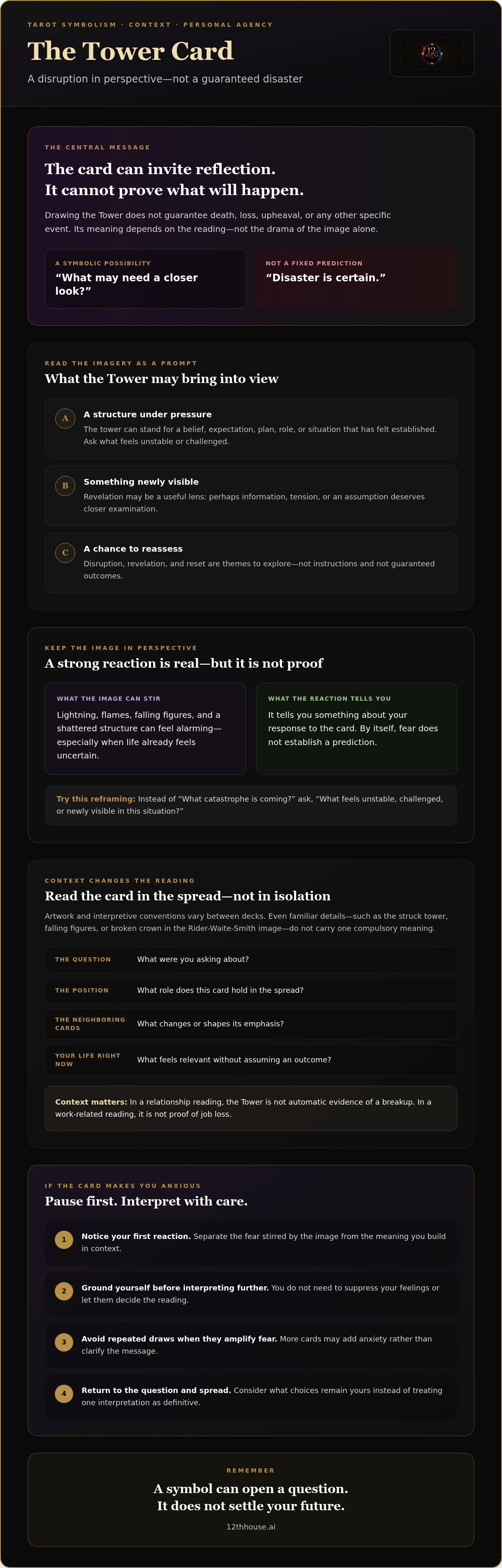
What to Do When the Tower Card Makes You Anxious
If you’re scared of the tower card in tarot, don’t force yourself to interpret it while your thoughts are racing. First, create a little distance between the card and the story you fear it tells. A pause can help you read the spread more clearly, without turning one unsettling image into a certainty about your future.
A Grounded Four-Step Response to an Unsettling Pull
Move through these steps before drawing more cards:
- Pause and name the fear. Take a slow breath and identify the specific thought that arose. Is it “I’m afraid my relationship will end,” or “I’m worried I’ll lose my job”? Naming the fear helps distinguish it from what the card itself shows.
- Return to your question and spread. Read the Tower in the position it occupies, and recall what you actually asked. Avoid expanding the reading into areas it wasn’t meant to address.
- Separate observations from assumptions. Write down the card’s imagery and possible themes, such as interruption or reconsideration. In a separate column, note predictions you’re making, like “something terrible will happen.” A prediction is an assumption, not a fact established by the card.
- Choose one useful question or action. Ask, “What would help me feel more prepared?” or “What assumption could I examine?” Choose a practical step within your control, such as reviewing a plan or having a thoughtful conversation, rather than acting as if a feared outcome is certain.
Pause, name the fear, read the spread, and choose a grounded next step instead of treating the card as a verdict.
When to Stop Pulling Cards and Seek Perspective
If you keep drawing cards to make sure the first one “doesn’t count,” stop for now. Repeated pulls while distressed can create more interpretations to worry about, rather than resolving uncertainty. Put the deck away, take a walk, drink some water, or return to the reading later when you feel steadier. You don’t need to solve the card immediately.
If tarot anxiety is disrupting your sleep, decisions, or sense of wellbeing, consider talking with someone you trust. You can also set a boundary for future readings, such as deciding in advance what question you’ll ask and when you’ll stop. For a structured way to explore follow-up questions, ask Lala about your tarot reading. Treat the response as a perspective to consider, not an infallible answer.
How to Read the Tower Card With Context and Personal Agency
A grounded Tower interpretation begins with the reading you actually did, not the outcome you fear. Look at the original question, the card’s spread position, and the cards around it. Together, these details shape the symbolic emphasis. A card in a position about an obstacle may invite a different reflection than one in a position about your response. Neither position dictates what must happen.
If you’re scared of the tower card in tarot, separate what the spread shows from what you’re adding to it. “The card appeared in a position about change” is an observation. “I’m certain I’ll lose something important” is a prediction. Treat the first as context and the second as a possibility to examine, not a conclusion.
Questions That Put the Tower in a More Useful Frame
Use open-ended questions to explore the card without steering yourself toward a feared outcome:
- What assumption, structure, or situation might this card invite me to examine?
- Which parts of my interpretation come from the spread, and which are speculation?
- What other meanings fit the question and the surrounding cards?
- What response or choice remains within my control?
These questions don’t require you to make the card positive. They make space for nuance. A difficult possibility can be considered without treating it as inevitable.
Explore a Tarot Reading Without Treating It as a Verdict
Tarot offers a symbolic framework for reflection, but you remain the interpreter. The Tarot Mastery guide can help you build broader foundations for reading cards with attention to context. If you want to explore a personal question, 12th House tarot readings are another optional reflection tool. Lala, 12th House’s AI spiritual guidance assistant, can help you ask follow-up questions about a reading; it isn’t a definitive authority. You can learn more about its broader guidance role in the AI astrology assistant guide.
Use these resources to consider possibilities, not to outsource your judgment. The Tower can raise a question about change, but it doesn’t decide what that change means for you. You interpret the symbolism, weigh it against your lived context, and choose what to do next.
Let the Tower Open a Question, Not Close the Story
If you’re scared of the tower card in tarot, remember that its dramatic imagery doesn’t establish a guaranteed outcome. The card may invite you to examine disruption, assumptions, or change, but its meaning depends on the reading’s question, position, and surrounding cards. Your reaction matters, too, but fear alone isn’t proof of what will happen.
Pause before drawing again. Separate what the cards show from what you’re imagining, then ask what perspective or practical choice might help. A reading can support reflection without replacing your judgment or deciding your next move for you.
If you’d like to explore a personal question, explore tarot readings and personalized guidance with 12th House. The platform also offers metaphysical library access, and Lala, its AI spiritual guidance assistant, can help you ask follow-up questions. Treat these as tools for reflection, not definitive answers. The Tower may feel unsettling, but you can meet its symbolism with curiosity, context, and confidence in your own agency.
Frequently Asked Questions
Is the Tower card in tarot always a bad sign?
No, the Tower isn’t always a bad sign. If you’re scared of the tower card in tarot, remember that a card can’t establish that harm is certain. Readers commonly associate it with disruption, revelation, or pressure on an existing structure. These themes may feel challenging, but they can also prompt reflection or reassessment. Interpret the card through the reading’s question and surrounding cards, not as a standalone omen.
Does the Tower card mean someone will die?
No. The Tower card doesn’t mean someone will die, and drawing it isn’t evidence that a death is coming. Tarot symbolism can’t verify or guarantee a specific event. If the image has triggered a concrete fear, step away from the reading and focus on what you know in real life. For concerns about someone’s immediate safety or health, rely on appropriate real-world support, not a card interpretation.
What does the Tower card mean in a tarot reading?
The Tower commonly represents disruption, revelation, or a structure being challenged. The structure might be an assumption, plan, relationship dynamic, or other situation, depending on the question. Its meaning isn’t fixed: consider the card’s spread position and the cards around it before deciding which theme fits. Treat your interpretation as one possible lens on the situation, not as proof of what will happen next.
Can the Tower card mean something positive?
It can support a constructive interpretation, though it doesn’t promise a positive outcome. A reader might see the Tower as a moment of clarity, a chance to question an assumption, or an invitation to reassess an arrangement that no longer feels stable. These possibilities don’t erase the card’s disruptive symbolism. They broaden the reading, allowing you to consider what the change could reveal as well as what feels difficult.
What does a reversed Tower card mean?
A reversed Tower may be read as internal change, delayed disruption, or resistance to change, but meanings vary by reader and tarot tradition. Some readers use reversals; others don’t, or interpret them differently. Check the method you chose for the spread, then read the card in its position and alongside its neighbors. Don’t assume that reversed automatically means the event is avoided, intensified, or certain to happen.
Should I pull more cards if the Tower scares me?
Usually, pause before pulling more cards if you’re drawing because you feel frightened and need certainty. Repeated pulls can create conflicting interpretations and make it harder to focus on your original question. Take a breath, note what you fear and what the spread actually shows, then step away if needed. Return when you feel steadier, and draw again only if you have a clear, useful question.
How should I interpret the Tower card in a love reading?
In a love reading, don’t treat the Tower as automatic evidence of a breakup, betrayal, or other specific event. Start with your question and the card’s position. Then consider whether its themes might relate to tension, an unexpected realization, or assumptions about the relationship that deserve examination. Look to neighboring cards for context, and distinguish what you know about the relationship from what you fear the card predicts.


