

What if the Ten of Cups says less about whether someone will choose you and more about the emotional world they imagine sharing with you? In a love reading, the ten of cups as feelings can point to warmth, belonging, and the ease of feeling at home with someone. It’s natural to read that as love or commitment, especially when the card’s image suggests lasting happiness. But a hopeful symbol isn’t a promise of what another person will do.
This guide helps you distinguish emotional fulfillment from a guaranteed relationship outcome. You’ll explore what the card may indicate upright and reversed, how the question and surrounding cards shape its meaning, and where interpretation has limits. You’ll also look beyond the idealized picture of harmony to consider whether the connection feels authentic in practice. Use the card as a framework for reflection: What kind of closeness is present? Can both people express their needs honestly, or does peace depend on avoiding difficult topics? Questions like these make a reading more grounded and useful than a simple yes or no.
Key Takeaways
- The ten of cups as feelings points toward emotional warmth and belonging, but comfort doesn’t automatically mean commitment.
- Use the card’s imagery as a symbolic lens for emotional fulfillment, while remembering that artwork can vary between decks.
- Compare upright and reversed meanings to explore whether the emotional tone suggests ease or tension.
- Read the card according to its spread position: a feelings card answers a different question than an outcome or advice card.
- Use the spread to frame reflection, not to assume marriage, reconciliation, or another person’s private thoughts are certain.
What Does the Ten of Cups Mean as Feelings?
The ten of cups as feelings often points to emotional warmth, contentment, belonging, and a wish for shared happiness. Someone may feel comfortable with you, value the bond, or picture what a harmonious connection could look like. That sense of security can matter deeply, but it doesn’t automatically mean a formal commitment, a decision to build a future together, or even that the person has expressed these feelings.
Read the card as a symbolic prompt, not proof of another person’s private inner state. The Ten of Cups is commonly associated with emotional fulfillment and domestic harmony, themes that help explain its reputation in love readings. Still, a card can’t verify what someone thinks or intends. Compare its hopeful message with your question, the surrounding cards, and what’s actually happening between you.
Does the Ten of Cups mean love and commitment?
Readers often connect this card with affection, harmony, and long-term happiness because its traditional symbolism evokes emotional fulfillment and shared joy. In a feelings position, it may suggest that someone associates the connection with comfort, closeness, or the possibility of belonging.
Keep desire separate from decision. A wish for a lasting bond isn’t the same as a promise, an agreement, or a concrete step toward commitment. Note what the spread actually suggests, then compare that interpretation with the person’s words and actions.
What emotional tone does the card carry?
The Ten of Cups has a warm, settled quality. Its emotional tone is less about dramatic longing or the uncertainty of a new attraction, and more about ease, acceptance, and feeling included. That doesn’t mean the relationship is perfect. It points to harmony as a theme to examine, not a guarantee that conflict is absent.
In one sentence: The Ten of Cups as feelings describes a sense of emotional homecoming, with a desire for shared joy and belonging.
To distinguish genuine harmony from hope, look for alignment between the card’s theme and the relationship’s lived reality. Is there mutual care, honest communication, and room for each person’s needs? Or are you filling gaps in the situation with an ideal image of happiness? The card can help you name what you long for or what the connection seems to offer, but those are different interpretations.
Hold both possibilities without forcing a verdict. The Ten of Cups may reflect real emotional ease, an aspiration toward closeness, or your own picture of a fulfilling relationship. Context helps you decide which interpretation fits the spread. Observing the relationship helps you avoid treating a symbolic promise as evidence of a specific outcome.
How the Ten of Cups Imagery Shapes Its Feelings Meaning
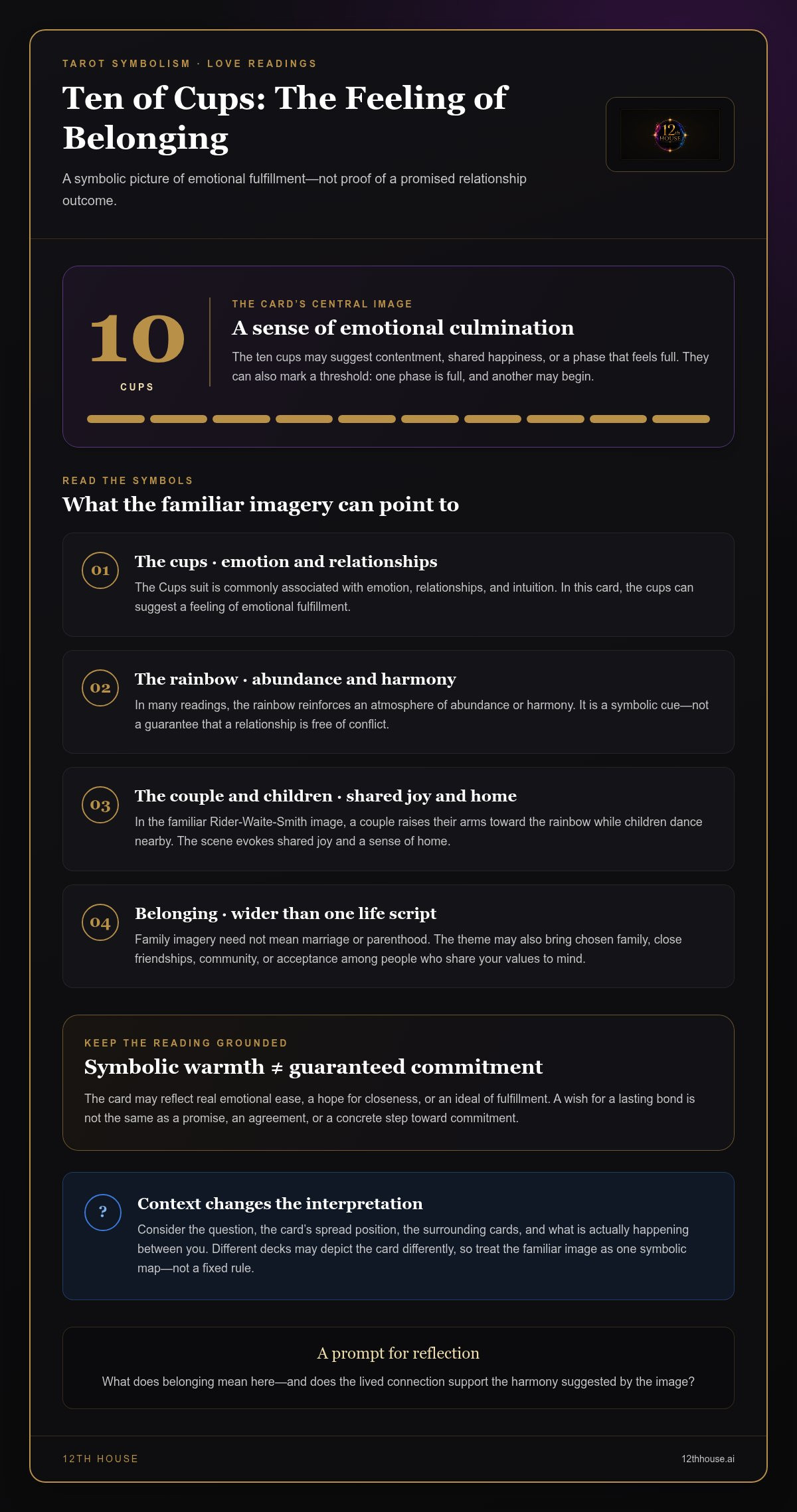
In the familiar Rider-Waite-Smith image, a couple stands together with their arms raised toward a rainbow of ten cups, while children dance nearby. The scene suggests shared joy and a sense of home. Other decks may depict the card differently, so treat this picture as one symbolic map, not a fixed rule for every reading.
The image helps explain why the ten of cups as feelings can point toward emotional fulfillment. The Cups suit is commonly associated with emotion, relationships, and intuition; the ten cups can suggest a sense of emotional culmination. Together, these symbols may evoke contentment or hope for shared happiness. They don’t prove that a person feels this way or that a particular future is coming.
What do the cups and rainbow symbolize?
In many readings, the cups represent the emotional dimension of a situation, while the rainbow can reinforce an atmosphere of abundance or harmony. The number ten may be read as a point of completion, but also as a threshold: one phase is full, and another may begin. Interpretive traditions and deck imagery differ, so let these associations inform the reading rather than dictate it.
For example, if the Ten of Cups appears beside cards suggesting hesitation, its image of fulfillment might describe an ideal or longing rather than ease in the present. Look at how the symbols interact across the spread. No single detail, including the rainbow or the number of cups, determines the answer.
Why do family and community appear in interpretations?
The couple and children in the familiar image can bring family happiness to mind, but the theme needn’t mean marriage or parenthood. It may point to chosen family, close friendships, community, or the relief of being accepted by people who share your values. Ask what “belonging” means in the context of your question rather than applying one life script to the card.
This broader lens can make the imagery more useful. A person asking about a new relationship might consider whether they feel welcomed into each other’s lives. Someone asking about emotional needs might reflect on where they experience safety and connection. For a wider foundation in interpreting symbols and spreads, explore Tarot card meanings and reading foundations.
Use the picture as an interpretive prompt: What kind of shared life, support, or emotional ease does it bring to mind? Does the rest of the spread support that reading? If you want to explore a spread through a structured Tarot reading, reflective Tarot guidance can offer another framework for considering its symbols.
Ten of Cups Upright vs. Reversed as Feelings
Orientation shifts the emotional emphasis, but it doesn’t deliver a verdict on a relationship. Upright, the Ten of Cups may suggest ease, affection, and a wish to share happiness. Reversed, it can draw attention to tension between an ideal of harmony and what someone can genuinely feel or express. Use the contrast to investigate the spread, not to predict a breakup or promise a future.
| Position | Emotional tone | Possible interpretation | Reflective question |
|---|---|---|---|
| Upright | Warm, open, settled | Emotional ease, shared happiness, or a wish for lasting connection | What supports this sense of closeness? |
| Reversed | Uneasy, disconnected, or strained | Unmet expectations, difficulty expressing warmth, or tension around belonging | Where might the ideal differ from the lived experience? |
What does the upright Ten of Cups suggest about feelings?
Upright, the card may indicate affection, emotional openness, or feeling at ease with someone. In a love reading, that could describe a person who enjoys the connection and values its potential for shared happiness. The ten of cups as feelings can therefore sound deeply hopeful, but a positive emotional atmosphere isn’t the same as a definite next step, such as making a commitment or defining the relationship.
Check the surrounding cards for context. Do they reinforce mutuality and openness, or introduce hesitation, distance, or practical obstacles? Let the full spread refine the interpretation.
What can the reversed Ten of Cups mean in a love reading?
Reversed, the card may suggest emotional mismatch, strained harmony, or expectations that feel difficult to meet. Warmth might be present but hard to express; someone may feel outside the relationship’s sense of belonging; or the image of a perfect future may be obscuring present needs. These are possibilities, not a diagnosis of the relationship.
Reversed meanings vary by reader and deck. Don’t treat the card as an automatic sign of lost love or relationship failure. Start with your question: Are you asking about someone’s feelings, the state of the connection, or what needs attention? Then consider whether nearby cards point toward repair, distance, or a need to reassess expectations.
Read both orientations with proportion. Upright doesn’t guarantee enduring harmony, and reversed doesn’t erase affection. Ask what emotional pattern the card brings into focus, then test that interpretation against the rest of the spread and the relationship as you experience it.
How to Read the Ten of Cups in a Love Spread
Read the Ten of Cups through the structure of the spread, not in isolation. A clear sequence can keep an appealing symbol from turning into a fixed prediction:
- Name the question. Are you asking about feelings, relationship direction, or what you can do next?
- Note the orientation. Read the card upright or reversed according to the spread’s method.
- Inspect its position. A feelings position explores an emotional theme; an outcome position concerns a possible direction, while advice points toward an approach to consider.
- Compare neighboring cards. Look for details that reinforce, qualify, or complicate the card’s themes.
For instance, in a feelings position, the card may invite you to consider whether warmth or emotional ease is present. In an outcome position, it may raise the possibility of greater harmony, but it doesn’t guarantee that result. In an advice position, it might prompt you to reflect on what helps create belonging. These are interpretive possibilities, not verified statements about another person’s private thoughts.
How do surrounding cards change the interpretation?
Nearby cards add context. They may strengthen a reading of emotional fulfillment, introduce friction, or suggest that the ideal of harmony needs closer examination. Avoid treating any card pairing as a rigid rule: combinations vary across readers and traditions. For another perspective on relationship dynamics, birth chart compatibility and relationship patterns can serve as a complementary lens, not a substitute for the Tarot spread.
What questions can help you read the spread clearly?
Before settling on an answer, ask whether the card reflects current feelings, your hopes, or the relationship’s broader emotional climate. Write down what the image evokes before searching for a fixed meaning. Then ask what in the spread supports your interpretation and what might challenge it. For recurring relationship questions, explore love readings for relationship clarity as a reflective resource.
The ten of cups as feelings is most useful as a prompt for inquiry. Let a reading clarify what you want to understand, then keep real-world communication and personal boundaries in view. A symbolic interpretation can help you frame a conversation, but it can’t replace one. For structured reflection on your own spread, explore a Tarot reading.
Use the Ten of Cups as a Reflection Tool, Not a Promise
A Tarot card can organize reflection, but it can’t verify another person’s feelings or guarantee what they’ll choose. The Ten of Cups may bring marriage, reconciliation, or a shared future to mind. Treat those images as possibilities your imagination is responding to, not facts established by the card. The value of the reading lies in what it helps you notice about your needs and the relationship in front of you.
How can you apply the card without overreading it?
Use the card to investigate what emotional fulfillment means to you. Is it consistent care, a sense of belonging, room for honest disagreement, or a shared direction? Then compare the reading with observable behavior and the wider relationship context. Do words and actions align with the harmony you hope to see?
Try these questions in your notes:
- What need or hope does this card bring into focus?
- What evidence of mutual care can I observe, separate from what I imagine?
- What boundary or conversation would help me feel clearer?
Don’t make a consequential decision based on one card alone. If you’re considering reconciliation, for example, reflect on what has changed and what you need before deciding whether to reconnect. A symbolic reading can help you frame those questions; direct communication, when appropriate and safe, can clarify what the other person is willing to share.
Where can you explore Tarot meanings further?
Continue by studying how card symbolism interacts with spread positions and neighboring cards. This keeps interpretation structured: the same card may carry a different emphasis depending on the question and the role it occupies. The ten of cups as feelings can prompt inquiry into emotional needs and mutuality without becoming a substitute for your judgment.
12th House offers Tarot readings and Lala, an AI spiritual guidance assistant, as digital tools for reflection. Use them to explore interpretations and generate questions, not as proof of another person’s private thoughts or as a decision-maker. Your lived experience remains central to the reading.
For continued symbolic exploration, explore 12th House spiritual guidance. Bring a clear question, consider the spread as a whole, and keep your own boundaries in view as you interpret what the cards suggest.
Carry the Reading Into Clearer Reflection
The ten of cups as feelings can point to warmth, belonging, and a wish for shared happiness. Upright, it may suggest emotional ease; reversed, it can invite you to examine strain, unmet expectations, or a gap between an ideal and the relationship as it is. Neither orientation confirms commitment or predicts a specific future.
Let the card help you name what emotional security means to you. Then consider its spread position, the cards around it, and whether observable actions support your interpretation. Tarot offers a symbolic framework for reflection, not verified access to someone else’s inner world. Your needs, boundaries, and honest conversations matter too.
Continue exploring with 12th House. The platform offers Tarot readings, Lala for AI spiritual guidance, and a metaphysical learning library to support your study of card meanings and spreads. Use these tools to deepen your reflection, while keeping your own judgment at the center. Explore 12th House Tarot and spiritual guidance, and let the cards open thoughtful questions rather than close them for you.
Frequently Asked Questions
Does the Ten of Cups mean someone loves you?
Not by itself. The card may suggest warmth, emotional ease, or a wish for shared happiness, but it can’t verify another person’s feelings. Check the spread position and nearby cards, then compare your interpretation with what you know from their words and actions. If you’re unsure where you stand, treat the card as a prompt to reflect or communicate, not as proof of love.
Is the Ten of Cups a good card for feelings?
Generally, yes. It’s associated with emotional contentment, harmony, and belonging, so it can be encouraging in a feelings reading. Its tone is often settled and supportive rather than driven by intense longing or uncertainty. Still, “good” doesn’t mean guaranteed commitment or a perfect relationship. Consider whether other cards reinforce this hopeful reading or point to complications that deserve attention.
What does the reversed Ten of Cups mean as feelings?
Reversed, the Ten of Cups may suggest emotional disconnection, strained harmony, unmet expectations, or difficulty expressing warmth. It can also point to a gap between an ideal of happiness and the relationship’s current reality. Interpretations vary by reader and deck, so don’t treat the reversal as automatic proof of lost love or a breakup. Consider your question, the spread, and the broader context.
Can the Ten of Cups mean marriage or a long-term relationship?
It can bring themes of lasting happiness, shared values, or building a sense of home into a reading, so readers may associate it with marriage or a long-term bond. But the card alone can’t promise either outcome. Look at its position, the surrounding cards, and the real choices both people are making. A hopeful symbol isn’t the same as a stated intention or mutual commitment.
What does the Ten of Cups mean in someone’s feelings position?
In a feelings position, it may symbolize affection, comfort, belonging, or a positive vision of emotional connection. This describes the theme the card brings to the reading, not verified access to someone’s private thoughts. Ask whether the surrounding cards support ease and mutuality or complicate that interpretation. The ten of cups as feelings is best read as a possibility to examine, not a certainty to rely on.
What should I do after pulling the Ten of Cups in a love reading?
Start by reviewing the question you asked, the card’s orientation, its position, and the cards around it. Write down what emotional fulfillment means to you, then compare that reflection with observable behavior in the relationship. Avoid making a major decision based on one card. If clarity depends on another person’s intentions, consider a direct conversation when appropriate, and keep your needs and boundaries in view.


