

What if the most useful answer to “Should I quit?” isn’t yes or no, but a clearer view of what’s shaping the question? A should I quit my job tarot spread can help you examine the pressures behind your decision without handing your agency to the cards. When work feels draining, it’s natural to wonder whether you need a short-term reset or a deeper change. It’s also wise to pause before making a choice with financial and practical consequences.
This guide offers a five-card spread to help you explore what’s driving your work decision, what you may be overlooking, and which grounded next steps deserve attention. You’ll learn how to phrase the question so it invites reflection rather than a fixed prediction, then interpret each card as a prompt for honest consideration. The cards may help you notice patterns, but they can’t assess your savings, obligations, or job prospects for you.
Move through the spread position by position. Notice where frustration, fear, and genuine desire intersect, then turn what you uncover into questions you can investigate. The aim isn’t to force a decision. It’s to understand what needs attention before you make one.
Key Takeaways
- Use the should I quit my job tarot spread to explore the pressures, needs, and uncertainties shaping your decision, not to seek a fixed yes-or-no verdict.
- Follow a five-card layout with a clear question so each position gives your reflection a distinct focus.
- Interpret each card through its position and your circumstances, then use its imagery to form a practical question.
- Turn useful insights into a conversation, small experiment, or other next step before making a major career move.
- Consider relevant finances, benefits, notice requirements, and personal circumstances as you weigh what the reading brings forward.
Should I Quit My Job? What a Tarot Spread Can, and Cannot, Clarify
“Should I quit?” can contain several different questions. Are you exhausted by a temporary workload, disconnected from the work itself, or ready for a different direction? A should I quit my job tarot spread gives those concerns structure. Reading each card through a specific position can help you examine what is influencing your thinking without asking the cards to decide for you.
Tarot is part of the broader card-reading practice of Cartomancy. In a career reading, its symbols can draw your attention to concerns, priorities, and questions you might otherwise overlook. Treat the result as material for reflection, not evidence that quitting is necessary or inevitable. Tarot can offer a mirror for your decision, but it can’t reliably predict what will happen if you leave.
When a career tarot reading can be useful
A defined question can help organize competing feelings about workload, purpose, values, and change. Instead of asking for a bare yes or no, try, “What should I understand about my current work situation?” That wording gives the reading a focus while leaving room for more than one interpretation. Card meanings vary by deck, reader, and personal context, so pay attention to what the imagery brings up for you.
Why tarot should not make the decision for you
Cards can’t establish whether your job is secure, calculate your future income, or confirm what another employer will offer. Don’t treat any card as an automatic command to resign or stay. Compare symbolic impressions with practical circumstances, including your financial needs, responsibilities, and available alternatives. If a card raises a concern, use it to identify what you need to check, discuss, or understand before acting.
Uncertainty isn’t a sign that you’re failing to decide. It may mean the question needs a clearer definition. Use the spread to distinguish what you feel from what you know, then let reflection inform your judgment without replacing it.
How to Lay Out a Tarot Spread About Quitting Your Job
Set up the reading before you draw. Choose a deck you can read comfortably, find a quiet place, and take a few breaths to settle your attention. Keep a notebook nearby so you can record your first impressions and return to them later. You’re building a map of the decision, not asking the cards to make it for you.
A five-card spread for a job decision
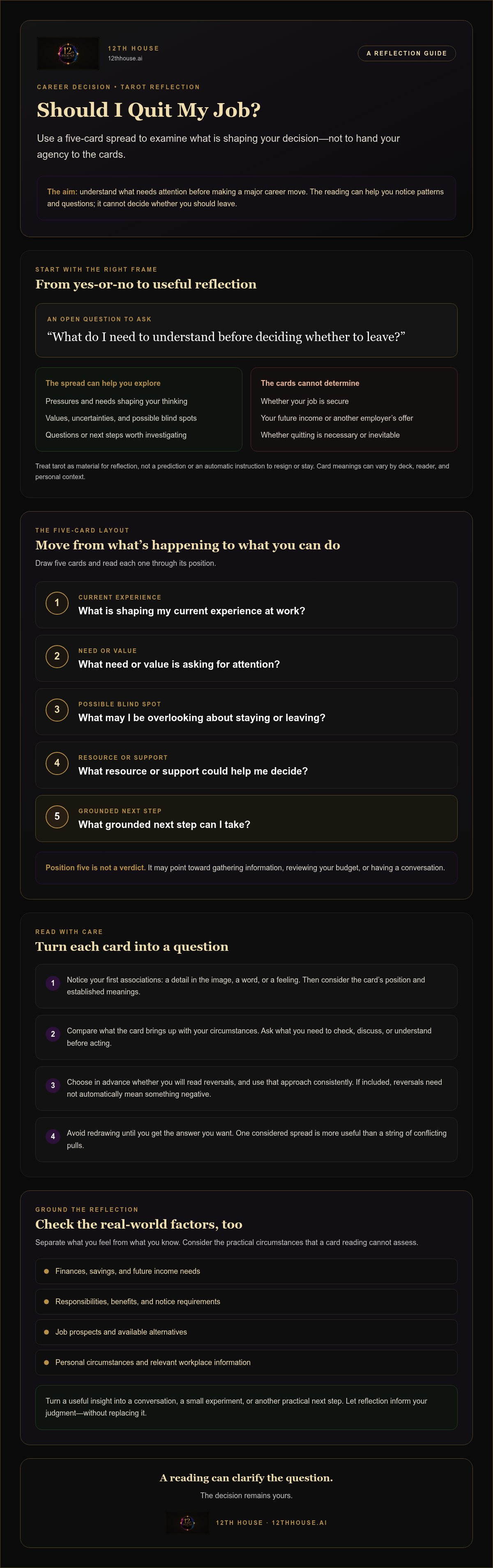
Ask, “What do I need to understand before deciding whether to leave?” Shuffle while holding that question in mind, then draw five cards and place them in a row. Read each card through its position. The sequence moves from your present experience toward a practical next step.
- Card one: What is shaping my current experience at work?
- Card two: What need or value is asking for attention?
- Card three: What may I be overlooking about staying or leaving?
- Card four: What resource or support could help me decide?
- Card five: What grounded next step can I take?
The five positions cover current work influences, an unmet need or value, a blind spot, a resource or support, and a grounded next step. The fifth card doesn’t have to mean “resign” or “stay.” It might prompt you to gather information, review your budget, or have a conversation.
Ask a question that opens reflection
Keep your wording focused and open. “What do I need to understand before deciding whether to leave?” invites examination without steering the reading toward a preferred answer. Before consulting a guidebook, write down your first associations with each card: a detail in the image, a word, or a feeling. Then compare those impressions with established meanings and the card’s position.
You can read only upright cards or include reversals. Choose your approach before you begin and apply it consistently. If you include reversals, decide what they mean in your practice, such as an internal tension or a blocked expression, rather than automatically treating them as negative. Avoid redrawing until you get the answer you want. One considered spread is more useful than a string of conflicting pulls.
Use the resource position to name what would help you assess the choice beyond the cards. A trusted person, relevant workplace information, or a structured career assessment may offer perspective. Florida State University outlines a grounded decision-making process that can complement the reading by directing attention to your values, interests, and skills. For additional self-guided reflection, 12th House offers tarot readings through its online platform.
How to Interpret Your Job-Quitting Tarot Spread Without Forcing an Answer
Read each card as part of a defined system. Start with what you notice in the imagery, consider the card’s traditional associations, then connect those ideas to the question and the position it occupies. A card about your current experience speaks differently from one about support or a next step.
A card’s role depends on its spread position as much as on its traditional meaning. Keep that distinction in view as you interpret the should I quit my job tarot spread. A card can suggest an area to examine, but it can’t confirm a definite future.
Read each card in context, not isolation
Suppose The Fool appears in the position for a grounded next step. It might prompt you to explore a new direction, but it doesn’t order you to resign without a plan. The Eight of Cups could raise questions about emotional disengagement or what you feel ready to leave behind. In a position about what you may be overlooking, it could instead prompt you to consider what remains unresolved. Let the image and position guide your inquiry.
Use each interpretation to generate a question you can check against your circumstances:
| Possible card prompt | Question for real-world reflection |
|---|---|
| A need for change | What specifically feels unsustainable, and when does it arise? |
| A call to pause | What information or support would help me decide with more clarity? |
| A new direction | Can I test this interest before making a major commitment? |
| A boundary under strain | What request or conversation might clarify what can change at work? |
Notice whether a concern appears in more than one position, but don’t force a pattern. Repeated themes may point to something worth examining. They aren’t proof that one outcome is destined.
Handle difficult or apparently contradictory cards
A challenging card doesn’t mean you’ve failed or must leave. Treat it as a prompt to investigate stress, boundaries, or unmet needs. If one card suggests security and another signals restlessness, name the tension. Stability may matter to you while your current role no longer feels meaningful. Both can be true.
When interpretations clash, return to the original question and read each card in its own position. Don’t draw again just to obtain certainty. Instead, write down what each card asks you to examine, then separate symbolic impressions from facts you can verify. This keeps the reading useful without turning it into a verdict.
Turn a Tarot Reading About Leaving Work Into a Grounded Decision Plan
A useful reading should change what you examine, not push you toward an irreversible choice. Translate each card that resonates into a question, conversation, or small experiment. If a card highlights a strained boundary, for example, note when the problem occurs and consider whether a specific workload conversation could clarify what might change.
Separate symbolic insight from practical constraints
Make two columns: one for what the reading brought into focus and one for facts you can verify. The first might include feeling depleted or wanting more meaningful work. The second could include savings, benefits, notice requirements, job-search options, and the effect of a change on people who depend on you. The cards can help you name a concern, but they can’t supply these facts.
For specialized financial, legal, or mental health concerns, seek guidance from a trusted person or appropriately qualified adviser. A tarot spread isn’t a substitute for professional advice. Use it to identify what you need to ask, then rely on relevant information to assess the answer.
Choose a low-risk next step
Document recurring concerns rather than relying on one especially difficult day. Record what happened, how it affected you, and whether the issue repeats. Then choose one manageable action: ask about workload adjustments, explore a transfer, learn what leave options may apply, or begin a discreet job search. These steps let you test what could improve without assuming resignation is the only path.
Consider your circumstances before acting. Review your finances and benefits, check any notice requirements that apply to your situation, and identify what information you still need. If the cards suggest a change but you’re unsure what form it should take, research roles or speak with someone in a field that interests you. These steps can turn a broad feeling into questions you can investigate.
Set a review date after taking your chosen step. Use that point to assess what you learned, what has changed, and what remains unresolved. This gives reflection a practical endpoint and can reduce the urge to keep drawing cards for certainty. Keep symbolic insights alongside the real-world checks that shape your decision.
12th House offers tarot readings and a metaphysical library for self-guided learning. These resources can support further reflection while leaving the career decision in your hands.
Continue Your Tarot Reflection With 12th House
The five-card spread gives your question a structure. It can help you name what’s shaping your work experience, identify a need or blind spot, and consider a grounded next step. It doesn’t replace your judgment or determine whether leaving is right for you. The decision remains yours, informed by reflection and circumstances you can verify.
Use tarot as an ongoing reflective practice
Keep a record of the question you asked, each card’s position, your first associations, and the interpretation you settled on. Add the real-world questions the reading raised, then note what you learn as you gather workplace or financial information. Revisiting your notes later can show which concerns remain relevant and which have shifted. You don’t need to draw again to track that change.
This approach makes a should I quit my job tarot spread part of a measured reflection practice rather than a repeated search for certainty. Let a reading open an inquiry. Let the evidence and your own priorities shape what you do next.
Explore related 12th House resources
12th House offers tarot readings and access to a metaphysical library. The library provides books, videos, and ritual frameworks for self-guided learning. Use these resources to explore card meanings and reflective practice, while remembering that a learning resource can deepen your reading skills but can’t make the career decision for you.
If you’re looking for another framework for reflection, 12th House also offers an AI assistant that answers personalized questions about charts, spells, and compatibility. Treat any additional perspective as optional, not a verdict about your work or future. Your priorities and practical circumstances remain central.
When you review the spread, note what has changed since you first drew the cards. Perhaps you’ve clarified a concern, had a useful conversation, or learned what options are available. Those observations can bring the symbols into clearer focus without turning them into predictions.
Let Reflection Inform Your Next Step
A should I quit my job tarot spread works best as a framework for examining what matters, not as a verdict that decides your future. Read each card in context, then translate useful insights into questions, conversations, or small steps you can take.
Keep symbolic impressions distinct from practical facts. Review your circumstances, gather the information you need, and consider whether changes at work or other options deserve exploration before making a major move. A measured decision can honor both your intuition and your responsibilities.
You don’t need to solve everything at once. Let each thoughtful question bring the next step into clearer focus.
Frequently Asked Questions
Can tarot tell me whether I should quit my job?
No. Tarot can’t reliably predict what will happen if you leave or establish whether your job, income, or future opportunities are secure. A reading can help you notice concerns, values, or tensions that deserve attention. Use those insights to form questions, then check the practical facts and options relevant to your situation. The decision remains yours, informed by reflection and real-world evidence.
What is the best tarot spread for deciding whether to leave a job?
A five-card spread can give your reflection a useful structure without forcing a yes-or-no answer. Assign positions to what’s shaping your current work experience, the need or value asking for attention, what you may be overlooking about staying or leaving, a resource or support that could help, and a grounded next step. Interpret each card through its position and your circumstances, not as a stand-alone instruction.
How do I ask tarot if I should quit my job?
Choose an open question such as, “What do I need to understand before deciding whether to leave?” This wording focuses the should I quit my job tarot spread on insight rather than a fixed outcome. Before consulting a guidebook, write down your first impressions of each card. Avoid drawing again and again until you get a preferred answer. Return to the original question and reflect on what it brings forward.
What tarot cards mean I should quit my job?
No card automatically means you should resign. The Fool might invite you to consider a new direction, while the Eight of Cups could raise questions about disengagement or what you feel ready to leave behind. Their meaning depends on the spread position, imagery, and your context. Treat a card as a prompt to examine a concern or possibility, then verify practical details before making a career decision.
Should I use reversed cards in a job decision tarot spread?
You can use reversals, but you don’t have to. Some readers include reversed cards as prompts for internal tension, delay, or a blocked expression. Interpretations differ by practice and deck. Others read every card upright and focus on its position and imagery. Choose your method before shuffling and apply it consistently throughout the spread. A reversal isn’t automatically negative, and it doesn’t dictate whether you should stay or leave.
What should I do after a tarot reading about quitting my job?
Record the cards, your interpretations, and the questions they raised. Turn one useful insight into a practical next step, such as documenting recurring concerns, asking about workload changes, or researching other roles. Review relevant finances, benefits, notice requirements, and available alternatives before acting. Set a date to reassess what you’ve learned. Use the reading as one reflection tool, not as financial, legal, or mental health advice.
For continued self-guided reflection, explore 12th House’s tarot readings and metaphysical library.


