

What if a tense aspect in your charts isn’t a forecast of heartbreak, but a pattern worth understanding? Generic compatibility summaries can make a difficult placement sound like a warning, or reduce a complex comparison to a score. A thoughtful relationship synastry chart analysis looks at how the charts fit together and what the symbols might help you reflect on, not what they supposedly decide.
Synastry compares two individual birth charts, highlighting where your needs, communication styles, and ways of relating may flow easily or create friction. Supportive connections and challenging ones are not predictions. They describe symbolic dynamics to consider alongside lived experience, choices, and communication.
This guide explains how a synastry comparison is structured, which planetary connections and chart factors to examine, and how to interpret patterns without treating them as destiny. You’ll also learn why accurate birth information matters and how a synastry chart differs from a composite chart. Read the patterns with care, and the chart can help you ask better questions instead of delivering a verdict.
Key Takeaways
- Follow a clear reading sequence so individual aspects stay in context and repeated themes are easier to spot.
- Choose between a calculator, self-guided resources, or personalized digital exploration based on how much interpretation and effort you want.
- Gather each person’s birth date, place, and available birth time, and note which details may be uncertain.
- Use relationship synastry chart analysis as a reflective framework, not a compatibility score or prediction.
- Turn chart observations into thoughtful questions, compare them with lived experience, and discuss relationship needs without labeling a partner.
What relationship synastry chart analysis reveals about two people
Relationship synastry chart analysis compares two natal charts to explore how each person’s planetary placements symbolically interact. Instead of reducing a connection to a Sun-sign match or compatibility score, it looks at a wider pattern of contacts that astrologers may interpret as ease, tension, attraction, or responsibility. The chart offers a language for reflection, not a reliable verdict about whether a relationship will succeed.
Start by reading each person’s birth chart on its own. Then consider where the two charts meet. A placement can mean something different in the context of a person’s full chart than it does as an isolated symbol, and the comparison adds another layer. For a foundational overview, see Astrological compatibility (synastry).
What does a relationship synastry chart compare?
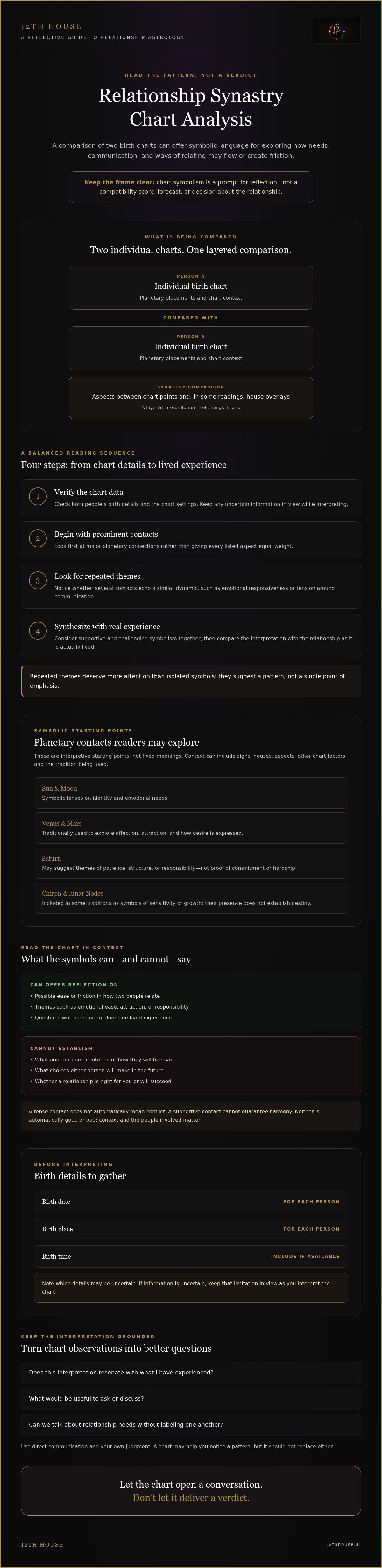
A synastry comparison examines planetary placements and the aspects between them. An aspect is an angular relationship between chart points, interpreted in astrology as a particular kind of interaction. Some readings also consider house overlays, which show where one person’s planets fall in the other person’s chart. Together, these techniques create a layered comparison rather than a single score.
For example, an astrologer might explore how one person’s communication style, represented symbolically by Mercury, relates to the other person’s emotional needs, often associated with the Moon. The interpretation depends on the signs, houses, aspects, other chart factors, and the astrological tradition being used. Since methods can emphasize different parts of a chart, keep the interpretive framework in view as you read.
What synastry can and cannot tell you
Astrologers may use chart contacts to consider themes such as emotional ease, attraction, friction, or responsibility. A tense contact doesn’t automatically mean conflict, and an apparently supportive contact can’t guarantee harmony. Context matters, as do the people involved.
Astrology can’t establish what another person intends, how they’ll behave, or what choices they’ll make in the future. It also can’t determine whether a relationship is right for you. Treat a chart as a prompt: Does this interpretation resonate with what you’ve experienced? What would be useful to ask or discuss? Keep your answers grounded in real interactions and direct communication. The symbols may help you notice a pattern, but they shouldn’t replace your judgment or become a way to label a partner.
How to read synastry aspects without over-weighting one placement
Read the chart as a pattern, not a catalogue of isolated contacts. An aspect is the angular relationship between two placements. In plain language, it describes how the symbols are positioned in relation to each other; astrologers interpret that geometry using the signs, planets, and chart context involved. A supportive aspect may suggest ease of expression, while a tense one may point to friction or a need for adjustment. Neither is automatically good or bad.
Use this sequence to build a more balanced relationship synastry chart analysis:
- Verify the chart data. Check both people’s birth details and the chart settings used. If any information is uncertain, keep that limitation in view as you interpret the chart.
- Identify major contacts. Begin with prominent planetary connections instead of giving every listed aspect equal weight.
- Note repeated themes. Ask whether several contacts echo a similar dynamic, such as emotional responsiveness or tension around communication.
- Synthesize the whole picture. Consider supportive and challenging symbolism together, then compare your interpretation with the relationship as it’s actually lived.
Repeated chart themes deserve more attention than isolated symbols because they point to a pattern rather than a single point of emphasis.
Which planetary contacts do readers usually examine first?
Start with the Sun and Moon as symbolic lenses on identity and emotional needs. Venus and Mars are traditionally used to explore affection, attraction, and how desire is expressed. Saturn contacts may suggest themes of patience, structure, or responsibility, but they shouldn’t be read as proof of commitment or hardship. Chiron and the lunar Nodes appear in some interpretive traditions as symbols of sensitivity or growth; their presence doesn’t establish destiny.
These are starting points, not fixed meanings. For instance, a tense contact involving Venus might prompt questions about differing ways of expressing affection. It can’t tell you whether either person is caring or compatible. Look at the surrounding chart before drawing conclusions.
How do you combine aspects into a chart-wide pattern?
First, distinguish each person’s natal tendencies from the interaction between their charts. A person’s natal chart offers one symbolic picture of their own style; synastry examines how placements from one chart connect with the other. Don’t assume a contact describes the whole relationship or that both people experience it in the same way.
Next, look for repetition and contrast. If several contacts touch on communication, note whether they suggest ease, strain, or a mixture. Preserve that complexity in your summary rather than forcing a simple positive or negative conclusion. If you want to explore a chart-specific question after considering these fundamentals, Ask Lala AI Spiritual Guidance offers a digital way to explore questions about charts and compatibility. Treat any interpretation as a prompt for reflection, not a substitute for your judgment.
Synastry chart analysis methods: calculator, guide, or personalized exploration?
Choose a method based on the question you want to answer. A calculator can map chart contacts, a guide can help you learn the language, and personalized digital exploration can help you ask focused questions about chart information and themes. Each serves a different purpose. Accurate calculation gives you chart data, but interpretation is a separate step that requires context and judgment.
| Method | Typical output | Interpretive depth | Your effort | Useful for questions like |
|---|---|---|---|---|
| Synastry calculator | Chart placements, aspects, and sometimes house overlays | Often limited unless explanations or context are included | Low to generate a chart, higher to interpret it | “Which contacts appear between these charts?” |
| Self-guided resources | Explanations of chart factors and interpretive techniques | Builds understanding, but you assemble the meaning yourself | Moderate to high | “How might this aspect fit with the rest of the chart?” |
| Personalized digital question-based exploration | Responses focused on supplied chart information and a specific question | Can help connect a question to relevant themes, without deciding what they mean for your relationship | Moderate, as you provide context and evaluate the response | “What chart themes could relate to how we communicate?” |
For broader foundations, read this guide to birth chart compatibility. It can help you place a two-chart comparison within the wider structure of chart interpretation.
What a synastry calculator can show, and what it leaves to interpretation
A calculator is useful for generating chart placements and listing aspects. But a list of contacts doesn’t tell you automatically which ones matter most, how they interact, or whether a theme appears elsewhere in the charts. Before interpreting the results, check the birth details entered and any stated calculation assumptions. Then treat the output as raw material for analysis, not a finished reading.
When can personalized chart questions add useful context?
Ask about a specific pattern instead of seeking a single compatibility verdict. For example, “What themes might this chart comparison raise around emotional expression?” gives you more to explore than “Are we meant to be?” A question-based tool such as Lala can help you explore personalized questions about charts and compatibility. Its responses are a starting point for reflection, not a decision about your relationship. For more on this kind of digital support, see the AI astrology assistant guide.
What birth data you need and how to handle chart uncertainty
A useful relationship synastry chart analysis starts with clear inputs. Gather the same core details for both people, and record what you know rather than filling gaps with guesses:
- Birth date: Day, month, and year.
- Birthplace: City and country, so the chart can use the relevant location.
- Birth time: The recorded time, if available. Note whether it’s confirmed, approximate, or unknown.
Keep the data separate from the interpretation. “Time confirmed from a record” is different from “family remembers it was around morning.” Recording that distinction makes it easier to see which chart details rest on firm information and which should be interpreted more cautiously.
Why does birth time matter in synastry analysis?
Some chart factors depend closely on birth time. The Ascendant and house placements, for example, can shift when the time is uncertain, affecting interpretations that rely on those details. This doesn’t mean every planetary placement becomes unusable without an exact time. Check original records when practical, and note any remaining uncertainty before interpreting time-sensitive factors.
How to read a chart when information is incomplete
Label each input as confirmed, approximate, or unknown. If a birth time is uncertain, avoid firm conclusions based on house overlays or the Ascendant. Other chart information may still be available, but its usefulness depends on what’s known and on the calculation method. Treat interpretations tied to uncertain data as possibilities, not settled conclusions.
Before reviewing the charts, use this short checklist:
- Have I entered each person’s date and birthplace correctly?
- Is each birth time confirmed, approximate, or unknown?
- Which parts of the chart depend on an uncertain time?
- Have I separated chart observations from assumptions about either person?
- Can I compare the interpretation with real interactions instead of treating it as a prediction?
A careful review leaves room for uncertainty. If you’d like to explore questions about your chart information and compatibility, ask Lala about chart-specific questions. Use the response as a reflection aid, while keeping your own judgment and lived relationship context central.
Turn relationship synastry chart analysis into a grounded next step
A chart becomes useful when it helps you notice, question, and reflect, not when it speaks for you. After your relationship synastry chart analysis, separate the symbols from the story you’re telling about them. The goal is to bring a clearer question into real life, not to make a decision based on a placement.
Questions to ask after reviewing a synastry chart
Write down the chart themes that stood out, then compare them with what you’ve actually experienced. Which interpretations feel consistent with your interactions? Which don’t fit or remain unclear? Keep the answers open. A symbolic reading can prompt inquiry, but it can’t confirm what another person feels or intends.
If a chart suggests tension around communication, turn that into a respectful question rather than a label. For example, ask, “How do we each prefer to handle misunderstandings?” or “What helps us feel heard?” You can use the same approach for boundaries and expectations. Discuss what you need, then pay attention to how you both respond.
A challenging aspect isn’t evidence that a relationship should continue or end. Instead, move through this practical sequence:
- Record observations: Write down the chart themes without turning them into claims about someone’s character.
- Identify questions: Choose one or two areas worth exploring, such as communication or emotional needs.
- Compare with lived experience: Notice what your interactions support, complicate, or contradict.
- Reflect: Decide what you’ve learned from both the chart and the relationship itself.
If you’re considering another reflective tool, this professional guide to AI love readings offers another perspective on using digital tools for exploration.
Explore chart-specific questions with 12th House
12th House offers Lala, an AI spiritual guidance assistant that answers personalized questions about charts and compatibility. You might use it to explore a specific theme or clarify how a chart factor is traditionally interpreted. Treat its responses as support for continued reflection, not as a definitive authority on your relationship or a substitute for your judgment.
For further chart exploration, explore 12th House, a digital membership platform that also includes access to a metaphysical learning library. Let the chart open a conversation with yourself and, where appropriate, your partner. Keep the meaning grounded in your choices, needs, and shared experience.
Let the chart sharpen your questions
A relationship synastry chart analysis is most useful when it helps you notice patterns without turning them into predictions. Read aspects in context, check the birth information behind the chart, and hold uncertain details lightly. Then compare what you see with how you and your partner actually communicate, respond, and meet each other’s needs.
Keep the interpretation curious rather than conclusive. A supportive contact doesn’t guarantee ease, and a challenging one doesn’t decide the relationship’s future. Use the symbols to form thoughtful questions, not to label a partner or make a decision for them.
If you want to explore a chart-specific question, Lala, 12th House’s AI spiritual guidance assistant, answers personalized questions about charts and compatibility. 12th House also offers astrology birth chart and transit analysis, with a metaphysical content library included in its membership platform. These resources can support continued exploration while leaving relationship choices in your hands.
Explore 12th House and ask Lala about your chart. Let the chart offer a perspective, then use your attention, conversations, and lived experience to guide what comes next.
Frequently Asked Questions
What is relationship synastry chart analysis?
Relationship synastry chart analysis compares two natal charts to explore how their astrological placements symbolically interact. It may consider planetary aspects and, when birth times are available, house overlays. Astrologers interpret these contacts as possible themes, such as ease, attraction, or tension. The chart is an interpretive framework, not a reliable measure of compatibility or a verdict on whether a relationship will last.
How do you read a synastry chart step by step?
Start by checking both people’s birth dates, places, and available times, then note any uncertainty. Review the major planetary contacts before considering less prominent details. Look for themes that repeat across multiple contacts, and distinguish each person’s natal tendencies from the interaction between the charts. Finally, consider supportive and challenging patterns together, then compare your observations with real experiences and communication.
Do you need an exact birth time for synastry?
An exact birth time is helpful, especially for interpreting time-sensitive details such as the Ascendant and house placements. If the time is missing or approximate, those parts of the reading may be uncertain. That doesn’t automatically make every planetary placement unusable. Record what’s known, check original records when practical, and avoid firm conclusions based on chart factors that depend on an uncertain time.
Which aspects matter most in relationship synastry?
No single aspect matters most in every chart. Readers often begin with Sun and Moon contacts for symbolic themes of identity and emotional needs, Venus and Mars for affection and attraction, and Saturn for responsibility or structure. Consider the wider chart and look for recurring themes. A supportive contact doesn’t guarantee harmony, and a tense one doesn’t automatically indicate a problem.
Can a synastry chart predict whether a relationship will last?
No. A synastry chart can’t reliably predict how long a relationship will last or establish what either person will choose. Astrology offers symbolic interpretations, not certainty about future behavior. You can use a chart to reflect on possible dynamics, then compare those ideas with your lived experience. Decisions about a relationship are better grounded in your needs, communication, safety, and the way you treat each other.
What is the difference between a synastry chart and a compatibility score?
A synastry chart shows interactions between two natal charts, giving you placements and contacts to interpret in context. A compatibility score compresses that information into a simplified rating, which may hide the reasons behind the result. Neither a chart nor a score can decide a relationship’s outcome. Synastry is more useful as a map of possible themes than as a ranking of how well two people match.
Can you analyze synastry without a birth time?
Yes, some synastry factors can still be considered if birth times are unknown, but parts of the comparison may be incomplete. House overlays and the Ascendant depend on accurate time data, so avoid firm interpretations of those elements. Gather each person’s birth date and place, label the time as unknown, and treat any reading that relies on time-sensitive details with caution.


