

What if the anxiety after a tarot reading is a signal to pause, not proof that a card has predicted what will happen? Feeling anxious after a tarot reading can make an unsettling interpretation feel unusually certain, especially when it touches a worry you already carry. Replaying the words or questioning your reaction can keep that alarm alive.
Your response is real, but it doesn’t make a symbolic reading a fixed forecast. Tarot can offer a framework for reflection; it can’t establish certainty about the future. You don’t have to dismiss what you felt or accept an interpretation as fact to regain perspective.
This guide explores why a card or reading may stir anxiety, how existing concerns can shape the meaning you hear, and what you can do to feel grounded again. You’ll learn to separate symbolism from certainty, slow repetitive thoughts, and choose a calm next step, whether that means pausing, reflecting, or seeking support if the distress continues.
Key Takeaways
- Feeling anxious after a tarot reading can reflect how a symbol connects with personal concerns, not just the card itself.
- Interpret a card within its question, spread, deck, reader, and surrounding cards rather than in isolation.
- Separate what was said from what you inferred and what remains unknown to get a clearer view of the reading.
- When anxiety rises, pause, orient to the present, write down the concern, and choose one measured next step.
- Use tarot as one reflective lens, not the sole basis for major decisions; consider outside support if distress continues.
Feeling Anxious After a Tarot Reading: Why Your Reaction Deserves a Pause
Feeling unsettled after a tarot reading can happen, especially if a card or interpretation touched a concern that already feels tender. Your reaction deserves care, but it doesn’t prove that a prediction is true. Anxiety is an emotional response, not evidence that a particular event will happen.
Post-reading anxiety is unease that can arise in response to tarot symbols, an interpretation, uncertainty, or personal concerns stirred by the reading. The feeling may be intense even when the meaning is unclear. A tarot reading is interpretive: its symbols can prompt reflection, but they aren’t a guaranteed forecast or a diagnosis. For a neutral overview of tarot’s practice and cultural context, see Tarot card reading.
Why a tarot reading can stay on your mind
Vivid imagery and emotionally charged phrases can hold your attention. If a reading touches a fear about a relationship, work, or change, your mind may return to that detail as it tries to make sense of it. That doesn’t mean the card revealed a fact. It means the image or interpretation felt significant to you.
Existing worries can shape what stands out. Someone already concerned about a breakup, for example, may focus on a phrase about endings and replay it afterward. Another person may notice a different part of the same reading. People respond in different ways, and there isn’t one explanation for every unsettled reaction.
A difficult card is not a fixed outcome
A card’s meaning can shift with the deck, tradition, question, spread, surrounding cards, and reader’s interpretation. Even a card commonly described as challenging can be read in more than one way. Its appearance alone doesn’t tell you exactly what will happen in your life.
Try separating the symbol from the conclusion attached to it. If a reader said, “This card points to an ending,” that is an interpretation, not proof that a specific relationship or opportunity will end. Ask what context shaped the reading and what remains unknown. Tarot can offer a lens for reflection, but symbolism by itself can’t establish a future event or require you to act.
Why Tarot Symbolism Can Intensify Uncertainty Without Settling the Future
A tarot reading can feel conclusive when you’re worried, even if the symbols allow several interpretations. Uncertainty creates space for the mind to fill in gaps, and fear may push one possibility to the front. That can make a reading feel like an instruction or warning, though neither follows from the card alone.
Tarot offers symbolic prompts for reflection, not verified predictions about what will happen. A card may help you consider a question or notice a concern, but it isn’t evidence that an event is certain, and it doesn’t require you to take a particular action. If uncertainty itself is difficult to sit with, the American Psychological Association offers guidance on dealing with the stress of uncertainty.
How context changes a card interpretation
A card doesn’t carry one definitive meaning in every reading. Its interpretation depends on the deck’s imagery, the question asked, its position in the spread, the surrounding cards, and the reader’s approach. The same image might prompt reflection on boundaries in a relationship question, but on limits or resources in a work question.
Before drawing a conclusion, return to the original question and the card’s position. Was it meant to represent a present concern, a possible influence, or something else within that particular spread? Context won’t produce certainty, but it can help you avoid treating a single phrase as the whole reading.
When a reading echoes an existing fear
Try separating the observation from the interpretation: What did the card or reader actually say? Then ask: What am I afraid it means? For instance, the card may have been described as a symbol of change, while your mind translates that into “I’m definitely going to lose my job.” The fear deserves attention, but it is not the same as what the reading established.
This is one way to notice confirmation bias, the tendency to give more weight to details that seem to support what you already suspect. It can affect anyone; it isn’t a diagnosis or a reason to dismiss your response. If you’re feeling anxious after a tarot reading, pause before letting the most alarming interpretation become the only one. When you feel ready, compare that interpretation with the question, spread position, and other cards rather than searching for the most frightening meaning. You can also use 12th House’s tarot resources as an optional place to explore questions and symbolism, without treating any interpretation as certain.
Tarot Reading or Anxiety: Questions That Help Separate Meaning From Fear
When an interpretation keeps looping in your mind, put it on paper before deciding what it means. The goal isn’t to prove or disprove a spiritual belief. It’s to map what happened in the reading, what you added afterward, and what the cards cannot answer for you. That separation can restore perspective without dismissing your feelings.
What did the reading actually say?
Write down the question you asked, the card and its position in the spread, and the reader’s exact words as closely as you can remember them. Then mark which thoughts came later. A reader might have described a card as “a period of transition”; your mind may have added, “Something bad is definitely coming.” Those statements aren’t equivalent.
Use the record to examine the reading once, not to reopen it repeatedly. Searching for increasingly alarming card meanings or drawing more cards compulsively can add interpretations without resolving uncertainty. Ask instead: What was the card meant to address? What context shaped the interpretation? What decision, if any, is actually in front of me?
What is known, feared, and still uncertain?
Sort the details into three columns. Keep observations distinct from predictions you fear, and leave unanswered questions unanswered for now.
| What was actually said or observed | What I inferred or fear | What remains unknown |
|---|---|---|
| The reader called the card a sign of change. | “My plans will fall apart.” | What changes, if any, will occur? |
| The card appeared in a position about a current influence. | “It must describe a future event.” | How should I understand this symbol in this spread? |
| I felt unsettled after hearing the interpretation. | “My reaction means the reading is true.” | What might have made this interpretation feel personal? |
Now ask: What evidence exists outside the reading? Is there another reasonable interpretation that fits the same card, question, and spread position? What part of this situation can I address through my own choices, regardless of what the symbol means?
An alarming interpretation is not the same as a confirmed event. If you’re feeling anxious after a tarot reading, you can acknowledge the feeling and still allow uncertainty to remain. You don’t have to reach a final interpretation or make an immediate decision. This exercise is a tool for perspective, not a verdict on tarot or your beliefs.
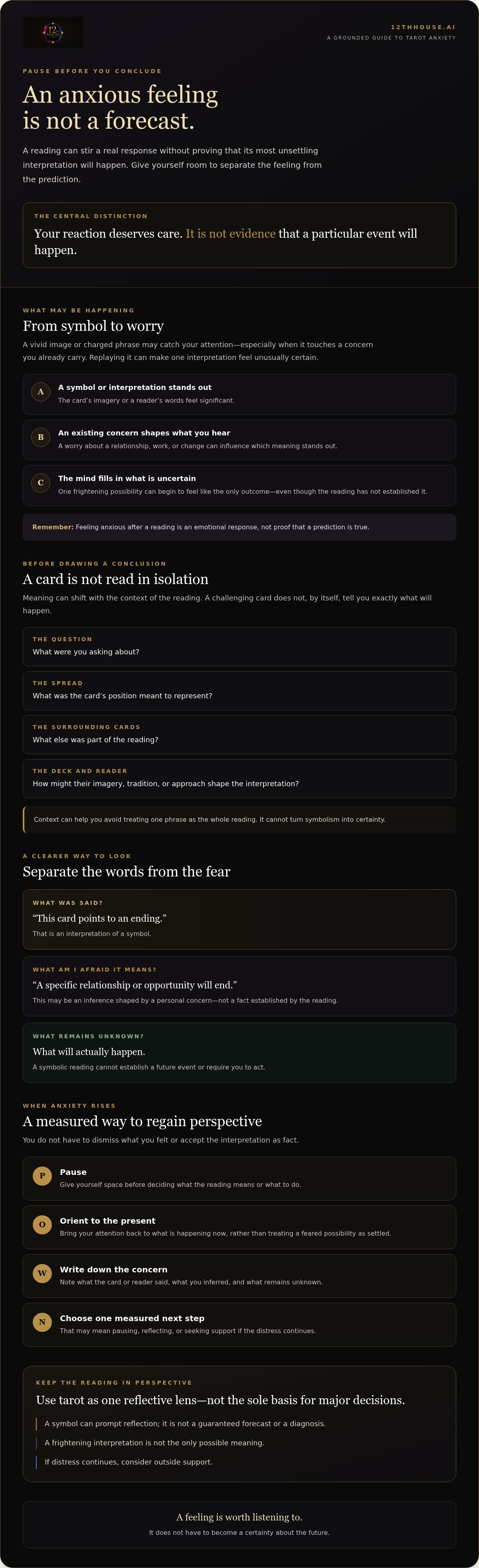
What to Do After a Tarot Reading Leaves You Anxious
If you’re feeling anxious after a tarot reading, don’t rush to resolve its meaning. First create some distance from the cards and the interpretation. The aim isn’t to force the feeling away. It’s to give yourself room to notice what’s happening and choose a response that fits your real circumstances.
A short grounding sequence for the moment
Try these steps in order, or choose only what feels comfortable. They’re simple ways to orient yourself, not a promise that anxiety will disappear.
- Pause. Put the cards or reading aside for now. You can return to it later or decide not to.
- Notice the present. Look around and name a few things you can see, hear, or feel. If it’s comfortable, take a slow, easy breath without trying to control it.
- Write down the concern. Capture the specific phrase or symbol that unsettled you, then note what you’re afraid it means. Keep those two statements separate.
- Choose one next step. Ask whether anything practical needs attention now or whether you can leave the question open. If you’d rather not process it alone, contact someone you trust.
Sometimes the most useful next step is no further interpretation. A pause can help you return to the reading with more perspective instead of responding from the first wave of alarm.
Set boundaries around follow-up readings
Repeated readings can produce more symbols and interpretations without creating certainty. If you notice that another reading increases rumination or distress, take a break. Before any future reading, decide when you’ll stop and what question genuinely needs reflection. You’re allowed to leave a question unanswered rather than keep searching for reassurance.
If anxiety persists, feels overwhelming, or disrupts daily life, consider reaching out to a qualified mental-health professional. Tarot and spiritual reflection aren’t substitutes for mental-health care. If you want to revisit the symbolism later, focus on the question, spread position, and surrounding cards, and take the time you need to consider what the reading brought up.
For a structured way to explore tarot symbolism as reflection, explore 12th House’s tarot learning resources. Treat any insight as a prompt for your own thinking, not as a verdict or a reason to make a high-stakes decision on the spot.
How to Reflect on Tarot Without Letting Anxiety Take Over
Let tarot be one reflective lens, not the authority over your choices. A reading may help you notice a question, feeling, or possibility, but it shouldn’t be the sole basis for a consequential decision about your health, relationships, work, or finances. Your circumstances, reliable information, and personal values belong in that decision too.
A reflective practice with clear boundaries
Once you feel steadier, write one open-ended question about what the reading brought up. For example: What concern did this interpretation touch, and what would help me understand that concern in daily life? This keeps reflection centered on your experience instead of asking the cards to settle an uncertain future.
Revisit the reading only if doing so feels useful. If rereading it or seeking another interpretation starts to feel compulsive, step away. Wait until you’re calmer before making a consequential choice, and consider what you would decide based on practical information apart from the reading.
Choose whether to reflect, pause, or seek support
- Reflect if you feel grounded enough to consider the symbolism without needing one definitive answer.
- Pause if you’re replaying the reading, seeking repeated reassurance, or feeling more distressed with each interpretation.
- Seek outside support if anxiety persists, escalates, or disrupts daily life. A qualified mental-health professional can offer care that tarot and spiritual guidance cannot.
If you’re feeling anxious after a tarot reading, you don’t have to solve the feeling through another reading. 12th House offers tarot readings and a metaphysical library as optional resources for exploring symbolism. Lala, its AI spiritual guidance assistant, can help you explore questions about tarot, but it isn’t a therapist, an emergency service, or a source of guaranteed predictions. These resources don’t replace human care.
If you or someone else is in immediate danger, contact local emergency services now. Otherwise, take the time you need. If exploring tarot again feels supportive, you can do so gently through 12th House’s tarot and learning resources, without urgency and without asking a symbol to decide for you.
Carry the Reading Forward With Perspective
Feeling anxious after a tarot reading can be unsettling, but the reaction isn’t proof that a feared event will happen. A card’s meaning depends on its context, and an interpretation is not a confirmed outcome. Give yourself room to separate what was actually said from what you fear it means.
Pause before making consequential choices. When you feel ready, reflect on what the reading brought up, or set it aside if revisiting it fuels rumination. Tarot can be one lens for self-reflection, not the sole authority on your future. If anxiety persists or disrupts daily life, seek support from a qualified mental-health professional.
If you’d like to explore tarot at your own pace, 12th House offers tarot readings and a self-guided metaphysical library. Lala, its AI spiritual guidance assistant, can help organize questions, but it isn’t clinical care or a source of certainty. Explore tarot resources and reflect at your own pace.
You can honor what you felt without treating a symbol as a verdict. Take the next step that feels grounded, and leave the rest open.
Frequently Asked Questions
Is it normal to feel anxious after a tarot reading?
Feeling unsettled after a tarot reading can happen, especially if a symbol or interpretation connects with an existing worry. The emotion is real, but it doesn’t confirm that the reading has predicted an event. Give yourself time before deciding what the reading means. You might write down the exact words that affected you, then separate those from the conclusions you drew afterward.
What should I do if a tarot reading scares me?
Pause the reading and step away from the cards or interpretation. Notice your surroundings, and if it feels comfortable, take a slow breath or name a few things you can see and hear. Write down what was said and what you fear it means, keeping those separate. You can contact someone you trust if you’d rather not sort through the reaction alone.
Can a tarot reading predict something bad will happen?
No card or interpretation can establish with certainty that something bad will happen. Tarot is a symbolic practice, and meanings depend on the question, spread, deck, reader, and surrounding cards. Treat an alarming interpretation as one way of framing a symbol, not as verified evidence or an instruction. For high-stakes choices, consider practical information and your own circumstances rather than relying on a reading alone.
Why do I keep thinking about a tarot reading?
A reading may stay on your mind because a vivid image or emotionally charged phrase touched a concern you already have. Uncertainty can also invite repeated attempts to settle what a symbol means. Replaying the reading doesn’t make one interpretation more certain. Try writing down the reader’s exact words, your own inference, and what remains unknown, then take a break from searching for more meanings.
Should I get another tarot reading if the first one made me anxious?
Consider waiting rather than seeking another reading right away. A second interpretation can introduce more possibilities without resolving the uncertainty, and repeated readings may fuel rumination. Ask yourself whether you feel calm enough to reflect and what question genuinely needs attention. If another reading feels driven by urgency or a need for reassurance, pause and revisit the issue through practical steps or trusted support instead.
Can tarot cards cause anxiety?
Cards don’t have to be treated as a direct cause of anxiety for a reading to stir an anxious response. Imagery, an interpretation, or the subject of a question may bring a worry into sharper focus. People react differently, and a strong response doesn’t prove that the reading is true or that something is wrong with you. If the reading increases distress, it’s reasonable to stop engaging with it.
When should I seek help for anxiety after a tarot reading?
Consider support from a qualified mental-health professional if anxiety persists, escalates, or disrupts sleep, work, relationships, or daily routines. Tarot readings and AI spiritual guidance are not mental-health care. If you or someone else is in immediate danger, contact local emergency services. You don’t need to wait for a reading to make sense before seeking help for distress that feels difficult to manage.


