

What if the most useful tarot reading begins not with a prediction, but with a better question? If you’ve asked an AI for guidance and received an answer too broad to apply, the prompt may need more focus. The questions to ask your tarot AI shape the reading, helping you connect symbolic interpretations to a specific choice, pattern, or concern in your life.
A clear question won’t make an AI an oracle, and a card reading can’t guarantee what will happen next. But a focused, open-ended prompt can give you a more grounded starting point for reflection. Ask about your choices, patterns, or possible next steps rather than trying to determine another person’s thoughts or pin down a yes-or-no outcome.
This guide offers practical prompts for love, career, and personal growth, plus a simple framework for writing your own. You’ll learn how to review an AI interpretation with discernment, notice what resonates, and set aside what doesn’t. Use the reading as a mirror for your judgment, not a substitute for it.
Key Takeaways
- Shape a focused prompt by naming your situation, choosing what you want to explore, and asking for insight or a possible next step.
- Use questions to ask your tarot AI that center your choices and patterns, rather than trying to predict another person’s private thoughts.
- Add only context that clarifies your question, and leave out unnecessary personal or sensitive details.
- Consider an AI interpretation a reflection aid, not proof of a fixed future. Keep what resonates and question what doesn’t.
- Build a simple practice: set an intention, record your first impressions, and make decisions with your own judgment at the center.
Why the Questions You Ask Your Tarot AI Shape the Reading
You want insight that feels connected to your life, not a vague message that could apply to anyone or an absolute answer that leaves no room for choice. A tarot AI question gives the reading a reflective focus. It identifies which part of a situation you want to examine, such as a decision, a recurring pattern, or a need that isn’t being met.
Tarot has a layered history, evolving from a card game into a practice associated with divination. That historical context is a useful reminder that card meanings are interpreted through traditions and frameworks, not delivered as unquestionable facts. With AI, your wording adds another layer. A specific, open-ended prompt can make an interpretation easier to connect to your circumstances. The reading can offer a perspective. You decide what, if anything, to do with it.
What makes a tarot question useful?
“What will happen?” is broad. It doesn’t identify the situation, the choice you’re facing, or the kind of insight that would help. A more useful question names the concern while leaving room for different outcomes: “What should I consider as I decide whether to accept this new role?” That framing invites reflection on your priorities and options instead of asking for a fixed forecast.
Questions about your own actions and patterns are often easier to apply because they return the focus to your agency. Ask what you might be overlooking, what value should guide your next step, or what pattern you want to understand. These prompts don’t guarantee a clearer answer, but they give the interpretation a defined point of reference.
Questions to avoid when seeking reflection
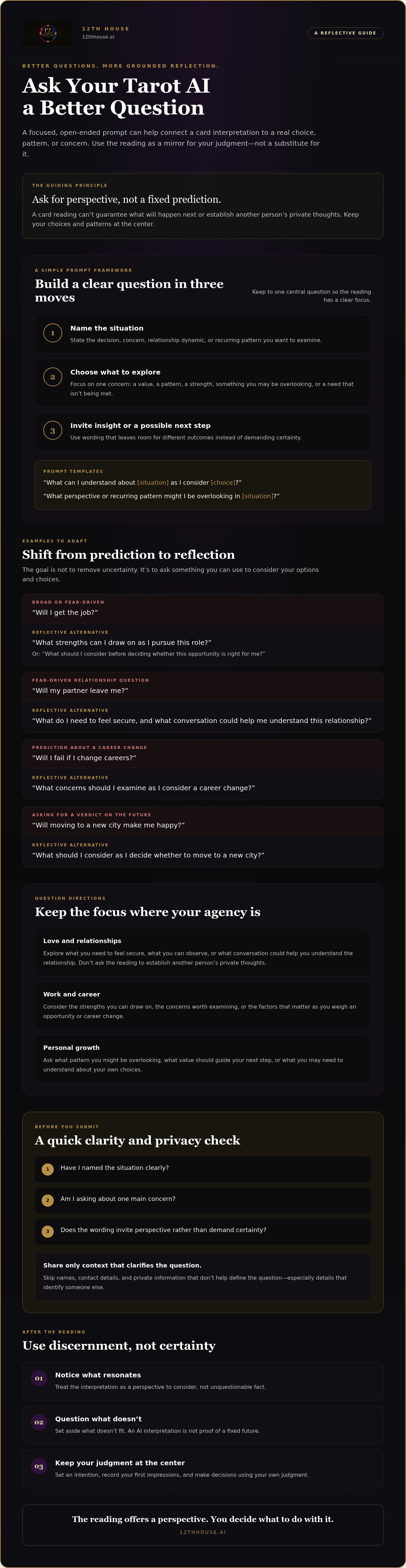
A yes-or-no prompt can feel appealing when uncertainty is uncomfortable. But “Will I get the job?” leaves little room for context, nuance, or next steps. If you want reflection, reshape it: “What strengths can I draw on as I pursue this role?” or “What should I consider before deciding whether this opportunity is right for me?”
Be cautious with questions that ask an AI to guarantee another person’s private thoughts or future actions, such as “Does my ex still love me?” No interpretation can establish what someone else thinks. Shift the focus to what you can observe and choose:
- Fear-driven: “Will my partner leave me?”
- Reflective: “What do I need to feel secure, and what conversation could help me understand this relationship?”
- Fear-driven: “Will I fail if I change careers?”
- Reflective: “What concerns should I examine as I consider a career change?”
The best questions to ask your tarot AI don’t hand your judgment over to a prediction. They create a structured space to examine what matters, identify options, and make your own decision.
How to Write a Clear Question for Your Tarot AI
A focused prompt gives a reading a clear frame. Build yours in three moves: name the situation, identify what you want to explore, then ask for insight or a possible next step. Keep to one central question at a time. If you combine several concerns, the response may be harder to interpret because it has no single point of focus.
A simple prompt framework for a more focused reading
Use a template as a starting structure, not a script. Adjust the wording until it reflects the concern you actually want to examine:
- Situation and choice: “What can I understand about [situation] as I consider [choice]?”
- Perspective and pattern: “What perspective or recurring pattern might I be overlooking in [situation]?”
For example, change “Will moving to a new city make me happy?” to “What should I consider as I decide whether to move to a new city?” The first asks for a verdict on an uncertain future. The revised version names the decision and invites you to examine relevant factors without assuming there’s only one outcome.
How much context should you include?
Give enough context to make the focus unmistakable. Mention the decision you’re weighing, the relationship dynamic you want to understand, or a pattern you’ve noticed. Skip names, contact details, and private information that don’t help define the question, especially details that identify someone else. Concision protects privacy and keeps the central inquiry visible.
Before submitting a prompt, check it against three questions:
- Have I named the situation clearly?
- Am I asking about one main concern?
- Does the wording invite perspective rather than demand certainty?
If a prompt feels tangled, write down the concern in plain language first. Then remove background that doesn’t change what you’re asking. This can help separate the core issue from the anxiety around it. Keep your own interpretation active, too: Duke University’s Center for Teaching and Learning discusses how overreliance on AI can erode critical thinking skills. Treat an AI response as material to consider, not a conclusion to accept automatically.
This framework can also help you explore spiritual questions in 12th House’s digital guidance space. A well-shaped prompt doesn’t control what a reading means. It gives you a clearer structure for reflecting on the response.
Questions to Ask Your Tarot AI About Love, Work, and Personal Growth
Once your prompt has a clear focus, adapt it to the area of life you want to examine. The strongest questions to ask your tarot AI center your choices, needs, and recurring patterns. Use these examples as starting points, not formulas that promise a particular card or outcome.
Relationship and connection prompts
Relationship questions can explore how you communicate, what you need, and where a boundary may help. Rather than asking an AI to reveal another person’s private thoughts or prove what they’ll do, turn the inquiry toward what you can understand and choose.
- What do I need to express more clearly in this relationship?
- What recurring dynamic should I pay attention to in my connections?
- What boundary could help me feel more grounded in this situation?
- What can I learn about my needs as I consider whether to deepen this connection?
- Instead of “What do they feel about me?”, ask “What can I observe about this connection, and what would help me decide how to engage?”
These prompts don’t establish someone else’s intentions, fidelity, or future behavior. They can help you reflect on your experience, the evidence you have, and the conversation or choice that may be yours to make.
Career, decisions, and personal-growth prompts
For work, use a reading to map priorities and possibilities, not to outsource a decision. Ask what matters in the choice and what you could explore next. For personal growth, focus on strengths, habits, and areas that may need attention.
- What priorities should guide me as I consider a change in my work?
- What option or resource might I be overlooking in this decision?
- What would help me assess whether I’m ready to take the next step?
- What is one manageable action I can take to explore this possibility?
- What strength can I draw on as I work through this challenge?
- What recurring pattern may be limiting my progress, and what could help me respond differently?
Choose the question that matches your real concern, then adjust its wording to fit your circumstances. A prompt about readiness might become a question about support, timing, or a practical first step. PBS NewsHour examines the growing reliance on chatbots for emotional support, a useful reminder to stay actively involved in your reflection rather than letting an AI answer stand in for your judgment.
How to Evaluate a Tarot AI Answer Without Treating It as Certainty
An AI tarot response isn’t evidence of a fixed future. Treat it as material for reflection: it may help you explore card symbolism, organize your thoughts, or generate a new question, but it can’t verify fate, diagnose a condition, or know another person’s private thoughts. You can find meaning in your own reflection without treating an interpretation as objectively proven fact.
Tarot symbolism isn’t a single, fixed code. An interpretation may shift with the deck, spread, question, context, and approach used to read the cards. If a response doesn’t match your situation, that doesn’t mean you’ve missed a hidden truth. It may be a prompt to reconsider the framing, seek more context, or set the interpretation aside.
A quick checklist for reviewing the response
Pause before acting on a reading. Use this checklist to examine its relevance and limits:
- Relevance: Does the interpretation address the question you asked, or drift into a different issue?
- Assumptions: Does it introduce claims about your motives, another person, or future events that the prompt doesn’t support?
- Certainty: Does it present an uncertain possibility as a guaranteed outcome?
- Response: What resonates emotionally, and what feels imposed, confusing, or disconnected?
- Usefulness: Does it suggest a perspective worth considering while leaving room for real-world information and your own judgment?
A strong emotional reaction is worth noticing, but it isn’t proof that a reading is accurate. Ask what the response brings up for you, then compare it with what you know from experience. For decisions with practical consequences, use relevant facts and trusted sources alongside reflection. Don’t rely on a divination response as a substitute for professional medical, legal, or therapeutic advice.
If the answer feels vague, ask for a specific theme to be explained in relation to your original question. If it sounds overly certain, try: “What are some possible ways to interpret this, rather than a guaranteed outcome?” If it misses the point, restate the situation and ask one focused follow-up. The best questions to ask your tarot AI support inquiry, not dependence on a verdict.
Bring that discernment to your own spiritual exploration. Ask Lala AI Spiritual Guidance is part of 12th House’s digital guidance platform. Treat any response as a perspective to consider, and keep your judgment at the center.
Build a Tarot AI Practice That Keeps Your Judgment at the Center
A useful reading doesn’t end when the response appears. Give the process a clear beginning, middle, and close: set an intention, ask one question, reflect on the interpretation, then make your own decision. This keeps the reading in its proper role, as a prompt for inquiry rather than an authority over your life.
A grounded routine for using tarot AI
Before you begin, write down what you want to understand. Keep the purpose simple, such as examining a choice, noticing a pattern, or considering what support you need. Record your exact prompt and jot down your own first impressions or expectations before reading the AI’s response. This gives you a reference point for your thinking instead of letting the generated interpretation define the whole experience.
Next, consider the response alongside card symbolism and your real circumstances. Ask what feels relevant, what seems assumed, and what information you would need to verify outside the reading. If an idea resonates, turn it into a practical reflection or a small, low-risk next step. For example, a reading that raises the theme of communication might lead you to clarify what you want to say, not assume how another person will react.
Close by writing what you’ve decided for yourself. Note what you’ll explore, what you’re setting aside, or what needs more thought. Revisiting your notes later can help you distinguish an insight that remained useful from a response that only felt compelling in the moment.
Where 12th House fits into a wider spiritual practice
The questions to ask your tarot AI are one part of a broader practice of reflection. 12th House is a digital platform offering tarot readings and spiritual guidance tools. Lala is its AI assistant for personalized spiritual guidance. Keep your own interpretation and judgment active as you explore any digital resource. No tool can make a personal decision on your behalf.
For a structured digital space to support your exploration, learn about 12th House. Bring a clear question, take time with what the response brings up, and choose independently what belongs in your next step.
Carry Your Questions Into a More Grounded Practice
The most useful questions to ask your tarot AI give a reading a clear focus without demanding certainty. Name the situation, ask about your choices or patterns, and center the prompt on what you can reflect on. Then review the response carefully: notice what resonates, question unsupported assumptions, and let real-world information guide decisions.
A simple practice can help you stay engaged: record your question and first impressions, consider the interpretation, then decide independently what to take forward. Tarot AI can offer a perspective, but your judgment gives that perspective its place in your life.
12th House brings tarot readings together with a broader digital metaphysical platform that includes Lala, an AI spiritual guidance assistant. To explore its spiritual guidance tools, visit 12th House. Bring your curiosity, keep your discernment, and choose your next step for yourself.
Frequently Asked Questions
What questions should I ask my tarot AI?
Ask open-ended questions about a situation, choice, pattern, or perspective you want to examine. For example: “What should I consider before making this decision?” or “What dynamic deserves my attention in this situation?” The best questions to ask your tarot AI stay focused, include only relevant context, and leave room for more than one possibility. Treat the interpretation as material for reflection, not a certain prediction.
Can a tarot AI predict my future accurately?
A tarot AI can generate an interpretation based on your prompt and the system’s approach, but that interpretation doesn’t prove what will happen. Use a reading to explore possibilities, feelings, and choices rather than establish a fixed future. For important decisions, consider real-world evidence and your circumstances, and seek guidance from appropriate trusted people. Your judgment remains essential, especially when a choice has significant consequences.
How do I ask a tarot AI about a relationship?
Center your question on your own experience, needs, communication, or boundaries. Instead of asking what someone secretly thinks, try: “What do I need to understand about this relationship dynamic?” or “What conversation could help me gain clarity?” This keeps the reading grounded in what you can reflect on or choose. An AI interpretation isn’t evidence of another person’s intentions, fidelity, or future behavior.
Is it better to ask a tarot AI yes-or-no questions?
Yes-or-no questions are concise, but they can leave little room for context or useful reflection. If you want to explore a decision, ask what factors deserve consideration, what options you may be overlooking, or how you might approach the situation. For example, replace “Will I get the job?” with “What should I consider as I prepare for this opportunity?” A clear prompt can still be open-ended.
What should I do if a tarot AI gives a vague answer?
Refine the prompt instead of repeating the same broad question. Name the situation more clearly, choose one aspect to explore, and ask for a perspective or practical reflection. Then check whether the response addresses your concern or relies on assumptions. If it still feels vague or disconnected, set it aside. You don’t need to force an interpretation to fit your circumstances.
Can I ask a tarot AI about health, money, or legal decisions?
You can use a reading to reflect on your feelings, concerns, or priorities around a high-stakes decision, but it isn’t professional advice or a substitute for qualified support. You might ask what information you still need or what concerns you want to clarify. For medical, financial, or legal decisions, rely on relevant evidence and appropriate professionals. Don’t use a reading to diagnose a condition or determine a legal or financial outcome.
How often should I ask a tarot AI the same question?
Revisiting a question can make sense when new information or a meaningful change in circumstances gives you a fresh perspective. Otherwise, repeating it until you receive a preferred answer may cloud your reflection. Take time to consider the first response, record your own thoughts, and decide whether any practical step feels appropriate. You can leave the question open without seeking a definitive answer from another reading.


