

What if the most useful tarot reading isn’t the one that tells you what will happen, but the one that helps you see your question more clearly? Generic card meanings can feel distant when you’re facing a specific choice, relationship, or transition. A personalized tarot interpretation connects symbolism to your question and circumstances, while leaving room for your own judgment.
That distinction matters. A confident-sounding reading isn’t automatically a thoughtful one. Context, clear reasoning, and respect for your agency matter more than certainty.
In this guide, you’ll learn what information can make a reading feel personal, how the question and card symbolism work together, and how to compare reading formats using practical criteria. You’ll also find a way to turn a reading into grounded reflection rather than treating it as a fixed prediction. The cards offer a symbolic framework. Your lived experience helps give that framework meaning.
Key Takeaways
- A card’s conventional symbolism is a starting point. Your question and context shape a personalized tarot interpretation.
- Compare reading options by how clearly they explain symbolism, address your question, and respect privacy and reader agency.
- Use a simple reflection practice to note which symbols resonate, record your response, and revisit it with fresh perspective.
- Keep symbolic insight distinct from verifiable facts, personal values, and decisions that call for expert advice.
- Explore tarot readings, Ask Lala AI Spiritual Guidance, and Metaphysical Library Access through 12th House as separate resources for spiritual exploration.
What Is a Personalized Tarot Interpretation, and What Makes It Different?
A card’s conventional symbolism gives you a starting point. Its meaning within a reading depends on the question, the surrounding cards, and the reader’s context. A personalized tarot interpretation connects these elements without claiming that a symbol has one fixed meaning for everyone.
Tarot can offer a structured prompt for reflection, not a guaranteed prediction or substitute for professional advice. Its usefulness depends on how clearly the question is framed, how transparently the symbolism is explained, and whether you retain the judgment to decide what resonates. For a broader overview of the practice and its history, see Tarot card reading.
How Does Personal Context Change a Tarot Card’s Meaning?
Imagery and established associations provide material for interpretation, not a complete answer. The question helps determine which parts of that material deserve attention. A card associated with effort, for example, may prompt different reflections when someone is considering a career change than when they’re thinking about a creative project.
Hypothetical example: Someone asking whether to pursue a new role draws a card associated with learning and focused work. An interpretation might invite them to consider which skills the role would require, rather than declare that they should accept it. That’s one possible reading, not a universal meaning. Personal context guides the inquiry; it doesn’t turn symbolism into proof.
Personalized Reading Versus a Generic Card Definition
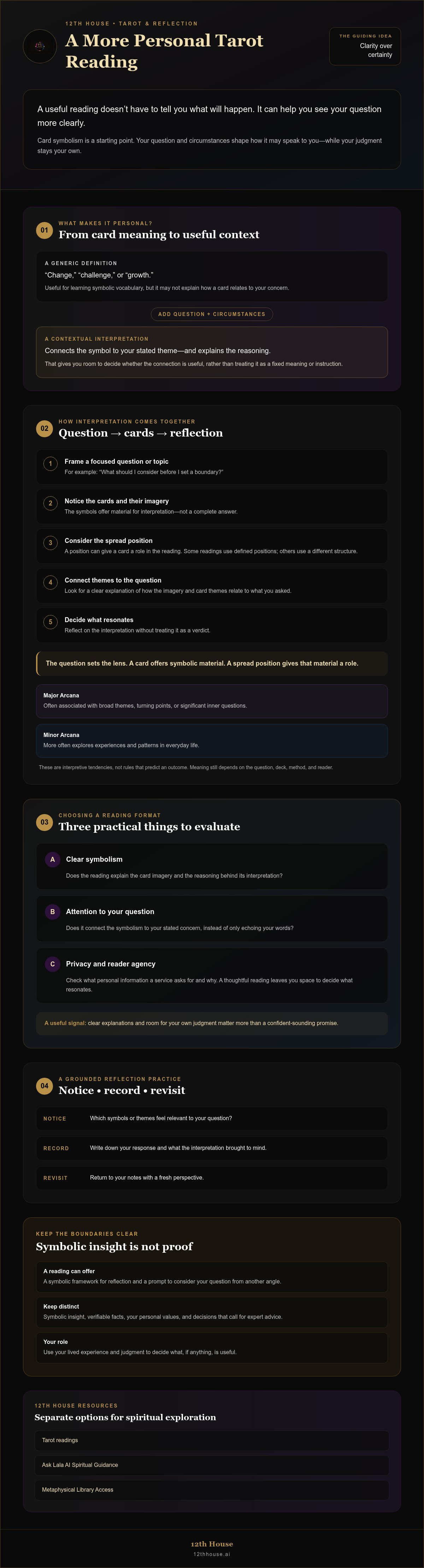
A standalone keyword list might describe a card as “change,” “challenge,” or “growth.” Those associations can help you learn the symbolic vocabulary, but they don’t explain how a card relates to your concern. A contextual interpretation connects the symbol to a stated theme and explains the reasoning, so you can judge whether the connection is useful.
Personalization should add perspective, not merely echo your wording. If you ask about a difficult decision, simply repeating that you feel uncertain adds little. A considered interpretation might use the card’s imagery to surface a relevant tension, then leave you space to test that idea against your own experience. For foundational concepts that can help you follow this process, explore Tarot Mastery: a professional guide to spiritual clarity.
Different traditions and readers may interpret the same card in different ways. Look for clear explanations rather than certainty. A reading is a symbolic lens, not an instruction. Your circumstances, values, and informed decisions remain your own.
How a Personalized Tarot Interpretation Connects Cards, Questions, and Context
A reading can be understood as a sequence of interpretive choices, though readers and traditions may arrange them differently. One illustrative approach is to:
- Frame a focused question or topic.
- Identify the cards drawn and notice their imagery.
- Consider what each spread position is meant to represent.
- Connect card themes to one another and to the question.
- Reflect on what feels relevant, without treating the reading as a verdict.
This is one possible framework, not a universal tarot method. Some readings use spreads with defined positions; others use a different structure. Ask how a reading is organized if that affects how you want to engage with it.
A question sets the lens, a card offers symbolic material, and a spread position gives that material a role in the reading.
The Major Arcana and Minor Arcana also offer different symbolic groupings. The Major Arcana is often associated with broad themes, turning points, or significant inner questions. The Minor Arcana more often explores experiences and patterns in everyday life. These are interpretive tendencies, not rules that predict a particular outcome. A card’s role still depends on the question, the deck, the reading method, and the reader’s interpretation.
What Should You Share Before a Personalized Tarot Reading?
Start with the topic you want to explore or an open-ended question, such as, “What should I consider before I set a boundary?” You don’t need to provide intimate details for a question to be meaningful. Before sharing personal information with any service, check what it asks for and why. Don’t assume a platform needs particular details. Review its own instructions and privacy information.
How Do Card Imagery and Spread Positions Work Together?
Imagery can draw attention to a symbol or tension. Traditional associations offer a shared vocabulary. A spread position, if used, adds another layer by indicating how the card is being considered, such as in relation to a challenge or a resource. The Rider-Waite-Smith deck is one familiar reference, not a universal standard. Other decks may use different imagery and emphasis.
For example, if someone is considering a difficult conversation, a card in a position about preparation might prompt reflection on what they want to communicate. It doesn’t prove how the other person will respond. A personalized tarot interpretation is more useful when it explains how the question, imagery, and position connect, so you can decide whether the reading fits your experience.
If you’d like to explore tarot within a digital spiritual-guidance setting, visit 12th House to learn about its tarot readings and other metaphysical resources.
How to Evaluate a Personalized Tarot Interpretation Before Choosing One
A compelling reading should do more than sound intimate. Check how it connects your question to the cards, explains its reasoning, and leaves you room to decide what the interpretation means for you. Use these criteria to compare options, whether you’re considering a digital self-guided tool or an individual provider.
| What to assess | Questions to ask |
|---|---|
| Contextual relevance | Does the reading address the topic you raised, or could the same wording fit almost anyone? |
| Symbolism | Does it explain how card imagery or traditional associations support the interpretation? |
| Transparency | Can you tell what method or structure is being used, and where interpretation involves uncertainty? |
| Privacy | Does the service explain what information it requests and how it handles what you share? |
| Reader agency | Does it offer prompts for reflection, rather than telling you what you must do? |
What Makes a Tarot Reading Feel Specific Rather Than Generic?
Look for a clear bridge between your stated theme and the cards discussed. A useful interpretation explains why a symbol might matter in this context and, where appropriate, acknowledges that another reading is possible. Specificity should make the reasoning clearer, not make the claims more absolute. Flattery or a confident tone alone doesn’t show that a reading is genuinely personal.
Quick check: Choose an interpretation that connects your question to explained symbolism, states its limits, protects your privacy, and leaves decisions in your hands.
Treat guaranteed outcomes, pressure to act urgently, or claims that replace professional advice as warning signs. Tarot can prompt reflection, but it can’t establish facts or take the place of qualified support for health, legal, or financial matters.
Should You Choose an AI Tarot Tool or a Human Reader?
Neither format is inherently better. A digital self-guided tool may suit someone who prefers independent exploration; an individual provider may appeal to someone seeking direct interaction. Compare the actual experience, how the interpretation is explained, what information is requested, and whether the format fits your preferences. 12th House offers an AI spiritual-guidance assistant, Lala, and tarot readings, but it doesn’t offer live human consultations. Check a service’s specific tarot workflow before assuming what it can interpret. For broader context on AI in spiritual tools, read the AI astrology assistant guide.
How to Use Your Tarot Interpretation for Reflection Without Handing Over Your Judgment
A reading can open a line of inquiry. What you do with that insight remains yours to decide. Use this sequence to turn a personalized tarot interpretation into grounded reflection:
- Note the question. Record what you wanted to understand when you sought the reading.
- Identify resonant symbols. Write down the cards, images, or themes that caught your attention.
- Record your reaction. Notice what felt accurate, uncomfortable, surprising, or irrelevant, and why.
- Revisit your notes later. See which ideas still feel useful after your first response has settled.
Journaling can help you distinguish a lasting insight from a momentary reaction. If a theme appears in more than one reading or reflection, treat that repetition as a reason to examine it, not proof that an outcome is destined. Keep the interpretation separate from verifiable facts, your personal values, and the practical options available to you.
Tarot offers reflective prompts, not instructions or guaranteed predictions.
What Questions Can You Ask After a Tarot Reading?
Ask questions that help you examine your response: What feeling did this interpretation bring forward? What assumption might I be making? Which perspective haven’t I considered? If you want to explore further, follow the theme rather than trying to force a yes-or-no answer. You can disagree with an interpretation, set it aside, or keep only the parts that help you think more clearly.
When Should a Tarot Reading Not Guide a Major Decision?
Tarot isn’t a substitute for qualified medical, legal, financial, or mental-health support. For a high-stakes or time-sensitive decision, consult an appropriate professional and use reliable information to assess your options. A reading may help you articulate concerns, but it can’t verify facts or determine what choice is right for you.
Pause if a reading leaves you feeling afraid, pressured to act immediately, or dependent on repeated reassurance. Step away, ground yourself in what you know, and speak with someone you trust or a relevant professional if you need support. Reflection should expand your perspective, not narrow your choices.
If you’d like to explore tarot as one tool for reflection, discover tarot readings and spiritual resources at 12th House.
Explore Personalized Tarot Interpretation with 12th House
Once you know how to assess a reading and use it as a reflection tool, you can decide what kind of setting supports your practice. 12th House brings tarot readings together with other digital spiritual resources. It may suit readers who want to explore metaphysical ideas on one platform while keeping their own judgment at the center.
What Does 12th House Offer for Tarot Exploration?
Tarot readings are among 12th House’s offerings. The platform also includes Lala, an AI spiritual-guidance assistant, and access to a metaphysical library of books, videos, and ritual frameworks. These resources offer different paths for exploration: a tarot reading, guidance through the AI assistant, or learning through library materials.
Lala provides broader spiritual guidance, including responses to personalized questions about charts, spells, and compatibility. Its specific tarot-reading capabilities aren’t established, so don’t assume it interprets particular cards or spreads. Check the current feature descriptions to understand what each resource does.
Membership includes access to the AI assistant and metaphysical library. Confirm tarot access and current membership terms directly with the platform before joining, since offerings and inclusions can change. A thoughtful personalized tarot interpretation depends on the actual reading experience, not simply on the presence of digital tools.
How to Decide Whether a Digital Tarot Experience Fits You
Consider how you prefer to explore. A digital platform may fit if you value self-guided use and want tarot alongside connected learning resources. If you’re looking for live conversation with a human reader, note that 12th House doesn’t offer live human consultations. Choose a format based on the kind of interaction you want, rather than assuming one approach is right for everyone.
Before joining, review the platform’s current descriptions and terms. Check:
- What the tarot reading includes and how its interpretation is presented.
- What information the service requests and its privacy information.
- Which resources are included with membership and what the current terms say.
Clear answers help you judge whether the platform fits your expectations and boundaries. Treat any reading as a prompt for reflection, not a prediction or replacement for informed decisions.
If digital tarot and connected metaphysical learning fit your approach, Explore 12th House and confirm the current membership details before you begin.
Let the Cards Open a More Thoughtful Question
A personalized tarot interpretation connects a card’s symbolism to your question and context without turning that symbolism into certainty. Look for clear reasoning, room for ambiguity, and an interpretation that leaves decisions in your hands. Then record what resonates, separate reflection from fact, and revisit your thoughts with perspective.
If you’d like to continue exploring, 12th House offers tarot readings alongside Lala AI spiritual guidance and a metaphysical library. Review the current feature descriptions and membership details to decide whether the platform fits the way you want to learn and reflect.
Explore 12th House and choose the tools that support your own inquiry. Let curiosity guide the reading, and let your judgment guide what comes next.
Frequently Asked Questions
What is a personalized tarot interpretation?
A personalized tarot interpretation connects a card’s conventional associations to the question, context, and structure of a reading. Instead of offering only keywords such as “change” or “patience,” it explains why a symbol may relate to the theme being explored. That connection is interpretive, not a universal fact. Different readers or traditions may draw different insights, and you decide which ideas, if any, feel useful.
How do I get a more accurate personalized tarot reading?
Make your reading more relevant by asking a clear, focused question and sharing only context that helps frame it. For example, ask what to consider about a career choice rather than demanding a definite outcome. Look for an explanation of how the cards relate to your topic. Tarot can’t verify facts or guarantee accuracy, so compare any insight with evidence, your values, and your own judgment.
Can a tarot reading answer a specific question?
Yes, a tarot reading can explore a specific question, but it can’t establish a certain answer or prove what will happen. An open-ended question often leaves more room to examine choices, assumptions, or feelings. For instance, “What should I consider before changing roles?” invites reflection, while “Will I get the job?” asks for a certainty the cards can’t reliably provide. Treat the interpretation as perspective, not evidence.
Is an AI tarot interpretation genuinely personalized?
It depends on how the tool uses the question or context it receives and whether it explains its reasoning. Tailored wording alone doesn’t prove that an interpretation meaningfully reflects your situation. Check what information a service uses, how it handles your privacy, and whether it explains the symbolism and limits of its response. 12th House offers tarot readings and Lala AI spiritual guidance, but Lala’s tarot-specific capabilities aren’t established.
What should I ask during a personalized tarot reading?
Ask questions that help you reflect on a situation rather than force a particular answer. You might ask, “What perspective could help me understand this conflict?” or “What should I consider before making this change?” Afterward, notice which symbols or ideas resonate and why. You can question, disagree with, or set aside an interpretation. A reading should support your thinking, not make a decision for you.
Can tarot predict the future with certainty?
No. Tarot can’t guarantee a future event or replace reliable evidence. A reading may help you consider patterns, concerns, or possible perspectives, but circumstances and decisions can change. Be cautious of anyone who promises a certain outcome, creates fear, or pressures you to act urgently. For high-stakes or time-sensitive medical, legal, financial, or mental-health concerns, seek guidance from a qualified professional.
Should I choose an AI tarot reading or a human tarot reader?
Choose the format that fits your preferences for interaction, privacy, and self-guided exploration. A digital tool may suit independent reflection; an individual reader may offer direct human interaction. In either case, assess how the interpretation is explained and whether it respects your judgment. 12th House offers tarot readings and AI spiritual guidance, but not live human consultations. Check current feature descriptions before assuming an AI assistant interprets tarot cards or spreads.


