

What if an astrology reading felt less like a prediction and more like a map of questions worth asking? Generic horoscopes can feel disconnected from your circumstances, while chart terms can make even a personal reading hard to follow. Personalized astrology insights become more relevant when you consider your birth-chart placements alongside current transits and the question that brought you to the chart.
The symbols don’t dictate what will happen. They offer a framework for reflection, one you can examine with curiosity rather than accept as certainty. A placement may describe a recurring theme; a transit may bring that theme into focus; your lived experience helps you decide what, if anything, resonates.
In this article, you’ll learn how these chart factors work together, how to make sense of common interpretation language, and how to assess a reading with discernment. You’ll also find ways to turn symbolic themes into practical questions for reflection, so astrology can support your own judgment instead of replacing it.
Key Takeaways
- Learn how planets, signs, houses, and aspects form a chart’s symbolic framework without getting lost in jargon.
- See how birth-chart placements and current transits contribute different layers of context to personalized astrology insights.
- Compare what broad horoscopes can offer with the more individualized perspective of a chart-based reading.
- Use a four-step reflection practice to connect a question with relevant chart factors and real-life circumstances.
- Keep questions, chart notes, and reflections organized so you can revisit themes as your perspective evolves.
What Are Personalized Astrology Insights, and What Makes Them Personal?
Personalized astrology insights are interpretations that connect an individual’s birth-chart details with a specific question or area of reflection. Rather than reading a symbol in isolation, they consider how chart placements relate to one another and to the concern someone brings to the reading.
That context is the difference between a broad forecast and an individualized interpretation. A sun-sign horoscope speaks to people who share a Sun sign, offering accessible themes that may prompt reflection. A chart-based reading considers more of the natal chart and the question being explored. Neither format can guarantee that a message will feel relevant or profound. The value depends on the interpretation and on how thoughtfully you compare it with your circumstances.
Astrology offers a symbolic framework, not an established scientific method for proving what will happen or why. Its history and core concepts sit within a scholarly tradition of astrology, but a symbolic reading is best treated as a lens for inquiry, not a factual verdict. Ask what a theme helps you notice, and keep your lived experience in view.
How Is a Personalized Reading Different from a Daily Horoscope?
A daily horoscope usually addresses a broad audience through a sign-based lens. A personalized interpretation can use birth details to map individual placements and patterns, then relate them to a reader’s question. For example, someone asking why work feels unsettled might use a chart reading to explore relevant symbolism, then consider practical circumstances such as changing responsibilities. The chart adds context; it doesn’t automatically make the interpretation accurate.
Which Birth Details Shape an Astrology Interpretation?
Birth date, birth time, and birthplace are used to calculate a natal chart. The date helps locate planetary placements, while time and location help establish time- and place-sensitive chart details, such as the Ascendant and houses. If the birth time is uncertain, those details may be less reliable or unavailable for interpretation. Be clear about what’s known rather than treating an incomplete chart as exact.
Think of the natal chart as a symbolic map of the sky at birth, not a fixed verdict about personality or destiny. It can provide a structure for exploring themes, but it doesn’t define the limits of your choices. A focused question helps you use that structure with discernment: what does the chart suggest, what do your circumstances show, and what interpretation feels worth examining further?
How Birth Charts and Transits Build a More Contextual Astrology Insight
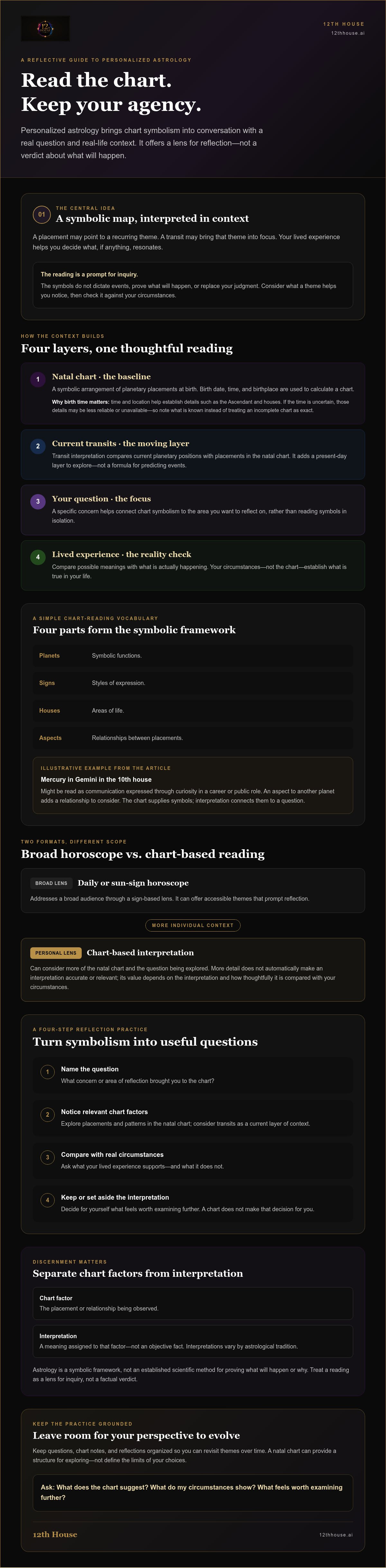
A natal chart provides the baseline: a symbolic arrangement of planetary placements at birth. Transits add a moving layer by comparing current planetary positions with that natal pattern. Together, they offer a framework for asking how a present theme might relate to enduring chart symbolism, not a formula for predicting events.
For context, the University of Cambridge describes the historical use of astrological charts, including the calculation of birth charts to consider character and fortune. Modern interpretations also vary by astrological tradition. The chart factor is the placement or relationship being observed; the meaning assigned to it is an interpretation, not an objective fact.
What Do Planets, Signs, Houses, and Aspects Contribute?
Think of planets as symbolic functions, signs as styles of expression, houses as areas of life, and aspects as relationships between placements. Here’s an illustrative example, not a client case: Mercury in Gemini in the 10th house might be read as communication expressed through curiosity in a career or public role. An aspect to another planet would add a relationship to consider. The chart lists the symbols; interpretation connects them to a question.
That distinction matters. A reader asking about communication at work might use the example to reflect on how they share ideas or handle competing priorities. The symbols don’t establish what’s happening in their workplace. Their actual circumstances do.
How Do Transits Relate to a Natal Chart?
Transit interpretation compares current planetary positions with placements in the natal chart. Imagine Saturn forming an aspect to the example’s natal Mercury. An astrologer might explore themes such as structure, responsibility, or careful communication, while the reader checks those ideas against their current work situation. Someone else experiencing a similar transit may have different natal placements or a different house emphasis, so the interpretation can differ.
Transits add timing context to a symbolic reading, but they don’t guarantee that a particular event will occur. Timing techniques and interpretive conventions vary, so treat any reading as one framework for reflection. Ask what’s observable in your life, what the symbolism suggests, and where the two do or don’t align.
To explore this method with a question of your own, you can review astrology birth-chart and transit analysis as a tool for self-guided inquiry. Keep the interpretation open to examination; your choices and circumstances remain central.
Personalized Astrology vs. Generic Horoscopes: What Can Each Tell You?
A general horoscope and a chart-based interpretation serve different purposes. One offers a shared point of entry; the other may bring more individual chart symbolism into view. Neither format can establish what will happen, and the word “personalized” doesn’t make an interpretation objectively proven or uniquely predictive. Use each as a prompt for reflection, not a substitute for your judgment.
| Feature | General horoscope | Personalized chart reading |
|---|---|---|
| Audience | People grouped by a sign or other broad category | One person, often guided by a specific question |
| Chart detail | Usually focuses on a sign-based theme | May consider more of an individual’s chart placements and patterns |
| Context | Broad themes with limited personal context | Can connect chart symbolism with a question or current circumstances |
| Suitable use | A quick reflection prompt or entertainment | Exploring a question through an individual symbolic framework |
When Is a General Horoscope Useful?
General horoscopes can make astrology approachable. A theme about patience, communication, or change might give you a simple idea to consider during the day. Their broad scope is a feature, not automatically a flaw: they can be enjoyable or reflective without accounting for every placement in your natal chart. Read them as possibilities to think about, not messages that must fit.
How Can You Assess a Personalized Interpretation?
Personalized astrology insights are more useful to assess when you can follow the reasoning behind them. Ask which chart factors inform the interpretation and how those factors connect to your question. A considered reading should leave room for uncertainty, differences between astrological traditions, and your own circumstances.
Use these checks as you read:
- Specificity: Does the interpretation name relevant chart factors, or could the same statement apply to almost anyone?
- Reasoning: Can you see how the reader moves from a symbol to a possible theme?
- Openness: Does the interpretation acknowledge ambiguity or other plausible readings?
- Agency: Are you invited to reflect, rather than told to obey a prediction?
Pause if a reading relies on sweeping certainty, fear, or pressure to act immediately. A symbolic interpretation can suggest a question worth exploring, but it can’t verify a claim about your future. Compare its themes with observable circumstances, keep what helps you think clearly, and set aside what doesn’t.
How to Use Astrology Insights for Reflection Without Handing Over Your Agency
A chart can open a line of inquiry. It shouldn’t make a decision for you. Use personalized astrology insights as prompts for journaling and perspective-taking, then compare symbolic ideas with what you can observe in your life. A reading is not an instruction, diagnosis, or substitute for practical advice when a decision has serious consequences.
Try this four-step process:
- Name a question. Make it open-ended, such as “What pattern do I notice in how I handle conflict?”
- Identify the chart factors. Note which placements or transit themes the interpretation refers to, rather than relying on a broad conclusion alone.
- Consider your context. Separate observable circumstances, such as a recent disagreement, from symbolic language about relationships or communication.
- Reflect before acting. Record what resonates, what doesn’t, and what further information you need. Let your own judgment guide any next step.
What Questions Make an Astrology Reading More Useful?
Questions work best when they explore patterns, priorities, or timing concerns without asking astrology to decide a high-stakes choice. Instead of “Should I end this relationship?” consider “What do I want to understand about how we communicate?” For relationship questions, a birth chart compatibility guide can offer a framework for exploring chart symbolism. The question focuses attention; it doesn’t predetermine the answer or replace direct conversation.
How Can You Turn an Insight into a Grounded Reflection?
Keep a simple record with three parts: the interpretation, your immediate response, and the real-world context. For example, note a reading’s suggestion to examine boundaries, whether that idea feels relevant, and what specific interaction brought it to mind. This makes it easier to distinguish an observable event from the meaning you’re considering.
Return to your notes as circumstances change. A single interpretation isn’t a final answer, and a theme that feels relevant now may look different later. If you’re curious about guided, question-led exploration, read this overview of an AI astrology assistant. You can also explore AI spiritual guidance as an optional tool for investigating chart questions while keeping your own discernment at the center.
Build an Ongoing Astrology Practice with Questions, Context, and Reliable Tools
An astrology practice gains depth through continuity. Keep your birth details, chart notes, questions, and reflections together so you can compare interpretations over time instead of treating each reading as a separate verdict. Record what you were exploring, which chart factors were discussed, and what was happening in your life. Later, you can revisit the notes and see whether a theme still feels useful or needs a different interpretation.
What Should You Look for in an Astrology Learning Tool?
Choose tools that make their material understandable. Chart information should be presented clearly, and an interpretation should show how its themes relate to the chart rather than relying on vague statements. Look for tools that support learning and questions, not promises of guaranteed outcomes. Before sharing personal birth details, review the service’s data practices and check what its features actually do. Don’t assume privacy protections or capabilities that aren’t stated.
A tool can organize chart information and make symbolic language easier to explore. It can’t settle which interpretation is right for you. Keep your judgment in the process: compare an interpretation with your circumstances, note where it feels uncertain, and decide what deserves further thought.
How Can AI Support Personalized Astrology Exploration?
Lala is 12th House’s AI assistant for personalized questions, including questions about charts. You might use it to clarify a chart theme or explore how a symbol relates to a question you’re considering. Treat the response as material to examine, not unquestionable authority. AI guidance is not a human consultation, and it doesn’t turn astrological symbolism into a guaranteed prediction. For a closer look at this kind of guided exploration, read the AI astrology guide.
12th House offers astrology birth-chart and transit analysis, Lala, and a metaphysical library. These can support continued self-guided exploration as your questions and circumstances evolve. Used thoughtfully, tools can help you return to personalized astrology insights with better records and sharper questions, while leaving interpretation and choice in your hands.
If you’d like to explore these resources, Explore 12th House.
Keep Your Chart in Conversation with Your Life
A useful astrology practice begins with a clear question and stays grounded in real circumstances. Birth-chart placements offer a symbolic baseline, while transits add timing context; neither guarantees a particular outcome. The most meaningful personalized astrology insights leave room for reflection, uncertainty, and your own judgment.
Keep notes as your questions evolve. Revisit interpretations against what’s happening in your life, and treat chart themes as prompts to explore rather than instructions to follow. This approach lets you engage with astrology thoughtfully while keeping your choices in your hands.
For continued self-guided exploration, 12th House offers astrology birth-chart and transit analysis, Lala for personalized questions about charts, and a metaphysical library for learning. Explore a more structured way to work with your astrology chart. Take what helps you reflect, stay curious about what you don’t yet know, and let your next question be your own.
Frequently Asked Questions
What are personalized astrology insights?
Personalized astrology insights are interpretations that connect an individual’s birth-chart placements with a specific question or area of reflection. Rather than relying on a Sun sign alone, they may consider how planets, signs, houses, and aspects relate within the chart. The interpretation offers a symbolic perspective, not a proven account of personality or destiny. Its usefulness depends on clear reasoning and how thoughtfully you compare it with your circumstances.
How is a personalized astrology reading different from a horoscope?
A horoscope usually speaks to a broad group, often through a Sun sign, and offers general themes that can serve as reflection prompts or entertainment. A personalized reading may use birth-chart details and a reader’s question to explore individual placements and patterns. That added context can make the interpretation more specific, but it doesn’t guarantee accuracy or relevance. Both formats are best approached with curiosity and room for your own judgment.
What information do I need for a personalized birth chart?
A birth chart is generally calculated using your birth date, birth time, and birthplace. The time and location help establish time-sensitive chart details, including the Ascendant and houses. If your birth time is unknown or uncertain, those parts of the interpretation may be limited or less precise. Avoid treating an estimated time as exact, and check what information a chart tool requires before entering your details.
Can astrology insights predict what will happen?
Astrology insights can’t guarantee that a specific event will occur. Transits and other chart factors are interpreted symbolically, so a reading may suggest themes to reflect on, not confirm future outcomes. Use it to consider questions such as what feels important or what patterns you’re noticing. For consequential choices, weigh observable facts, practical options, and trusted sources of advice rather than relying on an astrological interpretation alone.
How do transits affect a personalized astrology reading?
Transits describe current planetary positions interpreted in relation to placements in a natal chart. They add a timing layer to the reading, which astrologers may use to explore why certain themes feel relevant at a particular moment. The same transit can be interpreted differently across charts because natal placements and chart patterns vary. Transit symbolism doesn’t establish that an event will happen, so compare any interpretation with your actual circumstances.
Are personalized astrology readings accurate?
Astrological interpretations aren’t established scientific findings, so “accurate” depends on what you mean. You can check whether the birth details are correct, whether the reading identifies its chart factors, and whether its reasoning is understandable. Then consider whether the interpretation offers a useful perspective without making sweeping claims. A statement feeling relatable doesn’t prove it’s objectively true. Keep what supports reflection, and question certainty, fear, or pressure to act.
Can AI provide personalized astrology insights?
AI can help explain chart themes and respond to personal questions, but its answers should be treated as material to examine, not unquestionable authority. At 12th House, Lala is an AI assistant that answers personalized questions about charts, among other topics. It isn’t a human consultation, and an AI response can’t guarantee a prediction or replace your judgment. Check the reasoning, compare it with your lived context, and decide what deserves further reflection.


