

What if the most useful meaning of a dream isn’t hidden in a symbol dictionary, but in details only you can recognize? A falling dream may suggest loss of control to one person and relief to another. That’s why personalized dream analysis starts with your emotions, memories, and waking-life context, not a fixed translation.
If generic definitions don’t fit, or different interpretations leave you more confused, your hesitation makes sense. Dream symbols can invite reflection, but they aren’t reliable predictions or universal answers. Your own associations matter.
This guide offers a grounded process for exploring what a dream might bring into focus. You’ll learn which details to record, how to treat interpretations as hypotheses, and how to compare self-guided reflection, human-led dreamwork, and digital tools. You’ll also learn how to notice recurring themes without turning them into forecasts. Whether you reflect privately in a journal or use a digital Dream Interpretation Tool as a prompt, the aim is the same: build a thoughtful reading that leaves room for your own judgment.
Key Takeaways
- Use personalized dream analysis to develop possible meanings from your own context, not to diagnose, predict, or apply fixed symbol definitions.
- Notice how a dream’s emotional tone, recent experiences, recurring imagery, and personal associations shape the questions you ask.
- Compare journaling, human guidance, and digital interpretation by considering their approach, transparency, reflection prompts, accessibility, and privacy information.
- Follow a repeatable reflection process: record the dream, name the emotions, explore your associations, and consider waking-life context before drawing conclusions.
- Consider 12th House’s Dream Interpretation Tool as one possible aid for reflection, and review its available features before deciding whether it suits your practice.
What Is Personalized Dream Analysis: What Can It Actually Tell You?
Personalized dream analysis is a reflective process for exploring how a dream’s images and events may connect with the dreamer’s emotions, memories, and current circumstances. Rather than assigning one fixed meaning to a symbol, it uses personal context to develop possible interpretations and consider whether they resonate.
This approach can help you notice themes or questions worth reflecting on. It can’t establish what a dream “really” means, diagnose a health condition, or reliably predict what will happen. Dream interpretation has a long history, with ideas shaped by different cultural, spiritual, and psychological traditions, as outlined in this overview of the history of dream interpretation. No single method gives every dream a universally accepted explanation.
Dream interpretations are possibilities to explore, not proven facts about your inner life or future. Hold each reading lightly. A useful interpretation should open thoughtful questions, not pressure you to accept a conclusion that doesn’t fit.
How Is Personalized Dream Analysis Different from a Dream Dictionary?
A dream dictionary gives symbols general associations. Personalized dream analysis asks what those images mean to you. A snake might bring up fear, fascination, or a memory of a pet. Even a familiar image such as falling could feel alarming to one person and freeing to another. The image matters, but so do your associations and the dream’s emotional tone.
For example, falling during a stressful period at work might prompt you to consider whether you feel unsupported or out of control. If the fall felt playful, that interpretation may not fit. Context doesn’t prove a meaning. It helps you test whether a possibility is relevant.
Can a Dream Reveal Something About Your Waking Life?
A dream can offer material for reflection, but it isn’t a guaranteed message or forecast. Start with what you felt and what has occupied your attention lately. Ask whether a connection seems plausible, and allow “I’m not sure” to remain a valid answer. Don’t force a symbol to explain a situation or make a decision for you.
If dreams or nightmares cause persistent distress, consider speaking with a qualified mental health professional. Reflective dreamwork can support personal inquiry, but it isn’t a substitute for clinical care or diagnosis.
How Personal Context Shapes a Dream Interpretation
Personalized dream analysis develops possible meanings from the dreamer’s own context, then considers whether those readings feel relevant. It isn’t a formula that turns an image into a definitive answer. Instead, it brings several kinds of information into view: the dream’s emotional tone, recent experiences, recurring imagery, and the dreamer’s personal associations.
Imagine dreaming about a locked door. If you’ve recently faced a difficult decision, it might bring to mind hesitation or a perceived barrier. If the door resembles one from a childhood home, a memory may feel more relevant. Neither reading is automatically correct. Ask what fits the details and what doesn’t. Research on dreaming spans multiple approaches, and the American Psychological Association’s journal on dreaming offers a place to explore scholarly work without treating one interpretation as universal.
A dream’s emotional tone, recent events, recurring images, and personal associations can inform reflection, but they aren’t a validated formula for finding one correct meaning.
Which Details Should You Record After a Dream?
Write down what you remember before the details fade. Keep the record descriptive first and interpretive later. Note the sequence of events, people present, setting, and images that stood out. Add the strongest emotion you felt in the dream and how you felt immediately after waking.
- Dream details: What happened, where, and who was there?
- Emotions: What did you feel during the dream and on waking?
- Waking context: What recent events or concerns may be relevant?
Separate observation from interpretation. “I couldn’t open the door” is an observation; “I’m afraid of change” is one possible reading. A journal lets you revisit entries and notice whether certain settings, feelings, or images recur alongside similar waking-life circumstances. Patterns can suggest questions to explore, but they don’t prove a hidden message.
Why Do the Same Dream Symbols Mean Different Things?
Personal associations don’t always match popular or cultural symbolism. A train might suggest travel to one person, a daily commute to another, or a cherished memory to someone else. Start with your own associations: What does the image remind you of? How did it feel in the dream? What was happening around it?
Freud and Carl Jung offered influential historical perspectives on dreams, but their theories aren’t settled scientific explanations that assign a fixed meaning to every image. Use them as lenses to compare, not authorities that overrule your experience. A digital reflection aid, such as the 12th House Dream Interpretation Tool, is another option to consider alongside journaling. Review the available feature details before deciding whether it fits your practice.
Personalized Dream Analysis Methods: How to Compare Your Options
Choose a method by how well it supports careful reflection, not by how certain or dramatic its interpretation sounds. Self-guided journaling gives you control over the process. Human guidance may offer a conversation and another perspective. Digital tools can provide a structured prompt, but their approach and data practices vary. For background on another spiritual practice, read Tarot Mastery: A Professional Guide to Spiritual Clarity.
| Method | Personalization | Transparency | Reflection prompts | Accessibility | Privacy information |
|---|---|---|---|---|---|
| Self-guided journaling | You decide which personal details to include and how to explore them. | You can see and adjust your own reasoning. | You create questions that feel relevant. | Requires time and a way to keep notes. | Your notes stay under your control; consider where you store them. |
| Human guidance | May account for context shared in conversation; the approach varies by practitioner. | Ask how interpretations are formed and which framework is used. | Can involve follow-up questions; confirm the format beforehand. | Depends on the provider and how guidance is offered. | Ask how sensitive information is handled before sharing. |
| Digital interpretation | Depends on what context the tool invites and how it uses that input. | Check whether its method or limitations are explained. | Prompts vary by tool; review examples or feature details if available. | Depends on the platform, device, and access requirements. | Read the provider’s privacy information before entering personal details. |
What Should You Look for in a Digital Dream Interpretation Tool?
Check whether a tool asks for relevant context or relies mainly on matching symbols to preset meanings. Look for language that frames results as possibilities, not facts. Review the provider’s privacy information before sharing sensitive details, and check what information the tool collects and how it may be used. A feature list alone doesn’t explain how an interpretation is produced.
When Might Journaling or Human Support Be a Better Fit?
Choose journaling if you want to build awareness of themes over time and decide what to explore at your own pace. Human guidance may suit you if you value discussing your reflections with another person. Ask about their approach and boundaries first. If dreams cause ongoing distress or disrupt sleep, seek support from a qualified professional. Digital tools can aid reflection, but they don’t replace clinical care.
12th House offers a Dream Interpretation Tool as one possible resource for personal reflection. Review the available feature details before deciding whether it fits your needs. With any approach to personalized dream analysis, favor clear limits and useful questions over confident-sounding conclusions.
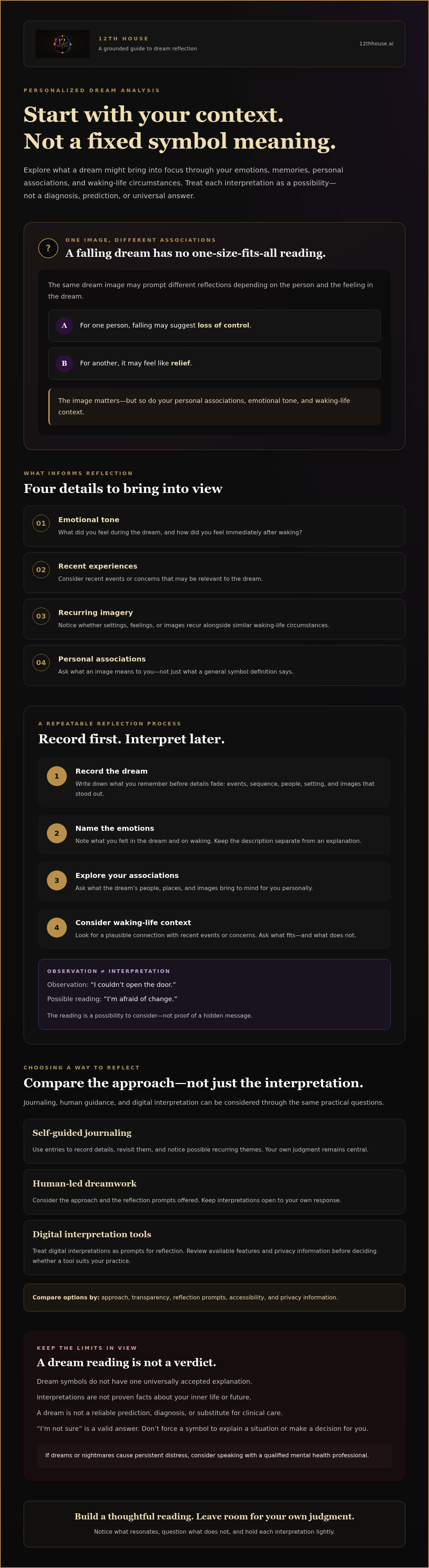
A Grounded Process for Interpreting a Dream Without Overreading It
Use a simple sequence to move from recall to reflection without forcing the dream into a single explanation. The aim isn’t to decode every detail. It’s to develop a few thoughtful possibilities, then decide whether any fit your experience.
How Can You Interpret a Dream in Five Reflective Steps?
- Record the dream. Write down what happened as soon as you can, even if you remember only fragments. Describe events plainly and leave meaning out for now.
- Mark what stood out. Note the strongest emotions, vivid images, and turning points. Was there a moment when the mood shifted?
- Explore personal associations. Ask what each important image brings to mind for you. A missed train, for example, might connect with a real schedule, a recent change, or a sense of being left behind. It may also have no clear association.
- Consider relevant context. Note current concerns or recent experiences that might relate. Treat these as observations, not proof that the dream refers to a particular event.
- Test more than one reading. Write down a couple of plausible interpretations. Ask which details support each one, which don’t, and whether either feels useful without being treated as certain.
Keep your notes and revisit them over time. If similar images or feelings recur, compare them with the circumstances around each dream. A pattern can offer a new question to consider, but it doesn’t establish a fixed message. This measured sequence makes personalized dream analysis a practice of inquiry rather than a search for a definitive answer.
How Can You Avoid Confirmation Bias in Dream Interpretation?
Once an interpretation feels compelling, it’s easy to notice only the details that support it. Pause and ask: What supports this idea? What might point elsewhere? Could another explanation fit just as well? Favor the reading that accounts for the dream’s details and your context, not necessarily the most dramatic one.
Keep uncertainty in the process. A dream shouldn’t be the sole basis for a major relationship, health, or career decision. Use reflection to identify questions you may want to explore, while also weighing waking-life evidence and practical considerations.
If a guided prompt would help you reflect, explore 12th House’s spiritual guidance tools, including its Dream Interpretation Tool. Treat any interpretation as a starting point for your own thinking, and review the available feature details before sharing personal information.
Using 12th House for Personalized Dream Reflection
After comparing journaling, human guidance, and digital interpretation, consider which format supports the kind of reflection you want. A digital tool may suit someone who prefers to explore at their own pace, but its value depends on its actual inputs, approach, and limits. Treat it as one possible aid, not an authority on what a dream must mean.
12th House offers a Dream Interpretation Tool within its digital spiritual guidance platform. Before using it, check what information it asks you to provide and what the tool offers. If you want an interpretation to account for emotions or waking-life context, look for details about whether and how you can include them. Also review any available information about how submitted data is handled.
What Should You Know About the 12th House Dream Interpretation Tool?
12th House offers a Dream Interpretation Tool. Don’t assume it uses a particular interpretive framework, accepts specific types of input, or produces a certain kind of reading unless those features are described. Nor should any digital interpretation be treated as scientifically validated, guaranteed, or definitive based on the tool’s name alone.
For a broader view of the platform’s digital guidance approach, read The Digital Sage: Why an AI Astrology Assistant is Your New Metaphysical Architect. Keep the distinction clear: an AI guidance offering doesn’t establish that dream analysis is supported through that feature. Check the current product details rather than assuming the tools share capabilities.
How Can You Decide Whether a Digital Tool Fits Your Practice?
Think about your preferred rhythm. If you want to reflect independently and use a digital prompt as a starting point, a tool may fit. If you’d rather build your own interpretive habits, journaling remains a simple alternative. If dreams cause persistent distress or disrupt sleep, seek qualified professional support instead of relying on a spiritual or digital tool for care.
As you review an interpretation, ask whether it engages with the details you provided, leaves room for more than one reading, and gives you useful questions to consider. A response that sounds certain isn’t necessarily more insightful. Keep what resonates, question what doesn’t, and avoid treating the result as a prediction or instruction.
Explore 12th House’s spiritual guidance offerings, including its Dream Interpretation Tool, and review the available feature and privacy information before deciding whether it belongs in your reflective practice.
Carry Your Curiosity Into the Next Dream
A useful dream reading doesn’t need to settle every question. Personalized dream analysis is strongest when it begins with your emotions and associations, considers waking-life context, and leaves room for more than one possible meaning. Record what you remember, test your interpretations against the details, and revisit recurring themes without treating them as predictions.
If you’d like a digital prompt for reflection, 12th House offers a Dream Interpretation Tool among its spiritual guidance offerings. Check the tool’s current details, including what information it asks you to provide, before deciding whether it fits your practice. 12th House also offers Ask Lala AI Spiritual Guidance, but check whether dream-specific discussions are supported rather than assuming they are.
Explore 12th House’s spiritual guidance tools and choose an approach that helps you reflect with care. Your dream doesn’t have to deliver a final answer to be worth exploring. Stay curious, keep your own judgment at the center, and let each reflection deepen your understanding at your own pace.
Frequently Asked Questions
What is personalized dream analysis?
Personalized dream analysis explores a dream through the dreamer’s emotions, personal associations, and waking-life context. Instead of assigning a fixed meaning to each symbol, it treats possible interpretations as ideas to examine. It can’t establish one universal meaning, diagnose a condition, or predict the future. Use it as a structured prompt for reflection, then consider whether a reading fits what you remember and your own experience.
Can an AI tool interpret my dreams accurately?
An AI tool can offer possible themes or questions, but its interpretation shouldn’t be treated as objectively accurate or definitive. Its response depends on the information you share and how the tool processes it. Compare suggestions with your own associations, and consider other plausible readings. Before entering personal or sensitive details, check the provider’s privacy information and confirm what the tool asks you to provide and how that information is handled.
How do I analyze a dream myself?
Write down the dream soon after waking, including the sequence of events, memorable images, and emotions. Then note what the details mean to you personally and whether recent experiences seem relevant. Keep observation separate from interpretation: “I missed the train” is a detail; “I’m afraid of change” is one possible reading. Consider alternatives, track recurring patterns, and don’t make a major decision based on one dream alone.
What does it mean if I keep having the same dream?
A recurring dream may offer a theme to reflect on, especially if it brings up a strong emotion or repeats a familiar situation. Record when it happens, what’s going on in your waking life, and whether the dream changes. Repetition doesn’t establish a single meaning or predict an outcome. If recurring dreams cause significant distress or disrupt your sleep, consider speaking with a qualified professional for support.
Are dream symbols universal?
No single interpretation applies to every dreamer, even when an image has familiar cultural associations. A house might bring one person to mind a childhood home, while another associates it with privacy, safety, or a recent move. Start with your own memories and feelings about the image. Cultural symbolism can be another lens to consider, but treat it as a hypothesis rather than a fixed translation.
Is personalized dream analysis a form of therapy?
No. Dream interpretation and reflective practices aren’t substitutes for therapy, diagnosis, or care from a qualified mental health professional. They may help you organize thoughts and consider possible meanings, but they can’t assess or treat a mental health condition. If a dream causes persistent distress, affects daily functioning, or connects with difficult experiences, seek support from a qualified professional rather than relying on a reflection tool alone.
What should I include when using a dream interpretation tool?
If the tool allows, useful details may include the dream’s sequence, vivid images, and how you felt during and after it. Personal associations and relevant waking-life context may also help you reflect. You don’t need to share anything that feels too sensitive. First check the tool’s available features and privacy information, including what it asks you to submit. More detail doesn’t guarantee a definitive or scientifically validated interpretation.


