

What if your palm is better read as a symbolic map than a forecast of what must happen? If unfamiliar terms and conflicting interpretations have made palmistry feel difficult to approach, you’re not alone. A palmistry guide for beginners should offer more than a list of meanings. It should show you how to observe the hand carefully and hold each interpretation with perspective.
In this guide, you’ll learn to recognize the major palm lines and features, then follow a clear sequence for exploring what they may symbolize. Start with what you can see: the shape of the hand, the placement of its lines, and their distinct qualities. From there, consider traditional interpretations as prompts for reflection, not certain predictions about your future. Palmistry isn’t supported as a scientific method of prediction, so keep curiosity and discernment in the same frame.
We’ll build a reading step by step, clarify key terms, and show how to approach differing meanings without forcing one answer. The aim is a grounded practice you can use to explore personal symbolism with care.
Key Takeaways
- Learn what palmistry can offer as a symbolic practice, and where its claims have limits.
- Identify the heart line, head line, life line, and mounts while remembering that traditions interpret them differently.
- Use this palmistry guide for beginners to build a clear reading sequence, starting with visible features before exploring their meanings.
- Compare interpretations thoughtfully instead of treating one source as the final authority.
- Keep palm readings open-ended and reflective, not diagnoses or guarantees.
Palmistry Guide for Beginners: What a Palm Reading Can and Cannot Tell You
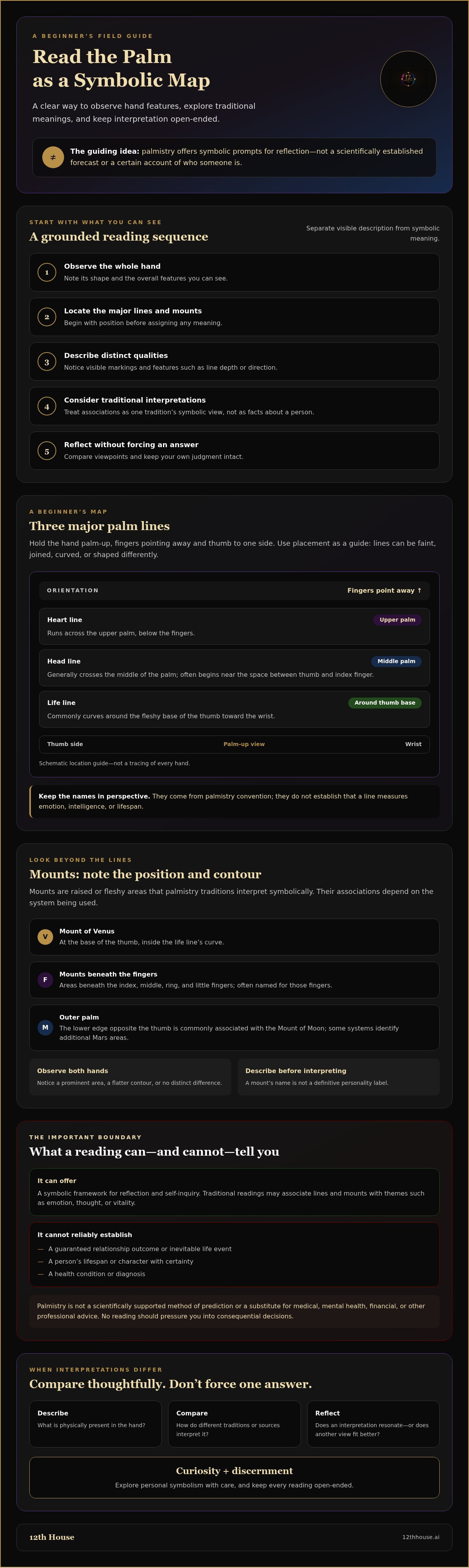
Palmistry, also called chiromancy, is a tradition of interpreting the hand’s shape, lines, mounts, and other visible features as symbolic indicators. It offers a framework for reflection, not a scientifically established way to predict events or determine someone’s character with certainty.
Think of the hand as a map, not a single clue. The major lines form visible pathways across the palm, while mounts are raised areas beneath the fingers and around the thumb. Hand shape, markings, and the lines’ depth or direction can also contribute to a reading. Traditions differ in how they interpret these details, so no single feature should carry the weight of a complete reading. The overview of Palmistry traces some of these cultural variations and discusses the practice’s pseudoscientific status.
For a palmistry guide for beginners, start with observation before interpretation. Note what’s physically present, then consider what a particular tradition associates with it. This sequence helps separate description from symbolic meaning and makes it easier to notice when sources disagree. You don’t need to settle every disagreement. The goal is to explore a symbol thoughtfully.
What is palmistry, and what do beginners examine?
Palmists commonly examine the overall hand, major lines, mounts, and other markings. Begin with the whole palm, then look closer at individual features. A line’s placement or appearance may matter within a tradition, but it doesn’t explain a person on its own. Compare features rather than turning one mark into a complete story.
Can palm lines predict the future?
Palmistry traditions may associate lines and mounts with themes such as emotion, thought, or vitality. Those associations are symbolic interpretations, not reliable, objective predictions. A palm line can’t guarantee a relationship outcome, establish a lifespan, diagnose a health condition, or prove that a life event is inevitable.
Use a reading as a prompt for self-inquiry: What does this symbol bring to mind? Does the interpretation resonate, or does another view fit better? Keep your judgment intact. Palmistry isn’t a substitute for medical, mental health, financial, or other professional advice, and no reading should pressure you into consequential decisions.
The Main Palm Lines and Mounts: A Beginner’s Map
Begin with location, not meaning. The heart line, head line, and life line are the three major lines commonly discussed in palmistry, but their names and interpretations can vary between traditions. Britannica’s overview of palmistry offers historical context for this evolving practice. Treat the lines as features to observe, not proof of a literal function or fixed outcome.
How do beginners locate the heart, head, and life lines?
Hold your hand palm-up with the fingers pointing away from you and the thumb to one side. Use this orientation map to find the common line positions. It’s a guide, not a tracing of every hand. Lines may be faint, joined, curved, or shaped differently.
Schematic palm map, not to scale
Fingers
Heart line: upper transverse line
Head line: lower transverse line
Thumb side Life line: curves around thumb base
Wrist
Heart line: Look across the upper palm, below the fingers. Head line: Find the line that generally crosses the middle of the palm, often beginning near the space between the thumb and index finger. Life line: Trace the curve that commonly arcs around the fleshy base of the thumb toward the wrist. These labels come from palmistry convention. They don’t establish that a line measures emotion, intelligence, or lifespan.
What are the mounts of the palm?
Mounts are the raised or fleshy areas of the palm that palmistry traditions also read symbolically. First note their position and contour. Their traditional associations depend on the system being used, so avoid turning a mount’s name into a definitive personality label.
- Mount of Venus: the fleshy area at the base of the thumb, inside the life line’s curve.
- Mounts beneath the fingers: areas below the index, middle, ring, and little fingers, often named for those fingers in palmistry systems.
- Outer palm: the lower edge opposite the thumb, commonly associated with the Mount of Moon. Other systems identify additional Mars areas.
Compare both hands and note what you actually see: a prominent area, a flatter contour, or no distinct difference. This palmistry guide for beginners works best when observation comes before interpretation. If you’d like a structured way to continue exploring, you can also review Palmistry Analysis as an optional resource.
How to Interpret Palm Lines Without Overreading Them
Read in two passes. First, describe a feature without assigning meaning: “The line is long, curves upward, and has a faint branch near the center.” Then consult a palmistry tradition and note its interpretation separately. Distinguishing observation from symbolism keeps a reading grounded. The history of palmistry reflects varied traditions, so interpretations aren’t a single, universal code.
In common palmistry systems, the heart line is associated with emotional expression and relationships, the head line with thought or decision-making, and the life line with vitality or life experience. These are traditional symbolic associations, not established facts about a person. A life line, for example, shouldn’t be treated as a measure of lifespan. Ask whether an interpretation offers a useful reflection rather than accepting it as a verdict.
Compare meanings with care
Similar features can carry different meanings across schools of palmistry. One source may emphasize a line’s length, while another focuses on its curve, branches, or relationship to nearby lines. Record what you see before choosing a framework, and name the framework you’re using. If interpretations conflict, let the difference remain visible instead of forcing one answer.
A single mark can’t represent the whole hand, much less define a whole person. Read features in context, and avoid turning a small break or branch into a dramatic story about an inevitable event. This palmistry guide for beginners treats symbols as prompts for inquiry, not evidence that a specific outcome is certain.
Try this three-part note: describe the feature, record a traditional interpretation, then write an open question about how it relates to your own experience. For example, a curved heart line might prompt, “How do I tend to express care?” It doesn’t prove how you behave in every relationship.
| Feature | Traditional interpretation | Cautious reflective question |
|---|---|---|
| Heart line | Emotional expression or relationships | What patterns do I notice in how I express care? |
| Head line | Thinking or decision-making | How do I approach choices when I have time to reflect? |
| Life line | Vitality or life experience | What experiences have shaped my sense of energy or direction? |
Keep the questions open-ended. If a reading feels alarming or overly specific, pause and return to what you can actually observe. A thoughtful interpretation leaves room for complexity, change, and your own judgment.
How to Read Your Palm: A Step-by-Step Beginner Practice
Use a repeatable sequence: observe first, interpret second. This keeps a reading anchored in what’s visible instead of letting a dramatic meaning shape what you think you see. A notebook helps you compare both hands and revisit your impressions without treating them as fixed conclusions.
Which hand should a beginner read first?
Palmistry traditions differ on whether the dominant hand represents present or developed qualities and the non-dominant hand reflects earlier or less conscious patterns. Neither approach is universal. Begin with both hands, note similarities and differences, and choose one clearly identified framework if you later compare their symbolic meanings. Consistency makes the comparison easier to follow.
What are the steps in a first palm reading?
Set aside a quiet moment and use good, even light. Keep your hands relaxed, and avoid stretching or pressing the skin, which can alter how creases appear. Then work through these steps in order:
- Prepare and observe. Look at each hand’s overall shape, palm contours, and visible lines. Notice where the major lines begin and end. Don’t interpret them yet.
- Record the details. Describe line positions, curves, depth, breaks, branches, or intersections in neutral terms. For example: “A fine line crosses the center of the palm and curves slightly downward.” Write what you see, not what you think it predicts.
- Compare the hands. Note which features appear on both palms and which look different. Record distinctions without assuming one hand is more important.
- Choose a framework. Consult one palmistry tradition and identify it in your notes. If you encounter a different interpretation, record it separately rather than blending conflicting meanings into a single claim.
- Write a measured reflection. Turn the interpretation into an open question about your experience. Leave room for the meaning to fit partly, change, or not resonate at all.
Simple journal template: Date; hand observed; visible feature; neutral description; source or tradition consulted; symbolic interpretation; reflection or open question. Keep the observation and interpretation in separate fields. That distinction makes it easier to notice what comes from the palm and what comes from the framework you chose.
This palmistry guide for beginners is designed as a practice in careful looking, not certainty. For another way to explore personal palmistry, consider 12th House Palmistry Analysis.
Build a Thoughtful Palmistry Practice and Explore Further
A useful practice doesn’t need to be elaborate. Set aside a short, consistent time to observe your hands, record what you notice, and reflect without demanding a definitive answer. Palmistry works best here as a symbolic language for inquiry, not a system for diagnosing a condition or directing a major decision.
How can you practice palmistry responsibly?
Keep a dated journal. For each entry, note the hand, visible feature, neutral description, and interpretive framework you consulted. Add your reflection separately. Later, revisit the entry and ask: What did I actually observe? Which parts were assumptions or meanings supplied by the tradition? Separating the two helps keep interpretation open-ended and makes changes in your perspective easier to recognize.
Use a reading to generate questions, not instructions. A symbol might prompt you to consider a pattern in your relationships or how you approach decisions, but it can’t diagnose your health or determine your financial future. For another symbolic practice centered on reflection, explore this Tarot Mastery guide. Different systems offer different prompts, and your judgment remains essential.
When might a digital palmistry tool help?
A digital tool may provide another structure for organizing questions and exploring interpretations. 12th House offers Palmistry Analysis as an optional way to continue exploring personal palmistry. Treat it as a resource for symbolic inquiry, not a source of diagnoses, guarantees, or final answers. The platform also includes the Lala AI assistant. This separate AI astrology assistant guide describes another example of its metaphysical tools.
Whether you work from your own notes or explore Palmistry Analysis, keep the method consistent: observe first, identify the framework, then reflect. That’s the foundation of a grounded palmistry guide for beginners.
Continue Your Palmistry Practice with Curiosity
A thoughtful palm reading begins with attention, not certainty. You’ve learned to locate the major lines and mounts, record visible details before consulting traditional meanings, and treat interpretations as questions for reflection rather than fixed predictions. That sequence gives you a grounded way to keep learning, even when different palmistry traditions offer different readings.
Return to your notes over time. Notice which observations remain clear and which meanings feel less relevant as your perspective changes. The aim of this palmistry guide for beginners isn’t to hand your judgment to a symbol. It’s to give you a structure for exploring one.
If you’d like a digital resource for that next step, 12th House offers Palmistry Analysis, alongside a personalized AI assistant and a self-guided metaphysical library. Explore Palmistry Analysis with 12th House and continue at your own pace. Stay curious, keep your interpretations open, and let each reading begin with what you can truly observe.
Frequently Asked Questions
Is palmistry accurate?
Palmistry is a traditional symbolic practice, not a scientifically established way to predict events or determine personality. You can still use its symbols as prompts for reflection, provided you distinguish interpretation from fact. Meanings differ between traditions, so identify the framework you’re using and apply it consistently. Don’t treat a reading as a diagnosis, guarantee, or replacement for professional guidance.
How do beginners read the lines on their palms?
Start by observing the visible lines without assigning meanings. Use a clear palm diagram to locate the heart line, head line, and life line, then note their positions and shapes in your own words. Next, consult one palmistry tradition and compare its symbolic interpretations with what you observed. This palmistry guide for beginners approach keeps line names and meanings from being mistaken for facts about health, character, or the future.
What do the heart, head, and life lines mean in palmistry?
In many palmistry traditions, the heart line is associated with emotional themes, the head line with thought, and the life line with vitality or life experience. These are traditional symbolic associations, not proven descriptions or predictions. Interpretations vary between systems. In particular, don’t read the life line as a measure of lifespan. Consider what a symbol brings to mind while leaving room for other interpretations.
Which hand should you read first in palmistry?
There’s no universally correct hand to read first. Some palmistry traditions prioritize the dominant hand, others the non-dominant hand, and some compare both. As a beginner, observe each palm and record similarities and differences before choosing an approach. If you consult traditional meanings, identify the framework you’re following and use it consistently. This makes comparisons clearer without treating one hand as the definitive map.
Can palmistry tell you how long you will live?
No. A palm reading can’t reliably establish how long someone will live. Despite its familiar name, the life line shouldn’t be presented as a lifespan measurement or certain prediction. Treat it as a symbolic feature within a chosen palmistry tradition. If you have questions about your health or longevity, speak with a qualified medical professional rather than relying on divination or an interpretation of your palm.
Do palmistry meanings change between traditions?
Yes. Different palmistry traditions may assign different meanings to the same line, hand, or mount. Before interpreting a feature, identify the framework you’re using and avoid blending conflicting claims without explaining the difference. Record visible details separately from a source’s interpretation. That simple practice helps you compare ideas clearly and keeps symbolic meanings from being mistaken for objective facts.


