

What if a planetary transit matters less on its own than the place it touches in your birth chart? A broad forecast can sound compelling and still feel generic when it isn’t connected to your natal placements. That’s the central question in birth chart transit analysis: what is moving through the sky, and how does it interact with your personal chart?
If aspects, houses, and orbs feel like a maze, you’re not alone. Conflicting interpretations can make every transit seem equally urgent, or leave you unsure what deserves attention. A clear method helps you distinguish a specific chart contact from background movement.
In this guide, you’ll learn how transiting planets interact with natal placements, how to assess aspects and houses, and how to prioritize the transits most relevant to your question. You’ll also see how to use timing and symbolism as tools for reflection, not fixed predictions. We’ll move from the chart’s basic mechanics to a structured reading process, so you can interpret the current sky with more clarity and less noise.
Key Takeaways
- Birth chart transit analysis connects current planetary positions to your natal chart, making interpretation personal rather than sign based.
- Read aspects in context: a conjunction, opposition, square, trine, or sextile describes a different kind of relationship between planets.
- Prioritize close contacts to natal planets, chart angles, and houses instead of treating every planetary movement as equally important.
- Use a dated transit chart and verified birth details to build a clear, repeatable reading process.
- Treat transit symbolism as a framework for reflection and timing, not a fixed prediction of what will happen.
What Is Birth Chart Transit Analysis and What Does It Actually Show?
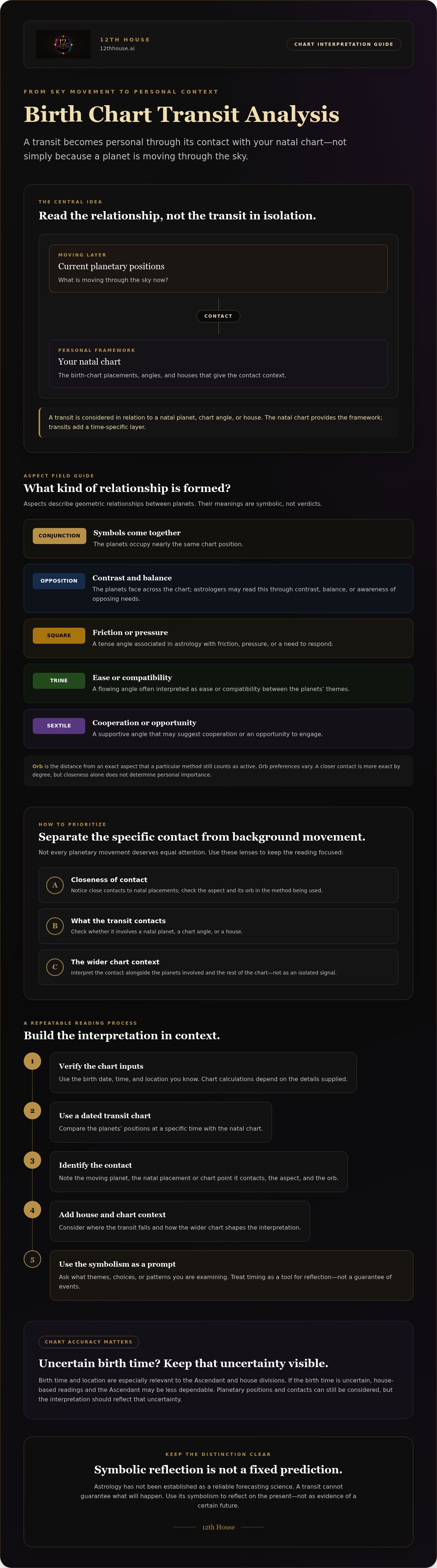
Birth chart transit analysis compares the planets’ current positions with the placements in a natal chart. A transit becomes personal when a moving planet forms a contact with a natal planet, angle, or house. The natal chart provides the framework. Transits add a time specific layer, showing which parts of that framework astrologers might consider symbolically active at a given moment.
This is a method of interpretation, not a scientific measurement of life events. Astrology has not been established as a reliable forecasting science, and a transit can’t guarantee that something will happen. Used thoughtfully, its symbolism can offer prompts for reflection: What themes are occupying your attention? What choices or patterns are you examining? Keep the distinction clear between symbolic meaning and evidence about what will occur.
How is a transit different from a natal chart?
Your natal chart is calculated for your birth time and place. It represents the positions of the planets at that moment. Transits are the planets’ changing positions in the sky. The two layers answer different questions: the natal chart describes the symbolic structure astrologers interpret, while transits offer a way to consider timing in relation to that structure.
For example, imagine a transiting planet forming a square to someone’s natal Mercury. An astrologer might use that contact to reflect on communication, thinking, or decision making. It doesn’t establish that a disagreement or important message will arrive. The natal contact gives the interpretation a personal reference point, but it doesn’t turn symbolism into certainty. A Saturn return, another well known transit, is similarly interpreted through its relationship to a person’s natal Saturn and the wider chart.
Why birth time and location matter
Birth date, time, and location help determine how the chart is calculated. Time and place are especially relevant to the Ascendant and house divisions, which astrologers use to organize chart areas and interpret where a transit falls. If your birth time is uncertain, house based readings and the Ascendant may be less dependable. Be transparent about what you know. No chart calculation can be more reliable than the details supplied.
That limitation doesn’t make every form of interpretation impossible. Planetary positions and contacts can still be considered, but the reading should reflect the uncertainty rather than hide it. Treat the chart as a symbolic map with defined inputs, not a fixed script. The most useful question is not “What must happen?” but “How might this symbolism help me examine the present?”
How Planetary Transits Interact With Natal Placements
A transit gains interpretive meaning through its relationship to the natal chart. Astrologers consider which planet is moving, which natal planet or chart point it contacts, the aspect between them, and the wider chart context. A transit description on its own is only one piece of the reading.
Aspects are geometric relationships between planets, measured by their angular distance in the chart. In plain language:
- Conjunction: The planets occupy nearly the same chart position, bringing their symbolism together.
- Opposition: The planets face across the chart, a relationship often read through contrast, balance, or awareness of opposing needs.
- Square: The planets form a tense angle associated in astrology with friction, pressure, or a need to respond.
- Trine: The planets form a flowing angle, often interpreted as ease or compatibility between their themes.
- Sextile: The planets form a supportive angle that may suggest cooperation or an opportunity to engage.
These are symbolic associations, not verdicts. An aspect isn’t universally good or bad; its interpretation depends on the planets involved and the chart around them. For a foundational overview of how planetary speed shapes transit timing, Astrostyle explains transiting planets.
What aspects reveal in transit analysis
In birth chart transit analysis, an astrologer also considers the orb: the distance a transit can be from an exact aspect and still count as active in a particular method. Orb preferences vary among astrologers and traditions. A closer contact is more exact by degree, but that alone doesn’t determine its personal importance. Check which natal placement is involved and whether the interpretation fits the broader chart, rather than reading the aspect as an isolated signal.
The same transit can carry different themes in different charts because it contacts different natal placements and operates in different house contexts.
How houses add life area context
Houses are chart areas associated with broad life themes. A transit through a house may be interpreted in relation to that area, while a transit to a planet can add another layer of symbolism. House placements depend on accurate birth time and location, as well as the chart method used. If the birth time is uncertain, treat house based conclusions with caution.
A house can suggest a lens for reflection, not promise a specific event. To explore how current planetary positions connect with your natal chart, consider a personalized astrology birth chart and transit analysis, then use your own judgment to assess what feels relevant.
Which Birth Chart Transits Deserve Your Attention?
A chart can show many transits at once. You don’t need to treat them as equally important. Start with close contacts to natal planets or angles, then check the houses involved and whether the same theme appears elsewhere in the chart. This gives you a stronger basis for interpretation than a broad horoscope based only on your Sun sign.
Planetary speed offers another useful filter. Faster moving planets form contacts that tend to change more quickly, while slower moving planets can remain near a natal point for longer. Astrologers may interpret the former as shorter term emphasis and the latter as a broader cycle, but duration alone doesn’t establish how an event will unfold.
Fast moving and slow moving transits: what changes?
Think of planetary speed as a timing scale, not a measure of importance. Jupiter moves more slowly than the faster personal planets; Saturn is slower still, and Uranus moves through an even longer cycle. These differences affect how long a contact may remain in focus. They don’t assign universal outcomes. The useful question is what each planet contacts in a specific chart.
| Transit factor | What to review | Why it matters |
|---|---|---|
| Fast moving planet | Its close natal contact and current house | May describe a shorter interpretive window; avoid treating a passing contact as a lasting forecast. |
| Jupiter | The natal planet, angle, or house it contacts | Its slower movement can extend the period under consideration. |
| Saturn or Uranus | Whether a close contact repeats or connects with other chart factors | A longer cycle may warrant review, but its meaning still depends on natal context. |
| Broad sign description | Whether it makes a specific contact to your chart | A sign wide statement may not be personally relevant without that connection. |
How to weigh an aspect, orb, and repeated contact
A closer aspect may receive more attention within an astrologer’s chosen method because it is nearer to exact. But there’s no single orb rule used by everyone. Note the orb applied in the chart you’re reading, and compare contacts using that same standard rather than switching rules to make a transit seem more significant.
Some transits appear to contact a natal point more than once, including when a planet changes direction and revisits a degree. Astrologers may consider those passes together, especially if other chart factors reinforce the same theme. That’s an interpretive choice, not proof of an inevitable event. Techniques and timing windows vary, so weigh a transit by its closeness, repetition, and natal context, not by dramatic wording or sign alone.
How to Read Your Birth Chart Transits Step by Step
A repeatable process keeps interpretation anchored in chart data instead of dramatic headlines. In birth chart transit analysis, separate what the chart shows from what you think it may mean. Then compare that interpretation with your actual circumstances without forcing a match.
A practical sequence for interpreting a transit
- Verify your birth details. Check the birth date, time, and location you’re using. If the time is uncertain, mark that limitation before relying on the Ascendant or houses.
- Set the chart parameters. Choose the chart method and settings, then keep them consistent. Record the date or date range you want to examine so you know exactly which sky positions the chart represents.
- Find the closest contacts. Identify transiting planets that form close aspects to natal planets or angles. Note the aspect and its orb, using the chart’s stated method rather than assuming one standard applies to everyone.
- Add house context carefully. If the birth time supports it, note the houses involved. Treat a house as a symbolic area for reflection, not evidence that a specific event must occur there.
- Frame a theme as a question. Combine the transiting planet, natal point, aspect, and chart context. Turn the symbolism into an open prompt, such as “What am I reconsidering in how I communicate?” rather than “A difficult conversation will happen.”
- Keep a dated record. Write down the transit, your interpretation, and what you observe in daily life. Include experiences that don’t fit the symbolism. Revisit your notes later to see whether your reading was balanced or shaped by hindsight.
How to keep an interpretation grounded
Compare a transit theme with your lived context, but allow for ordinary explanations and other points of view. If a reading suggests tension, for example, note what is actually happening rather than assuming every disagreement confirms it. Astrology can offer a reflective framework; it shouldn’t replace evidence, practical judgment, or advice from qualified professionals. Avoid making major decisions solely because of a transit interpretation.
Quick review checklist
- Chart data: Are the birth details, chart settings, and transit date clear?
- Transit contact: Which moving planet contacts which natal placement, and by what aspect?
- Context: What chart factors and, where reliable, house themes help frame the contact?
- Reflection: What have you observed, and what alternative explanations remain possible?
Use this sequence to explore personalized birth chart and transit analysis and connect transit symbolism with your natal placements, while keeping your own judgment at the center.
Use Personalized Birth Chart Transit Analysis as a Reflective Tool
A transit becomes easier to consider when it’s read within the architecture of your natal chart. A personalized interpretation can connect current planetary positions with the placements they contact, then offer symbolic themes to reflect on. Use that perspective to ask better questions, not to hand your choices over to a forecast.
Before using any chart service, check what birth details it requests, what chart information it provides, and how it presents timing and uncertainty. 12th House offers astrology birth chart and transit analysis. Its membership also provides ongoing access to Lala, its AI spiritual guidance assistant, and a metaphysical library. Review the current workflow directly rather than assuming which calculations or features are included.
Questions to bring to a personalized transit reading
Good questions clarify the method and keep interpretation open. Ask which natal placements a current transit contacts, what aspect or chart method is being used, and what timing window the reading considers. If birth time is uncertain, ask how that affects house or angle interpretations. Then bring the focus back to your own reflection:
- What pattern or priority does this symbolism invite me to examine?
- What choices are available to me, regardless of the transit?
- What remains uncertain, and what other explanations fit my circumstances?
These prompts keep astrology in its proper role: a symbolic lens, not proof that a particular outcome is fixed.
Explore related astrology guidance
If questions come up as you interpret a chart, Lala is 12th House’s AI assistant for personalized spiritual guidance. Membership includes unlimited interactions with Lala, which you can use to explore follow up questions while applying your own judgment to its responses. For more on this kind of tool, read the AI astrology assistant guide.
If your transit question relates specifically to a relationship, the guide to birth chart compatibility offers a related perspective. Keep the focus on understanding patterns and choices, rather than seeking a guaranteed answer about another person or the future.
When you’re ready to explore your chart in context, take a look at 12th House’s personalized astrology tools.
Read the Current Sky With Greater Clarity
A useful birth chart transit analysis doesn’t ask you to surrender to a forecast. It helps you connect current planetary movement with your natal chart, focus on the contacts that matter in context, and reflect without treating symbolism as certainty.
Keep your process grounded: note the chart details and timing, distinguish the transit itself from your interpretation, and leave room for what you observe in real life. Astrology can offer a language for reflection, while your choices remain your own.
For a more personalized way to explore these connections, 12th House offers astrology birth chart and transit analysis. Lala, the platform’s AI based spiritual guidance assistant, can also help you explore follow up questions. Use these tools as prompts for inquiry, not as a substitute for your judgment.
Explore 12th House’s personalized astrology tools and continue building your own thoughtful approach to the current sky. Each chart is an invitation to observe, question, and choose with greater awareness.
Frequently Asked Questions
What is birth chart transit analysis?
Birth chart transit analysis compares current planetary positions with the placements in your natal chart. Astrologers interpret the moving planet, the natal point it contacts, the aspect between them, and relevant chart context to explore symbolic themes and timing. For example, a transit to natal Mercury may prompt reflection on communication or thought patterns. It doesn’t establish that a particular conversation or event will happen.
How do I read current transits in my birth chart?
Start with a transit chart dated for the period you want to examine, then identify close contacts to natal planets or angles. Note the transiting planet, natal point, aspect, and orb. Consider house context only if your birth time supports it. Summarize the symbolism as an open question, then record what you observe without assuming every experience confirms the interpretation.
Which planetary transits are most important in astrology?
There isn’t one universally most important transit. Astrologers often give attention to close contacts with natal planets or chart angles, especially when a slower moving planet forms the contact or revisits it. Personal relevance depends on the natal placement, aspect, house context, and the interpretive method being used. A dramatic sign based horoscope may be less specific than a quieter transit that directly contacts your chart.
How long does a transit last in astrology?
Transit duration varies with the planet’s speed, the aspect, and the orb an astrologer uses. Faster moving planets usually pass through contacts more quickly, while slower moving planets can stay near a natal placement longer. A planet may also revisit a degree after changing direction, creating multiple passes. Check the dates and method in the chart you’re reading rather than assuming a fixed timing window applies to every transit.
Can birth chart transits predict specific events?
Astrological transits can’t reliably guarantee or establish that a specific event will occur. They’re interpreted symbolically, often as prompts for considering themes, patterns, or choices in a particular period. Treat a transit reading as a reflective framework, not as evidence or a substitute for practical judgment. Avoid making major decisions solely on an astrological interpretation, and consider other explanations for what’s happening in your life.
What birth information do I need for transit analysis?
You’ll generally need your birth date and birthplace, plus your birth time if it’s available. These details are used to calculate the natal chart, while the date being examined sets the current planetary positions. Use the most reliable records you can access. If the birth time is approximate or unknown, say so; chart interpretations should reflect that uncertainty instead of implying more precision than the data supports.
Does birth time affect transit analysis?
Yes. Birth time especially affects the Ascendant and house placements, which astrologers may use to interpret where a transit’s symbolism falls in the chart. If the time is uncertain, house based interpretations and contacts to chart angles may be less dependable. Some planetary placements and aspects can still be considered, but the reading should clearly separate those from conclusions that rely on an uncertain time.


