

What if the future feels frightening because uncertainty has crowded out what you can actually know and choose? The overcoming fear of the future tarot spread offers a structured way to separate present facts from imagined outcomes. When global events or personal decisions leave you weighing every possibility, a clear framework can help you pause and listen to your own instincts.
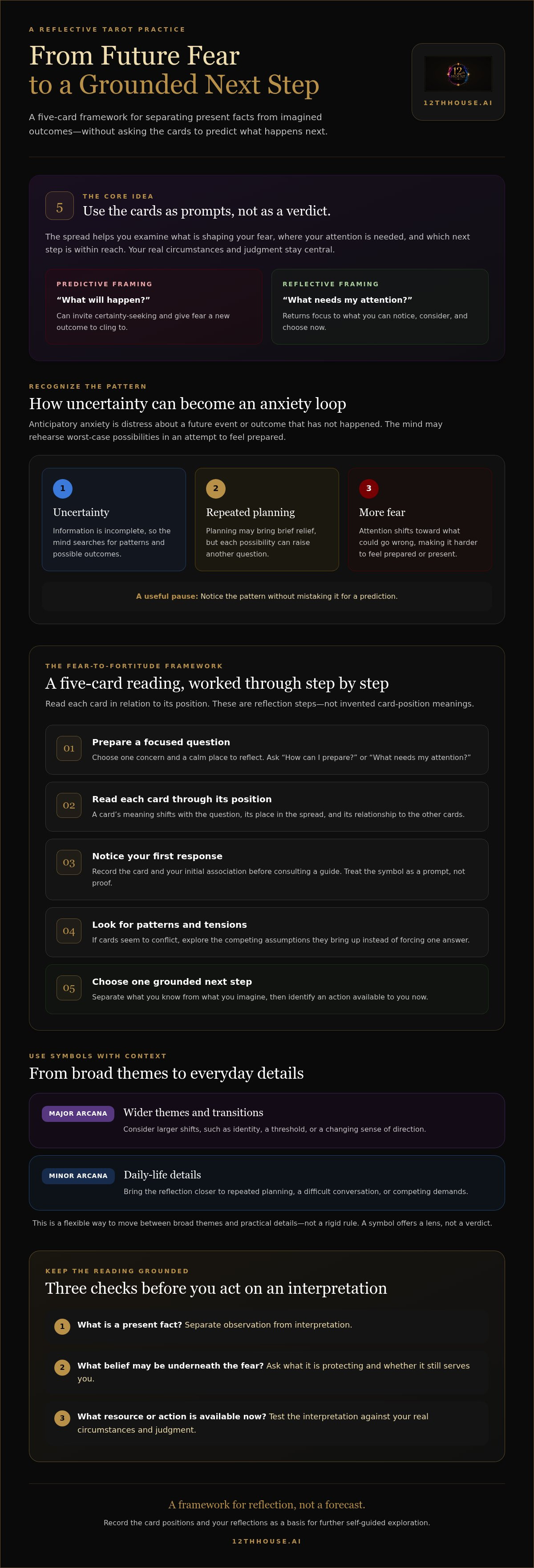
You don’t need tarot to predict what will happen. You can use it to examine what’s shaping your fear, where your attention is needed, and which next step is within reach. This five-card spread turns a difficult question into a reading you can work through without surrendering your judgment to the cards.
In this guide, you’ll learn how to prepare, interpret each position, and connect the cards to a practical path forward. Treat the reading as a repeatable reflection practice: a way to focus your attention, make planning feel more manageable, and meet uncertainty with greater clarity.
Key Takeaways
- Use the overcoming fear of the future tarot spread as a five-card framework for examining uncertainty and identifying a grounded next step.
- Prepare a focused question and a calm reading space so your attention stays on the concern you want to explore.
- Interpret each card in relation to its position, then look for patterns before turning symbols into practical action.
- When cards appear to conflict, use the tension to examine competing assumptions rather than forcing a single answer.
- Record the positions and your reflections as a useful basis for further self-guided exploration with Ask Lala AI Spiritual Guidance.
Understanding Future-Phobia: The Subconscious Architecture of Anxiety
What happens when the mind treats an uncertain possibility as if it were already unfolding? Anticipatory anxiety is distress about a future event or outcome that hasn’t happened. The body can respond to a perceived threat with alertness and tension. In a metaphysical practice, you might describe the experience as a mismatch between your present circumstances and the futures you’re imagining. That framing is a reflective tool, not a clinical diagnosis.
The mind looks for patterns to make uncertainty feel more manageable. When information is incomplete, it may rehearse a worst-case scenario as a form of preparation: What if the decision fails? What if the situation gets worse? This can create a loop in which planning brings brief relief, but each new possibility raises another question. For foundational context on the subconscious architecture of anxiety, consider how anxiety involves responses to perceived threats, not only immediate danger.
The Anatomy of Anticipatory Anxiety
Notice how the loop shows up in your life. You might delay a decision while trying to calculate every outcome, plan repeatedly without feeling prepared, or lose touch with the present as your attention stays fixed on what could go wrong. The subconscious can reinforce these habits into “fear-walls”: protective beliefs that seem to prevent mistakes but may also keep you from testing a new direction. Metaphysical reflection begins by observing the pattern without mistaking it for a prediction.
Why Traditional Fortune Telling Fails the Fearful
A fixed-outcome reading can give an anxious mind a new certainty to cling to, whether the message feels reassuring or alarming. Predictive tarot asks what will happen. Reflective tarot asks what is influencing your perception, what resources you can draw on, and what action is available now. This approach leaves room for choice. Cards don’t establish a guaranteed future; they offer symbols to consider alongside your real circumstances and judgment.
Use the deck as a framework, not an authority. A card’s meaning shifts with its position, its relationship to the other cards, and the question you bring. In the overcoming fear of the future tarot spread, that means identifying the belief beneath a fear, considering what it may be protecting, and asking whether it still serves you. The aim isn’t to force optimism. It’s to distinguish a present fact from an imagined outcome, then choose one grounded next step.
Tarot as a Diagnostic Tool for Metaphysical Intelligence
A tarot deck can be approached as a symbolic map of human experience, not a literal database or forecast engine. Its 78 cards offer a varied vocabulary for examining change, conflict, desire, uncertainty, and choice. Shuffling introduces chance into the reading. Calling the draw a “randomized data sample” can be a useful metaphor, but it doesn’t prove that the cards objectively reveal the subconscious. Their value lies in the associations they prompt and the questions those associations help you ask.
This is where tarot mastery matters. A symbol can prompt reflection, but its meaning depends on context: the question, the card’s position, and its relationship to the rest of the spread. Without a method, it’s easy to turn a striking image into another fixed prediction. With a method, symbols become prompts that help you pause, notice your reaction, and test your interpretation against what you know.
Mapping the Subconscious Terrain
Read the Major Arcana as a map of larger themes and transitions, such as a shift in identity, a threshold, or a changing sense of direction. The Minor Arcana bring the inquiry closer to daily life, where fear may appear as repeated planning, a difficult conversation, or competing demands. This distinction isn’t a rigid rule. It’s a way to move between the broad themes of a concern and its practical details.
Combine symbolic curiosity with clear reasoning. If a card suggests disruption, don’t assume disaster is inevitable. Ask what feels unstable, what evidence supports that feeling, and what resource is available now. The card offers a lens, not a verdict.
Grounded Intuition vs. Vague Escapism
A grounded spiritual practice means naming what you feel, separating observation from interpretation, and choosing a useful question. Ask “How can I prepare?” or “What needs my attention?” rather than “When will this happen?” The first questions return your attention to the present; the last can invite anxious certainty-seeking.
Set aside a quiet place for reflection. Write down one focused question, then record the card and your first response before consulting a guide. Note what is fact, what is fear, and what remains unknown. This ritual doesn’t remove uncertainty. It gives you a steady framework for working with it. For further structured exploration, the Metaphysical Library for self-guided learning can complement your reading.
The 'Fear-to-Fortitude' Spread: A 5-Card Blueprint for Stability
This five-card layout gives future-related fear a structure you can examine. Instead of asking for a fixed forecast, it traces what’s underneath the worry, what story fear adds, what support is already present, what action could shift your position, and what perspective you want to cultivate. The overcoming fear of the future tarot spread is a reflective framework, not a guarantee about what comes next.
Prepare Your Reading Space
Choose a quiet surface, your deck, and a notebook. Silence distractions if you can. Before drawing, write one sentence that defines your intent, such as: “I want to understand what is driving my anxiety about this decision and identify one grounded next step.” Keep the question focused on your experience instead of asking the cards to certify an outcome.
Shuffle while holding that sentence in mind. There’s no required technique: use a method that feels comfortable, and stop when you’re ready to draw. Treat the shuffle as a pause that gathers your attention, not as proof that a card has been selected by an external force. Draw five cards and place them face down from left to right so the sequence is easy to follow.
Card Positions and Their Logic
- Position 1, The Root: What underlying concern or present circumstance is feeding the fear?
- Position 2, The Shadow: What assumption or worst-case narrative may be intensifying it?
- Position 3, The Anchor: What existing strength, resource, or reliable fact are you overlooking?
- Position 4, The Pivot: What practical action could help change your relationship to the situation?
- Position 5, The Architect: What quality or perspective can your future self embody as you move through this transition?
“The Architect” is an invitation to consider a more empowered perspective, not a prediction of who you’re destined to become. Read each card through its position. A card that suggests disruption in The Shadow, for example, may point to a feared scenario, while the same card in The Pivot could prompt you to identify what needs attention now.
Turn Over and Observe the Cards
Turn the cards face up in order. Before interpreting individual meanings, scan the spread. Notice which images draw your eye, what mood the cards create, and whether one suit or element appears repeatedly. In common tarot traditions, Wands are associated with fire, Cups with water, Swords with air, and Pentacles with earth, though decks and interpretive systems can vary. Treat a recurring element as a prompt for inquiry, not a diagnosis. Record your observations, then interpret one position at a time.
Interpreting the Data: From Symbolic Archetypes to Strategic Action
Begin with the Pivot card. Read it as a prompt for action, not a command you must obey. Ask: “What is one small, practical step this symbol suggests?” If the card evokes communication, that might mean drafting a question before a difficult conversation. If it points toward rest or patience, your step could be postponing a decision until you’ve checked the facts. Keep the action specific and within your control.
Decoding the Elements of Fear
Suits can help locate the texture of a concern. Their meanings vary across traditions, so use these associations as prompts rather than fixed rules:
- Swords: Is analysis helping you clarify the fear, or keeping you in a loop of rehearsing every outcome?
- Cups: Are strong emotions flooding the question, or helping you notice a genuine need?
- Wands: Is restless energy scattering your attention, or pointing toward a creative move?
- Pentacles: Is the concern about material security, or reminding you to build on practical resources already available?
Synthesizing the Narrative
Read the five cards as a blueprint. The Root identifies the concern; the Shadow reveals a possible story layered over it; the Anchor names a resource; the Pivot suggests a response; and the Architect offers a perspective to cultivate. Look for the reading’s critical path: the smallest sequence of steps linking what you understand now to what you can do next.
Contradictory cards don’t necessarily mean the reading has failed. They may represent competing needs, such as wanting certainty while also needing room to adapt. Name both sides. Then ask what evidence, conversation, or boundary could help you respond thoughtfully. An AI astrology assistant can offer another interpretive lens, but it can’t verify that a card has revealed objective truth or guarantee an outcome. Compare suggestions with your own context and judgment. Use an AI astrology assistant as a framework for structured reflection, not a substitute for discernment.
Close by writing a 24-hour action plan: one task you can complete, one fact you need to check, and one worry you can set aside until you have more information. Record your interpretation and revisit it later. That comparison can help you see which readings led to useful questions and which assumptions deserve revision. For a guided way to explore spiritual patterns, explore Ask Lala AI Spiritual Guidance.
Deepening the Analysis: Using Lala AI for Spiritual Reflection
Your tarot reading can become more useful when you preserve its details and return to them with fresh questions. Ask Lala AI Spiritual Guidance can support continued reflection, not act as an oracle that confirms a card’s meaning or guarantees an outcome. Treat the spread as a starting point: your interpretation, real-world context, and next steps remain central.
Ask Lala: A Tool for Reflection
Bring your notes into a guidance conversation: include the question you asked, each card and position, your first impressions, and the action you’re considering. Then ask for a structured perspective. For example: “The Anchor is the Four of Pentacles and the Pivot is the Eight of Cups. What assumptions might I examine before deciding what to do?” This invites reflection on the pairing without treating an AI response as proof.
If you want astrological context, keep it distinct from the tarot interpretation. Ask what questions might help you explore a theme through astrology, or use Astrology Birth Chart & Transit Analysis as a separate lens. Don’t assume that a card draw establishes a connection to a transit. Compare insights carefully and keep what fits your circumstances. Disagreement between interpretations can be a prompt to clarify your question, not a reason to keep drawing until you receive reassurance.
Save your reading notes somewhere you can revisit them. Record the date, question, cards, interpretation, and action you chose. This creates a personal reference for noticing patterns over time without relying on memory alone.
From Fear to More Deliberate Choices
Repeated reflection won’t make you immune to fear. It can help you recognize familiar thought patterns sooner and respond with more deliberation. After taking the action identified in your overcoming fear of the future tarot spread, return to your notes: What happened? Which assumption changed? What would you ask differently next time? This closes the loop between symbolic insight and lived experience.
12th House brings tools such as Ask Lala AI Spiritual Guidance and Metaphysical Library Access into one environment for structured exploration. Membership provides ongoing access to the AI assistant, personalized data storage, and a library of books, videos, and ritual frameworks for self-guided learning. Start a reflective practice with Ask Lala AI Spiritual Guidance, and use each reading as one input in a considered path forward.
Build a Steadier Path Forward
The future may remain uncertain, but your next step can become clearer. The five-card spread helps you distinguish the concern beneath your fear from the story built around it, recognize resources you may be overlooking, and identify one action within your control. Read the cards as prompts for reflection, not fixed predictions.
Return to your notes as circumstances change. Over time, this practice can help you notice recurring assumptions and make future decisions with greater intention. Tarot becomes one part of a broader approach to metaphysical exploration, alongside tools for spiritual guidance and self-directed study.
Ask Lala AI offers personalized spiritual guidance, and 12th House membership includes access to its Metaphysical Library and personalized data storage. Explore 12th House membership for tools to support your ongoing metaphysical exploration. You don’t have to solve the entire future today. Begin with the next grounded choice.
Frequently Asked Questions
Can a tarot spread actually predict my future?
No tarot spread can guarantee what will happen. The cards are better used as prompts for examining your assumptions, feelings, and choices than as fixed forecasts. In the five-card layout, focus on what’s influencing you now and what action is available, rather than treating a card as proof of a future event. Your circumstances and decisions continue to matter after the reading.
What should I do if I pull “scary” cards like Death or The Tower?
Pause before assigning a literal or alarming meaning. In many tarot interpretations, Death can symbolize transition or an ending, while The Tower may raise themes of disruption or a changed foundation. Neither card confirms that something terrible will happen. Read the card in its position, consider the question you asked, and note your reaction. If you feel more distressed, set the deck aside and return when grounded.
How often should I use the fear of the future tarot spread?
There’s no fixed schedule. Use the spread when you have a focused question and enough space to reflect on the answer. Avoid drawing repeatedly on the same concern to seek reassurance; multiple readings can add interpretations without resolving uncertainty. Instead, write down your cards and choose one practical step. Revisit the notes after circumstances change or you’ve had time to act.
Do I need to be “psychic” to use this spread effectively?
No. You can work with tarot through observation, symbolism, and honest self-reflection without identifying as psychic. Start by noting what stands out in a card, then consider how that response relates to its position and your actual circumstances. A guidebook can offer symbolic context, but it doesn’t replace your judgment. Treat interpretations as possibilities to examine, not instructions you must follow.
How can AI like Lala help me interpret my tarot cards?
You can share the question, card names, positions, and your initial interpretation with Ask Lala AI Spiritual Guidance, then ask for reflective prompts or another way to consider the combination. Use the response as an additional perspective, not independent verification or a prediction. Compare its suggestions with your own context. If an interpretation increases anxiety or conflicts with concrete facts, pause and rely on grounded judgment.
What is the best environment for a tarot reading about anxiety?
Choose a place where you can pause without interruption, with enough space for your deck and notes. Keep the setup simple: write one clear question, arrange the cards so their positions are easy to track, and have a notebook nearby. You don’t need special objects or elaborate rituals. If you feel overwhelmed during the reading, stop, take a break, and return only if it feels useful.
Can I use this spread for someone else who is feeling fearful?
You can use the layout to support a conversation, but ask the person’s permission and let them guide the question and interpretation. Don’t present a card as a diagnosis, certainty, or substitute for professional support. They should be free to reject an interpretation or stop the reading. A respectful approach keeps the focus on their perspective and choices, rather than making decisions for them.
What happens if the cards in the spread seem to make no sense?
Don’t force a neat story. Check that you’re reading each card in the correct position, revisit the exact question, and write down what feels unclear. You might look at the card’s imagery or consult a trusted tarot reference, then connect only what genuinely relates to your situation. If the spread still feels confusing, leave it unresolved. You can reflect on it later without drawing more cards for reassurance.


