

What if your tarot pull and planetary transits were not separate messages, but two parts of the same reading? If you’re looking for apps that combine astrology and tarot, ask whether an app helps you explore both in a connected space or simply makes you switch between separate tools.
Astrology can offer context for a moment; tarot can give that context a symbolic, reflective focus. Together, they can support a richer interpretation, provided the app helps you explore the relationship between them rather than just placing unrelated features side by side. To compare options, look at how each app uses your chart details, explains its readings, and lets you revisit them.
This guide covers what to look for in an integrated spiritual app, from personalization to the way it connects planetary movements with card readings. You’ll also see how 12th House brings astrology, tarot, and other metaphysical systems together, with Ask Lala AI for personalized questions. Use these criteria to find a digital practice that supports reflection without turning a reading into a prediction.
Key Takeaways
- Separate spiritual apps can leave astrology and tarot insights disconnected. Look for tools that help you interpret them within a shared framework.
- When comparing apps that combine astrology and tarot, assess how they personalize readings and explain the relationship between transits and card pulls.
- Check what birth chart information an app requires and how its digital tarot experience works before relying on its interpretations.
- Try reflecting on a transit alongside a card pull, or use chart insights and a tarot spread to explore a relationship question.
- 12th House brings multiple metaphysical systems into one platform, with Ask Lala AI for personalized questions across your exploration.
Why You Need Apps That Combine Astrology and Tarot
A transit app gives you one perspective. A tarot app offers another. If the two tools don’t share context, you have to assemble the meaning yourself. This is the metaphysical silo: your chart and readings sit in different places, with no help tracing how they might inform one another.
An integrated app can bring personal chart information, planetary movements, and tarot reflections into one interpretive space. That doesn’t make decisions for you. It gives you a clearer way to ask questions and compare symbols across practices. When assessing an app, check whether it does more than display both tools. Can you see the transit context alongside a card? Does it explain why it connects them?
The Symbolic Bridge: How the Systems Intersect
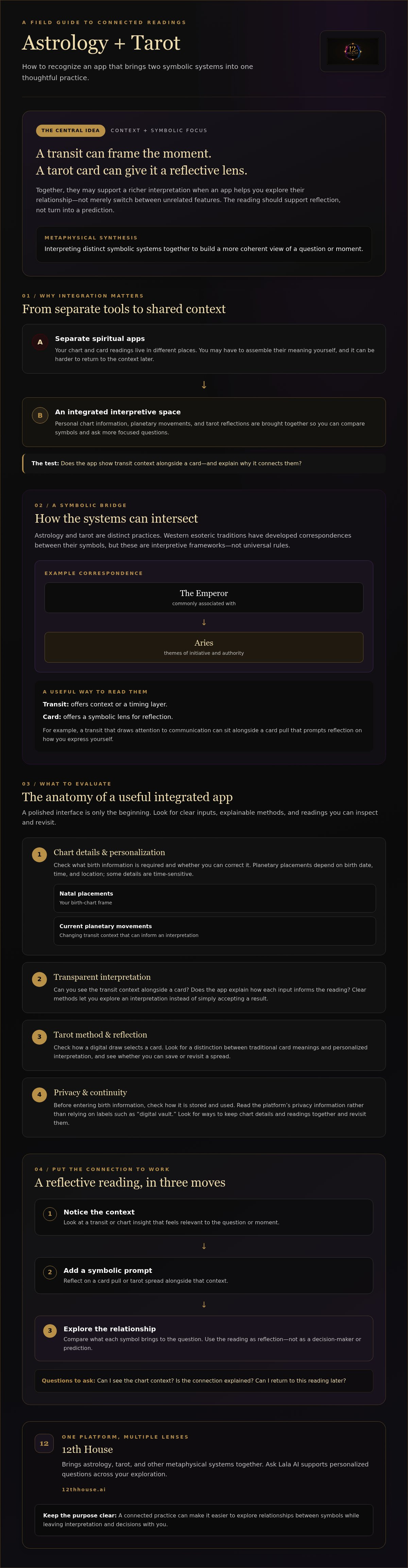
Astrology and tarot are distinct practices, but Western esoteric traditions have developed correspondences between their symbols. The Emperor, for example, is commonly associated with Aries, connecting themes of initiative and authority with the card’s imagery. For historical context, astrology is discussed alongside tarot among the core studies of Western esotericism. These correspondences are not universal rules. They are one framework readers can use to explore an interpretation.
Transits can add a timing layer to a tarot spread’s theme. If a transit draws your attention to communication, for instance, a card pull might prompt you to reflect on how you express yourself. The transit offers context; the card supplies a symbolic lens. Metaphysical synthesis means interpreting distinct symbolic systems together to build a more coherent view of a question or moment.
Less App Fatigue, More Continuity
Using several spiritual apps can mean juggling alerts, accounts, and interpretations. Even useful insights can be harder to revisit when you have to remember where each one lives. Apps that combine astrology and tarot can reduce that friction by keeping related tools in one place, making it easier to return to your reflections without rebuilding the context each time.
Look for a place to keep your chart details and readings together, and check whether you can revisit or update them. Interactive tools can also let you ask a specific question rather than rely only on a static calendar prompt. An AI assistant may help you explore how different symbolic inputs relate, depending on the features it offers. 12th House brings astrology, tarot, and other metaphysical systems together, with Ask Lala AI for personalized questions. A digital practice should help you focus, not create another stream of notifications.
The Architecture of a Superior Integrated Spiritual App
A polished interface can make an app inviting, but useful interpretation also depends on the details behind it: chart calculations, the tarot method, and how the app relates their outputs. Strong apps that combine astrology and tarot make their approach understandable, so you can explore a reading instead of simply accepting a result.
Start with the birth chart. Planetary placements depend on birth date, time, and location, interpreted against astronomical reference data such as an ephemeris. Some chart details are time-sensitive, so check what information the app asks for and whether you can correct it. A daily horoscope may be convenient, but it does not provide the same personal frame as a chart-based interpretation. Astrology’s place as a mainstream feature of modern culture is explored in academic work on belief and practice; digital tools should make the information behind their interpretations clear.
Data Integrity and Personalization
Look for an app that distinguishes natal placements from current planetary movements and explains how each informs an interpretation. A static reading stays fixed; a reading that includes transits can reflect changing planetary positions. Before entering birth information, check how the platform stores and uses it. Treat phrases such as “digital vault” as claims to verify: read the platform’s privacy information rather than relying on a label.
Tarot has its own design questions. A digital draw uses a method to select a card, but technical language about randomization does not automatically make a reading more meaningful. Check whether the app explains its draw method and separates traditional card meanings from personalized interpretation. If you want to repeat a spread, see whether the app lets you save or revisit it.
User Experience: From Intuition to Analysis
An integrated dashboard should make its connections easy to inspect. Can you see the transit context alongside a card? Does the app explain why it links them, and can you return to the interpretation later? AI can help turn those inputs into reflective questions, but it should support your judgment rather than present a symbolic reading as a guaranteed prediction. A searchable history can also help you revisit past questions and notice how your interpretations change.
Choose an interface that balances atmosphere with clarity. It can feel calm and contemplative without hiding dates, chart details, or the reasoning behind an insight. Astrology has become a subject of sustained cultural study, and an app can treat it with similar seriousness. Look for a modern library rather than a game: organized enough for analysis, with room for intuition. 12th House brings birth chart analysis, tarot, and other metaphysical systems together, with Ask Lala AI for personalized questions. Explore 12th House’s integrated tools as one example of this library-like approach.
Comparing Top Apps for Astrology and Tarot Synthesis
The useful distinction is not simply old app versus new app. It is whether a tool offers separate astrology and tarot features or helps you interpret them together. Standalone apps can focus on one discipline, while integrated platforms aim to bring personal chart information, current transits, and card readings into one experience. Check current feature descriptions before choosing. A shared menu does not necessarily mean the app offers a shared interpretation.
Labyrinthos is known for tarot learning tools and card interpretation, which can suit readers who want to build their knowledge of the deck. Its emphasis is tarot education; if you want detailed, personalized transit connections, check whether its current offering meets that need. Sanctuary is another recognizable example, pairing astrology content with tarot features. Separate sections can be convenient, but they do not by themselves show how a card pull relates to a transit. The key test is synthesis: does the app explain the relationship, or leave the interpretation entirely to you?
Established Apps and AI-Powered Platforms
A basic digital draw can select a card, but the result may feel limited if you want to explore its context through conversation. AI-guided tools can potentially respond to questions using multiple inputs, though capabilities vary. Don’t assume every assistant can interpret a complete chart or access current transit data. Check the feature descriptions and how the system uses your information. Strong tarot mastery does not require astrology, but astrological context can add another interpretive layer, inviting you to consider timing alongside a card’s imagery and traditional meanings.
12th House takes an integrated-platform approach, bringing astrology, tarot, Human Design, and numerology into one metaphysical intelligence platform. Its AI assistant, Ask Lala, supports personalized questions. The value of an integrated tool depends not only on how many systems it contains, but on whether it helps you explore their connections without treating an interpretation as certain.
Subscription Models and Value
Separate subscriptions can mean managing multiple accounts and recurring charges; a consolidated membership may reduce that friction. Compare the features included, the total cost shown by each provider, and any usage limits before deciding. Do not assume unlimited access unless the platform states it clearly. Also check whether a metaphysical library is included. Learning resources can help you understand the symbols behind a reading instead of relying on a quick answer alone.
How to Use Integrated Insights for Daily Decision Making
Use a reading as a prompt for reflection, not a verdict. Astrology can help you consider timing and broader themes; tarot can offer a focused image or question. Together, they can help you create a decision map: the transit suggests what conditions to notice, while the card invites you to consider how you might respond. Neither should replace practical judgment or your own knowledge of a situation.
A Framework for Morning Synthesis
Build a short ritual around information your app actually provides. If it shows current transits, note one that feels relevant. Draw a card and record your first response before reading its interpretation. Then compare the symbols. Does the card echo the transit’s theme, complicate it, or direct your attention elsewhere? If an AI guide can use those details, ask it to help you explore the connection. Treat its response as one perspective, not a fixed instruction.
For a more personal lens, consider your Moon sign as a prompt for emotional reflection, but do not assume every app can automatically connect it with a card. You could ask, “What might this card help me notice about my emotional response to today’s theme?” Close by setting an intention you can act on. Journal the transit, card, interpretation, and your own conclusion. Over time, those notes may help you recognize recurring questions and patterns in your readings.
Mapping Relationships and Long-Term Goals
For relationship reflection, give chart comparison and a tarot spread distinct roles. Birth chart compatibility can offer a framework for considering how two people’s astrological patterns interact; a relationship spread can help you examine a specific question or feeling. Keep the interpretation open-ended. Neither system can determine another person’s intentions or guarantee an outcome.
Other symbolic tools can also support longer-term reflection. Astrocartography mapping may help you think about place when considering where to travel or spend time on personal study. Numerology cycles can offer another lens for choosing when to focus on a learning goal. Treat both as reflective frameworks, then weigh practical factors such as time, access, and responsibilities. A ritual framework from a library can help organize your practice, but its value comes from consistent reflection, not following a formula without question.
Some apps that combine astrology and tarot bring chart analysis, tarot, and other systems into one space. 12th House offers integrated metaphysical tools and Ask Lala AI Spiritual Guidance for personalized questions. Explore 12th House’s integrated spiritual tools as you shape a practice that connects insight with deliberate action.
12Th House: The Digital Sage for the Modern Architect
Many apps that combine astrology and tarot place both practices under one interface. 12th House brings astrology, tarot, Human Design, and numerology together in a metaphysical intelligence platform, alongside Ask Lala AI Spiritual Guidance. The aim is not to hand you a fixed answer, but to give you a structured space to explore how different symbolic systems might inform your questions.
Lala: Your AI Spiritual Guide
A generic notification offers the same prompt to everyone who receives it. A personal question can begin somewhere more specific. For example, you might ask, “How could I reflect on a Saturn transit alongside my three-card spread?” The answer depends on the context available to the assistant and the features it supports. Check what information it uses, and treat its interpretation as a starting point for your own analysis.
AI can help organize a question across systems instead of presenting astrology and tarot as unrelated outputs. Ask Lala is designed for personalized questions, while the platform’s integrated data rooms bring multiple metaphysical systems together. To explore the broader role of AI in this kind of practice, read more about the AI astrology assistant.
A Library for Ongoing Exploration
12th House offers a digital environment for studying and working with metaphysical tools, rather than simply receiving a daily prediction. Its Metaphysical Library Access complements tools such as birth chart analysis and tarot readings. Use the resources to build your understanding of the systems you consult, then bring that knowledge back to your own reflections.
Bringing these disciplines together in one membership may simplify a practice that would otherwise span multiple apps. The value lies in having related tools in one place and being able to ask personalized questions through Ask Lala. Review the current membership details to understand what is available and how the terms fit your needs.
Being a “Metaphysical Architect” means engaging actively: bring a clear question, examine the symbols, and decide what resonates with your lived experience. Let an AI guide help you map connections, not dictate your choices. That is how an app can become a useful study space and a tool for building your own framework of insight.
Build a More Connected Spiritual Practice
The strongest apps that combine astrology and tarot do more than place two tools side by side. They help you explore how planetary context and card symbolism might inform the same question, while leaving room for your own judgment. Look for clear explanations, relevant personal information, and a space that supports reflection instead of adding digital noise.
12th House brings astrology, tarot, Human Design, and numerology together through integrated data rooms. Ask Lala AI Spiritual Guidance lets you explore personalized questions, while Metaphysical Library Access offers resources for ongoing study. Having tools and learning resources in one place can support a practice you shape for yourself.
Let each reading become a starting point for thoughtful inquiry, not a final instruction. Build a practice that is both intuitive and clear, one considered insight at a time.
Explore 12th House and join the membership.
Frequently Asked Questions
Can an app really combine astrology and tarot accurately?
An app can bring astrology calculations and tarot interpretations together, but “accurate” has two meanings here. Chart accuracy depends on correct birth details and reliable calculations; symbolic interpretation is a reflective practice, not a guaranteed prediction. Look for clear explanations of how a reading connects a transit with a card, and check whether the app distinguishes established correspondences from its own interpretation. Use the result as a prompt, not a certainty.
Is it better to use two separate apps or one integrated platform?
Choose based on how you use the systems. Separate apps may suit you if you prefer specialized tools and do not mind comparing insights yourself. A unified platform can reduce app switching and make it easier to explore astrology and tarot side by side. The key is meaningful integration: check whether the app connects chart and card interpretations or simply places both features in the same interface.
How does AI help in interpreting tarot cards through an astrological lens?
AI can help organize details from a question, chart, transit, and card pull into a response that explores possible connections. For example, you might ask how a card’s theme relates to a current transit, then use the answer to form questions for journaling. The quality depends on the system’s available context and design. AI interpretation is not proof or prediction, so weigh it against your own understanding and circumstances.
Are these combined apps suitable for beginners or only for experts?
Many combined apps can be useful to beginners, especially when they explain chart terms, card meanings, and how they connect. You do not need to master astrology or tarot before starting. Begin with one clear question, read the interpretation, and note what resonates. More experienced readers may value advanced chart context or cross-system comparisons. Before choosing, check that the explanations match your preferred level of detail and do not present interpretations as instructions.
Do I need my exact birth time for these apps to work?
No, you can explore some astrology and tarot features without an exact birth time, but the chart may be less complete. Birth time affects time-sensitive details, including the Ascendant and house placements, so an app may not be able to calculate or interpret them reliably without it. Enter the most accurate information you have, including birth date and location, and check how the app handles unknown or estimated times.
Can I save my readings and chart data in these apps?
Some platforms offer personalized data rooms or saved reading histories, but storage features vary. Check the app’s description and settings to see which details you can save, revisit, edit, or delete. 12th House provides personalized data rooms for metaphysical systems, including astrology, tarot, and Human Design. Do not assume every reading is automatically stored or searchable; confirm how the specific platform manages your information before building an ongoing practice around it.
What is the benefit of adding numerology or human design to the mix?
Numerology and Human Design offer different symbolic frameworks for reflection, so adding them can broaden the questions you bring to astrology and tarot. Numerology can give you another way to consider cycles or themes, while a Human Design profile offers a distinct lens for self-understanding. These systems do not automatically confirm one another. Use an integrated platform to compare perspectives thoughtfully, while keeping each system’s concepts and assumptions clear.
How do I know if my spiritual data is private and secure in an AI app?
Review the platform’s privacy policy and account settings before entering birth details or personal questions. Look for clear information about what data is collected, how it is used, whether it is shared, how long it is retained, and whether you can delete it. A “private” or “secure” label alone is not enough to assess data handling. If anything is unclear, contact the provider or limit the personal information you share.


