
A biblical basis exists for Christian concern about astrology, but calling it demonic is an interpretation, not a conclusion every Christian shares. If my parents think astrology is evil, they may be drawing on passages such as Deuteronomy 18:10-14, which forbids divination. The disagreement often turns on whether astrology is understood as divination, spiritual guidance, or a symbolic practice.
It makes sense to take their concern seriously, especially when faith and family are both involved. But you don’t have to reduce a complicated debate to a simple label. This article explores why some Christians associate astrology with demonic influence, how biblical passages shape that view, and why other Christians understand astrology differently.
You’ll also see how concerns about spiritual authority and reliance on astrology shape the debate. This can help you understand your parents’ position and reflect on your own without dismissing either faith or curiosity.
Key Takeaways
- Understand why some Christians connect astrology with divination, and why that interpretation isn’t shared by all Christians.
- Explore how faith, spiritual authority, and the way astrology is used shape different Christian perspectives.
- Consider the concerns people associate with astrology, including how much influence it has over personal choices.
- Approach a conversation with your parents by listening to their concerns, explaining your perspective calmly, and setting respectful boundaries.
Is astrology demonic?
Some Christians call astrology spiritually dangerous because they connect it with divination or seeking guidance apart from God. Deuteronomy 18:10-14 forbids divination and related practices. Deuteronomy 17:2-5 addresses worship of heavenly beings and, in this discussion, involvement with astrology. These passages ground serious concerns, but they don’t use the modern phrase “demonic astrology.” If my parents think astrology is evil, they may be interpreting biblical warnings through their church tradition.
Isaiah 47:13-14 describes Babylon’s astrologers facing judgment, while Isaiah 47:8-15 warns that astrologers and their advice cannot prevent it. The emphasis is on the limits of their power, not a detailed account of every modern horoscope. Second Corinthians 11:14 warns that Satan can disguise himself as an angel of light. Some Christians connect that warning to spiritual practices they believe could mislead people. Others distinguish astrology from demonic worship and focus on how someone uses it.
Astrology and astronomy are different. Astronomy studies celestial objects and physical processes; astrology interprets celestial positions as meaningful in human life. Using a star chart to track a planet is astronomy, while interpreting that planet’s position in a horoscope is astrology.
If your parents forbid horoscopes, ask what concerns them most and explain your perspective without reading one secretly. If you’re a minor, follow reasonable household rules while discussing the disagreement. A calm conversation is safer than escalating conflict.
A disagreement becomes emotionally harmful when it involves repeated humiliation, threats, intimidation, isolation, or fear that keeps you from speaking safely. If every conversation about astrology ends with insults or threats, for example, pause the discussion and seek support from a trusted adult.
In the United States, teens can approach a school counselor, therapist, or pediatrician for support with family religious disagreements. Before sharing sensitive details, ask how confidentiality works and what its safety exceptions are. A trusted adult outside the conflict, such as a relative or teacher, can also help you plan a safer conversation.
Astrology was practiced openly in biblical times, and Christians used the pentagram as a protective symbol against evil spirits. Neither fact, on its own, settles every concern today.
Astrology and Christian beliefs
Christian views differ because believers interpret biblical stories and spiritual practice through distinct traditions. Daniel 2:27-28 describes Daniel saying God reveals mysteries and enables him to interpret the king’s dream. Christians who oppose astrology may see Daniel’s reliance on God as a contrast with seeking answers through celestial patterns. Others distinguish that biblical account from astrology used as symbolic reflection.
Matthew 2:1-2 recounts wise men from the east saying they saw Jesus’s star rise and came to worship him. Some readers connect this story with astrology’s place in the ancient world; others emphasize that the passage describes a sign pointing toward Jesus, not a practice for directing daily choices. Astrologers don’t necessarily worship stars or planets, though Christian concerns often focus on where someone places trust.
Astrology is generally a system of interpretation, not a religion with one shared creed or institution. A person may approach a birth chart as a spiritual practice, a cultural tradition, or a tool for reflection. The meaning depends partly on the person’s beliefs and how they use the chart. A 1988 poll found that 10% of U.S. evangelicals believed in astrology, showing that Christian communities have not held one uniform view.
Church history also reflects tension. A council held at Laodicia declared astrology forbidden in 345 A.D. That decision illustrates one institutional position, not every Christian’s present-day interpretation. If you’re discussing astrology with Christian parents, ask which teachings shape their view, such as biblical authority, prayer, or church tradition. Then explain your own approach without insisting they adopt it.
Set a clear boundary with a specific phrase: “I’ll listen to your concerns, but I don’t want to be insulted.” If the conversation turns hostile, pause it and return when everyone can speak respectfully. For private reflection on astrology’s symbolic framework, explore a structured birth-chart analysis alongside your own beliefs.
Astrology's purported dangers
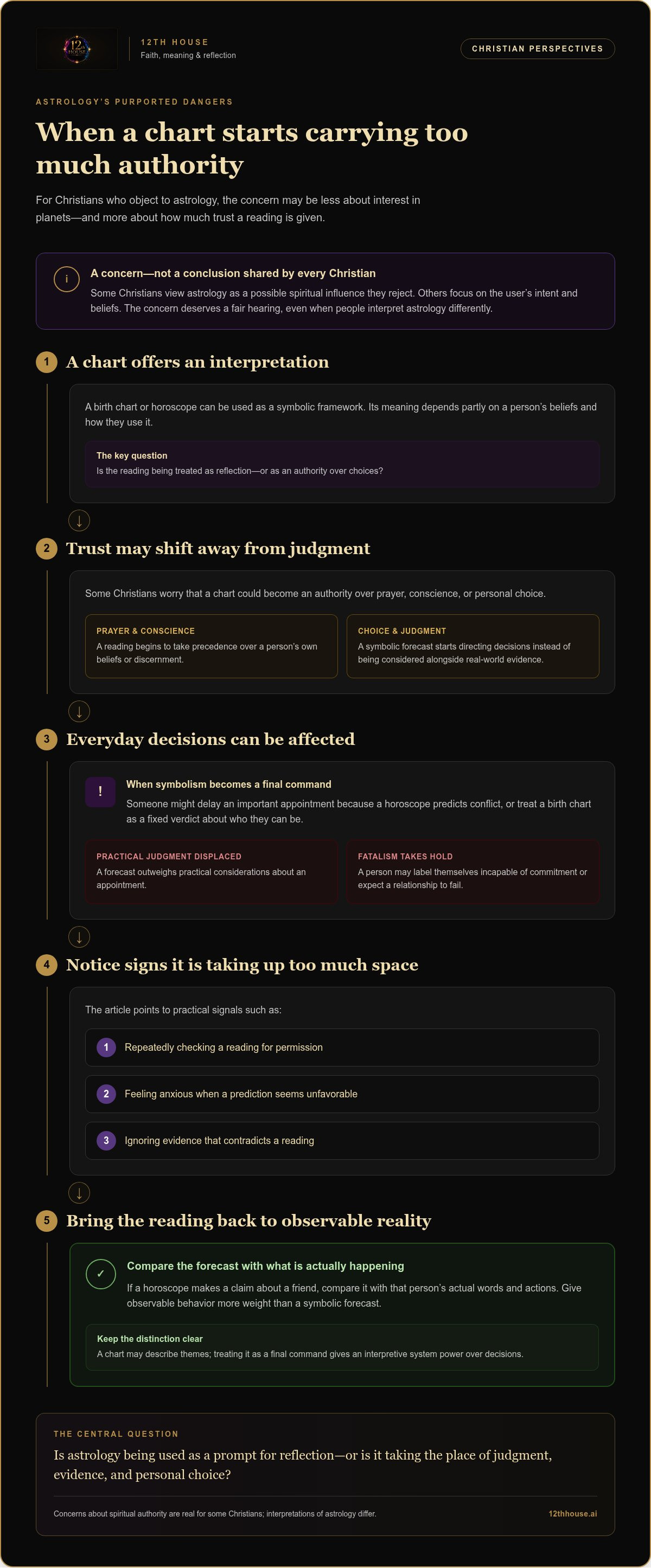
For Christians who object to astrology, danger can mean more than fear of demons. They may worry that a chart becomes an authority over prayer, conscience, or choice. If someone delays an important appointment because a horoscope predicts conflict, symbolism has displaced practical judgment. The concern is misplaced trust, not simply an interest in planets.
Another risk is fatalism. Treating a birth chart as a fixed verdict might lead someone to label themselves incapable of commitment or expect a relationship to fail. That can narrow choices before real experience is considered. A chart may describe themes, but using it as a final command gives an interpretive system power over decisions.
Parents may also fear that astrology invites spiritual influence they reject. Second Corinthians 11:14 warns that Satan can disguise himself as an angel of light. Some Christians apply that warning broadly to practices they consider occult; others focus on the user’s intent and beliefs. Their concern deserves a fair hearing, even when you interpret astrology differently.
Look for practical signs that any spiritual tool is taking up too much space: repeatedly checking for permission, feeling anxious when a prediction seems unfavorable, or ignoring evidence that contradicts a reading. For example, compare a horoscope’s claim about a friend with that person’s actual words and actions. Give observable behavior more weight than a symbolic forecast.
Astrology has been practiced for thousands of years, but its longevity alone doesn’t prove its claims or settle Christian objections. Consider the role it plays in your life. Does it prompt reflection or dictate choices? Does it support responsibility or become a reason to avoid it? These distinctions help separate symbolic exploration from dependence and give families a more specific topic to discuss.
How can I talk to my parents about astrology respectfully?
Choose a calm moment, rather than the middle of an argument about a horoscope. Start by naming their concern: “I understand that your faith shapes how you see astrology.” Then ask what worries them most. Is it biblical teaching, fear of spiritual influence, or concern that predictions might control your choices? Their answer gives the conversation a clear focus.
Listen without preparing a rebuttal. You might say, “I hear that you believe guidance should come from God.” Reflecting their point doesn’t mean you agree. It shows you’re trying to understand the thinking behind their position instead of dismissing it as superstition.
- Explain your meaning. Describe what astrology represents to you, such as a symbolic prompt for reflection rather than a command.
- Use one example. Explain how you might read a chart as a way to consider personal patterns, while still making decisions yourself.
- Ask about their boundary. Find out whether they object to reading horoscopes, discussing astrology, or treating it as spiritual guidance.
- Set your own limit. Say, “I want to talk about this, but I won’t continue if we insult each other.”
Keep the exchange specific. Instead of debating whether astrology is universally good or evil, discuss one practice, such as reading a daily horoscope. You can acknowledge that Christians interpret astrology differently while explaining your own view. Don’t present a chart as proof that your parents are wrong; that turns a family conversation into a contest.
If voices rise, pause: “Let’s stop here and return to this when we’re calmer.” If you depend on your parents or feel unsafe disagreeing, prioritize your safety and speak with a trusted adult. Respectful dialogue allows honest limits; it doesn’t require forced agreement.
To examine what a birth chart means to you without treating it as a fixed verdict, explore your chart’s symbolic patterns as a reflection tool.
12Th House: Ask Lala AI Spiritual Guidance
12th House offers Ask Lala AI Spiritual Guidance for exploring spiritual questions through structured reflection. If you’re weighing your own beliefs against your family’s concerns, use it to organize what you’re curious about and clarify the questions you want to consider. It isn’t a substitute for your faith or a way to settle disagreements with your parents.
For a closer look at astrology’s symbolic framework, Astrology Birth Chart & Transit Analysis can help you explore birth-chart and transit themes. Treat that exploration as reflection, not a command to make choices or a reason to dismiss your family’s beliefs.
If you’d like to continue your reflection, visit 12thhouse.ai.
Choose a thoughtful next step
If my parents think astrology is evil, I can approach the disagreement with curiosity instead of turning it into a test of loyalty. Give yourself room to decide what you believe, which boundaries matter, and how to keep the relationship respectful. You don’t need to settle every theological question in one conversation.
For personal reflection, Ask Lala AI Spiritual Guidance can help you organize questions, while Astrology Birth Chart & Transit Analysis explores chart symbolism. Tarot Readings offer another reflective framework. Use these tools to clarify your thinking, not to replace your judgment or dictate what your family should believe.
If you’re ready to explore your questions in a structured way, connect with 12th House. Let your next step be considered, grounded, and your own.
Frequently Asked Questions
Why do some Christians believe astrology is evil?
Some Christians view astrology as seeking spiritual guidance from a source they believe should not direct a person’s life. If my parents think astrology is evil, clarify what they mean: reading a horoscope, studying a birth chart, or letting predictions govern decisions. These practices can raise different concerns. Identifying the specific concern helps you respond to their actual belief instead of arguing against a broad label.
What does the Bible say about astrology and divination?
The Bible condemns divination and warns against relying on astrologers for protection or authority. Deuteronomy 18:10-14 prohibits divination, while Isaiah 47:13-14 depicts Babylon’s astrologers facing judgment. For a careful discussion, distinguish those passages from astronomy, which studies celestial objects rather than interpreting them as personal guidance. Christians differ over how directly biblical warnings apply to contemporary horoscopes and chart readings.


