
A difficult tarot reading is not a verdict. The best way to deal with a negative tarot reading is to treat it as a prompt for reflection, not a fixed outcome. A card’s meaning shifts with its position, its relationship to nearby cards, and the question behind the spread. Even symbols associated with upheaval or endings can point to change, clearer understanding, or a choice about what comes next.
It makes sense to feel unsettled when a reading touches a fear you already carry. You don’t have to dismiss that reaction or accept the cards as a prophecy. This guide shows you how to read challenging cards in context, pause before drawing more, and turn the reading into useful questions about your choices and needs. You’ll also find ways to step back when the symbols feel too close, then return with a steadier perspective.
Key Takeaways
- Read difficult cards as symbols of change, not fixed predictions; ask what choices or insights they bring into focus.
- Use each card’s position and relationship to the surrounding cards to understand the spread’s broader pattern.
- Explore what challenging cards such as Death, the Devil, the Tower, and the Three of Swords may represent in context.
- Turn an unsettling reading into reflection, and step away if you need time before deciding what it means to you.
1. Viewing difficult cards as change rather than fixed outcomes
A difficult tarot card describes a symbolic pattern, not an unchangeable event. The Tower, for example, can point to a structure breaking down, but also to illusions falling away and space to rebuild. Consider its position and neighboring cards before deciding what its energy might mean. A guidebook can offer constructive interpretations when your first response feels bleak.
Consider the image, the spread position, and your reaction. A card from the Swords suit might draw attention to conflict, grief, or a hard conversation; it doesn’t establish what another person will do. Ask yourself: What part of this situation can I influence? What assumption might need examining? What decision could create a different path? These questions turn interpretation into a practical framework for reflection.
After a negative reading, record the cards and their positions in a journal, then step away if you feel overwhelmed. Return when you can separate the card’s symbolism from your immediate fear. To understand how to deal with a negative tarot reading, consider what the image invites you to notice instead of treating it as a fixed forecast. A walk or quiet pause can help you settle before interpreting further.
A reader applies pressure when they present frightening meanings as certain, dismiss your questions, or insist you must pay for more readings to prevent harm. A grounded interpretation explains its reasoning and leaves room for your judgment. You’re entitled to decline further guidance or set aside an interpretation that doesn’t resonate.
You can reset your tarot cards after a difficult reading with a simple ritual, such as shuffling the deck or placing it on a clear surface. Treat this as a symbolic transition, not a requirement to erase the reading. For growth, note one small action the card suggests: after the Tower, identify what needs rebuilding; after a difficult Swords card, consider which conversation needs clarity. Change begins with a choice you can make.
2. Considering card meanings in the context of a spread
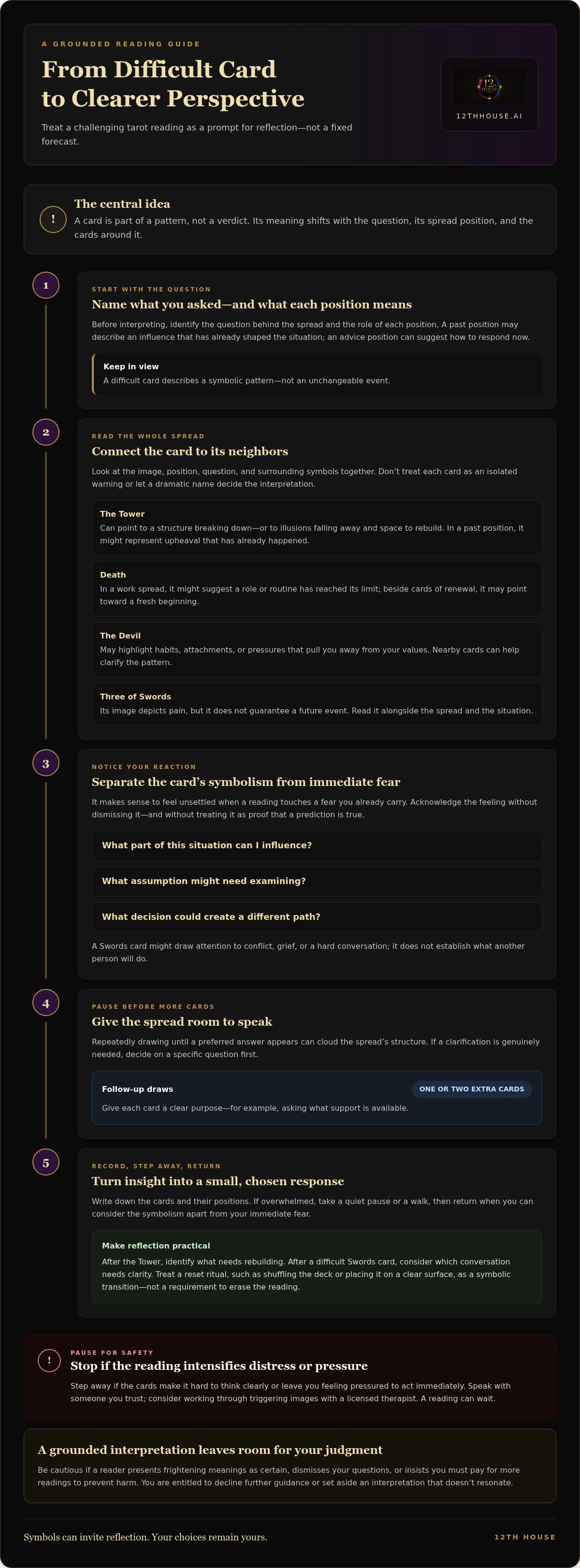
A tarot card’s meaning changes with its position and relationship to nearby cards. Read the spread as a connected pattern, not a set of isolated warnings. A card in a past position may describe an influence that has already shaped the situation, while an advice position can suggest how to respond now. Before interpreting, name the question and identify what each position represents.
If Death frightens you, pause before deciding it predicts literal loss. In a spread about work, it might suggest a role or routine has reached its limit; beside cards of renewal, it may point toward a fresh beginning. The Devil can highlight habits, attachments, or pressures that pull you away from your values. Ask what the card depicts in this situation and what the surrounding cards add.
When reading for someone else, acknowledge their fear directly. Briefly explain the card’s traditional symbolism, connect it to its position, then ask whether that interpretation resonates with the querent. For example, if Death appears in a relationship spread, describe possible endings or transformation without declaring that a breakup will happen. The querent’s perspective helps test the reading against lived experience.
Limit follow-up draws to one or two extra cards, each with a clear purpose, such as asking what support is available. Repeatedly drawing until a preferred answer appears can cloud the spread’s structure. If you think another card could clarify a specific point, state the question before drawing.
Stop the reading if the cards intensify distress, make it hard to think clearly, or leave you feeling pressured to act immediately. Step away, speak with someone you trust, and consider working through triggering images with a licensed therapist. A reading can wait; emotional safety comes first.
3. Interpreting challenging cards in the context of the spread
Tarot’s challenging cards hold both light and shadow; neither side cancels the other. Death, the Devil, the Tower, and the Three of Swords can signal difficulty, but their meaning depends on spread position and surrounding cards. Read the image, question, and neighboring symbols together before deciding what may happen. A tarot card is part of a pattern, not a verdict by itself.
Fear often begins with a card’s familiar image or dramatic name. Death may suggest an ending, while the Three of Swords depicts pain; together, they can describe a painful but necessary breakup. That interpretation still isn’t a guaranteed event. Ask what the combination reflects in your current situation, and whether it describes something already unfolding or a concern you carry.
The Devil can feel threatening because its imagery suggests entrapment. In a spread, it may point to behavior or influence that distances you from your values. Look for nearby cards that clarify the pattern: do they suggest avoidance, attachment, or a possible route toward change? This turns a frightening symbol into a specific question about what you can recognize and address.
Context also changes how the Tower reads. In a past position, it might represent an upheaval that has already occurred, such as a layoff. The card doesn’t decide what follows; the spread can help identify what remains within your control. Acknowledge the impact first, then consider what the surrounding cards suggest about support, recovery, or a response.
Notice your reaction as part of the interpretation. If a card triggers an immediate prediction, pause and name the fear before assigning meaning. Then compare that reaction with the spread’s actual positions and symbols. The Threes, Fives, and Nines in the Minor Arcana can also feel challenging, but a number or image alone doesn’t define the whole reading. Let each card contribute to the spread’s larger structure, including its possibilities for insight and change.
4. Negative readings as prompts for reflection rather than fixed prophecies
A difficult reading can serve as a map of current energies, not a sealed account of what comes next. Treat each card as a message to examine: what does it highlight, what might you be avoiding, and what response remains available? If the Three of Swords brings relationship anxiety into focus, write down the expectation or pattern you want to understand. Reflection turns a symbol into a question you can work with.
Tarot readings can suggest possible directions, but they can’t determine what will happen or remove your agency. Your choices, circumstances, and actions shape how a situation develops. Use the spread to consider whether another path feels healthier, rather than treating its images as instructions you must obey.
Give the reading a practical follow-through. Record the cards, the question you asked, and your first interpretation; then add one action you control. For example, if a spread raises concerns about a difficult conversation, prepare what you want to say or decide what boundary matters. Revisit the notes later to see whether the message points to a real pattern, an assumption, or an anxiety that needs care.
Don’t force certainty from a symbol. If the interpretation doesn’t resonate, set it aside; a tarot reader can be mistaken. If you want to explore the same issue again, wait one moon cycle unless the matter is urgent or a substantial new development occurs. Advice-oriented questions can help you examine your role and identify steps toward a healthier direction instead of asking for repeated predictions.
For a deeper, structured reflection, explore a tarot reading with a question focused on your choices and next steps. Keep your autonomy at the center: the cards can help you examine possibilities, while you decide how to proceed.
12Th House: Ask Lala AI Spiritual Guidance
12th House offers Ask Lala AI Spiritual Guidance for moments when a difficult spread leaves you with more questions than clarity. Use it to explore the concern behind the reading, shape a reflective question, or consider how the symbolism relates to your choices. The aim is perspective, not a fixed prediction. If you want a focused interpretation of the cards themselves, 12th House also offers Tarot Readings.
Bring the card or theme that unsettled you, then stay curious about what it may help you examine. Let your own judgment guide what feels useful. Visit 12thhouse.ai to explore Ask Lala AI Spiritual Guidance.
Let the next question restore your perspective
The next step isn’t to demand certainty from the cards. Choose a question that returns attention to your own agency: what do you need to understand, what choice deserves care, or what support would help you move forward? This shift can turn anxiety into a deliberate inquiry. When deciding how to deal with a negative tarot reading, let curiosity guide your next step rather than fear.
If you want a structured space to explore that question, 12th House offers Tarot Readings, Ask Lala AI Spiritual Guidance, and Astrology Birth Chart & Transit Analysis. Each can offer a different lens for reflection, while your judgment remains central. Bring the question that matters most, and leave room for your own interpretation.
Explore a tarot reading with 12th House, and take the next step at your own pace. A difficult reading can become the beginning of clearer choices.
Frequently Asked Questions
How should you interpret difficult tarot cards without assuming the worst?
Start with the question and spread position, then consider more than one plausible meaning. For example, the Five of Wands might reflect competing priorities or friction, not inevitable failure. Compare those possibilities with what’s actually happening in your life. If an interpretation depends on assuming a specific future event, separate that assumption from the card’s image and the evidence you have.
How can you use a negative tarot reading for reflection and practical action?
Translate the reading into a question you can answer through observation. If a card suggests conflict at work, note what happened in a recent exchange and identify one response you can control, such as clarifying a deadline. Then assess the result rather than treating the card as proof. This approach makes the reading a starting point for deliberate action, not a substitute for judgment.
Should you get another tarot reading after receiving a negative one?
Usually, wait at least one moon cycle before asking the cards about the same issue again, unless it’s urgent or a substantial new development has occurred. A new reading may be useful when the circumstances or your question have genuinely changed. For instance, a decision made since the first spread gives you a different point to explore than simply asking for reassurance about the original answer.
How do tarot readers interpret reversed or challenging cards?
Readers interpret reversed cards according to their chosen tarot system and the spread, rather than applying one universal definition. A reversal might suggest an internal, delayed, or blocked expression of a card’s themes; another reader may focus on the image and surrounding cards without assigning reversals a separate meaning. Ask what the position contributes and how the reader arrived at that interpretation.


