
Tarot doesn’t need to predict the future to support self-discovery. Convincing a skeptic about tarot cards starts with presenting them as symbolic prompts that can surface thoughts, assumptions, and intuition, not as proof of supernatural knowledge. A reading can open a path for reflection without deciding what you should do.
Skepticism is reasonable: cards can’t establish that a prediction is true, and interpretations can vary. But you don’t have to choose between unquestioning belief and dismissing tarot outright. You can stay curious, notice what a card brings to mind, and consider whether that insight holds up in your life.
This article explores how tarot readings work, why their imagery may prompt self-reflection, and how to keep a clear-eyed perspective. You’ll learn to treat a reading as one source of insight among several, using its symbolism to explore possibilities rather than accept a fixed answer.
Key Takeaways
- Approach tarot as a reflective tool, not proof of supernatural insight or a fixed prediction.
- Notice which symbols stir a response, then examine what that reaction reveals about your assumptions and priorities.
- Keep your judgment active: weigh a reading alongside other information, especially when making major life or financial decisions.
- Explore how spreads and interpretations create different perspectives, and use what resonates to open possibilities rather than dictate a choice.
Is Tarot Reading Bullshit?
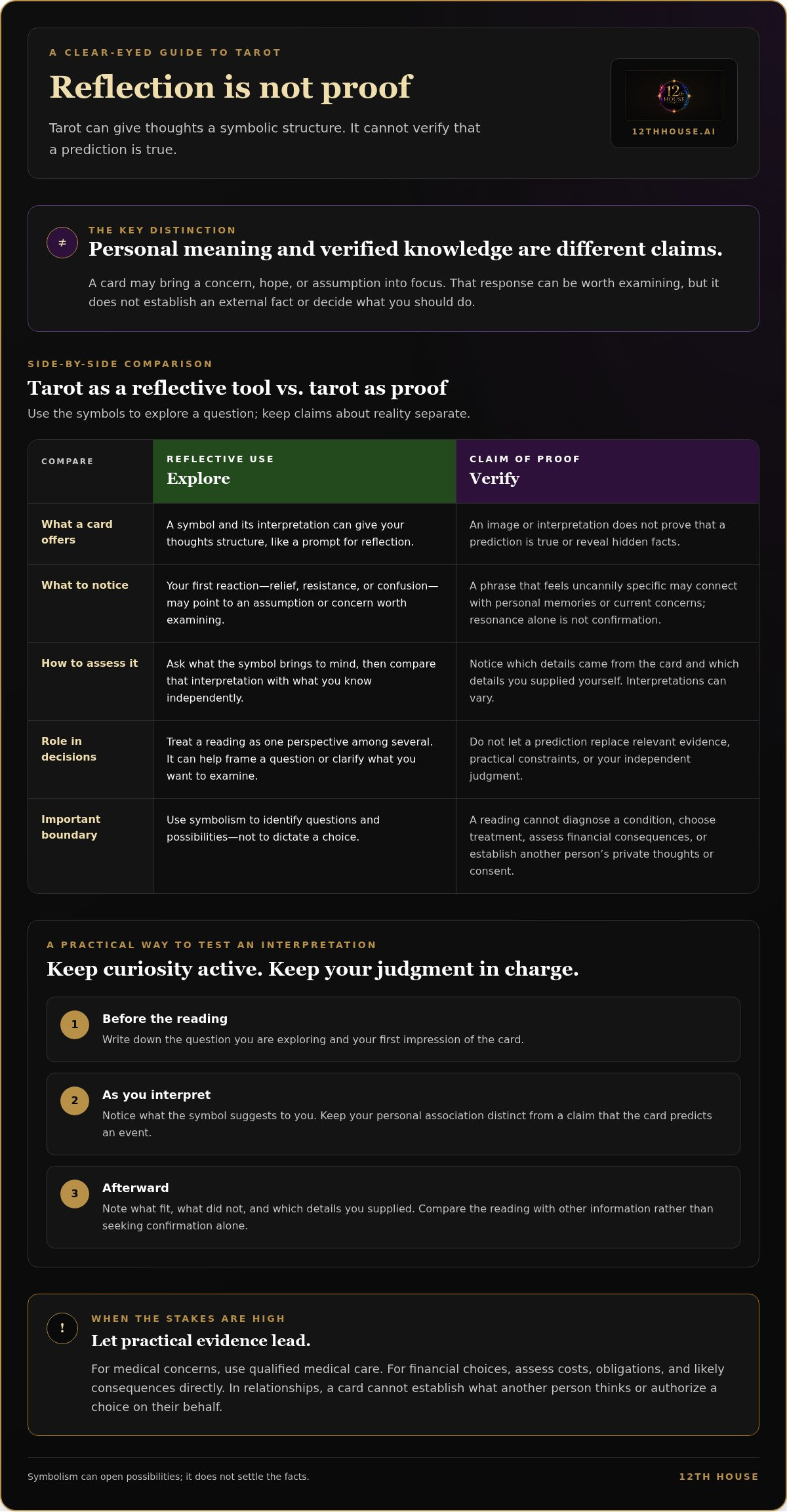
Tarot can’t prove that a prediction is true, but a reading can still prompt reflection. The distinction matters: symbolic interpretation and verified knowledge are different claims.
A Skeptical First Tarot Reading
A skeptical first reading is an encounter with tarot before deciding what its symbols mean. The author’s first experience came in 2017, when her friend Eliza read three cards for her: past, present, and future. That structure offered a sequence to consider, not independent proof of what would happen. Six years later, the author described herself as a tarot devotee, showing how experience can shift a person’s view without settling every question.
Professional experience adds context, not automatic evidence. Paul Hughes-Barlow had read tarot professionally for over 20 years, while Andy Cook had seven years of professional reading experience. Years of practice may deepen familiarity with card systems and interpretation. They don’t, by themselves, establish predictive accuracy. A reader’s fee is a service cost, not evidence that a reading is true.
Tarot Among Divination Practices
Tarot is a form of divination that uses a spread of cards and their symbolic relationships. Astrology interprets celestial placements; psychic readings generally emphasize a reader’s claimed intuitive impressions; and practices such as rune casting use different symbolic systems. For a skeptic, comparing methods clarifies what each asks you to accept and what you can examine through reflection.
The Forer effect describes how broad, general statements can feel personally precise. In tarot, a familiar theme may seem uncannily specific when you connect it to personal memories or current concerns. You can try a reading without paying by interpreting cards you already own, or study card meanings independently and record your interpretations. Compare your notes with later events rather than treating a resonant phrase as confirmation.
Risks of Relying on Tarot
Relying on tarot becomes risky when symbolic interpretation replaces practical evidence or another person’s consent. For medical concerns, use qualified medical care rather than a card reading to diagnose a condition or choose treatment. For financial decisions, assess costs, obligations, and likely consequences directly. In relationships, a card cannot establish what another person thinks or authorize a choice on their behalf.
Use tarot to frame questions, not make high-stakes decisions for you. A card suggesting change, for example, can prompt you to identify what feels unstable and what evidence supports a next step. Keep the interpretation separate from verifiable facts, and avoid acting solely on a prediction about health, money, or a partner.
Keeping an open mind while maintaining a skeptical perspective
An open-minded skeptic can explore tarot without treating a reading as proof. The useful stance is disciplined curiosity: examine the interpretation, notice your response, and distinguish reflection from evidence.
The author says she has never felt 100% certain about tarot, intuition, or spirituality. That uncertainty can be a method, not a barrier. You can ask what a card suggests, then separate your first impression from what you know independently. A meaningful association may reveal a concern or hope, but it doesn’t establish an external fact.
Keep a reading in proportion by comparing it with other information. If a card seems to point toward a career change, consider your actual work conditions, finances, and alternatives. Treat the reading as one perspective among several, then make your decision using evidence relevant to your circumstances. This leaves room for intuition without giving it authority over your choices.
Test interpretations instead of looking only for confirmation. Before a reading, write down the question you’re exploring and your first impression of the card. Later, note what fit, what didn’t, and which details you supplied yourself. For example, if a card about change feels relevant, identify the change you had in mind before deciding it predicted an event.
Be especially measured with major life or financial decisions. The author advises against relying on tarot alone for either; a relationship reading also can’t verify another person’s private thoughts. Use a card to clarify what you want to ask or examine, then weigh conversations, practical constraints, and observable facts. That boundary keeps curiosity active while judgment remains yours.
If you’d like to explore symbolism with this reflective approach, consider a guided tarot reading as a prompt for your own interpretation, not a substitute for independent judgment.
Tarot as a prompt for intuition and self-discovery
Tarot can prompt reflection without proving that cards reveal hidden facts. Explain it as a symbolic framework for exploring a question, not a source of certainty.
Tarot as a Tool for Reflection
A tarot reading uses images and meanings to give your thoughts structure. After receiving her first deck the previous year, the author used a three-card draw to organize her thoughts and plans. A card can bring a concern into focus, much like a journal prompt. Its value lies in the associations you examine, not in claiming the image knows your private circumstances.
For example, a card associated with transition might lead you to ask what you’re ready to change. Notice your immediate response before looking up a formal interpretation. Relief, resistance, or confusion can point to assumptions worth examining. The card doesn’t supply the conclusion; it gives you a defined symbol to question, reinterpret, or think through.
Explaining Tarot Without Unsupported Claims
Describe tarot as an interpretive practice, and separate personal meaning from claims about prediction. You might say, “This card makes me think about a choice I’ve been avoiding,” rather than, “This card proves a change is coming.” That distinction is useful when convincing a skeptic about tarot cards: it invites discussion without presenting an unverifiable claim as fact.
Keep the reading open-ended. Tarot can open possibilities rather than reduce a person’s life to one prophecy or answer. If a symbol suggests a new direction, consider several explanations: a real opportunity, a wish, or a worry. Compare each interpretation with what you know. The exercise supports inquiry while keeping evidence and personal judgment distinct.
Test your interpretations in everyday life. Write down the card, your first association, and the question you had in mind. Later, note where the connection fit and where it didn’t. If an interpretation proves inaccurate, reflect on the link you made and why it seemed persuasive at the time. That record can refine future readings without turning coincidence into proof.
For instance, a card that suggests conflict might initially seem to describe a colleague. On reflection, it could relate to an internal disagreement instead. Hold both possibilities, then look for concrete details that distinguish them. This approach lets intuition offer a hypothesis, not a verdict, and gives skeptical readers a clear way to engage without adopting supernatural beliefs.
What does tarot claim to do, and how do tarot readings work?
Tarot readings use cards and interpretation to explore a question, situation, or possible perspective. There’s no single system everyone must follow, so the reader’s method shapes how a spread is understood.
A standard tarot deck contains 78 cards: 22 Major Arcana cards and 56 Minor Arcana cards. The Major Arcana often frames broad themes, while the Minor Arcana can focus attention on everyday situations. These categories offer an organizing structure, not a universally fixed answer. A card’s meaning depends on the interpretive tradition and the question being considered.
A reading usually begins with a question or topic. The reader shuffles and draws cards, then interprets each one in relation to its position and the surrounding cards. In a past, present, and future spread, for example, each position gives the reader a distinct lens. The cards provide symbols; the reader connects them into an interpretation.
That interpretation isn’t mechanically determined. Ten professional readers could give ten different interpretations of the same cards because experience, symbolic associations, and the spread’s context influence their readings. This variation matters: ask what an interpretation is based on, and distinguish the image’s traditional meaning from the reader’s personal inference. A clear reading can explain both without treating either as objective proof.
Tarot cards were most likely invented in the 1400s, and the practice has existed for over 600 years. Their long history explains the depth of their symbolic traditions, but age alone doesn’t demonstrate predictive power. For a skeptical reader, the practical question is what the reading helps clarify. Does a card reveal a question you hadn’t considered, or merely echo what you already believe?
Explore a tarot reading as a structured way to engage with card symbolism and examine your own interpretation.
12Th House: Ask Lala AI Spiritual Guidance
12th House: Ask Lala AI Spiritual Guidance gives you a place to explore spiritual questions through a structured, reflective lens. Turn to it when a tarot symbol raises a question you want to examine further, or when you’re looking for another framework for personal reflection.
For a card-focused perspective, 12th House also offers Tarot Readings. Astrology Birth Chart & Transit Analysis and Numerology Reports offer distinct symbolic systems for exploring patterns and personal questions. Each can support reflection without replacing your own judgment or practical evidence.
Keep your inquiry specific. Instead of asking a reading to decide what you should do, consider what perspective might help you understand your own response. Explore Ask Lala AI Spiritual Guidance at 12thhouse.ai.
Let curiosity lead to a clearer question
You don’t have to persuade anyone to adopt a belief. A more useful next step is to ask what a symbol brings into focus, then consider that reflection alongside ordinary evidence. If it sharpens a question, helps name a tension, or reveals an assumption, you have something specific to consider. If it doesn’t resonate, that response also tells you something about the method’s limits for you.
For anyone convincing a skeptic about tarot cards, the strongest approach is honest framing: describe what the practice offers you, distinguish personal meaning from established fact, and leave space for disagreement. Curiosity works better than pressure. It lets another person examine the symbols on their own terms.
If you want to continue exploring tarot through a reflective lens, visit 12thhouse.ai. Bring a question, stay attentive to your own reasoning, and let the inquiry unfold at a pace that feels right. Skepticism and curiosity can share the same table.
Frequently Asked Questions
What scientific evidence exists for tarot's predictive or supernatural claims?
Tarot’s predictive or supernatural claims should be treated as unverified, not as established scientific findings. To assess a prediction, define beforehand what outcome would count as accurate and record the interpretation before events unfold. For example, “a major change is coming” is difficult to evaluate; a specific, time-bound prediction is easier to test. A personally meaningful reading can still matter, but meaning alone doesn’t demonstrate supernatural accuracy.
Can tarot help with reflection or decision-making without predicting the future?
Yes. Tarot can help organize reflection without supplying a forecast. For example, if you’re choosing which work task to prioritize, a card might prompt you to consider what feels urgent, what you’ve been avoiding, and what evidence supports each option. Write down your reasoning before acting, then compare it with the result. The value lies in clarifying your priorities, not treating the card as an instruction.
What are common skeptical arguments against tarot, and how do tarot practitioners respond?
Skeptics often point to chance, flexible interpretations, and confirmation bias: people may remember apparent hits and overlook misses. A thoughtful practitioner can acknowledge those limits and explain a reading as symbolic interpretation, not objective proof. If you’re discussing a reading, ask how the reader connected a card to your question and what interpretation might challenge their first impression. That exchange makes the reasoning visible without requiring agreement.


