
Tarot cards aren’t reliable verdicts. A reading can be misinterpreted, and its outcome may shift as people make choices. The dangers of misinterpreting tarot cards often begin when a symbolic message is treated as a fixed prediction rather than one possible reading of the moment.
It makes sense to want certainty when a reading touches on a major decision. But a card’s meaning depends on its position, its relationship to the other cards, and the question being explored. Strong hopes or fears can also shape what stands out, making a warning feel like a promise or a possibility seem inevitable.
This guide explains how interpretation, attention, and action influence what happens next. You’ll see why a reading can seem wrong, how distraction and narrow questions can distort its message, and why a prediction shouldn’t be the sole basis for a high-stakes choice. Treat the spread as a framework for reflection, not a command. Its value lies in helping you examine possibilities and choose your next step with greater clarity.
Key Takeaways
- Notice how responding to a warning can change the path ahead, and treat a reading as one possibility rather than a fixed script.
- Give the reading your attention; distraction during shuffling or cutting can interfere with the process.
- Use the question and spread as part of the interpretation. A past-position card can offer context, while a brief spread may not resolve a complex yes-or-no issue.
- Pause before acting on a frightening prediction, and don’t use a reading alone to justify taking on debt or making another high-stakes decision.
How acting on a reading may change an outcome
A tarot reading can describe a likely possibility, not every future path. What you do with its message can influence which path unfolds.
Anxiety and Fear from Readings
Anxiety from a reading can arise when an uncertain symbol is treated as a threatening certainty. A card interpreted as loss, for example, may make someone expect a breakup or job setback, even when the spread doesn’t establish either outcome. That fear can narrow attention: ordinary disagreements may seem like proof, while reassuring details go unnoticed. Pause and identify what the card actually suggests, apart from what you fear it means.
Decisions Based on Tarot Alone
Making a major decision based only on tarot means letting a symbolic interpretation replace practical evidence. To avoid that, treat the spread as a prompt, then weigh concrete factors such as finances, available options, timing, and likely consequences. A prediction shouldn’t be treated as a guarantee or used alone to justify taking on debt. For example, a warning about a business venture can prompt you to review its costs more closely, but it can’t determine whether the plan is sound. You may still choose to proceed, even when a reading advises against it; that choice can change the outcome the cards appeared to describe.
Mental Health and Delusion Risks
A reading may affect mental wellbeing when its symbols intensify distress or seem to prove a fixed belief. Can tarot readings affect mental health or reinforce delusions? They can heighten fear, and treating a card as confirmation may strengthen an interpretation someone already holds. But a spread cannot establish that a belief is true or diagnose a condition. Notice the difference between considering a symbolic possibility and feeling compelled to act because the cards seem to give instructions. If a reading is disrupting sleep, relationships, or daily choices, pause further readings and discuss the distress with a trusted person or qualified mental health professional. Keep the cards in the role of reflection, not evidence.
How focus and distraction can affect a reading
Attention shapes both the card draw and the meaning assigned to it. A reader who is distracted while shuffling or cutting may lose track of the question, handle cards without intention, or overlook how a card relates to its position. The resulting spread can feel confusing because its context has become unclear, not because every card carries a fixed message.
A clear head matters more than cleansing the deck. Before a reading, set aside your phone, name the question, and notice whether urgency or worry is dominating your attention. For example, someone anxiously awaiting a job offer may see every difficult card as a sign of rejection. That reaction can steer interpretation before the full spread is considered.
Confirmation bias can strengthen this pattern: people notice meanings that support what they already hope or fear, then discount details that challenge them. If you expect a particular outcome, record your first interpretation of each card before deciding what the whole spread means. Compare those notes with the question and the card positions, rather than selecting only the symbols that confirm your expectation.
If a reading causes distress or fear, stop interpreting and step away from the cards. Write down the exact prediction that upset you, separate it from observable facts, and talk it through with someone you trust before taking action. Returning to the spread while alarmed can make one frightening interpretation feel like the only one.
Focus also means making the reading’s limits clear. A practical question such as “What should I consider before applying?” gives the cards a defined frame; a rushed question about every possible consequence invites confusion. If you want a more deliberate space to examine a spread, explore Tarot Readings as a reflective tool, not a substitute for your own judgment.
One commenter considered a clear head more important than cleansing the deck, emphasizing attention to the question and interpretation.
Interpreting tarot cards
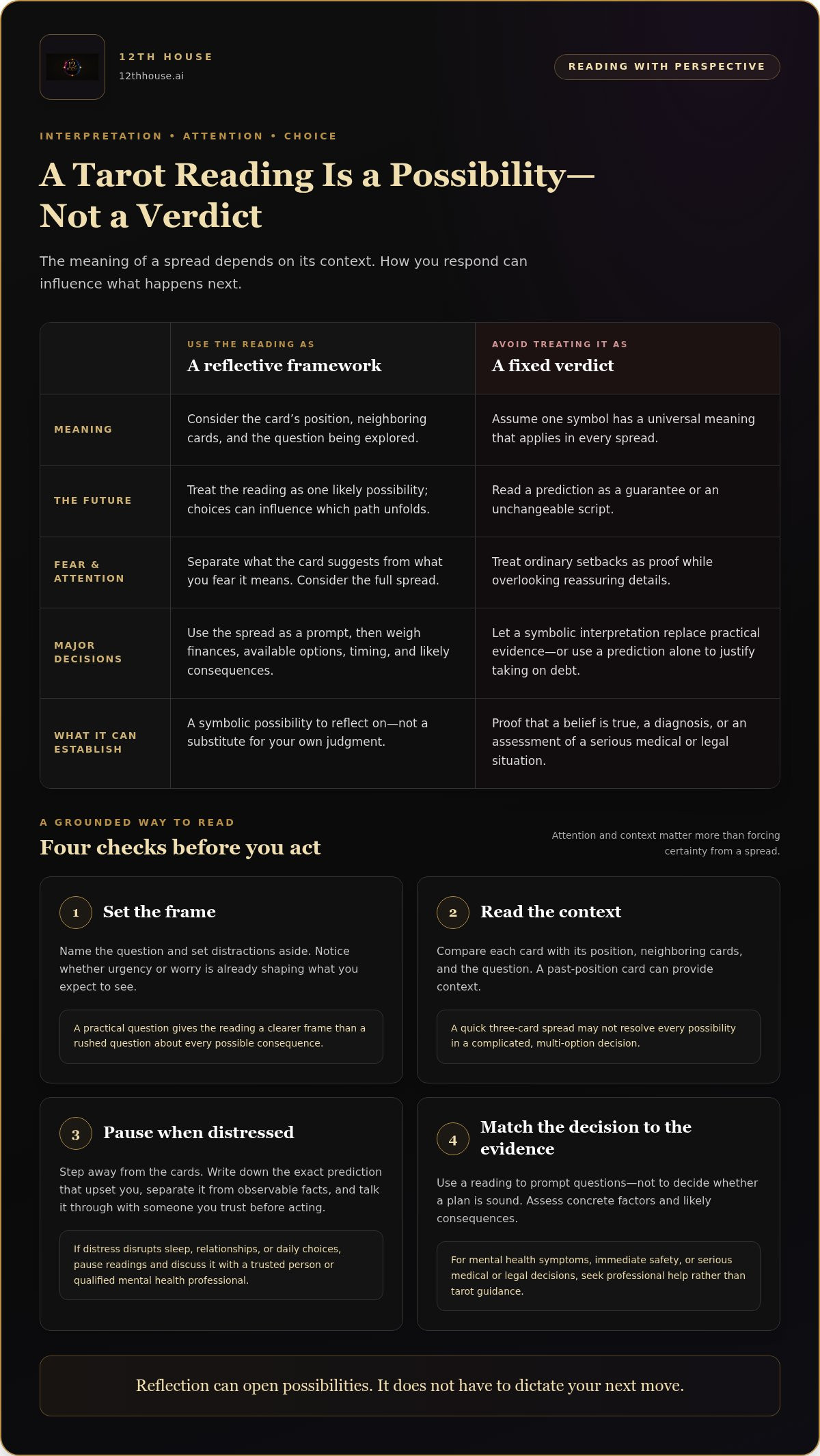
A card’s meaning depends on its position, neighboring cards, and the question being explored. The dangers of misinterpreting tarot cards grow when one symbol is treated as a universal verdict.
Differences Across Readers and Traditions
Tarot interpretations vary because readers and traditions use different symbolic frameworks and emphasize different details. The same card may suggest a challenge in one spread and a resource in another. Consider how the card relates to its position and question instead of assuming one meaning applies everywhere. Starting with a card for the past can also give the reader or querent context to assess before interpreting the rest.
A quick three-card spread may not account for every possibility in a complicated question. For example, a career decision involving several options needs more nuance than a forced yes-or-no answer. Timing can also be difficult to interpret: one reported career change occurred two years after a prediction. Wait before judging an apparent mismatch, since later events may add context to the symbols.
Seek professional help rather than tarot guidance when a question concerns mental health symptoms, immediate safety, or a serious medical or legal decision. A symbolic reading can’t assess those situations or replace qualified care.
Unethical or Exploitative Readers
An exploitative reader uses fear, pressure, or claims of certainty to control a querent’s choices. Watch for someone who presents a frightening prediction as unavoidable, insists that only they can prevent it, or urges repeated paid readings to remove a supposed threat. The dangers of misinterpreting tarot cards deepen when a reader turns uncertainty into leverage instead of leaving room for reflection and personal agency.
Another warning sign is discouraging outside advice or telling you to ignore practical evidence. A claim that a card guarantees success shouldn’t override a careful review of a job offer or contract. Keep your own judgment in the picture, and step away if pressure replaces interpretation.
Can tarot readings cause anxiety, fear, or harmful decisions?
Yes. A reader or querent can take the wrong message from a spread, and fear can make that interpretation feel absolute. The risk grows when a symbolic prediction becomes the main reason for a consequential choice.
Consider a card interpreted as conflict. Someone may approach a partner expecting betrayal, read ordinary tension as proof, and withdraw before discussing what happened. The card didn’t establish betrayal, but the interpretation can shape behavior and strain the relationship. This feedback loop can make a feared outcome seem confirmed, even when the person’s response helped create the distance.
Notice what follows the reading. Are you sleeping less, repeatedly drawing cards about the same fear, or avoiding a conversation because of one prediction? These are useful signals to pause. Put the spread aside, write down the specific claim that worries you, and distinguish it from events you can observe. A card is a symbol, not independent evidence that a feared event will occur.
High-stakes choices need more than a spread. A tarot prediction shouldn’t be treated as a guarantee or used alone to justify taking on debt. Before borrowing for a business plan, for example, examine the repayment terms, expected income, and alternative options. The cards may prompt reflection, but they can’t calculate whether the debt is manageable. Apply the same distinction to work, relationships, and major commitments: identify the real-world facts, then decide based on those facts and your priorities.
If the reading leaves you distressed, stop pulling cards and speak with someone you trust. If fear begins to interfere with daily life, seek support from a qualified mental health professional. Tarot can support reflection; it isn’t a diagnostic tool or a substitute for care. To explore a spread as a reflective practice, reflect on a tarot reading without treating its symbols as instructions.
12Th House: Ask Lala AI Spiritual Guidance
12th House’s Ask Lala AI Spiritual Guidance offers a next step when a tarot reading leaves you sorting through symbols, questions, or competing interpretations. Use spiritual guidance to reflect on what a reading brings up, while keeping your own judgment central. If you want to explore the cards themselves, Tarot Readings may help you examine their meanings in context. For a wider personal framework, Astrology Birth Chart & Transit Analysis or Numerology Reports offer other forms of metaphysical inquiry. Treat these tools as prompts for reflection, not instructions for major decisions or substitutes for professional support when you need it. Explore the guidance that fits your question, and visit 12th House online.
Carry the Reading Forward with Clarity
A tarot reading can open a line of inquiry, but your next move belongs to you. Let the dangers of misinterpreting tarot cards remind you to hold each interpretation with care, not fear. Choose one grounded action: write down what the reading brought up, name the question you still have, and decide what evidence or perspective would help you consider it more fully.
When you want a structured space for spiritual reflection, 12th House offers Ask Lala AI Spiritual Guidance, Tarot Readings, and Astrology Birth Chart & Transit Analysis. Each offers a different lens for exploring your questions, while your judgment remains central. Use guidance to deepen reflection, not to surrender your choices.
Explore tarot guidance with 12th House and take your next step with intention.
Frequently Asked Questions
Can Tarot Cards Be Wrong?
Tarot cards aren’t factual instruments that can verify a future event, so a prediction may not match what happens. A reading can also seem wrong because its symbols were applied too literally or the original question was unclear. For example, a card suggesting transition could refer to changing responsibilities, not leaving a job. Revisit the question and interpretation before treating the spread as a failed forecast.
What are the psychological risks of misinterpreting tarot cards?
Misinterpretation can intensify worry, encourage repetitive checking, or make someone view ordinary events as proof of a feared prediction. For example, someone worried about a friendship might repeatedly search a spread for signs of rejection, then read a delayed reply as confirmation. If tarot begins disrupting sleep, concentration, or relationships, pause readings and seek support from a qualified mental health professional.
Can tarot cards predict medical, legal, or financial outcomes reliably?
No. Tarot shouldn’t be treated as a reliable way to determine a diagnosis, court decision, investment result, or debt outcome. For a new symptom, seek medical care; for a legal dispute, review the documents with a qualified legal professional; for borrowing or investing, examine terms, risks, and repayment capacity. Cards can prompt questions, but they can’t verify evidence or replace informed professional judgment.


