
Yes, you can become dependent on astrology readings if you start relying on them for reassurance or direction instead of treating them as one perspective. A horoscope may comfort you when life feels uncertain, but repeatedly seeking predictions can make uncertainty harder to tolerate. What matters is how readings affect your choices and emotional balance.
It makes sense to turn to astrology for meaning: its symbols can help you reflect on patterns and name feelings that are difficult to put into words. But comfort and dependence aren’t the same. You’ll learn how horoscope predictions can shape your feelings and how to tell whether your reading habits support reflection or fuel a cycle of reassurance-seeking.
We’ll explore why predictions can feel compelling, which recurring behaviors may point to an unhelpful relationship with readings, and how to reflect on astrological themes without letting them dictate your decisions. The goal isn’t to dismiss astrology, but to approach it with curiosity, discernment, and a steady sense of agency.
Key Takeaways
- Notice whether horoscope predictions help you reflect or leave you seeking more certainty and reassurance.
- Track recurring astrological themes alongside your own feelings and choices to see what meaning you’re assigning to them.
- Look for patterns such as repeated checking or difficulty making decisions without a reading, and consider how they affect daily life.
- Focus less on a label and more on whether your reading habits cause distress or interfere with your well-being.
Astrology and horoscope predictions
Astrology readings interpret symbolic patterns, while horoscope predictions apply those symbols to possible experiences. A prediction can prompt reflection, but it doesn’t determine what you must do.
Enjoyment and Excessive Reliance
Enjoying astrology means treating a chart or horoscope as one perspective. Excessive reliance means feeling that you need a reading before you can choose. The distinction matters: the same daily horoscope can inspire reflection or become a rulebook.
For example, you might read a forecast, consider whether it resonates, then decide whether its framing fits. Reliance becomes more concerning when you postpone a conversation, purchase, or personal decision until a reading gives you permission. Notice whether astrology expands your perspective or narrows your options.
Compulsive Reading and Reassurance Seeking
Compulsive reading means repeatedly checking predictions to ease uncertainty, even when each reading brings only brief relief. Reassurance can create a loop: doubt prompts another search, and conflicting forecasts create fresh doubt.
Look for specific patterns, such as opening several horoscope apps before a date or rereading a prediction after receiving a difficult message. You might also feel driven to ask different readers the same question until one answer feels safe. The signal isn’t a particular reading frequency; it’s feeling unable to stop or tolerate uncertainty without another prediction.
Mental Health and Decision-Making Risks
Frequent readings can intensify worry when you treat predictions as warnings or instructions. For example, a forecast about conflict may lead you to interpret a neutral text as proof of rejection.
This can shift attention from observable evidence to feared outcomes, complicating decisions about work, relationships, or money. A reading may also increase distress if a person keeps searching for certainty but encounters contradictory interpretations. Watch for an impact on sleep, concentration, relationships, or everyday choices; those effects matter more than whether astrology itself feels meaningful.
Reducing Compulsive Reading
To reduce compulsive reading, create space between an anxious thought and your next search. Try one practical boundary: pause before opening a horoscope, write down the question you want answered, and identify a real-world source of information.
For a relationship concern, that source might be a direct conversation rather than another prediction. If anxiety or reassurance-seeking disrupts daily life, seek support from a licensed mental health professional. They can assess your situation and discuss approaches such as cognitive behavioral therapy. Professional help is especially relevant when repeated readings feel uncontrollable or distress affects sleep, relationships, or decisions.
Reflecting on recurring astrological themes
Recurring astrological themes can prompt you to examine patterns in your choices, relationships, and responses. Treat a transit as a symbolic lens, not proof that an event must happen.
For example, Saturn themes are often associated with responsibility, limits, and commitment. Astrology places the Saturn return around ages 28 to 30, a period some people use to reflect on changing obligations. The useful question isn’t whether Saturn caused a life event. Ask what the theme helps you notice about decisions you’re already making.
Astrologers can encourage dependence if they present repeated readings as necessary for safety, certainty, or permission. A reflective reading supports your own judgment and leaves room for choices beyond a chart’s interpretation.
Use a short record to separate the astrological symbol from your lived experience:
- Name the theme: Write down a specific idea, such as boundaries or change.
- Record an example: Note a real interaction or decision that brought the theme to mind.
- Identify your response: Describe what you felt and what you chose, without treating the chart as the cause.
- Review the pattern: Ask whether the theme helps you understand yourself or makes you search for more predictions.
This method anchors the interpretation in observable details. If a horoscope mentions tension, for instance, compare it with what was actually said during a conversation. That distinction can show whether astrology is helping you reflect or shaping your expectations before events unfold.
Recurring symbols can offer useful language for self-inquiry, but they don’t replace direct evidence. A chart can raise a question about commitment; your actions, conversations, and circumstances provide context for answering it. Let the theme prompt reflection, then let your lived experience guide the meaning you give it.
What are signs of compulsive astrology reading or reassurance seeking?
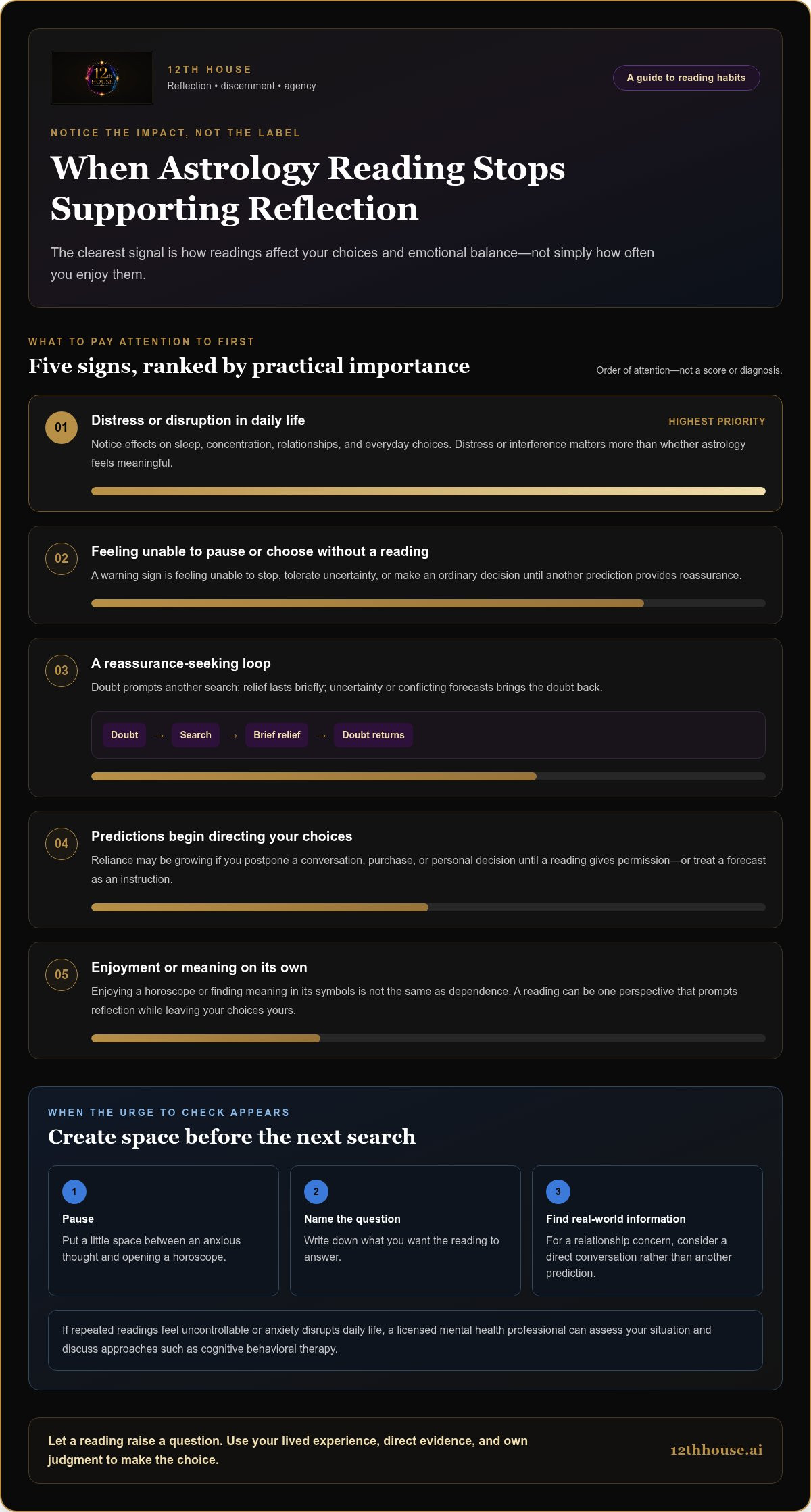
Compulsive astrology reading means returning to predictions to ease distress, even when the relief fades quickly. For example, you might check several horoscopes before deciding whether to send a routine message. The key sign isn’t enjoying astrology often; it’s feeling unable to pause or make ordinary choices without another reading.
Look for changes in how you use readings. A curious check-in may leave you with a question to consider. Reassurance-seeking often demands a definite answer, then prompts another search when forecasts disagree or uncertainty returns. Notice the effect on your attention, time, mood, and ability to act.
- Repeated checking: You refresh a daily forecast several times because its first wording didn’t settle your worry.
- Seeking matching answers: You ask different sources about the same relationship concern until one prediction feels comforting.
- Delaying decisions: You postpone accepting an invitation until a horoscope seems favorable.
- Distress without access: You feel unusually anxious when you can’t check a chart or reading.
- Life getting crowded out: Horoscope searches interrupt work, conversations, or sleep routines.
One sign alone doesn’t establish a problem. Consider the pattern: does checking help you return to your day, or create more questions? For instance, after reading a forecast about change, you might search for more predictions instead of addressing a practical concern. That shift can show that reassurance, rather than reflection, is driving the habit.
A simple observation practice can make the pattern clearer. For each reading, note the trigger, how you felt beforehand, the answer you sought, and what happened afterward. If uncertainty returns quickly, record whether you searched again or made your decision using other information. Reviewing your notes can show whether readings support reflection or have become a condition for feeling safe enough to act. Focus on impact and choice, not a strict count of how often you read.
Is astrology reading addiction recognized as a mental health diagnosis?
The phrase “astrology reading addiction” doesn’t, by itself, establish a mental health diagnosis. A clinician considers a person’s distress, daily functioning, and broader symptoms, not astrology use alone.
That distinction matters. Someone may read a horoscope regularly without experiencing a problem, while someone else may feel unable to stop checking predictions. For example, repeatedly consulting forecasts before ordinary decisions could be worth discussing if it disrupts work, relationships, or rest.
A professional assessment looks at the pattern behind the habit. A clinician may ask what triggers each reading, what relief it provides, and how long that relief lasts. They’ll also consider whether anxiety, low mood, or another concern is affecting your choices. Those details help distinguish a spiritual practice from behavior that causes significant distress or disruption.
If you seek support, prepare concrete examples. Note a recent moment when you felt compelled to check a chart, what you feared might happen, and what you did next. Include practical effects, such as postponing a decision or losing focus during a conversation. These observations give a mental health professional a clearer picture than a label alone.
Support can focus on the underlying difficulty, such as tolerating uncertainty or managing anxiety. A therapist may discuss ways to notice urges, examine anxious predictions, and make decisions using available evidence. The approach depends on your circumstances and goals; the aim isn’t to judge your beliefs about astrology.
Seek professional help when repeated readings feel difficult to control or interfere with daily life. For instance, if checking predictions repeatedly disrupts your sleep or strains a relationship, describe those specific effects to a qualified mental health professional. You don’t need to decide whether “addiction” is the right word before asking for support. Start with what’s happening, how it affects you, and what you want to change.
12Th House: Ask Lala AI Spiritual Guidance
12th House offers Ask Lala AI Spiritual Guidance for exploring spiritual questions through reflection. Use it to examine an astrological theme, clarify what you’re feeling, or frame questions about a recurring pattern. Let the reading open inquiry, not decide what you should do.
If you want a broader symbolic framework, Astrology can help you explore chart and transit themes. Tarot and Numerology offer other ways to reflect on a question. These tools support personal exploration; they don’t replace professional mental health support when anxiety or compulsive checking disrupts daily life.
Bring a specific question, stay curious about your own interpretation, and keep real-world evidence in view. Visit 12thhouse.ai to explore Ask Lala AI Spiritual Guidance.
Choose Reflection That Returns You to Yourself
Asking whether you can become dependent on astrology readings can help you notice what you need from them. Use that insight to shape a more deliberate practice: bring a question to a reading, then make room for your own judgment and the evidence in front of you. The aim isn’t to silence curiosity, but to keep symbolic insight in conversation with your lived experience.
For continued spiritual reflection, 12th House offers Ask Lala AI Spiritual Guidance, Astrology Birth Chart & Transit Analysis, and Tarot Readings. These offerings can give you different frameworks for exploring a question while keeping interpretation active in your hands.
Choose the next step that feels thoughtful, not urgent. Contact 12th House to explore its spiritual guidance offerings, and continue your inquiry with clarity and agency.
Frequently Asked Questions
Can horoscopes make people feel better?
Yes, a horoscope can feel comforting when its language helps you name an emotion or consider a situation differently. For example, a forecast about patience might help you pause before replying to a tense email. That comfort can come from reflection and perspective, not proof that a prediction will come true. Notice whether you feel more grounded afterward or more worried about what might happen.
Does the position of astronomical bodies affect a person's life beyond basic weather?
Astronomical bodies have physical effects: sunlight reaches Earth, and the Moon’s gravity contributes to tides. Astrology adds symbolic interpretations to planetary positions, but those interpretations aren’t the same as a demonstrated physical mechanism shaping your choices. For example, you can use a planetary transit to reflect on change without treating it as the cause of a job offer or relationship shift.
Can people become psychologically dependent on astrology readings?
Yes, you can begin relying on readings for reassurance or permission, though “astrology reading addiction” isn’t itself a diagnosis established here. Imagine someone who won’t accept a dinner invitation until checking a forecast, then feels compelled to consult another source if the wording seems unclear. The practical concern is whether this pattern limits choices or creates distress, not whether astrology matters to you.
Why do people rely on astrology readings for decisions and anxiety relief?
Astrology can offer a ready-made framework when a decision feels ambiguous or emotionally charged. Someone weighing a career change, for example, may turn to a chart because it gives the question structure and language. Reassurance can feel especially compelling when outcomes are uncertain. To keep perspective, pair symbolic reflection with concrete considerations, such as the role’s responsibilities, your priorities, and a conversation with someone involved.


