

What if a human design test isn’t testing your personality at all? It’s better understood as a chart calculation: your birth date, time, and place are used to generate a BodyGraph, not a score from a conventional quiz. That distinction matters when unfamiliar terms or fixed-sounding labels make the result feel like a verdict.
If you’re unsure whether an approximate birth time is accurate enough, or what to make of terms like Type, Strategy, and Authority, you’re asking the right questions. This guide explains how a Human Design result is generated, what birth information to gather, and how to approach uncertainty about your birth time. You’ll also learn to read the chart’s core elements without treating them as a definition of who you are.
Use the chart as a framework for reflection and personal experimentation, not a diagnosis or final answer. We’ll move from the information needed to create a chart to the meaning of its key features, so you can approach your result with curiosity and discernment.
Key Takeaways
- A human design test result is most useful when you understand how the chart was generated, not just the label it assigns.
- Check your birth details against reliable records, and note any uncertainty before entering them into a chart calculator.
- Learn what Type, Strategy, Authority, and Profile mean within the system before applying them to your choices.
- Use chart interpretations as prompts for observation and personal experimentation, rather than rules you must follow.
- A Human Design Profile, Lala, and a self-guided metaphysical library can offer structured ways to explore chart concepts further.
What Is a Human Design Test, and What Does It Actually Tell You?
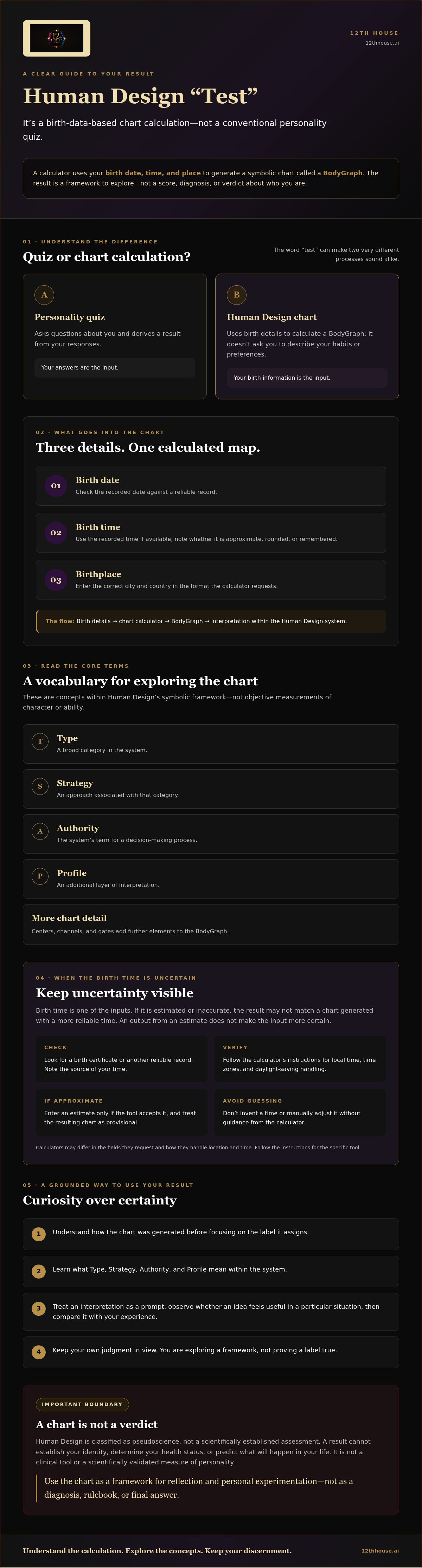
A Human Design test usually calculates a chart from birth details rather than measuring your personality through a series of answers. The result is commonly displayed as a BodyGraph, a symbolic map interpreted within the Human Design system. In short: a Human Design test is a birth-data-based chart calculation, not a conventional personality quiz.
A chart may identify your Type, Strategy, Authority, and Profile, alongside defined or undefined centers, channels, and gates. These terms belong to Human Design’s symbolic framework. They aren’t objective measurements of your character or abilities. For a neutral overview of its origins and concepts, see the Human Design system, which is also classified as pseudoscience rather than a scientifically established assessment.
Is a Human Design test a quiz or a birth chart?
The word “test” can be misleading. A personality quiz typically asks questions and derives a result from your responses. A chart calculator instead uses birth details to produce a chart; it doesn’t ask you to describe your habits or preferences. Change an answer on a quiz, and the outcome might change. For a chart calculation, the birth information is the basis of the result.
Some websites use “test” loosely, so check what a tool actually does before entering information. Does it ask you to answer questions, or request birth details and generate a BodyGraph? Knowing the difference clarifies what the result represents and what it can reasonably help you explore.
What can a Human Design result help you explore?
Begin with three common entry points. Type is a broad category in the system; Strategy describes an approach associated with that category; and Authority is the system’s term for a decision-making process. A Profile adds another layer of interpretation, while centers, channels, and gates provide more chart detail.
Treat these concepts as questions to consider, not instructions to obey. You might reflect on whether a suggested decision-making approach feels useful in a particular situation, then compare it with your experience. You’re exploring the idea through observation, not proving a label to be true.
A result cannot establish your identity, determine your health status, or predict what will happen in your life. Human Design isn’t a clinical tool or a scientifically validated measure of personality. Keep that boundary in view: the chart can offer a structured lens for reflection, but it cannot replace your judgment or define the full complexity of who you are.
How a Human Design Test Uses Your Birth Date, Time, and Place
A chart calculator turns birth information into a BodyGraph through a defined calculation. Start by gathering your details, enter them as the selected tool requests, generate the chart, then review the result alongside the tool’s explanations. Calculators may differ in the fields they ask for or how they handle location and time, so follow the instructions on the specific site rather than assuming every tool works the same way.
Birth time matters because it’s one of the inputs used in the chart calculation. If the time is wrong or only an estimate, the result may not match a chart generated with a more reliable time. Don’t assume a small discrepancy is irrelevant, or that a particular chart feature must change. Check the calculator’s guidance and treat uncertain results cautiously.
What birth information should you gather first?
Look for your recorded birth date and time on a birth certificate or another reliable record. Enter the birthplace in the format requested, including the correct city and country. Pay attention to whether the calculator asks for local birth time or explains its time-zone handling. Keep a note of the source and any uncertainty, especially if the time is rounded or remembered rather than documented.
Before generating a chart, check for possible time-zone or daylight-saving complications. These are details to verify, not reasons to guess or manually adjust the time without guidance from the calculator. If you’re exploring Type as a first step, this practical overview explains the five types and offers context for interpreting that part of a chart.
What if you do not know your exact birth time?
Don’t invent a time or assume a default setting creates a precise result. If your record says “around noon,” enter that only if the tool accepts approximate times, and label the resulting chart provisional. A calculator that requires an exact time may still produce an output from an estimate, but the display doesn’t make the input more certain.
If a tool offers transparent time-range testing, you can compare charts generated from plausible times and note which details remain consistent or differ. This comparison won’t prove your exact birth time. Otherwise, seek a reliable record before drawing strong conclusions. Hold any interpretation lightly while the input remains uncertain.
Once you have a chart to interpret, a structured Human Design Profile may help you explore its concepts. Lala, 12th House’s AI assistant, can also answer personalized questions about your chart.
How to Read Human Design Test Results Without Treating Them as Fixed Labels
A chart can look authoritative because it arranges symbolic terms into a precise visual map. Read those terms as parts of Human Design’s interpretive framework, not objective measurements that define your nature. Your Type or Profile may offer a lens for reflection, but neither captures every influence on your choices, relationships, or identity.
Start with the four elements below. They form a useful entry point before you explore the rest of the BodyGraph.
| Chart element | Role in the system |
|---|---|
| Type | A broad category used to describe a person’s energetic role. |
| Strategy | An approach associated with that Type for engaging with life. |
| Authority | The system’s framework for how someone might approach decisions. |
| Profile | A symbolic description of recurring themes in a person’s role or way of moving through life. |
Which Human Design chart elements should beginners read first?
Begin with Type and Strategy to understand the chart’s broad structure, then consider Authority and Profile. A deeper reading may include the BodyGraph’s centers, channels, and gates, which add further layers of terminology. You don’t need to decode every feature at once. For more context on Type, explore this Human Design types guide.
Descriptions can vary between sources, and some interpretations may sound more certain than the chart itself warrants. Compare definitions, check how a writer explains a term, and notice whether a claim is presented as one interpretation or as an unquestionable fact. The same label can’t tell the whole story of a person.
How can you test an interpretation against real experience?
Use neutral questions rather than searching only for evidence that confirms a description. If an interpretation suggests a particular decision-making approach, ask: “What factors did I consider in recent choices?” and “Were there times this approach didn’t fit?” Record observations across different situations. One example could reflect coincidence, context, or memory shaped by the interpretation; it isn’t proof that a label is accurate.
Keep what helps you notice a useful pattern. Set aside what feels inaccurate, limiting, or unhelpful. A human design test can supply language for reflection, but it doesn’t take authorship of your decisions. Let the chart prompt inquiry, then weigh its ideas against your lived experience and your own judgment.
A Practical Human Design Test Checklist for More Useful Results
A clear result starts with careful inputs and an explanation you can follow. Before treating any chart interpretation as meaningful, check what the tool calculated and how it presents its claims. Use this checklist to create a sound starting point:
- Confirm your birth date and time against a birth certificate or another reliable record.
- Enter the birthplace in the format the calculator requests, and note any uncertainty about the recorded time.
- Check whether the tool explains its terminology and makes its calculation inputs clear.
- Look for interpretations that invite reflection, not rigid predictions or absolute claims.
- If another calculator gives a different result, recheck your entries and compare how each tool describes its calculation method.
Accurate inputs improve calculation consistency, but they don’t prove the system’s claims. A precise-looking chart can still be an interpretation within a symbolic framework, not an objective assessment. If results conflict, investigate the inputs and methods before deciding what to make of the difference. Don’t simply choose the answer that feels most flattering.
How can you tell whether a Human Design result is useful?
A useful result gives you enough context to understand its labels. If a chart names a Type or Authority but offers no definitions, look for a source that explains those terms without turning them into rules. Be cautious of claims that predict what you’ll do or insist there’s only one correct way to make a decision. Clarity and room for inquiry matter more than a certain tone.
What should you do after generating your chart?
Choose one unfamiliar element and learn its definition before trying to interpret the whole chart. Then write down one or two practical questions it raises. For example, “What influences my decisions in this situation?” is more open-ended than “Does this label prove I should wait?” Record observations over time and notice both matches and exceptions. Don’t use the chart as a decision rule.
If you want to ask follow-up questions about chart concepts, an AI assistant can be one optional learning aid. This guide to an AI astrology assistant explores that kind of support. At 12th House, Lala is an AI assistant for personalized spiritual guidance, including questions about charts. You can also explore Human Design Profiles as a structured starting point for further study.
Explore Your Human Design Profile with 12th House
Once you’ve generated a chart, you don’t have to decode every symbol alone. A structured profile can help organize unfamiliar Human Design concepts and give you a clearer starting point for further study. Treat personalization as context for learning, not proof that every interpretation is definitive. The chart remains a symbolic framework, and you decide what, if anything, feels useful.
When might a personalized Human Design profile help?
A profile may be useful if your human design test left you with labels but little explanation, or if you want a more organized way to approach the chart’s terminology. 12th House offers Human Design Profiles through its digital metaphysical guidance platform. Before choosing a membership, check the current profile contents and access details so you know what’s included.
Keep your questions practical. You might want to understand a chart term, compare two definitions, or consider how an interpretation relates to an experience you’ve observed. A profile can provide structure for that exploration, but it can’t establish that one reading is the only correct one. Stay curious and make room for differences between sources, as well as your own judgment.
How can you continue exploring your chart?
At 12th House, members can ask Lala, the platform’s AI assistant, personalized spiritual guidance questions about their charts. Use it as an optional way to clarify concepts or form follow-up questions, not as a guarantee that an interpretation is accurate or a substitute for your own discernment. The platform also includes a metaphysical library for self-guided learning, giving you another way to explore at your own pace.
Choose a single chart concept to investigate, then compare what you read with what you actually notice in your life. You don’t need to accept every label or turn an interpretation into a rule. Keep the ideas that support thoughtful reflection; set aside those that feel inaccurate or constraining. A profile is a map to explore, not an instruction to follow.
If a more structured starting point would help, explore 12th House and its Human Design Profiles, AI spiritual guidance, and self-guided metaphysical library. Bring your questions, keep your perspective, and remain the interpreter of your own experience.
Carry Your Chart Forward with Curiosity
A human design test can give you a chart to explore, but it doesn’t deliver a final verdict on who you are. Begin with the birth details you can verify, learn the meaning of core terms such as Type and Authority, and notice how interpretations compare with your experience over time. Use the framework to ask better questions, not to outsource your choices.
If you’d like more structure for exploring chart concepts, 12th House offers Human Design Profiles within its digital metaphysical guidance platform. It also offers Lala for AI-based spiritual guidance. Treat these as learning supports, and check current details before choosing how to explore further.
Explore 12th House to continue your inquiry at your own pace. Stay open, stay discerning, and let your lived experience remain part of the map.
Frequently Asked Questions
Is a Human Design test the same as a personality test?
No. A Human Design test usually means a chart calculation based on birth details, while a conventional personality test typically uses your answers to questions. The chart’s Type, Strategy, Authority, and other elements come from the calculation, not from self-reported preferences. Human Design offers a symbolic framework for reflection, not a scientifically established measure of personality or a complete account of who you are.
What information do I need for a Human Design test?
You’ll generally need your birth date, birth time, and birthplace. Enter the city and country as the calculator requests, and check its instructions for handling local time and location. A birth certificate or another reliable record can help confirm the date and time. If your time is estimated or rounded, make a note of that uncertainty rather than treating the result as exact.
Can I take a Human Design test without knowing my birth time?
You may be able to generate a chart using an estimated time, depending on the calculator, but the result should be treated as provisional. Don’t enter a default time and assume it produces a precise chart. First, look for a reliable record. If a tool transparently supports comparing possible times, you can review differences, but that comparison won’t establish which time is correct.
How accurate is a Human Design test?
Accuracy depends partly on whether the birth information is entered correctly and how the selected calculator handles it. Consistent inputs can support a consistent calculation, but that doesn’t validate Human Design’s interpretations. The system isn’t a scientifically established or clinical assessment. Consider the chart a symbolic lens for reflection, and judge interpretations by their usefulness rather than treating them as proven facts about you.
What do Human Design test results include?
Results commonly present a BodyGraph with elements such as Type, Strategy, Authority, and Profile. Depending on the chart display, you may also see centers, channels, and gates. These terms have specific meanings within Human Design, so look for explanations rather than relying on labels alone. A chart provides material for interpretation, not a diagnosis, a prediction, or a definitive description of your identity.
Can my Human Design type change?
In the system, Type is calculated from birth information, so it doesn’t change as you gain new experiences or your personality develops. If different calculators show different Types, first recheck the birth date, time, and place you entered, then review each tool’s calculation approach. Even when a chart displays one Type consistently, treat it as a category within the framework, not a fixed definition of you.
What should I do after taking a Human Design test?
Start by checking your birth details and learning the meaning of one chart element at a time. Write down a question the interpretation raises, then observe how it relates to your experience across situations instead of using it as a rule for decisions. You can explore a Human Design Profile for structured context or ask Lala, 12th House’s AI assistant, questions about your chart.


