

What if an argument isn’t proof that one of you is wrong, but a pattern you can learn to recognize? If the same tension keeps returning, resolving conflict with human design can offer a new lens: not a verdict on either person, but a way to notice how you each respond under pressure.
Chart terms can feel abstract when a conversation is already charged. A Human Design chart can’t decide who’s right, explain away hurtful behavior, or guarantee an easy repair. Used with care, it can help you pause, consider your own habits, and stay curious about the other person without reducing them to a type or label.
This guide shows you how to use Human Design as a reflective map for recurring conflict patterns and more deliberate communication. You’ll learn to describe a dynamic without assigning blame, make room for each person’s perspective, and choose a practical next step for the conversation ahead.
Key Takeaways
- Start with the interaction pattern, not a judgment about either person. Human Design is a reflection framework, not a diagnostic test or a fixed label.
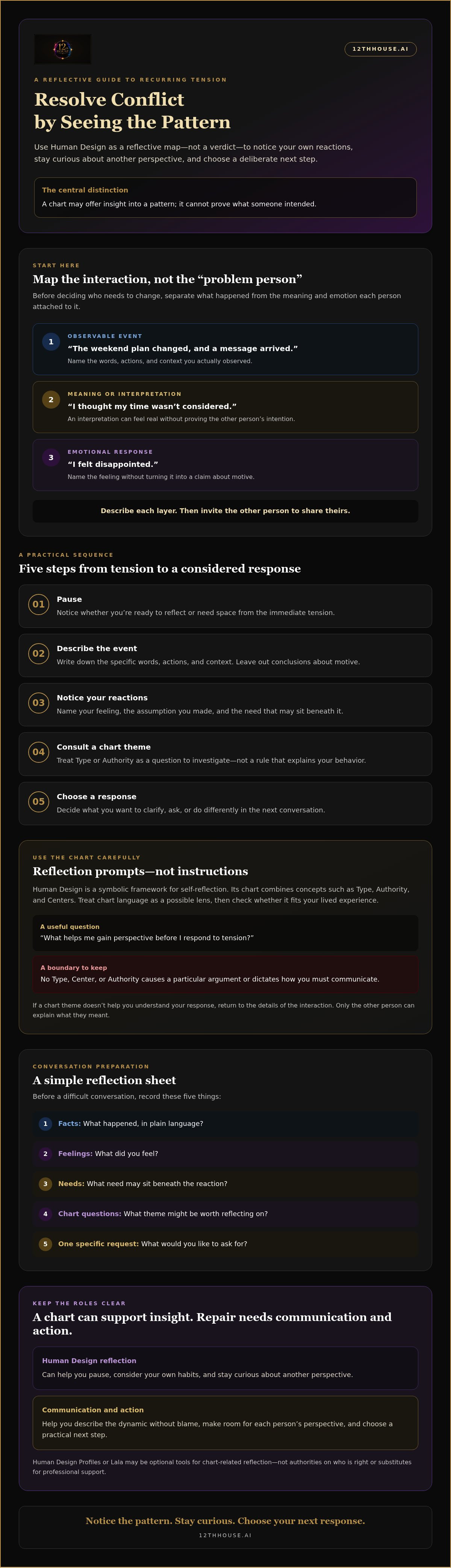
- Use a simple sequence: pause, describe what happened, notice your reactions, explore relevant chart themes, and choose a deliberate response.
- Resolving conflict with human design means using chart reflection to support self-understanding, while relying on communication and action to support repair.
- Prepare for a difficult conversation by recording the facts, feelings, needs, chart questions, and one specific request.
- Explore Human Design Profiles or Lala as optional tools for chart-related reflection, not authorities on who is right or substitutes for professional support.
Resolving Conflict with Human Design Starts with the Pattern, Not the Person
You agree to talk things through. You both mean well. Then the same disagreement returns, and the conversation feels familiar for all the wrong reasons. Before deciding who needs to change, map the pattern: what happened, how each person interpreted it, and what each did next.
Human Design is a symbolic framework for self-reflection, not a diagnostic tool or scientific test of conflict. Its chart combines concepts such as Type, Authority, and Centers. A neutral overview of the Human Design system can help explain its origins and components, but a chart can’t establish fault or reliably predict another person’s motives. It can suggest questions worth exploring.
A chart may offer insight into a pattern; it cannot prove what someone intended. Keep that distinction in view. It helps you stay curious without turning a chart interpretation into a verdict.
What does Human Design add to a difficult conversation?
Chart language can prompt you to consider how you approach decisions, express yourself, or respond when a conversation gets tense. Treat those ideas as possible lenses, then check whether they fit your lived experience. Does a theme help you describe what you noticed, or does it tempt you to excuse behavior or label someone? No Type, Center, or Authority causes a particular argument or dictates how you must communicate.
Why the same conflict can feel different to each person
Separate three layers: the observable event, the meaning each person gives it, and the emotional response that follows. Imagine one person changes a weekend plan by text. The observable event is that the plan changed and a message arrived. One person may see the change as practical; the other may interpret it as disregard and feel hurt. Neither interpretation proves the other person’s intention.
In your next conversation, name each layer separately: “The plan changed,” “I thought my time wasn’t considered,” and “I felt disappointed.” Then invite the other person to describe their experience. This makes it easier to discuss the interaction without casting either person as the problem.
If you’re new to chart language, explore this guide to the five Human Design types for foundational context. Use it to build vocabulary, not to assign roles in a disagreement. The practical aim of resolving conflict with human design is to notice what may be happening between you, then choose how to respond with care.
How Human Design Can Help You Trace a Conflict Pattern
A chart is most useful as a prompt for reflection, not a script for the conversation. Before reaching for an explanation, write down what happened in plain language. “They said, ‘Can we decide now?’” is more precise than “They pressured me.” The first describes an event; the second interprets it.
Use this five-step sequence to examine your part in the pattern without assuming you know what is happening inside the other person:
- Pause. Notice whether you’re ready to reflect or need space from the immediate tension.
- Describe the event. Record the specific words, actions, and context you observed. Leave out conclusions about motive.
- Notice your reactions. Name the feeling, the assumption you made, and the need that may sit beneath it.
- Consult a chart theme. Use Type or Authority as a question to investigate, not a rule that explains your behavior.
- Choose a response. Decide what you want to clarify, ask, or do differently in the next conversation.
This sequence makes self-reflection concrete. It doesn’t make the chart responsible for the disagreement, and you don’t have to accept an interpretation that doesn’t fit. If a chart theme doesn’t help you understand your response, return to the details of the interaction.
Use chart themes as questions, not instructions
Within Human Design, Type describes a broad category in the system, while Authority refers to a personal decision-making concept. You might ask, “What helps me gain perspective before I respond to tension?” Don’t turn an answer into a prescription about when or how you must speak. If Type terms are unfamiliar, review this Human Design chart guide for context, then compare the language with your own experience.
A chart can generate reflection questions, but it can’t read another person’s intent. A theme may help you examine your response; only the other person can explain what they meant.
Separate the trigger, reaction, and repair opportunity
Imagine a friend asks you to make a decision about shared plans before you’ve had time to consider it. Record the trigger as the specific request. Then note your reaction, perhaps feeling rushed, and the assumption that your preferences won’t be heard. The need might be time to think or a chance to explain your view. These notes describe your experience without labeling your friend.
If a written chart reflection would help you organize your questions, you can explore Human Design Profiles as an optional self-guided resource. Bring one open question into a calmer conversation: “Can you tell me what was happening for you when you asked for an answer right away?”
Human Design Versus Communication Tools: What Helps Resolve Conflict?
Human Design and communication tools serve different purposes. Chart reflection can help you examine your preferences or recurring reactions. It can’t repair a rupture on its own. Repair depends on what people say and do: listening, making clear requests, respecting boundaries, and following through.
- Chart reflection: Use Type, Authority, or other chart themes to generate questions about your own responses. A chart offers a lens, not a complete account of the situation.
- Active listening: Listen to understand the other person’s experience, then check what you heard. Listening can clarify a misunderstanding, but it doesn’t require agreement or giving up your perspective.
- Clear boundaries: State what you’re comfortable with and what needs to change. A boundary makes your limit explicit; it doesn’t control another person’s choices.
- Facilitated support: A qualified professional, therapist, or mediator may help people work through complex conflict. Chart interpretation isn’t a substitute for this support.
The distinction matters: Human Design may inform self-reflection, while repair requires communication and action. Use the chart to prepare for a more thoughtful conversation, not to replace one.
When a chart-based lens may be useful
A chart theme may help you name a personal preference or notice a reaction worth exploring. For example, you might reflect on how you approach decisions when you feel pressed. Check any interpretation against the circumstances and the other person’s account. Compatibility language can offer chart context, but it can’t determine whether two people should stay together or separate. This birth chart compatibility guide offers related context, not a conflict verdict.
When direct communication or outside support matters more
For an ordinary disagreement, name the specific issue, listen without interrupting, and make one clear request. For example: “I’d like us to check in before changing plans. Can we agree on that?” Then pay attention to whether the request is understood and respected.
No Type or Center excuses harm, dismisses a boundary, or proves who’s to blame. If conflict is repeated, coercive, or unsafe, prioritize appropriate help from a qualified human professional or support service. Spiritual interpretation alone can’t assess risk or provide the care such situations may require.
A Practical Human Design Process for Your Next Conflict Conversation
Reflection is most useful when it leads to a clearer exchange. Use this process to prepare, stay present during the conversation, and review what changed afterward. Your chart can help you frame a question, but it shouldn’t become a script for the other person.
Prepare without turning the chart into a script
Before you talk, write the event in neutral terms and decide what you hope the conversation will make possible. Choose one chart concept to reflect on, then set the chart aside while you listen. For instance, consider what helps you approach a difficult exchange with more perspective. Don’t use that reflection to explain the other person’s behavior.
Try opening with: “Can we talk about what happened and what would help next time?” A short worksheet can keep your preparation grounded:
- Facts: What was said or done? Keep this observable.
- Feelings: What did you feel, without judging the feeling?
- Needs: What matters to you in this situation?
- Chart question: What personal response or preference do you want to understand better?
- One request: What specific action would help next time?
Speak, listen, and revisit the agreement
During the conversation, take turns describing what each of you experienced. Summarize what you heard before replying: “I hear that you felt left out of the decision. Did I understand?” You don’t have to agree. Checking your understanding shows that you’re listening instead of preparing a counterargument.
Use accountable language that stays with your experience: “I felt uncertain when the task changed and I didn’t know who was handling it.” Avoid claims about motives, such as “You changed it because you don’t trust me.” Then make a concrete request or state a boundary: “Could we confirm who owns each task before we leave the meeting?”
Agree on one manageable next step, then review whether it happened and what effect it had. A useful conversation doesn’t have to end in instant agreement. Progress may mean clearer expectations, an understood boundary, or a specific change to try.
For an optional way to explore chart questions before a conversation, explore Human Design Profiles. Treat the reflection as preparation, not a verdict. Resolving conflict with human design still rests on what each person communicates and does next.
Use 12th House and Lala for Ongoing Human Design Reflection
Once you have a practical conversation process, chart tools can support reflection between conversations. 12th House offers Human Design Profiles and Lala, an AI assistant for personalized questions about charts and compatibility. These digital tools can help you explore chart themes and organize what you want to ask yourself. They can’t determine who was right or resolve a disagreement for you.
Bring a specific question to Lala
A focused, open-ended prompt is more useful than asking a tool to judge the conflict. Keep the inquiry centered on your own chart and choices. For example:
- “What questions could I explore about how I approach communication under stress?”
- “What chart themes might help me reflect on how I make decisions in tense conversations?”
- “What are some possible interpretations of this theme, and what should I consider before applying it?”
Ask for possibilities and questions to consider, not a definitive explanation of what someone meant or what you should do. Check any interpretation against your lived experience, the details of the situation, and the other person’s perspective. If an answer sounds certain about someone else’s motives, treat that certainty with care.
Keep Human Design in its proper role
Human Design can be one part of your reflection, not the authority over your relationship. Repair still depends on listening to each other, taking accountability for your actions, respecting boundaries, and following through on agreed changes. A profile or AI response can’t replace those steps.
12th House provides digital tools for self-guided exploration, not live human consultations. Lala isn’t a therapist, mediator, or arbiter, and it shouldn’t replace qualified human support when conflict is repeated, coercive, unsafe, or too difficult to address alone. Used thoughtfully, these tools may help you prepare clearer chart questions as part of resolving conflict with human design, while leaving decisions and responsibility with the people involved.
If you’d like to explore your chart at your own pace, explore 12th House and use its digital resources as prompts for reflection, not as a verdict on your next conversation.
Carry a More Deliberate Approach into Your Next Conversation
The next disagreement doesn’t have to follow the same script. Start by separating what happened from what you assumed, then use Human Design as a prompt to reflect on your own responses. A chart can offer questions to consider, but it can’t assign blame or make a repair for you. Listening, accountability, clear boundaries, and follow-through remain the work of the people involved.
That’s the practical value of resolving conflict with human design: use the framework to understand a pattern, then choose a grounded next step. You don’t need instant agreement for a conversation to move forward. A clearer request or a better understanding of each other’s experience can matter, too.
12th House offers Human Design Profiles, Lala for personalized questions about charts and compatibility, and access to a metaphysical content library through membership. These are tools for reflection, not a verdict on who’s right or a substitute for human support. Explore 12th House and continue your Human Design reflection.
Approach the next conversation with curiosity, care, and room for both people to choose what comes next.
Frequently Asked Questions
Can Human Design help resolve a conflict?
Human Design may support self-reflection, but it can’t resolve a conflict by itself. Use chart themes to consider your communication preferences or reactions, then check those ideas against what happened. Resolving conflict with human design still depends on practical steps: listening, naming your experience, making clear requests, respecting boundaries, and following through. A chart can offer perspective, not guarantee agreement or repair.
How do you use Human Design during an argument?
During an argument, prioritize the conversation over chart interpretation. If you can, pause and identify what was said or done, what you’re feeling, and what you need to clarify. Save chart reflection for later, when you can consider your own response without using Type or Authority as instructions. Return with a specific question or request, such as, “Can we talk about how to handle this differently next time?”
Can Human Design explain why two people keep arguing?
Human Design can suggest questions about how you and another person approach decisions or communication, but it can’t establish the cause of repeated arguments. Look for observable patterns first: what tends to trigger tension, what each person assumes, and how the exchange unfolds. Compare any chart-based interpretation with the situation and each person’s account. Recurring conflict may also involve unmet needs, unclear expectations, or unresolved issues that deserve direct discussion.
Should you use Human Design to decide who is right in a conflict?
No. A chart isn’t evidence that one person is right, another is wrong, or either person intended harm. Separate the facts from each person’s interpretation and emotional response. You can use a chart to reflect on your own perspective, but resolve disagreements by discussing what happened, listening to each other, and considering the impact of each person’s actions. Shared understanding doesn’t require identical interpretations.
What if someone uses their Human Design type to excuse hurtful behavior?
A Human Design type doesn’t excuse harm or cancel another person’s boundary. You can acknowledge someone’s interpretation of their chart while still being clear about the impact of their behavior. Try saying, “I understand that’s how you see your response, and I still need this behavior to stop.” Accountability means taking responsibility for actions and making a change, not using a chart label to avoid repair.
Can Lala help me understand a Human Design conflict pattern?
Lala can answer personalized questions about charts and compatibility, which may help you organize questions for self-reflection. Ask for possible themes or prompts about your own communication preferences, rather than a verdict on who is right or what another person intended. Check any interpretation against your lived experience and the other person’s perspective. Lala is an AI assistant, not a therapist, mediator, or substitute for direct communication and human support.
Is Human Design a replacement for couples counseling or mediation?
No. Human Design is a self-reflection framework, not a replacement for couples counseling, mediation, or other qualified human support. It may help you prepare questions about your own patterns, but it can’t facilitate a conversation, assess safety, or provide professional care. If conflict is repeated, coercive, unsafe, or difficult to address together, consider reaching out to an appropriately qualified professional or support service.


