
The best CHANI app alternative isn’t necessarily the one with the fullest daily horoscope. You don’t need prior astrology knowledge to compare options: look for clear explanations, then weigh subscription terms, included features, language, and the topics each app explores. The right fit is the one whose approach matches the questions you want to explore.
It’s reasonable to want more than a polished reading. You also need to understand what comes with a subscription, which features may cost extra, and whether the app’s language and subject coverage suit you. This guide compares five astrology app options by those practical criteria, without assuming you already know how to read a chart.
You’ll see how to assess plans and add-ons alongside each app’s approach to astrology, language support, and themes such as relationships, work, and personal growth. Use the comparison to narrow your choices, then follow the decision guide to identify the kind of tool that fits your practice.
Key Takeaways
- Compare subscription plans by what they include, then account for paid add-ons before judging overall value.
- Choose an app based on the astrology tools you’ll use, such as birth charts, daily horoscopes, or transit reports.
- Check that the app’s supported language and life themes fit how you want to explore astrology.
- Assess personalization by how clearly an app connects its interpretations to your chart and current transits.
- If you want to explore beyond astrology, Ask Lala AI Spiritual Guidance offers a way to work with personalized spiritual questions.
Subscription fees and add-on costs
A useful comparison starts with the full cost structure, not the first plan label you see. For any astrology app, distinguish core readings from optional content and note how billing renews. A low-cost entry point may be less useful if the chart interpretation, transit details, or journaling tools you want require separate purchases.
What are the best free astrology apps for iPhone and Android in the United States? The best free option is the one that offers useful chart or horoscope features for your main purpose without requiring an upgrade. Compare the same task across free tiers, such as checking a rising sign or reading a daily horoscope.
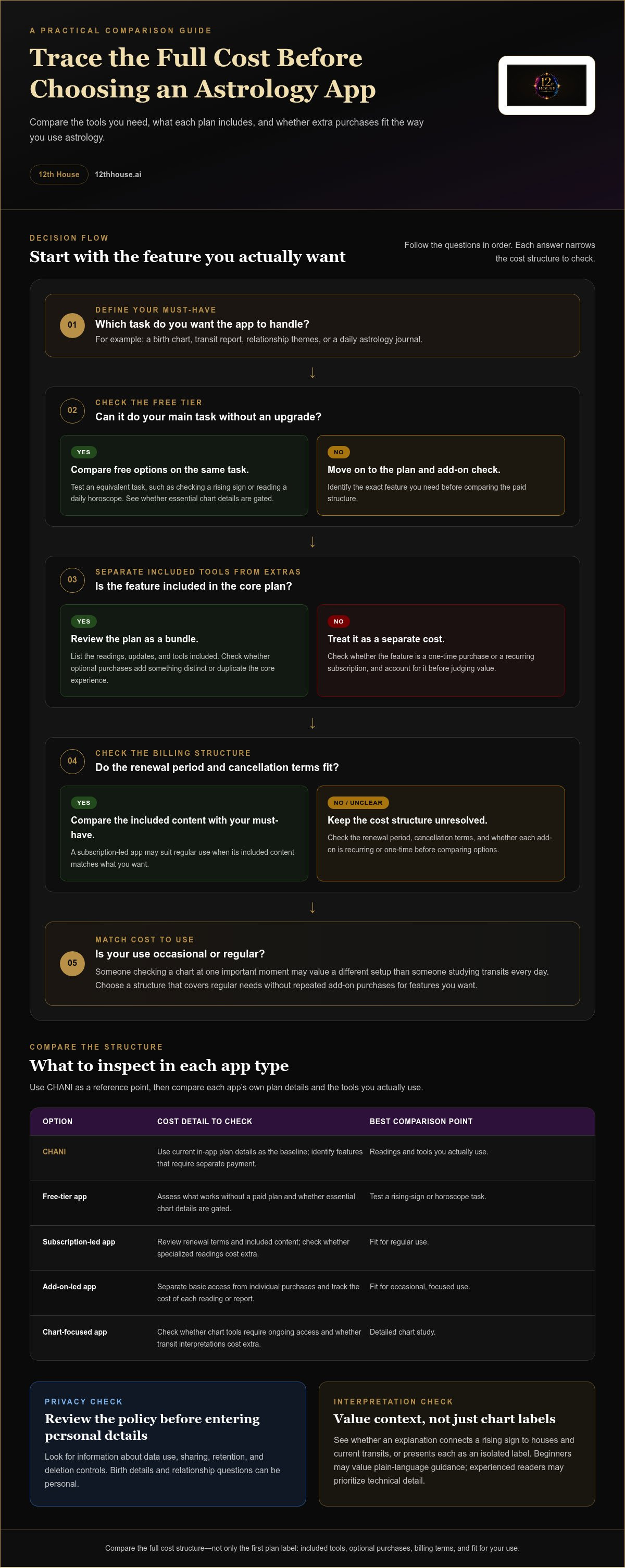
Use this sequence before you download:
- List your must-haves. Note whether you want birth charts, transit reports, relationship themes, or a daily astrology journal.
- Separate included tools from add-ons. Record which features remain available without a paid plan and which unlock separately.
- Compare billing structure. Look for the renewal period, cancellation terms, and whether an add-on is a recurring subscription or a one-time purchase.
- Match the cost to your use. A reader who checks charts at one important moment may value a different setup than someone who studies transits every day.
Which CHANI alternatives protect user privacy and avoid selling personal data? Read each app’s privacy policy for information about data use, sharing, retention, and deletion controls. Birth details and relationship questions can be personal, so review those practices before entering your information.
What are the most highly rated astrology apps similar to CHANI in 2026? Ratings depend on the storefront, the date, and the version being reviewed, so compare current user scores alongside written feedback. Look for comments about chart clarity, useful explanations, and whether paid features match what the app promises.
| Option | Subscription structure | Add-on question | Best comparison point |
|---|---|---|---|
| CHANI | Use its current in-app plan details as your baseline. | Identify which features require separate payment. | Compare the readings and tools you actually use. |
| Free-tier astrology app | Assess what works without a paid plan. | See whether essential chart details are gated. | Test a rising sign or horoscope task. |
| Subscription-led app | Review renewal terms and included content. | Check whether specialized readings cost extra. | Estimate fit for regular use. |
| Add-on-led app | Separate basic access from individual purchases. | Track costs for each reading or report. | Consider occasional, focused use. |
| Chart-focused app | Check whether chart tools require ongoing access. | Look for extra transit interpretations. | Prioritize detailed chart study. |
Choose a structure that covers your regular needs without making a feature you want depend on repeated add-on purchases.
Subscription value also depends on interpretation. A chart may map planets, signs, and houses, while an app’s paid features determine how much context accompanies that map. For example, see whether a rising sign explanation connects to houses and current transits or presents each as an isolated label. If you already understand astrology, technical detail may matter more than beginner prompts. If you’re learning, plain-language guidance may be more useful.
Chani Nicholas’s work is one reference point for readers seeking a reflective astrology voice, but compare actual app features rather than assuming similar plans or content. Assess a CHANI app alternative by its own terms, language, and subject coverage. Treat a subscription as a bundle: identify the readings, updates, and tools included, then consider whether any optional purchases add something distinct or duplicate the core experience.
What apps are the best alternatives to the CHANI astrology app?
The best alternative depends on what you want astrology to do. A daily horoscope app, a chart calculator, and a transit guide serve different purposes. Start with one concrete task, such as understanding your rising sign or following a planetary transit, then compare apps built around that task. Use CHANI as a reference point, but choose based on the structure and depth you prefer.
Use these five app types as a practical shortlist. They describe different ways astrology apps organize their tools, not a ranking of specific brands.
- Daily horoscope apps make a short reading the central feature. Choose this format if you want a brief prompt for a particular moment, rather than a detailed chart study.
- Birth-chart apps center on your natal placements. They suit readers who want to explore signs, houses, and the relationships between planets.
- Transit-focused apps connect current planetary movement with a birth chart. They can help you follow how a specific period relates to your existing placements.
- Learning-led apps explain astrological terms alongside readings. Choose one if terms such as “rising sign” or “house” still need context.
- Multi-system apps let you explore different astrological frameworks. They may suit readers comparing Western tropical astrology with Vedic sidereal astrology, which differ by approximately 24 degrees.
That distinction matters. A reading can change when the underlying zodiac framework changes, so compare the system an app uses before interpreting its chart. Don’t treat readings from two apps as directly comparable until you know whether they calculate and describe placements using the same framework.
Next, examine how each app turns its framework into a reading. A birth-chart tool might display your rising sign and houses, while a horoscope tool might focus on the day’s themes. Ask whether the app explains how those pieces connect. A list of placements offers a map; interpretation provides a route through it.
Also consider how you want to engage. Someone who prefers a short daily prompt may want a different interface from someone who revisits charts and records reflections in a journal. Try the same question in each app, such as “What does my rising sign describe?” Compare whether the answer gives clear context, uses familiar language, and helps you keep learning.
Keep your comparison focused. Select one app type, test one reading, and note what the result helps you understand. If you want a chart-centered approach that connects birth-chart placements with current transits, explore astrology birth chart and transit analysis as another way to examine those patterns.
Choose an app that matches your main use, explains its astrological framework, and gives you readings you can work with. A daily horoscope and a detailed transit interpretation are different tools, even when both use the language of astrology. Define your purpose first, then it becomes easier to identify the strongest alternative.
Which astrology apps offer birth chart readings, horoscopes, and transit reports like CHANI?
Look for an astrology app that connects three layers: your birth chart, current horoscopes, and transit interpretations. These tools answer different questions. A birth chart maps planetary placements at birth; a horoscope offers a time-based reading; a transit report relates current planetary movement to that personal map. One app may provide all three, while another may focus on just one.
Compare the app’s structure before choosing. A chart-led app should show placements and explain how signs, planets, and houses interact. A horoscope-led app should clarify whether its reading uses your Sun sign, rising sign, or both. A transit-led app should connect current planetary movement to your chart rather than presenting it as a general prediction.
- For birth-chart readings: Choose an app that presents a complete natal chart and explains its components. For example, check whether it interprets your rising sign alongside the planets and houses, instead of displaying isolated symbols.
- For horoscopes: Look for readings organized by a clear reference point, such as your rising sign. Compare a daily entry with a longer forecast to see whether the app gives usable context or only a brief theme.
- For transit reports: Find an app that relates current planetary positions to natal placements. A useful report explains which chart area it discusses and why that movement matters within the app’s chosen framework.
- For all three: Prefer an app that carries your chart details into its horoscope and transit sections. That connection makes it easier to follow one astrological framework across different reading formats.
The zodiac system also shapes what a chart displays. Western tropical and Vedic sidereal astrology differ by approximately 24 degrees, so placements can appear in different signs. Before comparing readings, identify the system each app uses. Otherwise, two interpretations may seem inconsistent when they follow different calculations.
Check how an app handles specific events, too. A Full Moon corresponds to a 180° separation between the Moon and Sun. An app may use that event in a horoscope or transit report, but the useful distinction is whether it explains the event generally or connects it to your own chart.
Use this short test when comparing options:
- Open the birth-chart section and find the rising sign, houses, and planetary placements.
- Read a horoscope and note which sign or chart point anchors it.
- Open a transit report and see whether it refers to your natal chart.
- Compare the explanations for clarity, continuity, and the astrological system used.
An app that passes all four steps offers a more connected experience than separate tools with no shared chart context. If your main goal is to interpret your chart alongside current transits, focus on those features first. If you prefer a brief daily reading, a horoscope-centered app may fit your routine better. Let the reading format guide your choice, then assess how clearly the app explains its symbols and framework.
How do CHANI alternatives compare in astrology accuracy and personalization?
“Accuracy” can refer to chart calculations or the relevance of an interpretation. Separate those standards before comparing apps. A chart calculation can consistently map placements using the birth details and zodiac system selected. Whether an interpretation feels personally meaningful depends on its framework, language, and connection to your circumstances.
Start with the information you enter. Birth date, time, and location shape a natal chart’s calculated placements. If the birth time is approximate, the rising sign and house placements may also change. Compare apps using the same birth details, then note whether their displayed placements align under the same zodiac system.
Next, identify the system each app uses. Western tropical and Vedic sidereal astrology differ by approximately 24 degrees. That difference can shift a planet’s sign, so comparing interpretations across systems without noticing the distinction can create apparent inconsistencies. Look for a clear explanation of the framework behind each chart.
Personalization also varies according to how an app uses your chart. A broad horoscope may address a Sun sign, while a more individualized reading may refer to a rising sign, house, or planetary placement. For example, see whether a transit report explains which natal placement it connects with, rather than offering the same general message to every reader.
- Calculation transparency: Does the app identify the zodiac system and show chart placements?
- Chart context: Does a reading connect planets, signs, and houses, or discuss them separately?
- Transit relevance: Does the report relate current movement to your natal chart?
- Interpretive clarity: Can you trace a reading’s explanation back to a specific chart factor?
- Personal input: Does the app use the birth details and chart points relevant to your question?
Test those criteria with one consistent example. Choose a transit report and record the placement, house, and interpretation each app presents. Then compare it with a horoscope for the same period. An app that explains the connection between its chart data and reading offers greater traceability, even if its symbolic interpretation differs from another app’s.
Astrological readings interpret symbolic systems; they don’t establish guaranteed outcomes. Judge an app by calculation consistency, transparent methods, and how specifically it applies a framework. “Personalized” should mean more than inserting a name into a generic paragraph. Look for references to distinct chart placements and an explanation of their relevance.
Spiritual AI emerged as a new category of astrology in 2026. Its personalized responses can make clarity and traceability especially important: notice whether an answer explains which chart details inform its interpretation. You can also compare an AI response with a conventional birth-chart and transit analysis, using the same question and chart context.
For a chart-centered comparison, explore personalized birth-chart and transit analysis and observe how placements connect with current transits. Use your own question as the test. The strongest fit is the one whose method you can understand and whose interpretation gives you a clear structure for reflection.
12Th House: Ask Lala AI Spiritual Guidance
12th House offers Ask Lala AI Spiritual Guidance for readers who want to explore a personal question through a spiritual lens. Use it when an astrology app gives you chart information, but you want to reflect on how it relates to a specific concern. For chart-focused exploration, Astrology Birth Chart & Transit Analysis connects natal placements with current transits. Tarot Readings and Numerology Reports offer other interpretive frameworks when astrology isn’t the only lens you want to use.
Bring a clear question, such as how a transit relates to a decision or which chart themes you want to examine. Choose a tool that fits the question, then use its interpretation as a structure for your own reflection.
To explore these guidance options, visit 12th House.
Choose a Practice That Grows With Your Questions
Turn comparison into a personal practice by choosing one question to explore and noticing which kind of guidance helps you think more clearly. A chart can offer structure; the meaning you make from it develops through reflection and attention.
Choosing a CHANI app alternative can be the start of a wider inquiry, not a final verdict on which tool is best. If your focus shifts from chart patterns to a more direct personal question, Ask Lala AI Spiritual Guidance offers another way to explore. Tarot Readings can bring a different symbolic framework to reflection, while Astrology Birth Chart & Transit Analysis keeps the focus on placements and transits.
Let your question set the direction. You don’t need to force every concern into one method; choose the tool that best supports the inquiry in front of you. For guidance that meets you at that point, contact 12th House for guidance.
Stay curious, keep your discernment, and let each reading prompt your own insight.
Frequently Asked Questions
Do I need to know astrology to use these apps?
No. Start with an everyday question, then use an app’s explanations to learn unfamiliar terms as they arise. For example, if a reading mentions your Moon sign, note the phrase and look for how the app connects it to emotions or habits. Keep a short list of terms you want to understand. This turns a reading into a guided learning path, not a test of prior knowledge.
So which one should a beginner pick?
Choose an app that explains its interpretations in language you can follow and lets you explore one question at a time. If chart symbols feel unfamiliar, start with a guided birth-chart reading rather than a tool focused on raw placements. Try asking what one placement means in a familiar situation, such as communication at work. The best starting point is an app that helps you understand the answer and encourages thoughtful follow-up.
How much do popular astrology apps cost, and what features are free?
Costs depend on each app’s plan, billing period, included readings, and optional add-ons. Free access can range from basic horoscopes to limited chart features, while detailed interpretations or extra tools may require payment. Compare the specific feature you want, not just the free label. For example, check whether a birth-chart view includes an interpretation or only displays placements, and whether a transit reading is included in the plan or costs extra.
Which CHANI alternatives protect user privacy and avoid selling personal data?
Before entering birth details or relationship questions, review each app’s privacy policy for data use, sharing, retention, and deletion controls.


