
The best AI astrology apps aren’t automatically the most accurate. Accuracy starts with the birth data and chart calculation, not the fluency of an AI reading. A year has 365.25 days, while an astrological chart has 360 degrees, so an app must map astronomical positions into a chart framework before interpreting them.
When comparing the best AI astrology apps, look beyond polished answers. The astrology system, compatibility tools, report depth, pricing model, and voice features all shape the experience. This guide shows you how to assess chart calculations and interpretations, compare systems and compatibility tools, and weigh AI reports, voice options, and access models. That way, you can choose based on the method and features, not just the promise on the screen.
Key Takeaways
- Judge chart accuracy by the birth details and calculation method behind a reading, not by how confident the AI sounds.
- Compare pricing models by what they include, such as free chat, paid reports, or wallet-based access.
- Use compatibility tools to examine chart patterns and relationship dynamics, not to treat a single score as a verdict.
- Choose between Vedic and Western astrology based on the system and interpretive framework you want to explore.
- Assess whether reports or voice calls suit your needs, then use Astrology Birth Chart & Transit Analysis for a structured look at chart placements and transits.
Which is the most accurate AI astrology app in 2026?
No single app is the most accurate for everyone. AI astrology apps differ in chart options, navigation, and privacy controls. Compare their calculation settings and data practices before weighing the interpretations.
Birth Chart and Kundli Readings
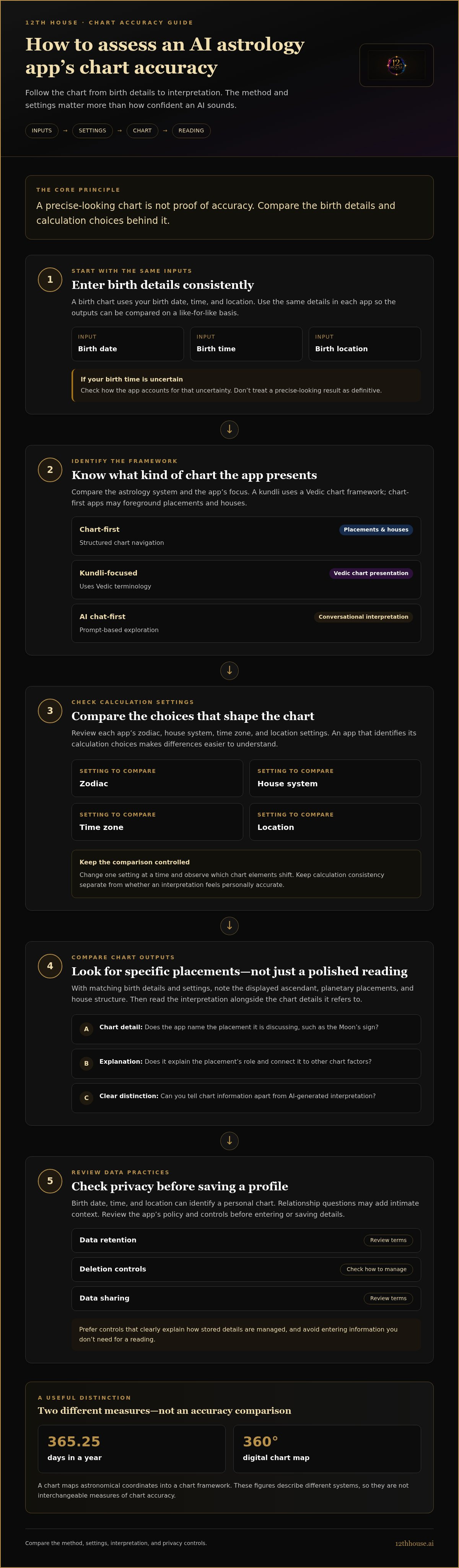
A birth chart maps planetary positions using your birth date, time, and location. A kundli uses a Vedic chart framework. Compare apps by checking whether they let you enter precise birth details and identify the system they use. A chart-first app may foreground placements and houses, while a kundli-focused app may organize its reading around Vedic terminology and conventions.
For a practical comparison, enter the same birth details in each app and note the displayed ascendant, planetary placements, and house structure. If your birth time is uncertain, see how the app accounts for that instead of treating a precise-looking result as definitive. Matching inputs and settings gives you a clearer basis for comparing chart outputs.
Chart Calculations and Ephemeris Accuracy
Ephemeris data underpins planetary positions, but matching birth details and chart settings matters too. A computer-generated natal chart maps astronomical coordinates onto a 360-degree digital map; a year has 365.25 days. Those figures describe different systems, so they aren't interchangeable measures of chart accuracy.
Compare each app’s zodiac, house system, time zone, and location settings. Then change one setting at a time and observe which chart elements shift. An app that identifies its calculation choices makes it easier to understand why its chart differs from another’s. Keep calculation consistency separate from whether an interpretation feels personally accurate.
Natal Chart Interpretations
Natal interpretations turn chart placements into themes, explanations, or prompts. Some apps prioritize concise, conversational AI responses; others organize content by planets, signs, houses, or aspects. Compare how each app explains a placement, such as the Moon’s sign, and whether it connects that placement to other chart factors.
Read an interpretation alongside the chart details it refers to. A useful report names the relevant placement and explains its role in the reading, rather than offering a broad statement that could fit anyone. Look for a clear distinction between chart information and AI-generated interpretation. This helps you assess the reasoning, not just the tone.
Privacy deserves its own comparison. Birth date, time, and location can identify a personal chart, while relationship questions may add intimate context. Before saving a profile, review the app’s privacy policy and controls for data retention, deletion, and sharing. Prefer settings that clearly show how to manage stored details, and avoid entering information you don’t need for a reading.
| App type | Chart focus | Usability | Privacy comparison |
|---|---|---|---|
| Chart-first | Placements and houses | Structured chart navigation | Review profile and deletion controls |
| Kundli-focused | Vedic chart presentation | Uses Vedic terminology | Review retention and sharing terms |
| AI chat-first | Conversational interpretation | Prompt-based exploration | Consider what each prompt reveals |
Choose an app whose chart settings match your preferred system and whose privacy controls suit the birth details you enter.
Pricing, free chat, and wallet credits
AI astrology apps use different access models, including free features, subscriptions, paid reports, or wallet credits. Compare what each model includes before choosing. A free chat may answer a limited prompt, while a paid tier may include saved charts or longer interpretations.
Which AI astrology apps are available on iOS and Android in the United States? Availability varies by app, and some services may be web-based rather than available on both mobile platforms. Compare current US app-store listings for the exact service you plan to use.
Free Tiers and Subscription Pricing
A free tier can help you test an app’s interface and reading style before paying. Try a specific task, such as asking it to explain one natal placement, then check whether the response refers to the chart details you entered. Note whether free access ends after a prompt, limits saved profiles, or excludes detailed reports.
Subscriptions can suit readers who return for recurring features, such as transit updates or ongoing chart exploration. Before starting one, identify the renewal period, included tools, and cancellation steps shown in the app. Compare those terms with how you expect to use it. Someone who checks a daily horoscope may need less access than someone who regularly studies charts and reports.
Free and Paid App Options
Distinguish free access from a free trial. A free feature may remain available, while a trial may unlock paid functions temporarily before subscription billing begins. Read the offer screen carefully, including its end date and renewal terms. This helps you avoid mistaking introductory access for a permanently free plan.
Paid options can package features differently. One app may include longer AI conversations in a subscription; another may sell individual reports. Compare the output you need, not just the plan label. For a one-time natal overview, a single report may suit you better than recurring access. If you explore new questions often, broader access may be more practical.
Free Chat and Wallet Credits
Wallet credits require a separate check: each interaction may use part of a balance rather than being covered by unlimited access. Find out which actions consume credits, whether the app shows the deduction before you send a prompt, and what happens when the balance runs out. A short follow-up question and a full chart report may use different amounts.
Track a typical session before adding funds. Write down the questions you want answered, then check whether the app uses credits for chat, calls, or report generation. This shows how quickly usage could add up, beyond what a headline offer suggests. Compare credits with subscriptions based on how often you expect to use the app.
Use a simple comparison: list the features you need, mark which are free, and note the payment model for each remaining feature. Then compare renewal terms, credit deductions, and platform availability. Choose an arrangement that makes its cost structure and access limits clear before you begin.
Relationship compatibility and patterns
Compatibility features compare two birth charts, usually through synastry, which looks at the placements and aspects formed between them. The clearest tools show which chart factors they compare and explain how those contacts shape the reading. A single compatibility score compresses that detail, so look for the planetary factors behind the result.
Compare the information each app accepts for both people. A full comparison can use each person’s birth date, time, and location, while limited inputs may leave out some chart factors. If a partner’s birth time is unknown, note which parts of the reading depend on time-sensitive placements. This helps you understand the comparison’s scope.
Check whether the app interprets aspects, not just sign pairings. For example, it might describe a Moon-Saturn contact as a difference in emotional expression and responsibility. A useful explanation identifies the aspect and both planets, then puts the interpretation in context. A generic statement about two signs being compatible offers less insight into how the charts interact.
Venus and Mars offer another interpretive lens. An app may use Venus to discuss affection and preferences, and Mars to describe desire or conflict style. Compare whether it connects these placements across both charts or simply lists each person’s traits separately. Connecting them gives you a clearer view of the relationship dynamic the app describes.
Some tools also create a composite chart, which treats the relationship as a chart in its own right. This differs from synastry: synastry compares two individual charts, while a composite reading interprets a combined chart. Check whether the app labels these methods clearly. Otherwise, it may blur two different approaches and make its conclusions harder to follow.
To explore relationship patterns, start with a specific question, such as how each person handles emotional needs. Compare the app’s interpretation with relevant placements, then note whether it distinguishes individual tendencies from interactions between charts. A report that names a pattern and explains its chart basis gives you more to reflect on than a prediction about whether a relationship will succeed.
Use the same pair of birth details across the apps you compare. Record whether each offers synastry, a composite chart, aspect explanations, or only a summary score. Then inspect an example, such as how the tool interprets a Venus contact. This makes feature differences easier to see without mistaking polished language for deeper chart analysis.
Use relationship readings as structured prompts for reflection, not verdicts about another person. Compare the chart factors, interpretation style, and available methods before choosing an app. If a reading identifies a communication pattern, bring that observation into a real conversation rather than treating the chart as proof of someone’s intentions.
Vedic and Western astrology coverage
Vedic and Western astrology use different frameworks, so an app’s system shapes its chart and interpretation. Western astrology commonly uses the tropical zodiac, while Vedic astrology commonly uses the sidereal zodiac. Compare the system label, chart settings, and terminology before interpreting differences between readings.
The zodiac choice affects how signs are assigned to planetary positions. For example, the same birth details can produce different sign placements in tropical and sidereal charts. Vedic apps may also identify the ayanamsa, the calculation used to relate sidereal positions to the zodiac. Check whether an app names this setting so you can understand which framework informs its result.
Vedic astrology often includes concepts such as nakshatras, or lunar mansions, and dashas, planetary periods used in timing interpretations. These features can differ from Western astrology readings, whose focus may vary by app and practitioner. Look for explanations of the concepts, not just a list of unfamiliar Sanskrit terms.
Western astrology tools may emphasize planetary aspects, transits, or progressions. A transit reading compares current planetary positions with a natal chart, while a progression offers another technique for interpreting chart development. Check how an app labels these methods and whether its report distinguishes natal placements from later timing techniques. Clear labels help you trace an interpretation to its framework.
Some apps offer both systems, but a dual-system label alone doesn’t show how well each is supported. Open a sample chart and see whether the calculations and vocabulary change when you switch systems. For instance, check whether a Vedic view presents sidereal signs and nakshatras, while a Western view explains tropical placements and aspects.
Use this sequence to compare coverage:
- Choose a chart system, tropical or sidereal, and record the setting.
- Enter identical birth details in each app you’re evaluating.
- Compare sign placements, house presentation, and named interpretive methods.
- Read one explanation and check whether it uses the selected system consistently.
A system’s depth matters more than the number of labels on an app screen. If you study Vedic astrology, prioritize clear explanations of nakshatras or dashas. If you prefer Western astrology, examine how the app connects signs, houses, aspects, and transits. If you explore both, choose an interface that keeps the frameworks distinct instead of blending their terms into one reading.
Before comparing AI-generated interpretations, decide which tradition you want to learn. A reading can sound precise while using a different zodiac or technique than you intended. Match the app’s settings to your preferred framework, then check that its chart details and explanations stay aligned throughout the report.
AI-generated astrology reports and voice calls
Which astrology apps use generative AI chatbots for personalized questions? Look for apps that explicitly offer AI chat or question-and-answer features connected to a birth chart. Compare how each ties your prompt to chart placements instead of judging personalization by conversational tone alone.
A useful report connects its interpretation to identifiable chart details. For example, a transit report should name the transit it discusses and explain how it relates to a natal placement. A broad statement about change or opportunity may sound personal, but gives you little way to trace the reasoning. Check whether the app separates chart data from interpretation.
Test report quality with a focused prompt, such as asking how a current transit relates to work routines. Then check whether the response names the relevant planet, house, or aspect. A well-structured report makes those connections visible and stays on topic. Compare the same prompt across apps to see which gives you a clearer, more coherent interpretation.
Evaluate voice features separately. A spoken response may simply read an AI-generated report aloud, or it may support a back-and-forth conversation. These experiences differ: a narrated report follows a set structure, while an interactive exchange depends on how the app handles follow-up questions. Check whether the voice interface can refer to your chart or only respond to general prompts.
Listen for consistency between written and spoken versions. If a report identifies a Saturn transit, the voice explanation should preserve that placement and meaning. Also consider practical details: can you pause, replay, or review the text afterward? These features affect how easily you can reflect on a detailed reading at your own pace.
Use a short comparison process:
- Ask each chatbot the same chart-specific question.
- Check whether the answer identifies relevant placements or transits.
- Compare the written report with any available voice response.
- Note whether follow-up questions retain the original chart context.
Keep personalized language separate from chart-grounded analysis. A chatbot can respond warmly without showing how its interpretation follows from your chart. Prefer reports that make the symbolic framework clear, and voice tools that preserve the same context in spoken and written formats.
For a chart-focused next step, explore a birth-chart and transit reading that connects placements with current astrological themes.
12Th House: Ask Lala AI Spiritual Guidance
12th House offers Ask Lala AI Spiritual Guidance for readers who want to explore a personal question through a spiritual lens. If your focus is a natal chart or current planetary movement, Astrology Birth Chart & Transit Analysis offers a chart-centered path. Tarot Readings and Numerology Reports provide other frameworks for reflection when astrology isn’t the method you’re seeking.
Choose a tool that matches the question you have. Use Astrology to explore placements and transits, or Ask Lala when you want spiritual guidance around a specific concern. These tools can support reflection, but they don’t replace your own judgment about personal choices.
Visit 12thhouse.ai to explore Ask Lala AI Spiritual Guidance and the available reading options.
Choose a Reading That Meets Your Question
Turn a broad curiosity into a focused question. What pattern are you trying to understand? Which decision would benefit from a different perspective? A clear question gives any astrology tool a more meaningful direction.
The best AI astrology apps can support exploration, but treat their interpretations as a starting point for your own reflection. For a structured look at your chart, choose Astrology to explore placements and transits. Ask Lala offers another way to approach a personal question, while Tarot provides a distinct symbolic framework.
Choose the method that fits your question, then consider what resonates and what calls for practical action. Your chart can offer a map; your choices shape the path.
Explore a reading with 12th House and continue your inquiry with care and curiosity.
Frequently Asked Questions
Who Should Use AI Astrology Apps?
AI astrology apps suit readers who want to explore chart symbolism independently, revisit interpretations, or organize questions before a reading. Beginners can use them to learn terms such as ascendant or transit, while experienced astrology students can compare how different tools explain a placement. These apps work best as learning and reflection aids. Readers seeking direct human conversation need a format designed for that.
How Accurate are the results?
Accuracy has two parts: chart calculation and interpretation. Correct birth details and consistent chart settings support a reliable calculation, while the reading depends on how the app applies astrological ideas. Check whether an interpretation points to specific chart factors. For example, a transit explanation should identify the planetary contact it discusses, rather than relying on general language that could apply to many readers.
Is AI astrology any good, or is it just a chatbot?
AI astrology can be useful when it connects a question to chart information and explains its reasoning. A chatbot that replies with broad, horoscope-like statements offers a different experience from a tool that refers to your placements or transits. Ask a focused question, then check whether the response names relevant chart factors and answers directly. Clear reasoning matters more than fluent conversation.
Is AI astrology real or fake?
AI astrology is a digital way to generate astrological charts and interpretations, not a human astrologer. You can examine chart output through its settings and placements, while the interpretation is a symbolic reading, not a guaranteed description of events. Treat it as a framework for reflection. For example, use a reading about communication patterns to form questions, not as proof of another person’s intentions.
What are the best AI astrology apps in the United States in 2026?
There isn’t one best choice for every reader. The best AI astrology apps for you depend on whether you want chart calculations, personalized chat, compatibility readings, or written reports. Compare the astrology system, chart settings, privacy controls, and access model. 12th House offers Ask Lala AI Spiritual Guidance and Astrology Birth Chart & Transit Analysis for readers seeking AI guidance or chart-focused exploration.
Which AI astrology apps offer personalized birth chart readings and transit forecasts?
Look for tools that explicitly provide natal chart interpretation and transit analysis, then check whether their readings connect current planetary movements to your chart. 12th House offers Astrology Birth Chart & Transit Analysis. Ask Lala AI Spiritual Guidance is another option for exploring personalized questions about astrology. A useful prompt names the area you want to examine, such as work or relationships, and asks how chart factors relate.
How accurate and reliable are AI astrology app readings, according to users and experts?
User impressions can show whether an app feels clear and useful, but they don’t establish that its interpretations are accurate. Assess reliability by checking whether the app uses consistent birth details, identifies its chart framework, and links conclusions to specific placements. For a practical test, compare how two readings explain the same chart factor. Treat agreement as a comparison point, not independent proof of a prediction.
What are the subscription prices and free features of leading AI astrology apps?
Plans and free features differ by app, so compare current offers for the functions you intend to use. Note whether free access includes chart creation, chat, saved readings, or transit content, and whether paid access is a subscription or one-time report. Read renewal and cancellation terms before starting a plan. A free feature and a limited-time trial aren’t necessarily the same kind of access.


