
The Pattern app can feel confusing because its reflective language may be easier to connect with emotionally than to trace through a clear astrological framework. If you can’t see how an interpretation relates to a chart placement or transit, it can be hard to understand why it applies or what to do with it. That gap is often why The Pattern app is confusing for readers who want more structure.
You’re not necessarily missing a hidden instruction. A reading can feel compelling and still leave you unsure what it means in practical terms. The difference often comes down to how information is organized: some readers prefer intuitive, narrative interpretations, while others want chart details and explanations they can follow step by step.
This guide explains what can make The Pattern difficult to interpret and compares astrology options by reading style, detail, and practical focus. You’ll be able to identify the format that helps you make sense of the symbolism, whether you want a concise overview or a more structured reading of your chart and its transits.
Key Takeaways
- Identify whether the app’s narrative style, use of astrological language, or lack of visible chart context is making its readings hard to follow.
- Separate a personality description that resonates from an explanation of the astrological placements behind it.
- Use the Pattern personality section as a prompt for reflection, not as a complete map of your birth chart.
- Compare astrology options by how clearly they connect interpretations to chart details, transits, and your preferred level of depth.
- Choose a reading format that helps you turn symbolic insight into questions you can explore and understand.
Why The Pattern app is confusing
The Pattern can feel confusing when a personal interpretation offers emotional meaning without showing a clear path back to its astrological basis. You may recognize a theme, such as tension around change, yet wonder which chart factor explains it. That gap between resonance and explanation is a common reason why The Pattern app is confusing for people seeking a structured reading.
Astrology has a technical vocabulary. A birth chart maps planetary placements, signs, houses, and relationships between planets. An interpretation is easier to assess when it identifies those elements and explains their role. If a passage gives you the conclusion but not the reasoning, you may struggle to tell whether it describes a natal pattern, a current influence, or a broad reflection.
Interpretive language can also hold several meanings at once. Consider a statement about needing more independence. It could refer to personal boundaries, a relationship dynamic, or a period of change. Without a named chart factor or specific context, you have to make the connection yourself. The result may feel insightful, yet leave the practical question unanswered: what does this mean for my situation?
Personal relevance creates another puzzle. A description can seem accurate because it reflects a familiar experience, while its astrological basis remains unclear. For example, someone reconsidering a career might connect with language about transformation. That connection can support reflection, but does not explain whether the reading describes a lasting personality pattern or a temporary period.
Navigation and presentation matter, too. A sequence of short readings may give each idea its own emotional emphasis, but separate insights can be difficult to assemble into one framework. If one passage discusses relationships and another personal growth, you may not know whether they share a chart source. Note the passage and the question it raises to make the material easier to revisit.
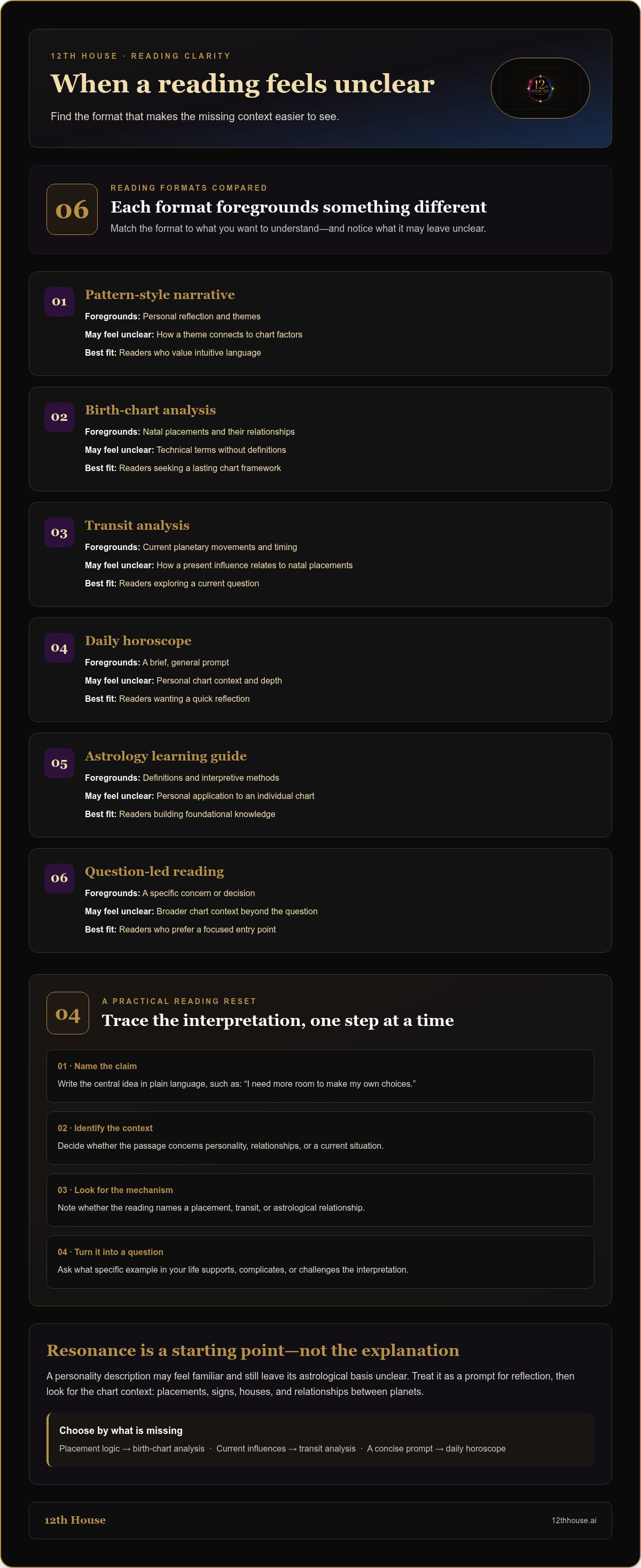
Different astrology formats make different parts of a reading visible. Compare the format with what you want to understand before choosing what to explore next.
| Reading option | What it foregrounds | What may feel unclear | Best fit |
|---|---|---|---|
| Pattern-style narrative | Personal reflection and themes | How a theme connects to chart factors | Readers who value intuitive language |
| Birth-chart analysis | Natal placements and their relationships | Technical terms without definitions | Readers seeking a lasting chart framework |
| Transit analysis | Current planetary movements and timing | How a present influence relates to natal placements | Readers exploring a current question |
| Daily horoscope | A brief, general prompt | Personal chart context and depth | Readers wanting a quick reflection |
| Astrology learning guide | Definitions and interpretive methods | Personal application to an individual chart | Readers building foundational knowledge |
| Question-led reading | A specific concern or decision | Broader chart context beyond the question | Readers who prefer a focused entry point |
Choose based on what’s missing: a birth-chart format for placement logic, a transit reading for current influences, or a concise prompt for reflection.
To make an existing reading easier to understand, use this simple sequence:
- Name the claim. Write the central idea in plain language, such as “I need more room to make my own choices.”
- Identify the context. Decide whether the passage concerns personality, relationships, or a current situation.
- Look for the mechanism. Note whether the reading names a placement, transit, or astrological relationship.
- Turn it into a question. Ask what specific example in your life supports, complicates, or challenges the interpretation.
This method separates symbolic language from personal evidence. A reading can prompt meaningful self-inquiry without providing a complete explanation. If the app leaves you with a strong impression but no clear framework, choose an astrology format that makes its chart logic easier to follow.
Pattern personality
A Pattern personality reading can feel precise because it gives language to recognizable inner tensions. For example, someone may value independence yet seek reassurance in close relationships. That description can prompt useful reflection. The next step is to separate the experience itself from the astrological explanation attached to it. A resonant statement is a starting point, not a complete account of personality.
Astrology describes personality through a chart, not a single label. The Sun sign is one component; the Moon, rising sign, houses, and planetary aspects add other layers. For instance, other placements can shape how someone expresses their Sun sign. When an interpretation highlights a personality theme without explaining its chart context, you may struggle to understand how that theme was derived.
Specific wording can also shape how a reading lands. “You avoid conflict” sounds like a fixed verdict. “You may delay difficult conversations to protect a relationship” describes a behavior and a possible motive. The second version gives you something observable to examine. Think of a recent disagreement: did you speak directly, change the subject, or wait for the tension to pass?
Use the reading as a mirror, then test its language against real examples. If a passage describes being guarded, consider where that pattern appears. Do you share personal information slowly with friends, but speak openly at work? That contrast matters. A personality description may capture one setting without defining every part of your character or every relationship.
Separate three kinds of statements as you read: a trait, a behavior, and an interpretation. “Independent” is a trait. Choosing to solve a problem alone is a behavior. Saying that choice reflects fear of dependence is an interpretation. The distinction helps you assess what the text actually says and what meaning you’re adding to it.
Astrological language is easier to evaluate when you can trace each claim. If a description connects emotional intensity to a Moon placement, learn what that placement represents in the reading’s framework. If it mentions a planetary aspect, note which planets are involved and how the interpretation links them. These details map the connection between symbolic language and the personality theme.
- Mark the claim: underline a phrase such as “needs recognition.”
- Find an example: recall a specific moment, such as presenting work or asking for feedback.
- Check the scope: decide whether the pattern appears across settings or only in one context.
- Keep your own evidence: record a counterexample, such as accepting feedback without seeking praise.
This process prevents a broad personality phrase from becoming a rigid identity. “I always withdraw” may overlook the times you ask for support. “I sometimes step back when conversations feel charged” leaves room for context and change. In astrology, a birth chart can offer a symbolic framework; your lived experience supplies the details that give an interpretation personal meaning.
Choose the reading style that matches your question. For a broad self-portrait, look for explanations that connect traits to chart placements. For a specific relationship habit, focus on the behavior and its context. If you want to explore personality through a more structured astrological lens, a structured astrology reading can help connect chart symbolism with the question you bring.
Keep the distinction clear: a personality reading suggests themes, while reflection tests how those themes appear in your life. When a description feels accurate, ask what behavior supports it, what contradicts it, and which chart factors the interpretation uses. This turns a compelling phrase into a more precise inquiry without reducing your identity to one astrological label.
12Th House: Ask Lala AI Spiritual Guidance
12th House’s Ask Lala AI Spiritual Guidance offers a focused next step when an astrology reading leaves you with questions. Bring a specific theme, such as a relationship pattern or a choice you’re weighing, and use the guidance to explore it through a spiritual lens.
For clearer astrological structure, Astrology connects your chart with the themes you want to understand. Tarot offers another way to reflect on a particular question, while Numerology explores meaning through number symbolism. Choose the format that matches the insight you’re seeking, rather than expecting every tool to explain the same thing.
If you want to continue exploring, visit 12th House online and choose the reading that best fits your question.
Choose the Next Question to Explore
Understanding why The Pattern app is confusing can help you name what you need from a reading. Before exploring another interpretation, write down one question in plain language. Do you want to understand a recurring personal pattern, examine a current astrological influence, or find a reflective prompt? A clear question gives your exploration direction.
Then choose a method that matches that purpose. For chart-based context, 12th House’s Astrology Birth Chart & Transit Analysis offers a focused path into astrological symbolism. For a more open-ended spiritual inquiry, Ask Lala AI Spiritual Guidance can help you explore the question from another angle. The aim isn’t to force certainty from a reading. It’s to find a framework that helps you think clearly and make your own meaning.
Bring the question you want to explore, and visit 12th House for astrology support. Your next reading can begin with a clearer intention and leave room for your own judgment.


