
The most accurate astrology app in 2026 is the one that fits your purpose, uses precise birth details, and makes its interpretations clear enough to assess. An exact birth time helps determine your rising sign and house placements across the chart’s 12 houses. No single app is the right choice for every reader.
A detailed chart can look authoritative, but precise calculations do not make an interpretation certain. To find the most accurate astrology app for your needs, compare its specific claims with your experience and look for clear explanations of how it reached them.
This guide compares astrology apps for birth-chart detail, traditional references, transit tracking, pricing, and free trials, while also explaining what app accuracy can and can’t mean. You’ll find a criteria table and a decision guide to help match an app to your priorities, whether you’re mapping natal placements, following transits, or exploring relationship and career themes. The aim is a clear framework for choosing, not a promise that any app can predict your life with certainty.
Key Takeaways
- Choose an app around your purpose, from learning chart basics to tracking transits or studying traditional astrology.
- Enter an exact birth time when you have one; it helps determine your rising sign and house placements.
- Compare what each app includes in its free access, trial, and paid plans before deciding which features matter to you.
- Assess readings by looking for clear reasoning and claims you can reflect on, not by treating confident language as proof.
- Use astrology apps as tools for interpretation and self-reflection, not as substitutes for medical or financial professionals.
What is the best astrology app for your birth chart in 2026?
The right choice depends on whether you want a clear first reading, detailed chart interpretation, or ongoing transit analysis. Compare how an app calculates and explains a chart, not just how polished its horoscopes sound.
Apps for Beginner and Experienced Users
For beginners, a sun sign app with concise daily horoscopes offers an accessible starting point. It can help you notice recurring themes, but usually provides less chart-specific detail than a tool using your birth time and location. If you’re ready to explore placements and houses, look for a chart-focused app.
Experienced users may prioritize chart layers, transit dates, and interpretive detail over a simple daily forecast. Test a reading against a specific example from your life, then check whether the app explains the astrological factors behind it. Choose a tool that supports your learning goals without burying the chart in jargon.
Individual App Strengths and Weaknesses
Astrology apps vary in purpose, so compare their functions instead of assuming they all offer the same depth. A sun sign app is quick to use, but its general horoscopes may not reflect your full birth chart. A chart calculator provides personal placements, while a transit tracker focuses on current planetary movements.
Each format has tradeoffs: quick readings may offer less context, while detailed charts can take more effort to interpret. Tarot tools also differ from birth-chart apps because a reading may not connect to your chart. Look for a clear explanation of what information informs each result.
AI Horoscope Evaluation Criteria
When assessing an AI horoscope, ask for the reasoning behind a specific interpretation. Look for explanations of the chart placements or transits shaping its response, rather than a confident prediction with no visible method. Compare the answer with your chart and consider whether it addresses your actual question.
Watch for warning signs such as vague claims presented as personal insight, guaranteed outcomes, or pressure to subscribe before you can understand the app’s approach. Review how it handles birth data, too. A responsible platform should explain its privacy practices and protect personal information, not sell it or quietly feed it to another model.
Birth Details for Accurate Charts
What birth details are needed for an accurate astrology chart? Provide your birth date, location, and exact birth time when available. The time helps determine your rising sign and house placements, while the date and location support the chart calculation.
Astrology charts divide life areas into 12 houses, and birth time can affect how those houses are mapped. If you don’t know the exact time, avoid treating time-sensitive placements as settled. Compare readings based on details you do know, and see whether an app makes clear which parts of its interpretation depend on birth time.
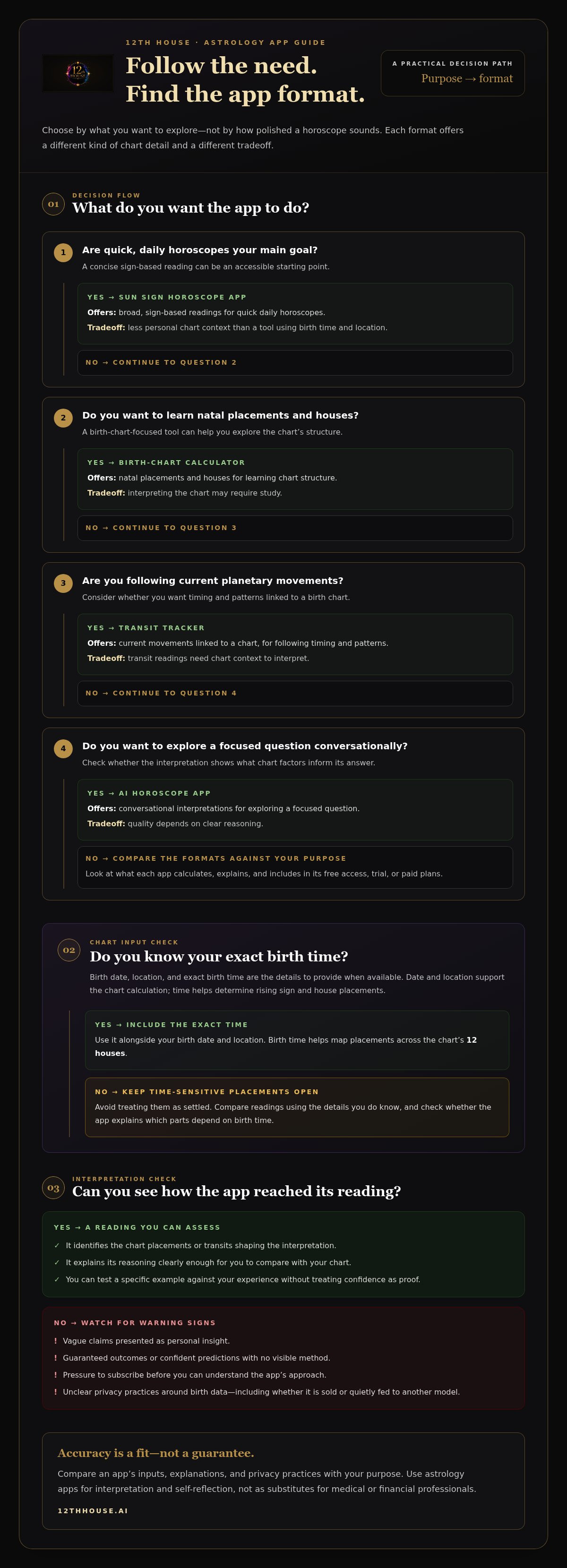
Use this comparison table to identify which app structure fits your current practice.
| App option | Chart detail | Best suited to | Main tradeoff |
|---|---|---|---|
| Sun sign horoscope app | Broad sign-based readings | Quick daily horoscopes | Less personal chart context |
| Birth-chart calculator | Natal placements and houses | Learning chart structure | Interpretation may require study |
| Transit tracker | Current movements linked to a chart | Following timing and patterns | Needs chart context to interpret |
| AI horoscope app | Conversational interpretations | Exploring a focused question | Quality depends on clear reasoning |
Choose a format that matches your goal, then compare its explanations, chart inputs, and privacy practices.
Traditional astrology references and transit tracking
Traditional references provide context for an app’s reading, while transit tools show how current planetary positions interact with a birth chart. Compare the method, explanation, and display together. A clear calendar makes dates easier to follow, but it cannot explain a technique the app never identifies.
Look for labels that identify the system behind an interpretation. An app might distinguish Hellenistic techniques from modern psychological astrology, or say whether it uses a tropical or sidereal zodiac. These choices shape how placements are calculated and explained. If an app discusses your rising sign, its reference material should explain how that placement informs the reading, not reduce it to a personality label.
Methodology matters when two apps interpret the same chart differently. Check whether each explains the planetary placements, aspects, or traditional rule behind its conclusion. A transparent app makes its reasoning visible so you can compare the interpretation with the chart. If explanations are minimal or shift from prompt to prompt, it’s harder to judge whether the app follows a consistent method.
For transit tracking, see how an app connects a current planetary movement to your natal placements. A useful timeline may show the transit date, planets involved, and chart point being activated. Read the interpretation: does it explain the relevant aspect, or offer only a broad forecast? A calendar helps with timing, while a chart overlay makes the underlying geometry easier to study.
Use a simple comparison process before relying on a transit reading:
- Choose one transit the app identifies and note the date and planets involved.
- Open the chart view and find the natal placement or aspect the interpretation references.
- Compare the explanation across formats, such as a timeline, chart wheel, and written reading.
- Save the interpretation, then review it later against the events or patterns you observed.
This method also helps distinguish personal insight from language that could apply to anyone. Compare readings with friends as interpretations, not as proof that a forecast is universally accurate. A clear app separates chart factors from speculation and describes its approach honestly.
If you want a guided interpretation that brings chart placements and current movements into one framework, explore birth-chart and transit analysis. It can help you examine the symbolism behind a transit instead of treating a notification as a complete reading.
App prices and free trials
Astrology apps may offer features through free access, a trial, or a paid subscription. Compare the tools included, not just the headline offer. A free chart might show planetary placements, while written interpretations, relationship readings, or transit timing may require a paid plan.
Distinguish a free tier from a free trial. A free tier provides ongoing access to included features; a trial opens paid features temporarily before billing begins. This matters if you want to study a chart over time. Before starting a trial, read the renewal terms, billing frequency, cancellation process, and end date.
Assess value against a specific use. If you mainly want daily horoscopes, a subscription focused on advanced chart tools may not suit your routine. If you’re studying houses or tracking transits, check whether the plan includes chart views, explanations, and saved readings. A relationship feature is useful only if it offers a chart comparison you’ll use.
| Access type | What to examine | Useful for |
|---|---|---|
| Free access | Included chart details and reading limits | Testing the interface and basic interpretations |
| Free trial | Trial duration, renewal terms, cancellation steps | Exploring paid features before committing |
| Subscription | Billing frequency and features included | Regular use of tools such as transit tracking |
| One-time purchase | What the payment unlocks and whether access continues | A defined report or feature without recurring billing |
Use a trial to test a real task, such as finding a natal placement and reading its explanation. Then open a transit view to see whether the app connects timing to your chart. This reveals more than browsing sample interpretations. Note which features are available without payment and which require a subscription.
Before choosing a plan, review these details in the app’s billing screen:
- Which chart placements, houses, and interpretations are included?
- Does the trial convert to a subscription when it ends?
- How do cancellation and renewal work?
- Can you retain saved charts or written readings after access changes?
Compare the ongoing cost with the features you’ll actually use rather than paying for every available tool. A reader focused on transit timing, for example, may value an updated calendar more than extra compatibility reports. Someone learning astrology may prioritize clear explanations of placements. Choose a plan that matches your practice, and reassess when your needs change.
Astrology app accuracy and limitations
Accuracy can mean correct chart calculations, clear interpretation, or a forecast that feels personally relevant. Separate these measures when comparing apps.
Daily Horoscope Accuracy
Which astrology apps provide the most accurate daily horoscopes? No single app is accurate for every reader. A sun-sign forecast is broad, while chart-based readings can account for more personal placements. Compare the reasoning behind each forecast, record specific claims, and review them against actual events.
Daily horoscopes are most useful as prompts for reflection, not precise schedules. A statement about communication, for example, is easier to assess than a vague promise of change. Check whether the app connects its interpretation to a chart factor or current transit. This helps distinguish a personal reading from familiar language that could fit almost anyone.
Accuracy Definitions and Measures
Apps may use “accuracy” to mean correct chart calculations, consistent interpretations, or relevance to the reader. These are different tests. Check whether the app explains how birth details produce a chart and identifies the placements or transits behind its claims.
How accurate are AI-generated astrology readings compared with astrologer-written readings? AI can produce fast, consistent responses, while a written reading may offer a distinct interpretive perspective. Neither format proves a forecast. Compare the stated chart factors, reasoning, and limitations instead of treating fluent language as evidence.
Reviews and Independent Tests
What do user reviews and independent tests say about astrology app accuracy? Reviews can describe usability, clarity, and whether readings feel relevant, but personal reactions don’t establish predictive accuracy. Independent comparisons are more useful when they use identical birth details and settings, then examine whether chart outputs match.
Look for concrete examples in reviews, such as a chart showing a different rising sign after a birth-time correction. Separate those reports from comments about design or notifications. In an independent test, compare calculations and explanations separately: a consistent chart can still receive a debatable interpretation.
Try this evaluation process before relying on a reading:
- Enter the same birth details in each app and compare chart placements.
- Choose one specific interpretation and note its stated astrological reason.
- Review the claim later, distinguishing a concrete event from a broad feeling.
- Check whether the app explains uncertainty and protects personal data.
Astrology apps should explain their limits. Treat any claim to predict death as a warning sign, and don’t use an app instead of medical or financial professionals. A horoscope should never override qualified support for those decisions.
An app can support learning, chart exploration, or psychological reflection, but these uses differ from verified prediction. Treat a reading as a symbolic framework: examine its premises, note what resonates, and ground consequential choices in evidence beyond astrology.
How do astrology apps define and measure accuracy?
An astrology app can mean several things by “accurate”: correct chart calculations, coherent interpretation, or a forecast that feels personally relevant. These are separate measures. A chart can calculate placements consistently even when apps interpret the same placement differently.
Start with the calculation. Enter identical birth details and compare chart outputs, including planetary placements and house positions. If the apps disagree, review the input format and chart settings before assessing their interpretations. This checks whether an app produces a consistent chart, not whether its reading predicts events.
Next, assess interpretive accuracy. A useful reading connects a specific conclusion to identifiable chart factors. If an app describes a relationship pattern, for example, it should show which placements or aspects inform that interpretation. Clear reasoning lets you assess how the app moves from symbolic data to a personal claim.
Forecast accuracy requires a different test. Before an event occurs, record a specific prediction, its timeframe, and what would count as a match. “A conversation may change your plans this week” is easier to assess than “transformation is near.” Later, compare the recorded claim with what happened instead of relying on your memory of a general impression.
Use this repeatable review protocol:
- Keep the birth details and chart settings consistent across apps.
- Save the exact interpretation, including its stated astrological reason.
- Separate concrete claims from broad language that could fit several outcomes.
- Review the prediction against the event and timeframe you recorded.
- Track missed claims as carefully as readings that seemed relevant.
Personal resonance matters, but it measures fit, not predictive performance. A reading may offer a useful prompt for reflection without describing a verifiable event. User reviews can show whether an app feels clear or engaging, but they can’t establish accuracy across readers, whose charts and expectations differ.
Look for methodological transparency before trusting an app’s accuracy claim. Does it explain its chart settings, identify the placements behind its reading, and distinguish interpretation from prediction? “Personalized” alone doesn’t answer those questions. Visible reasoning makes it easier to evaluate an app’s claims on their own terms.
Use a structured chart interpretation to examine how birth-chart factors and transits connect, then apply the same evaluation steps to its reasoning.
12Th House: Ask Lala AI Spiritual Guidance
12th House: Ask Lala AI Spiritual Guidance gives you a place to explore personal questions about charts, spells, and compatibility. Turn to it when an app’s interpretation raises a question and you want to examine the symbolism through a focused prompt.
For chart placements and current planetary movements, Astrology Birth Chart & Transit Analysis offers a chart-centered path. Tarot Readings and Numerology Reports provide other interpretive frameworks when you want to explore a question beyond astrology. Each tool supports reflection; it doesn’t replace medical or financial guidance.
Bring a clear question, such as how a transit relates to a theme in your birth chart. Explore the available guidance at 12thhouse.ai.
Choose a Clear Next Step for Your Astrology Practice
The most accurate astrology app for 2026 is ultimately the one that helps you ask better questions and examine its reasoning. Let your next step be specific: choose a chart theme you want to understand, then notice which interpretations offer a useful framework rather than a fixed verdict.
If you want to explore a question with guidance, 12th House offers Ask Lala AI Spiritual Guidance and Astrology Birth Chart & Transit Analysis. Tarot Readings provide another interpretive lens when you want to reflect beyond chart placements. Bring the question you’re working with and choose the approach that fits it.
Contact 12th House for astrology guidance and continue your exploration with intention. Let curiosity lead, and keep your own discernment at the center.
Frequently Asked Questions
What Actually Makes an Astrology App "The Best"?
The best app is the one whose chart tools and explanations match your purpose. Someone learning natal astrology needs clear placement descriptions, while a transit-focused reader needs dates linked to chart factors. Test those tasks directly in the app. Consider whether the interface makes it easy to revisit a reading and distinguish calculated chart information from interpretation.
What Makes an AI Horoscope App Worth Using?
An AI horoscope app is worth using when it responds to your specific question and explains the basis for its interpretation. Ask about a chart placement, then note whether the response identifies relevant astrological factors or offers generic encouragement. Look for ways to revisit answers and clear information about handling birth details. Treat confident wording as presentation, not proof of prediction.
What is the difference between an app that draws your chart and one that reads it?
A chart-drawing app calculates and displays placements from the birth details you enter. A chart-reading app adds interpretations, such as how a placement might relate to communication or work habits. Some tools do both; others focus on a chart wheel or report. Open a sample chart to see whether the app explains the symbols or simply displays them.
Which app reads my whole birth chart, every planet included?
Look for a natal chart app that lists planetary placements individually and interprets them, rather than stopping at the sun sign. Check its sample report for the Moon, personal planets, outer planets, and chart angles. A complete placement list doesn’t guarantee equal interpretive depth for every point. Compare the explanations and see whether they form a coherent reading.
Which astrology apps are rated most accurate in 2026?
The search phrase “most accurate astrology app 2026” has no single universal winner for every reader. App-store ratings largely reflect user experience, while accuracy depends on what you’re evaluating, such as chart calculations or reading relevance. Compare apps using the same birth information and task. Look for transparent methods and specific explanations, then separate calculation consistency from personal resonance.
What are the best astrology apps for natal chart accuracy?
If you search “most accurate astrology app 2026” for natal chart work, prioritize apps that accept complete birth details, state chart settings, and display placements clearly. Enter the same information into each candidate and compare outputs before judging interpretations. Settings such as zodiac framework or house system can affect results. The strongest option makes those choices visible and explains how to read the chart.
How much do leading astrology apps cost in the United States in 2026?
There is no standard price across astrology apps. Cost depends on the app, plan, billing cycle, and included features. Compare current U.S. listings, distinguishing free access from trials and recurring subscriptions. Check renewal terms and cancellation steps before starting a trial. For a fair comparison, assess features you’ll use, such as saved charts or detailed interpretations, rather than the headline offer.
Which astrology apps offer accurate birth time rectification or chart calculations?
Chart calculation uses the birth time you enter; birth time rectification is different, estimating a time from life events and chart interpretation. Don’t assume a chart calculator performs rectification. Look for a clearly identified rectification feature and an explanation of its method. To compare calculations, use identical details and settings, then inspect the resulting angles and placements.


