

If your birth time is wrong by 30 minutes, your Ascendant and house cusps may shift, changing the chart’s angles and which houses contain some planets. Your Sun sign usually stays the same because it depends on your birth date, unless you were born near a sign change. The difference matters most when you’re interpreting rising-sign traits, house placements, or timing techniques.
It’s reasonable to want one exact birth time before trusting a chart. But an uncertain time doesn’t make the whole chart unusable; it changes which parts you can read with confidence. This guide explains what a 30-minute discrepancy can alter, how to work with astrology when you don’t know your time, and when birth-time rectification may help. It also explores the practical question behind the uncertainty: whether your chart points to Cancer Lagna or Leo Lagna, and how life events can help assess the fit.
Key Takeaways
- Use your birth date to explore planetary signs and aspects; treat the Moon sign cautiously if it changed signs on your birth date.
- Compare family recollections with available birth records to narrow the time window before interpreting chart angles.
- Rectification compares possible birth times with dated life events, using a process that can involve trial and error.
- A 30-minute uncertainty can make rising-sign and house interpretations less dependable, even when other chart factors remain useful.
How do I work with astrology if I don’t have my birth time?
Without an exact time, you can still study planetary signs and aspects from your birth date. Use 12 PM as a chart time for those placements, then treat the Moon separately if it changed signs that day.
Effects of a Birth-Time Error
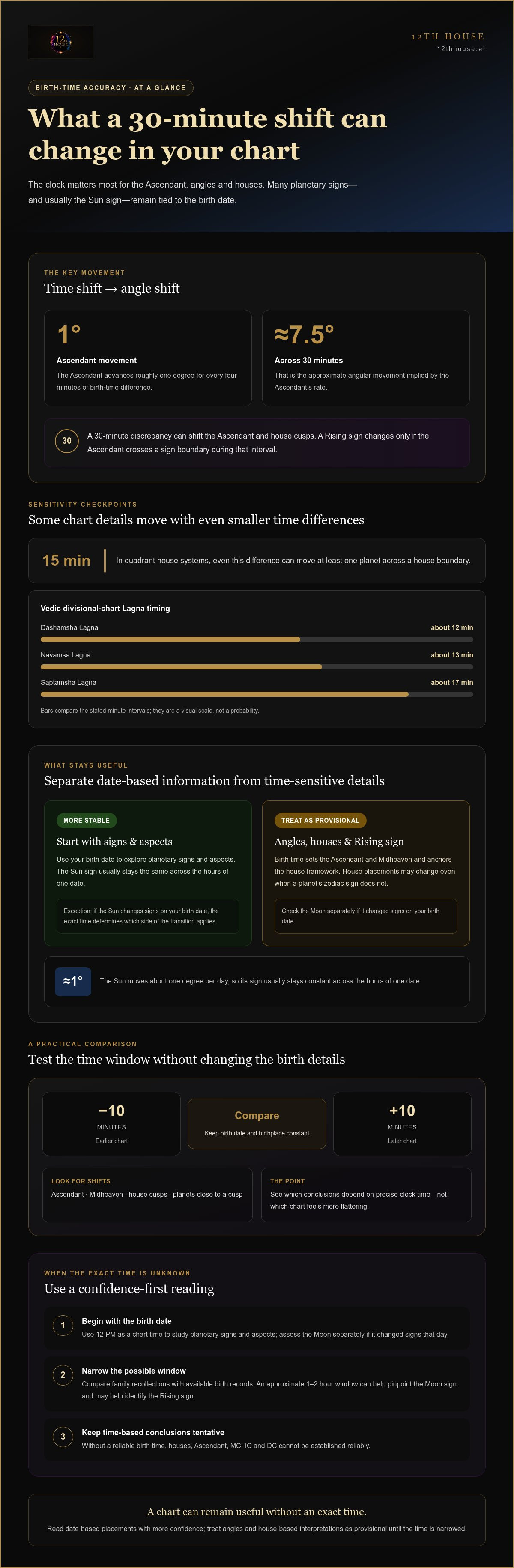
A 30-minute error can shift the Ascendant and change house cusps, altering the chart’s angle-based structure. The Sun and most planetary signs usually remain tied to the birth date, but their house placements can change. In quadrant house systems, even a 15-minute difference can move at least one planet across a house boundary, changing the life area emphasized in an interpretation.
This distinction helps separate stable chart information from time-sensitive details. A planet’s sign, for example, may stay the same while its house changes. Start with the signs and aspects, and treat the Ascendant, houses, and angles as provisional until you narrow down the birth time.
Comparing Earlier and Later Chart Times
Chart comparison means generating versions for plausible times before and after the recorded time, then identifying which placements shift. If a birth time seems rounded, compare charts 10 minutes earlier and 10 minutes later. Note changes to the Ascendant, Midheaven, house cusps, and any planet close to a cusp; those points reveal how sensitive the interpretation is to the time.
Keep the birth date and birthplace constant in each comparison. A 30-minute window can show whether the rising sign stays put or approaches a sign boundary. It can also reveal whether a planet changes houses. The purpose is not to choose the chart that feels most flattering, but to see which conclusions depend on a precise clock time.
Chart Angles and Houses
Birth time sets the chart’s angles, including the Ascendant and Midheaven, and those angles anchor the house framework. The Ascendant advances roughly one degree every four minutes, so a 30-minute difference represents about seven and a half degrees of movement. Since the angles move through all zodiac degrees over a 24-hour day, a small time shift can alter house cusps even when the planets’ zodiac signs remain steady.
Divisional charts can be even more sensitive to birth time. In Vedic astrology, the Navamsa Lagna changes about every thirteen minutes; the Dashamsha Lagna can shift with about twelve minutes of variation, and the Saptamsha Lagna with about seventeen minutes. Without a birth time, a chart cannot reliably establish its houses, Ascendant, MC, IC, or DC. Refine the time before treating these placements as fixed.
If no birth time is available, use the birth date to explore planetary signs and aspects, and check whether the Moon changed signs that day. An approximate window of 1-2 hours can help pinpoint the Moon sign and may help identify the rising sign. Keep conclusions tied to what the available time supports; the chart remains useful, but its angles and house-based readings require greater precision.
Does birth time change your Sun sign?
Usually, a different birth time changes the Ascendant, not the Sun sign. The Sun moves about 1 degree per day, so its zodiac sign usually stays constant across the hours of one date. The exception is a birth date when the Sun changes signs. In that case, the exact time determines which side of the transition applies.
The distinction matters because the Sun sign and Rising sign refer to different chart positions. Your Sun sign is based on the Sun’s position at birth. Your Ascendant, or Rising sign, is the zodiac sign on the eastern horizon at that moment. A time discrepancy may leave the Sun sign unchanged while shifting the chart’s outward-facing structure.
How the Ascendant Moves
The Ascendant advances roughly 1 degree for every 4 minutes of birth-time difference. Its exact degree changes every couple of minutes, so two charts cast for different times can show distinct Ascendant degrees even when the Rising sign remains the same. The degree matters because it sets the starting point for house calculations and can place a nearby planet on a different side of a house boundary.
A Rising sign can change within a few minutes when the Ascendant is close to the next sign. An error of 1 to 2 hours can change the Rising sign, depending on the chart’s location and starting degree. A 30-minute discrepancy can therefore alter the sign if the Ascendant crosses a boundary during that interval. If it doesn’t cross, the sign can stay constant while its degree shifts.
Using the Sun Sign as a Reference
When a birth time is unavailable, some chart methods use the Sun sign as a reference, placing it at the Ascendant to create a solar chart. This gives you a framework for reading planetary signs and their relationships to the Sun. It does not establish your actual Ascendant or reproduce time-based house placements.
Keep the distinction in mind. A solar chart can organize an interpretation around a known Sun sign, such as Cancer, but it cannot prove Cancer Lagna. If possible birth times put the Ascendant in Cancer or Leo, the Sun-sign framework cannot resolve that boundary. It offers another way to structure a reading, not a substitute for a birth time.
For a Sun sign near a transition, compare the birth date and time against the Sun’s movement. For an uncertain Ascendant, compare charts at plausible times and note whether the sign changes. Astrology Birth Chart & Transit Analysis can help you examine how the recorded time shapes the chart’s placements and angles.
Why does my birth time matter?
A birth time anchors the chart to a specific moment and place. How reliable it is depends on how it was recorded and remembered.
U.S. birth records generally show the clock time recorded at the place of birth. The form may not say how daylight saving time was handled, so consider the birth location and date when interpreting the recorded time.
You can request birth-time information from a hospital medical records department. Whether the original record is available depends on the hospital’s retention practices and access requirements.
Checking Recorded-Time Precision
Checking precision means comparing the written time with how it was recorded and what people remember. A time ending in :00 or :30 can be statistically suspicious unless it was clearly recorded in a delivery setting that times to the minute.
Start with the document that gives the time, then ask who recorded it and when. Birth-related events used to establish a time can be 30 to 60 seconds apart, sometimes more. A recorded minute may therefore reflect one event in the sequence, rather than the exact moment a family member remembers.
Ask a parent or someone else who was present at the birth what they remember. Separate a direct memory from a story repeated later, and compare recollections with any written record. If the recorded time is rounded or memories differ, keep the plausible range rather than treating one time as exact.
Note whether the time comes from an original document or a later family record. A handwritten note, baby book, or copied form may repeat an earlier entry. Keeping the source beside the time helps you judge its precision when interpreting chart angles.
Birth Times on Records and Hospital Paperwork
A long-form birth certificate may include more detail than a short-form record, but first confirm that the birth-time record is available before ordering one. Document formats vary, so identify the relevant state or local records office and find out which document contains the time.
A hospital may record the birth time in medical paperwork, but the entry can depend on how the timing was recorded during delivery. Ask the medical records department for the birth-time entry and the document it appears on. Retention and processing practices differ, so a later request may not retrieve the same paperwork as a birth record.
Paperwork may be completed after delivery rather than at the moment of birth. Distinguish the time of the event from the time it was entered on a form. If family recollections and documents disagree, write down each source and its wording. A rounded entry and a remembered sequence are different kinds of evidence.
Use the strongest available record as a working reference, not proof that every chart placement is exact. If the time is near a sign boundary, compare charts for nearby times. This approach narrows uncertainty before you interpret the Ascendant or house structure.
Birth-time rectification
Birth-time rectification is an astrological method for evaluating possible birth times against dated events and chart patterns. It can help when records leave a meaningful uncertainty, such as a 30-minute window that changes the Ascendant or house placements. The aim is a more workable time, not a claim that calculation can recover an event with absolute certainty.
Start with the time range supported by records or family recollections. Then list dated, significant events, such as a move, marriage, or career change. Compare charts for candidate times against the same events, noting which chart factors each interpretation relies on. Keep the birth date and birthplace fixed so the time is the only variable.
Rectification is iterative. A candidate time may seem to fit one event but fit less well when tested against other dates. Give more weight to events with clear timing, and avoid reshaping your account to match a preferred chart. Record why a time seems plausible, which events support it, and what remains uncertain.
Timing methods can make small differences consequential. A 15-minute birth-time error can shift the predicted timing of a life event by approximately a year in longer-range timing predictions. That example explains why rectification may matter for forecasting, but it doesn’t prove that a particular chart time is correct. Event dates must be assessed alongside the chart’s actual time-sensitive placements.
Rectification is not an exact science and may involve trial and error. One reported personal rectification took about two weeks and narrowed the time to within about one minute. That is an individual example, not a standard timeline or result. Treat the outcome as an evidence-based estimate, not a mathematically certain timestamp.
The precision you need depends on the chart technique. In Vedic astrology, the Shashtiamsha is generally considered to require a rectified birth time accurate to roughly two minutes or better. A time estimate suitable for broad natal interpretation may be too imprecise for this divisional chart. Match the confidence of your conclusions to the precision the method requires.
A useful rectification record separates evidence from interpretation. For each candidate time, note the dated event, the chart feature being tested, and the result. Revisit the comparison if new documentary evidence appears. This makes your reasoning traceable and helps prevent one vivid life event from determining the whole chart.
How often do astrology rising signs or house placements change within 30 minutes
There’s no single interval at which every chart changes signs or houses. The result depends on the Ascendant’s starting degree and how close it is to a sign boundary. Since a rising sign can change within a few minutes, a 30-minute error may cross that boundary. In another chart, the Ascendant may move within the same sign.
The Ascendant advances roughly 1 degree for every 4 minutes of birth-time difference. Across 30 minutes, that amounts to about 7.5 degrees of movement. This is enough to change the rising sign when the starting degree lies near the next sign. If the Ascendant begins farther away, its degree still changes, while the sign may remain constant.
House placements have their own thresholds. A planet near a house cusp can move into the neighboring house as the chart time changes, even if its zodiac sign stays fixed. In quadrant house systems, a 15-minute difference can often shift at least one planet across a house boundary. A 30-minute uncertainty can therefore affect more than the chart’s angles.
Consider a recorded time of 7:00 AM when the actual birth time was 7:15 AM. In one chart example, the Midheaven moves from 20° Pisces to 3° Aries across that 15-minute difference. This illustrates why a chart’s angles can shift sharply near a sign boundary. The example does not mean every chart’s Midheaven will cross signs within 15 minutes.
To assess your chart, compare the recorded time with charts cast 10 minutes earlier and 10 minutes later. Track the Ascendant sign and degree, each house cusp, and planets close to those cusps. Then widen the comparison to the full 30-minute window if the birth time could be wrong by that amount. Record which interpretations change and which remain stable.
A sign change and a house change are separate events. The Ascendant can remain in one sign while its degree shifts, and a planet can change houses without changing zodiac signs. The Moon can also change houses with a larger time difference; one example places it in another house after a 45-minute error. Assess each placement independently instead of treating the chart as wholly right or wrong.
Use Astrology Birth Chart & Transit Analysis to examine how candidate birth times alter your chart’s rising sign, angles, and house placements.
12Th House: Ask Lala AI Spiritual Guidance
12th House offers Ask Lala AI Spiritual Guidance for exploring questions that arise when your birth time is uncertain. Use it to reflect on what you can interpret from the chart and which time-sensitive details need closer examination. For a focused chart reading, Astrology Birth Chart & Transit Analysis can help you consider placements and transits within the birth-time context.
Choose a path based on your next question. Ask Lala supports guided spiritual exploration, while Astrology focuses on astrological patterns. Neither replaces a reliable birth record, but both can help you engage more deliberately with the symbols and uncertainties.
Explore 12th House at 12thhouse.ai.
Give Your Chart a Clearer Next Step
If you’re still asking, “What if my birth time is wrong by 30 minutes?” let that question guide your next inquiry, not define the limits of your self-understanding. Separate what you can interpret now from what depends on a more precise time. Then decide whether you want to explore chart structure, reflect on a personal crossroads, or approach the question through another symbolic lens.
12th House offers Astrology Birth Chart & Transit Analysis for chart-focused exploration, alongside Ask Lala AI Spiritual Guidance and Tarot Readings for broader reflection. Choose the form of inquiry that best matches what you’re trying to understand. A thoughtful next step can help turn uncertainty into a more deliberate practice of self-discovery.
Explore your birth-time question with 12th House and continue your inquiry with care and curiosity.
Frequently Asked Questions
A Worked Example: Cancer Lagna or Leo Lagna?
Compare charts for plausible birth times and see whether the Ascendant shifts from Cancer to Leo. Keep the birth date and birthplace fixed, changing only the time. Note the Ascendant degree and house placements in each chart, then compare them with dated events and reliable records. A sign that feels familiar may prompt reflection, but it cannot establish the correct birth time on its own.
How much does the Ascendant change per hour?
The Ascendant shifts about 15 degrees in an hour, though its exact movement depends on the chart’s location and timing. This estimate follows the approximate pace of 1 degree per 4 minutes. An hour’s difference can move the Ascendant through a substantial part of a sign without necessarily changing its sign. Whether it crosses a boundary depends on its starting degree.
What Actually Counts as “Birth Time”?
For an astrology chart, birth time is the clock time entered as the moment of birth, paired with the birth date and place. A relative’s memory of when labor began or when the baby was first held refers to a different event. If a record and a family recollection differ, note what each source describes. That way, separate events aren’t mistaken for the same timestamp.
What if I have a rough idea of my birth time?
A rough window of 1-2 hours can help identify the Moon sign and may help narrow the rising sign. Cast charts for the earliest and latest plausible times, then compare the placements that change. For example, if both charts show the same Moon sign but different Ascendants, keep those findings distinct. The shared placement offers a stable point for interpretation while the rising sign remains unresolved.
What is the rule for birth time accuracy in transit predictions?
There’s no single accuracy rule for every transit prediction; sensitivity depends on the technique and chart factors being timed. A 15-minute birth-time error can shift predicted life-event timing by approximately a year in longer-range predictions. Before relying on a timing interpretation, identify which birth-time-sensitive placements drive it. The precision needed follows from the method and the specific question being examined.
What if my birth time is wrong by 30 minutes?
If you’re asking, “What if my birth time is wrong by 30 minutes?” compare charts using the same birth date and birthplace, but different plausible times. The Ascendant, house cusps, or a planet’s house placement may change, depending on their positions. Mark those differences and separate interpretations that remain consistent from conclusions that depend on the disputed time. This shows where the uncertainty matters most.
How can I find my exact birth time in U.S. hospital or government records?
Look for the time on an available long-form birth record or in hospital paperwork. Before ordering a long-form certificate, confirm that the birth-time record is available. You can also request the time entry from the hospital medical records department. Compare the document with family recollections, noting whether the time appears rounded. Record the source beside each time to distinguish official paperwork from remembered accounts.
What is astrological birth time rectification and how accurate is it?
Rectification compares candidate birth times with dated life events to assess which chart best fits the evidence. It is not an exact science and may involve trial and error. Keep a record of event dates, candidate times, and the chart factors tested. The result is a reasoned estimate, and its useful precision depends on the astrological method. Treat each interpretation as part of the analysis, not proof on its own.


