

Birth chart rectification using life events estimates an uncertain birth time by testing possible charts against dated milestones such as marriage, childbirth, career changes, and relocation. The strongest candidate is the chart whose rising sign, houses, and timing patterns align most coherently with those events, not simply one that feels familiar. Because the rising sign and house placements can change with the birth time, even a small difference may alter the chart’s structure.
Not knowing your exact birth time doesn’t make your chart impossible to explore. It does call for a clear method: compare plausible rising signs, separate lasting patterns from one-off experiences, and give dated events more weight than broad personality impressions.
This guide explains how to weigh life events and personal traits, then use timing techniques to compare candidate charts. You’ll see how marriages, births, career changes, and moves can help narrow the possibilities, and why a well-supported estimate is more useful than false precision.
Key Takeaways
- Compare plausible rising signs and house placements before narrowing the exact birth time; a chart’s structure can shift with a small time difference.
- Build an evidence-based event timeline, giving dated, personally distinctive milestones more weight than broad personality impressions.
- Use transits and other timing techniques to test leading chart candidates, rather than treating them as a substitute for event evidence.
- When event dates are uncertain or candidates appear tied, track the uncertainty and compare how consistently each chart explains the available details.
- Marriage, childbirth, career shifts, and relocations can each provide useful timing anchors when assessing an uncertain birth time.
Comparing possible rising signs and house placements
Rectification compares candidate charts with dated events, personal traits, and the life areas emphasized by each chart. Western astrology often examines the Ascendant, houses, transits, and progressions. Vedic astrology may also consider the Lagna, divisional charts, and Dasha timing.
Comparing Rising Sign Candidates
A rising-sign comparison tests which Ascendant and house layout best fits a person’s observable life history. The rising sign sets the chart’s house sequence, shaping where astrologers interpret marriage, career, family, and other themes.
Start with the rising sign, not its exact degree. There are 12 signs, and the Ascendant sign changes roughly every two hours. A small difference in recorded birth time can also shift the Ascendant and house placements, so compare charts across the plausible time window.
For example, if two candidate charts place career matters in different houses, compare each with documented job changes or public responsibilities. A match is more persuasive when the chart’s structure fits several distinct events, rather than one broad impression. Even a small time difference can substantially change the Ascendant degree, so degree-based interpretations require careful timing.
Assessing Placements and House Rulers
Placement assessment examines planets by sign and house, then considers the planet ruling each house. An event may relate to both a house topic and its ruler’s condition, giving a more specific comparison than sign symbolism alone.
For each candidate, note the house connected to an event and identify its ruler. Then consider whether the planet’s placement supports a coherent interpretation. For instance, compare a documented career shift with the tenth house and its ruler, and check whether other chart factors echo the same theme.
Keep the comparison consistent across candidates. Use the same house system and interpretive rules each time; otherwise, a chart may seem to fit simply because the method changed. Record which placements shift between houses as the birth time changes, and prioritize clearly dated events over general impressions.
In Vedic astrology, the Lagna advances by about one degree every four minutes on average, though latitude and the rising zodiac segment affect its speed. Degrees can help fine-tune an estimate, but first identify the likely rising sign.
Some Vedic astrologers also consider Pranapada Lagna in relation to the Moon. Treat it as an additional symbolic cross-check, not a substitute for comparing the main chart. Note the Pranapada placement from the Moon for each candidate, then consider whether its interpretation fits the same dated events and chart themes.
A disciplined comparison separates structural evidence from appealing symbolism. Keep candidates that account for multiple areas of life, and set aside those supported only by one trait or isolated placement.
Using life events and personal characteristics as evidence
Rectification tests candidate charts against recorded milestones and observable characteristics. Useful starting materials include birth records, relatives’ memories, and a timeline of major events. Together, they can help distinguish a chart that fits a specific life from one that merely sounds familiar.
Life Events as Evidence
Life-event evidence comes from comparing known experiences with chart patterns associated with their timing and subject. A dated event offers a clearer test than a broad personality description.
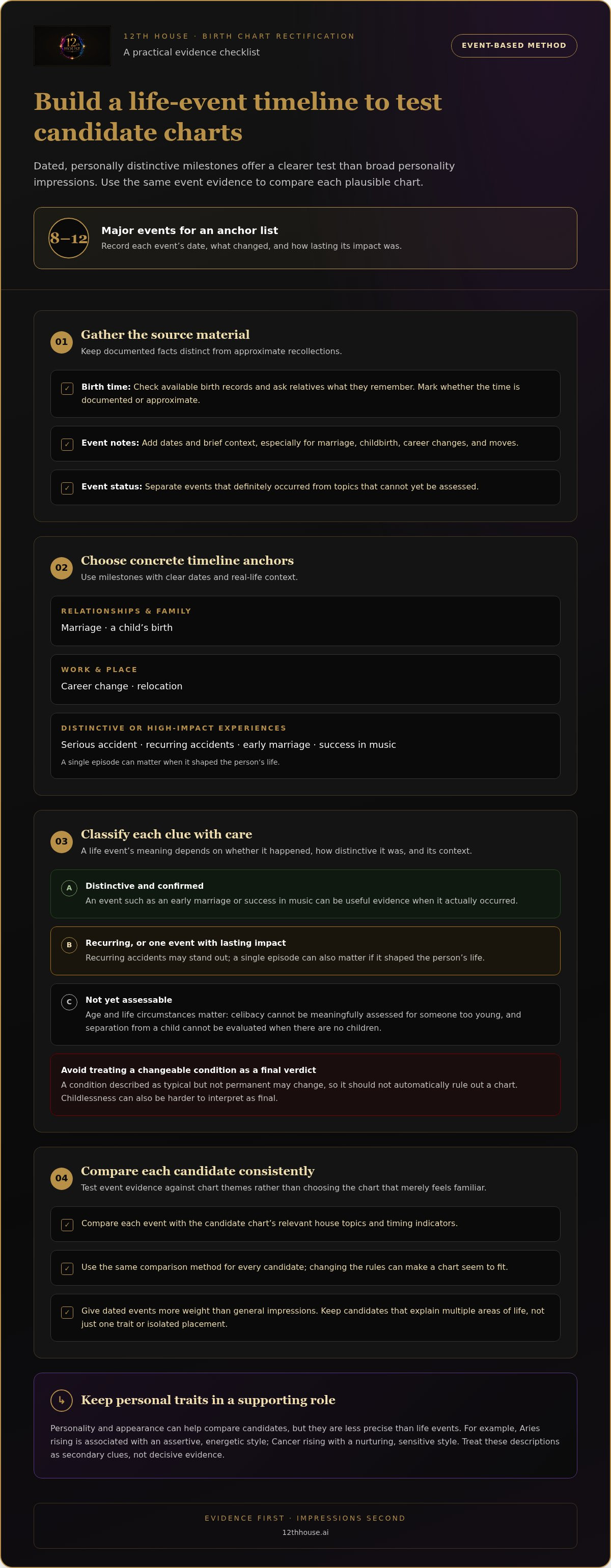
Build an anchor list of 8 to 12 events, such as marriage, a child’s birth, a career change, relocation, or a serious accident. Note the date, what changed, and how lasting the impact was. Then compare each event with the candidate chart’s relevant house topics and timing indicators.
Classify each item carefully. An early marriage or success in music can be distinctive if it actually occurred. Recurring accidents may also stand out, while a single episode can matter if it shaped the person’s life. By contrast, a condition described as typical but not permanent may change, so it should not automatically rule out a chart.
Age and life circumstances affect what can be assessed. A 40-year-old who has never married may count as atypical when testing an early-marriage indicator. Childlessness is harder to interpret as final, while celibacy cannot be assessed meaningfully for someone too young. Separation from a child cannot be evaluated when there are no children.
Information and Documents Needed
The information set is the source material used to test possible birth times. Precise dates and direct recollections make comparisons more useful than vague family stories.
Start with any available birth records, then ask relatives what they remember about the birth time. Record whether the time is documented or approximate. Add event dates and brief notes about the circumstances, especially for marriage, childbirth, career changes, and moves.
- Gather birth records and family recollections about the time of birth.
- List 8 to 12 major life events with dates and concise context.
- Separate events that definitely occurred from topics that cannot yet be assessed.
Personality traits and physical appearance can help compare candidates, but they are less precise than life events. Aries rising, for example, is associated with an assertive, energetic style, while Cancer rising is associated with a nurturing, sensitive style. Treat these descriptions as secondary clues, not decisive evidence.
In Vedic astrology, a Navamsa Lagna changes roughly every 13-14 minutes. A personality check against that chart can add another layer, but it should support the event-based comparison rather than replace it. For a structured review of chart placements and timing, explore astrology chart analysis.
Applying transits and other timing techniques
Use timing techniques after narrowing the possible birth charts, not before. Transits, progressions, and annual profections can test whether a candidate chart connects significant events with relevant astrological periods. They refine the comparison but do not replace clear event dates or a consistent reading method.
Annual profections advance one sign and house per year. For each event, identify the profected house and its ruler, then compare that year’s themes with the recorded experience. If a career change occurred during a year activating career-related topics, note the correspondence. Apply the same check to every candidate chart rather than choosing only the one that produces a pleasing match.
Transits offer another timing layer. Saturn takes about 29.4 years to orbit the Sun, staying in one zodiac sign for roughly two and a half years on average. Jupiter takes about 11.9 years to orbit the Sun. These cycles provide broad timing windows, while the natal chart shows which houses and planetary connections an astrologer examines for a particular event.
For a practical comparison, place each dated milestone beside the timing indicators in each candidate chart. A relocation, for example, can be assessed against relevant house themes and the transits or progressions active at the time. Look for repeated patterns across distinct events. One transit that seems meaningful on its own is less useful than several coherent correspondences.
Progressions are also used to examine symbolic development over time. Their value in rectification depends on accurate event information and interpretation, so keep the method consistent across candidates. Record which progressed factors you consider, which event you compare them with, and whether you apply the same interpretive rule each time. This makes the comparison easier to review.
Significant life events are often treated as the strongest basis for rectification when detailed dates are available and transits and progressions can be interpreted. Timing techniques help distinguish candidate charts when their broad symbolism is similar. They are most useful after narrowing the possible birth-time range, when small differences can change relevant houses, rulers, and timing contacts.
Keep a simple comparison record:
- Event: write the milestone and its date.
- Technique: note the profection, transit, or progression examined.
- Chart link: record the house, ruler, or natal placement involved.
- Comparison: apply the same criteria to every remaining candidate.
Treat timing as a structured test, not a search for isolated confirmation. A candidate is more compelling when several dated events align under consistent techniques. Unexplained events should remain part of the assessment rather than being discarded.
Handling uncertain event dates and tied candidates
Uncertain dates affect how strongly an event can test a candidate chart. Separate exact records from remembered seasons, approximate years, and events that unfolded over time. A wedding date may be documented precisely, while a career transition may span several months. Note that distinction before comparing planets, houses, or timing periods.
There is no fixed margin of error for rectification. The result remains an astrological estimate unless the birth time is later discovered, because no independent method can otherwise verify it.
For each milestone, record the narrowest date range you can support and its source, such as a certificate, family recollection, or personal calendar. Keep the original details alongside your interpretation. If a move took place over a broad period, describe its sequence and known circumstances instead of assigning an exact day.
Then test each candidate against the same date range. A transit that aligns with only one possible month is weaker evidence if the event could have occurred over a wider period. Compare whether the candidate’s relevant houses, rulers, and timing techniques still fit across the plausible dates. Don’t change the event window just to preserve a preferred chart.
A practical search can begin with a one-hour window from 8:30 PM to 9:30 PM when that range fits the available birth-time account. Compare candidates at six-minute intervals, then run a second sweep at one-minute resolution around the strongest result. These intervals organize the search; they don’t prove the chart on their own.
Some candidates may remain close. In a worked example, the remaining times are tied within the two-minute range from 9:00 PM to 9:02 PM. Describe both as viable candidates if the available evidence does not distinguish them. Review which events fit each chart, which depend on uncertain dates, and whether the same astrological framework produces the comparison.
Agreement among several tests within one framework is convergence, not independent empirical proof. A transit and a progression may both support one candidate, for example, but both rely on the same astrological model. Record the methods separately, then state clearly where they converge and where uncertainty remains.
- Preserve date quality: mark each event as exact, approximate, or extended over time.
- Compare consistently: apply the same techniques to every candidate.
- Describe the outcome: report a leading time or a tied range, such as 9:00 PM to 9:02 PM.
This record makes uncertainty visible instead of hiding it. If a birth record later provides the exact time, compare it with the estimate and update the chart’s status.
Using marriages, births, career changes, and relocations for rectification
Marriage, childbirth, career shifts, and moves can anchor chart comparisons because each marks a concrete change. Their dates and circumstances help test whether a candidate birth time connects chart patterns with lived events.
Marriage and Birth Events
Marriage and childbirth are dated relationship and family milestones used to test relevant chart themes and timing. A recorded ceremony or birth offers a clearer comparison point than a general feeling about relationships.
Record the date and context: a marriage may follow a long partnership, while a child’s birth may coincide with a major change in family responsibilities. Compare each milestone with the candidate chart’s relevant houses and timing indicators. Don’t treat any single event as decisive; assess whether other dated experiences support the same chart.
Rectification Steps
Rectification uses a sequence of documented events to compare possible birth times. A consistent process matters because changing interpretive rules between candidates can distort the result.
- Set the widest birth-time window supported by the available account.
- List dated marriages, births, career changes, and relocations.
- Compare each event with the same chart topics and timing techniques.
- Narrow the leading candidates and record any remaining tie.
For a professional rectification in the United States, the price depends on the case and is provided after a quote request; scope, event records, and methods affect the quote.
Number of Events Needed
A useful event anchor list contains 8 to 12 milestones. This range gives the comparison several distinct life areas, making it easier to see whether one candidate repeatedly fits.
Choose events that are personally meaningful and can be dated. For example, include a marriage, a child’s birth, a career transition, and a relocation if these occurred. A focused timeline with clear dates and context can be more useful than a long list of vague or overlapping experiences.
Limitations and Risks
Rectification remains interpretive until the birth time is later discovered. Astrologers should disclose that a chart has been rectified, and agreement among tests within one astrological framework is convergence, not independent empirical proof.
Life circumstances also complicate interpretation. A situation that appears typical may change, while a person’s age can make some indicators impossible to assess. Injury or abuse can suppress a person’s initial values and priorities, making frustration about the incident more visible. Avoid reducing complex experiences to a single placement.
For a structured review of natal patterns and event timing, explore birth chart and transit analysis.
12Th House: Ask Lala AI Spiritual Guidance
12th House offers Ask Lala AI Spiritual Guidance for exploring questions that arise as you review your birth-time evidence. Use it to reflect on recurring themes and organize your thoughts, not as proof of a particular birth time. For chart-specific insight, Astrology Birth Chart & Transit Analysis can help you examine natal patterns and timing alongside your event timeline.
Choose the support that fits your next question: spiritual guidance for reflection, or chart and transit analysis for astrological interpretation. The aim is a clearer framework for your own inquiry, grounded in the events and records you have gathered.
Visit 12thhouse.ai to explore your next step.
Carry Your Chart Inquiry Forward
Let your next step be a clearer question, not a demand for absolute certainty. Keep what you know distinct from what you interpret; that discipline makes birth chart rectification using life events a more thoughtful process. As new records or memories emerge, revisit your working chart with curiosity rather than forcing every detail into one explanation.
For continued reflection, 12th House offers Ask Lala AI Spiritual Guidance, Astrology Birth Chart & Transit Analysis, and Tarot Readings. These tools can support spiritual inquiry and chart exploration, while your event evidence remains the foundation of your own rectification work.
Contact 12th House for support as you continue exploring your chart. Move forward with care, keep your reasoning visible, and let each insight sharpen the questions you ask next.
Frequently Asked Questions
What If I Don’t Know My Birth Time?
You can begin with the widest time range supported by your available information. Search for birth records and ask relatives what they remember, including whether the time was approximate. A time written exactly on the hour or half-hour may have been rounded. If family remembers “around 8:30 PM,” treat that as a clue, not a verified minute, and compare candidate charts against documented events.
When is rectification usually necessary?
Rectification is useful when the birth time is missing, uncertain, or too imprecise for the chart questions you want to explore. For example, someone may know they were born in the morning but have no recorded hour. If the time is reliable and the question concerns placements that don’t depend on the Ascendant or houses, rectification may add little. Whether it is useful depends on the question and the precision of the birth-time record.
What is birth chart rectification in astrology?
Birth chart rectification is an astrological method for estimating a birth time by comparing candidate charts with a person’s known experiences and characteristics. In practice, birth chart rectification using life events tests whether dated milestones align coherently with a candidate chart’s structure and timing patterns. For instance, an astrologer may compare candidate charts with a dated life transition, then assess whether the interpretation also fits other available evidence.
Which life events are used to rectify a birth time?
Astrologers may consider marriage, childbirth, career changes, relocation, recurring accidents, and events that altered a person’s life direction. A useful event is personally distinctive and can be placed on a timeline with meaningful context. Instead of recording only “changed jobs,” describe whether it involved a promotion, an abrupt departure, or a move into a different field. That context helps distinguish the event’s significance in chart interpretation.
How do astrologers match life events to planetary transits and progressions?
For birth chart rectification using life events, astrologers compare an event’s date or time window with transits and progressions in each candidate chart. They examine which planets, houses, and natal placements are activated, applying the same interpretive framework to every chart. For example, if a move took place over several months, they assess the timing throughout that window instead of selecting one convenient date. Consistent patterns across different events strengthen the interpretation.
How much does professional birth chart rectification cost in the United States?
Professional birth chart rectification fees in the United States typically range from $150 to $500 or more, depending on the astrologer's experience, the complexity of the client's history, and the depth of the analysis required. Because birth chart rectification using life events demands meticulous examination of multiple candidate charts and historical timelines, it is generally priced higher than a standard consultation at practices like 12th House.


