
An astrology reading with an unknown birth time can still reveal a meaningful pattern. Set the chart to 12 PM and focus on planetary signs and aspects; leave out the Ascendant, house placements, and the Midheaven, Imum Coeli, and Descendant. Check the Moon and Sun carefully, since either may change signs on the day of birth.
Losing your birth time can make an astrology reading with unknown birth time feel incomplete, especially when you want to understand the chart’s angles and houses. The uncertainty has limits: some placements remain useful, while time-sensitive factors cannot be treated as reliable.
This guide explains how to read planetary placements across the day, what to do with an approximate birth time, and which chart factors to set aside. You’ll get a practical way to work with the information your birth data supports, without drawing conclusions from details it cannot establish.
Key Takeaways
- Use a noon chart to examine planetary signs and aspects, then compare positions across the birth date for placements that may shift.
- Compare charts set for midnight and noon to see whether the Moon stays in the same sign.
- Set aside the Ascendant, house placements, and time-sensitive chart points when the birth time is unknown.
- Use a sunrise chart as a symbolic framework, with the Sun sign or Moon sign serving as the first house depending on whether the birth was during daylight or at night.
- Separate stable planetary patterns from time-dependent factors before interpreting the chart’s themes.
Checking the range of planetary positions throughout the day
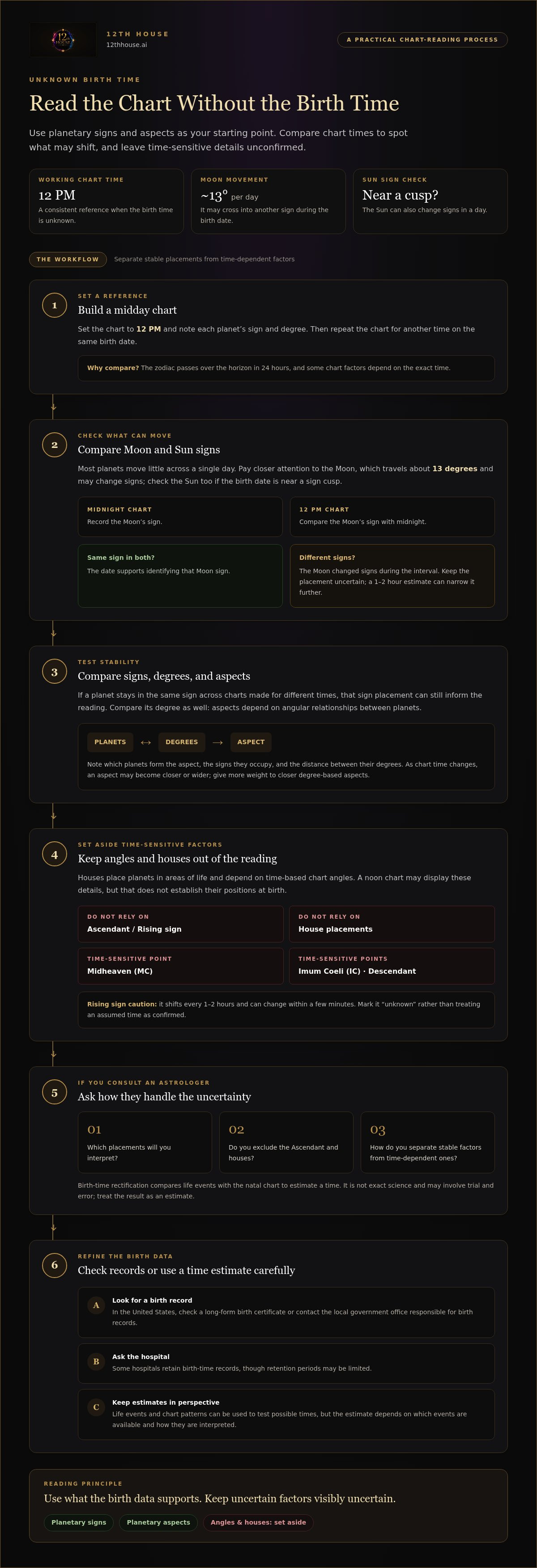
Yes. A birth chart can still show planetary signs and aspects without an exact birth time, though time-sensitive details need careful handling. The zodiac passes over the horizon in 24 hours, so separate stable placements from those that can shift during the day.
- Set a midday chart and record planetary positions. Use 12 PM as a working time when the birth time is unknown. Note each planet’s sign and degree, then repeat the chart for another time on the same date. Most planets move little across a single day, but the Moon travels about 13 degrees and may cross into another sign. The Sun can also change signs in a day when birth falls near a sign cusp.
- Compare signs and degrees before interpreting. If a planet stays in the same sign across charts made for different times, that sign placement can still inform the reading. Compare its degree as well, because aspects depend on the angular relationships between planets. Two planets may stay in the same signs while their aspect becomes closer or wider as the chart time changes. Give more weight to closer degree-based aspects.
- Read aspects through the planets and signs involved. An aspect describes a geometric relationship between planets; the planets and their signs shape how astrologers interpret it. Note which planets form the aspect, the signs they occupy, and the distance between their degrees. Without a reliable birth time, leave houses out: they place planets in areas of life and depend on time-based chart angles.
- Keep points and houses in a separate column. A natal placements list may show planets and points with signs, degrees, and houses, but house placements can change with the chart time. If your birth time is unknown, don’t rely on a listed house. The Ascendant, Midheaven, Imum Coeli, Descendant, and house positions are time-sensitive. Planetary signs and aspects offer a more useful starting point.
- Ask focused questions before booking a reading. Ask how the astrologer handles an unknown birth time, which placements they interpret, and whether they exclude the Ascendant and houses. A careful approach separates stable planetary signs and aspects from time-dependent points. Birth-time rectification uses life events alongside the natal chart to estimate a time, but it isn’t exact science and may involve trial and error.
- Search records if you want to refine the chart. In the United States, look for your long-form birth certificate or contact the local government office responsible for birth records. Some hospitals retain birth-time records, though retention periods may be limited. Rectification can also use documented life events and a chart, but estimates depend on which events are available and how they are interpreted.
What if I have a rough idea of my birth time?
A time window can narrow the possibilities, especially for the Moon and rising sign. Use the steps below to see which placements stay stable across that window.
-
Compare Moon Signs at Midnight and Noon
Create two natal charts for your birth date, one set to midnight and one to 12 PM. Compare the Moon’s sign in both charts. If it stays in the same sign, you can identify your Moon sign from the date without knowing the exact birth time. If the signs differ, the Moon changed signs during that interval, so the date alone cannot settle its placement. Avoid treating a midday result as certain in that case. A birth-time estimate within a 1-2 hour window can help narrow the Moon sign further.
-
Assess Possible Moon Sign Changes
Check the Moon’s movement across the birth date before interpreting its sign. The Moon moves about 13 degrees in a day and changes signs every 2-3 days, so a sign change is possible if it was near a boundary. A noon chart may not show the Moon’s position at your birth time, so check carefully if it may be near a sign boundary. Compare the chart’s Moon degree with the sign boundary. If the Moon could cross it during your possible birth-time window, keep both signs in view rather than choosing one prematurely.
-
Estimate or Rectify the Birth Time
Gather a time estimate, then compare charts across that window. A rising sign shifts every 1-2 hours, and it can change within a few minutes, so a rounded hour may not establish it accurately. An estimate within a few hours can make rectification easier; life events are compared with the natal chart to assess possible birth times. How does an astrologer estimate or rectify an unknown birth time? They use life events and chart patterns to test possible times. Rectification involves trial and error, so treat the result as an estimate, not a recovered record. An Astrology Birth Chart & Transit Analysis can help you examine chart placements while keeping time-sensitive factors distinct.
Omitting the Ascendant and house positions
Build the chart around planetary signs and aspects, not time-sensitive angles. Without a reliable birth time, the Ascendant and houses can give an unwarranted sense of precision.
- Remove the Ascendant from your working notes. The Ascendant, or rising sign, depends on the exact moment and place of birth. Its degree advances every couple of minutes, so an assumed time can produce a different Ascendant. Don’t use that sign to describe your outward style or chart ruler as if its placement were established. Mark it “unknown” in your notes.
This distinction matters because the Ascendant also anchors the house system. If the rising sign changes, house boundaries and placements can shift too. A noon chart may display an Ascendant, but that result reflects the noon setting, not necessarily your birth moment.
- Set aside houses in the chart and interpretation. Houses divide the chart into areas of life, such as relationships or work. Their placements depend on the Ascendant and birth time. If your chart tool supplies houses for an assumed time, don’t treat a planet’s house as a reliable statement about where its themes unfold.
For example, Venus in a displayed house might suggest a focus on partnership or resources, depending on the house’s meaning. Without a known birth time, that assignment may change. Keep Venus’s sign and aspects to other planets in your interpretation, and leave its house out.
- Exclude other time-dependent points. The Midheaven, Imum Coeli, Descendant, Vertex, and Part of Fortune depend on birth time. Don’t use their signs, degrees, or houses to build a fixed reading from an assumed time. A calculator may include these points when you enter a birth time, but their appearance doesn’t make them reliable when the time is unknown.
Separate these entries from planetary placements. For instance, write “Mars in its sign, aspects retained” and leave any house or angle connection unassigned. This keeps the interpretation grounded in information that doesn’t depend on a guessed Ascendant.
- Rebuild the chart view around stable information. Use a placements list to record planets, signs, degrees, and aspects, then leave out the house column. A birth-chart calculator may let you omit house positions when the birth time is unknown. If yours displays houses, treat them as results of its selected time, not facts about your birth.
Review the chart in two layers: planetary signs describe how a planet expresses itself, while aspects describe its relationships with other planets. Leave houses and angles blank until you have a reliable birth time. This gives the reading a clear structure without assigning life areas from an uncertain calculation.
Using the Sun sign as the rising sign
Yes. A noon or sunrise chart can map planetary placements without an exact birth time, but it doesn’t establish your actual Ascendant. Treat the Sun sign as a symbolic first house, not as a verified rising sign.
- Choose the chart framework. A noon chart uses 12 PM to examine planetary positions, while a sunrise chart sets the chart for the moment when the Sun is on the Ascendant. These approaches solve different problems. Noon offers a consistent time for viewing the planets; sunrise provides a framework that places the Sun sign at the chart’s starting point.
Use either method as a structure for reading, not proof of your birth-time angles. The calculated Ascendant and houses reflect the time entered. If that time is only a placeholder, don’t present those results as personal natal placements.
- Use the Sun sign as the first house for a daylight birth. Place the Sun sign in the first-house position, then arrange the zodiac signs in sequence around the chart. For example, if your Sun is in Leo, Leo becomes the symbolic first house, followed by Virgo, Libra, and the remaining signs.
This creates a solar chart. It lets you explore planetary signs through a consistent house sequence, but these aren’t verified birth-chart houses. Label the distinction clearly in your notes: “solar chart framework,” not “confirmed natal house.”
- Use the Moon sign as the first house for a nighttime birth. If you know you were born at night and have identified your Moon sign, place that sign first. Then sequence the zodiac signs from there, as in the daylight method. For example, a Moon in Taurus can begin the symbolic house sequence with Taurus.
If the Moon may have changed signs on your birth date, resolve that placement before using this framework. Compare charts for midnight and noon. If the Moon stays in one sign across both, the date can identify its sign without an exact birth time.
- Keep the chart’s purpose visible. A sunrise chart places the Sun on the Ascendant by design; it doesn’t reveal your actual rising sign. If you’re comparing a calculated rising sign with the Sun sign using a sunrise approach, adjust the entered birth time by five minutes if needed. Use that adjustment only within the sunrise method, not as a substitute for a recorded birth time.
Interpret planetary placements within this chosen framework, then keep them distinct from actual natal houses and angles. The result can organize a reading, but it cannot establish the birth-time-dependent Ascendant, Midheaven, or house positions.
Astrological factors to disregard without a birth time
Which parts of a birth chart require an exact birth time? The Ascendant, houses, Midheaven, Imum Coeli, Descendant, Vertex, Part of Fortune, and day-or-night sect depend on birth time.
-
Identify Factors Requiring an Exact Birth Time
Mark each time-sensitive point before interpreting the chart. The Ascendant advances every couple of minutes and determines the house framework. The Midheaven, Imum Coeli, Descendant, Vertex, Part of Fortune, and house positions also depend on the entered birth time. Without a known time, don’t present their signs, degrees, or placements as established natal facts. Keep them separate from planetary signs and aspects.
-
Set Aside Time-Dependent Chart Factors
Remove houses and angles from the main interpretation. A chart calculator may display them using an assumed time, but those calculations describe the entered moment. They don’t establish where the Ascendant or Midheaven stood at birth. For example, don’t use a displayed house to assign a planet to partnership, career, or another life area. Focus instead on planetary signs and aspects that remain consistent across the possible birth-time range.
- Keep the exact Ascendant degree out of your conclusions. Even a small time difference can shift its degree, so a rounded birth time may create a misleadingly precise result. This matters when interpreting aspects to the Ascendant or identifying a chart ruler. Record the Ascendant as unknown rather than carrying forward a degree calculated from a placeholder time.
- Separate sect from planetary interpretation. Birth time helps determine whether a chart is a day chart or night chart, which establishes its sect. Without knowing whether the Sun was above or below the horizon, don’t assign sect based on a noon chart. Leave this factor unresolved while reading planetary signs and aspects; don’t let an assumed time dictate the chart’s interpretive framework.
- Use rectification only to investigate the missing time. Birth-time rectification compares life events with a natal chart to estimate a possible time. Treat it as a separate inquiry, not as permission to use uncertain angles as facts. Knowing which placements rely on time helps you distinguish an estimate from a recorded birth detail. For a structured review of planetary placements, continue examining your birth chart.
12Th House: Ask Lala AI Spiritual Guidance
12th House’s Ask Lala AI Spiritual Guidance offers a structured space to explore questions that remain after mapping a chart without a birth time. Bring your known planetary signs and aspects, then use them as prompts for reflection rather than treating uncertain houses or angles as fixed facts.
For a chart-focused next step, Astrology Birth Chart & Transit Analysis can help you explore birth-chart themes and transits. Use it to organize the placements you can interpret and distinguish them from time-sensitive factors. If you want to explore beyond chart symbolism, Tarot Readings or Numerology offer different frameworks for reflection.
Visit 12thhouse.ai to explore Ask Lala AI Spiritual Guidance.
Choose the Next Step in Your Chart Work
Let the unknown birth time shape your method, not silence your curiosity. An astrology reading with an unknown birth time can still open useful questions when you focus on placements you can interpret. You might explore a chart theme, reflect on a current decision, or try a different symbolic framework.
12th House offers Astrology Birth Chart & Transit Analysis for chart-focused exploration, Ask Lala AI Spiritual Guidance for questions that need reflection, and Tarot Readings for another lens on a situation. Choose the path that best matches the question you’re carrying now.
Contact 12th House about an astrology reading, and take the next step with clarity and intention.
Frequently Asked Questions
How do I work with astrology if I don’t have my birth time?
Start with your birth date and place, then treat the chart as a map with some coordinates missing. An astrology reading with an unknown birth time can still explore planetary patterns, but clearly note any assumptions. For a focused reading, choose one theme, such as communication or motivation, and examine the relevant planets and their relationships instead of searching for certainty in every chart detail.
So, what do you do if you don’t know your birth time?
First, separate what you know from what you’re estimating. Record your birth date and location, and label any time entered into a chart as a placeholder. If a family account gives a broad time window, note its source and limits rather than converting it into an exact time. Then frame your questions around placements that don’t rely on angles, so software doesn’t make assumptions look like personal facts.
Why does my birth time matter?
Birth time anchors the chart to the local horizon and determines which part of the sky was rising. It also shapes the chart’s angles and house layout, and whether the chart is considered a day or night chart. The birth date maps planetary positions, while the time gives them a more specific orientation for interpretation. That’s why charts for the same date and place can differ in their angles and houses.
What can a birth chart reveal if the birth time is unknown?
A chart can still show planetary signs and relationships, giving you material to reflect on patterns and themes. Consider how a planet’s sign shapes its expression, then look at its aspects as connections with other planetary functions. If you’re exploring change over time, secondary progressions can track planets changing signs and aspects becoming exact. Keep these observations separate from conclusions that depend on a timed chart.
How do unknown birth times affect rising sign and house placements?
Without a reliable birth time, the rising sign and house placements can’t be treated as dependable natal positions. The rising sign can shift every 1-2 hours and may change within a few minutes, which affects the house framework calculated from it. If a chart tool displays an Ascendant or houses for a default time, read those as results for the time entered, not as confirmed features of your birth chart.
What information and life events are needed for birth time rectification?
Rectification uses life events alongside the natal chart to test possible birth times. Documented events and a time estimate can help narrow the chart, but the process involves trial and error.


