

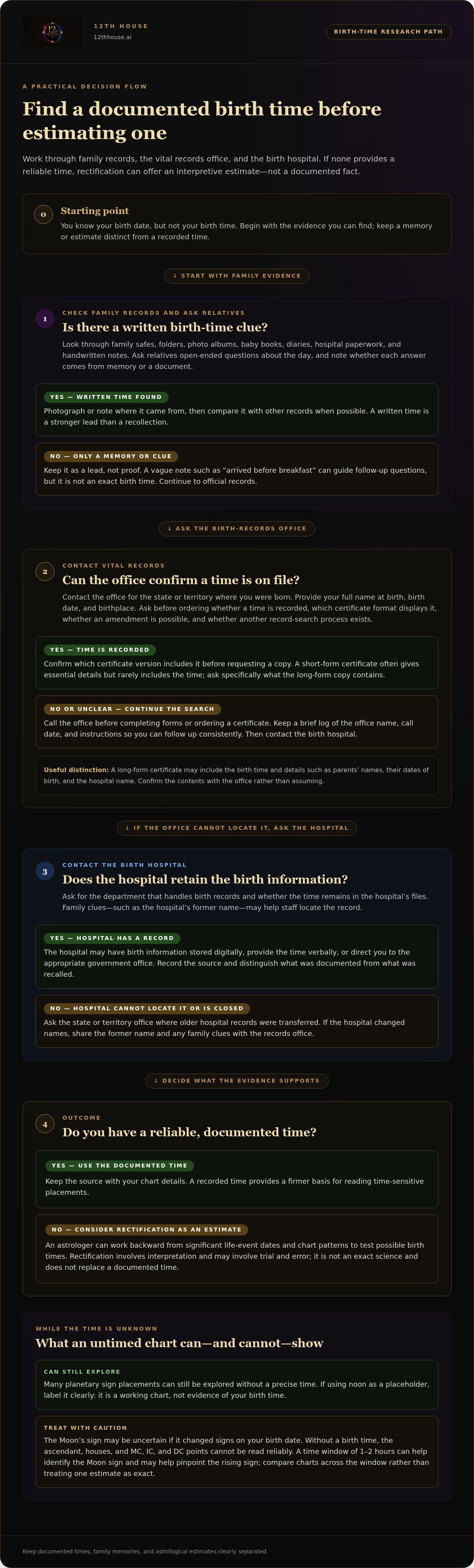
You may be able to find your birth time even without a certificate. To find your birth time for astrology without a certificate, start with family records, then ask the vital records office or hospital where you were born whether the time is on file. If those searches don’t produce a reliable time, birth-time rectification can help estimate one.
It’s frustrating to have your birth date but not the detail that anchors a precise chart. The time matters because the rising sign can shift every 1-2 hours, changing key chart placements. Still, you can begin exploring astrology with the information you have.
This guide explains how to search official and family records, what an unknown birth time can and can’t reveal, and how to prepare for rectification. Follow the steps in order, and keep any estimate distinct from a documented time.
Key Takeaways
- Ask the vital records office in your birth state or territory whether birth time appears in its records before ordering a replacement certificate.
- Contact your birth hospital, which may have the time recorded or be able to direct you to the right records office.
- Search baby books, diaries, photo albums, and family safes, then compare any remembered time with written records.
- Without a precise time, you can still explore many planetary sign placements, but the ascendant and house placements may be unreliable.
- If records and family memories don’t provide a usable time, an astrologer can attempt rectification by examining significant life events.
Contacting vital records offices and hospitals
A replacement certificate may show the birth time if it appears in the underlying record and the office issues a version that includes it. Ask the birth-records office whether the time is on file, whether an amendment is possible, and which certificate format displays it.
Newspaper birth announcements usually identify the baby and family, not the exact birth time. Search them for clues, but treat an announcement as a lead rather than proof.
- Contact the vital records office for the state or territory where you were born. Provide your full name at birth, birth date, and birthplace so staff can locate the record. Before ordering a replacement, ask whether the available certificate version shows the recorded time. A short-form certificate often gives essential details, such as the birth date, but rarely includes the time.
- Ask specifically about a long-form birth certificate. It may include the birth time and details such as parents’ names, their dates of birth, and the hospital name. Before submitting a replacement request, confirm what the office’s long-form copy contains. If the time is absent from the record, ask whether the office has another record-search process.
- Call the records office before completing forms or ordering a certificate. Ask whether staff can tell you if a birth time is recorded and whether you need to request a new certificate. Keep a brief log of the office name, call date, and instructions. This makes it easier to follow the process if you call again.
- Contact the hospital where you were born if the records office can’t locate the time or you’re unsure which agency holds the record. Ask for the department that handles birth records and whether the hospital retains the time in its files. The hospital may have birth information stored digitally, provide the time verbally, or direct you to the appropriate government office.
- Use clues from relatives and old documents to make your request more precise. A parent may remember the hospital name, while an old family record may show its former name. Share these details with the vital records office or hospital. If the hospital has closed or changed names, ask the state or territory office where its older records were transferred.
Why does my birth time matter?
- Separate reliable chart placements from time-sensitive ones before interpreting a natal chart. A chart calculator uses birth data, but a chart without a known time can still show planetary sign placements. The Moon’s sign may be uncertain if it changed signs on your birth date. Without a birth time, the ascendant, houses, and MC, IC, and DC points can’t be read reliably.
- Use a time estimate only when you can explain its basis. A family member’s recollection or a written note can narrow the possibilities, but a guess is not the same as a recorded time. A window of 1-2 hours can help identify the Moon sign and may help pinpoint the rising sign. Compare the resulting charts across that window instead of treating one selected time as exact.
- If you want to inspect a chart before finding your birth time, enter noon as a placeholder and label it clearly in your notes. Noon creates a working chart, not evidence that you were born then. Use it to examine placements that stay stable across the day, but don’t treat its ascendant or house layout as personal facts. If the Moon changes signs on your birth date, compare both possible Moon placements.
- Try a Sun-sign-as-rising chart as a simplified framework, not a recovered birth chart. Pop-astrology and magazine horoscopes often treat the Sun sign as the first house. To explore this approach, use your birth date and birthplace to look up sunrise, then set the chart so your Sun sign aligns with the rising sign. Adjusting the chart time by 5 minutes may help make those signs match. This method does not establish your actual ascendant or house cusps.
- Consider rectification if you need a more focused estimate and have significant life events to examine. An astrologer can work backward from event dates and chart patterns to test possible birth times. Treat the result as an interpretive estimate: rectification is not an exact science and may involve trial and error. It can help you compare plausible chart structures, but it doesn’t replace a documented birth time.
Searching family records and asking relatives
- Search family safes, photo albums, and folders of important papers. Look for an original birth certificate, hospital paperwork, or a handwritten note from the day you were born. Check envelopes and albums as well as loose documents, since a time may appear beside a date or family caption. Photograph useful records and note where each came from. Treat a written time as a stronger lead than a memory, then compare it with other evidence when possible.
- Check baby books and diaries page by page, including entries written soon after your birth. A parent may have recorded the time beside your name, birth date, or details about the delivery. Check the backs of photographs too: relatives sometimes wrote captions there, such as “arrived before breakfast.” Preserve the exact wording and handwriting in a photo or transcription. A vague phrase can guide follow-up questions, but it isn’t an exact birth time.
- Ask parents, grandparents, siblings, and family friends who were present or heard the news soon afterward. Begin with open questions: “What do you remember about the day I was born?” Then ask whether they recall a clock time or seeing one written in a baby book. Don’t suggest a time before they answer. A prompt can shape recollection, so record their first response and whether it comes from memory or a document.
- Compare each account without forcing different memories into one precise answer. A parent might recall a morning delivery, while a family friend remembers a call later that day. Ask what each person remembers directly and what they learned afterward. Record names, the source of each recollection, and any time range they offer. A family member’s best guess may help identify some astrological placements, but label it as an estimate.
- Build a simple evidence log before entering a time into a chart calculator. List written records and recollections separately, then note whether each gives an exact time, a broad clue, or no timing detail. For example, compare a baby-book entry with a relative’s memory of the delivery. If accounts conflict, keep both versions rather than choosing the one that feels most convincing. This lets you see how different estimates affect the chart.
Why exact birth time matters in astrology
- Start by separating time-sensitive placements from those you can still explore. An astrology chart uses your birth date, time, and place to calculate its structure. Without an exact time, it can still show planetary sign placements, but the ascendant, houses, and MC, IC, and DC points cannot be read reliably. For example, you can examine a planet’s sign while leaving its house placement unresolved.
- Check the rising sign before relying on interpretations tied to the chart’s angles. The ascendant, also called the rising sign, is the zodiac sign rising on the eastern horizon at your birth location and time. Rising signs move over the horizon throughout a 24-hour period, and the sign can shift every 1-2 hours. A chart time that’s several hours off can therefore produce a different ascendant and a different chart framework.
- Consider the Moon’s position alongside the date, especially if the Moon changed signs on your birthday. The Moon changes signs every 2-3 days, so the date alone may not settle its placement when a sign change falls that day. Compare the chart at plausible times around the transition. A narrower estimate can clarify which Moon sign applies, while a broad guess may leave more than one interpretation in play.
- Use a precise time if you want to examine chart angles and houses in detail. Your birth time, date, and place determine the Moon sign, descendant, and Midheaven, among other placements. The ascendant’s exact degree advances every couple minutes, so even a small time difference can alter degree-based readings. Precision matters most when your question depends on a specific angle, house cusp, or placement rather than broad planetary sign themes.
- Choose a chart method that matches the evidence you have. If your birth time is unknown, record that uncertainty rather than treating noon or another placeholder as your actual time. A placeholder can generate a chart for exploration, but its time-based angles and houses aren’t reliable personal data. If you later find a plausible time window, compare charts across it. Separate interpretations that stay stable across the window from placements that change.
Birth-time rectification by an astrologer
Birth-time rectification uses significant life events to test possible birth times against astrological chart patterns. Treat the result as an estimate, not a recovered record.
-
Gather information for an astrologer
Prepare your birth date and birthplace, along with any time clues from relatives or family documents. List significant events with their dates, such as a move, graduation, marriage, or career change. The astrologer compares these events with possible chart configurations to work toward a plausible time. Separate exact dates from approximate memories, and don’t reshape your timeline to fit a preferred chart.
-
Consider professional rectification costs
For professional birth-time rectification in the United States, the price depends on the case and is provided after a quote request. The work involved, the event information you provide, and the astrologer’s process can affect the quote. Before proceeding, understand what the service covers, what information you’ll need to supply, and whether the result is an estimate or a documented birth time.
- Ask how the astrologer will compare possible times. A useful process tests a range against dated events and explains which chart factors support or weaken each candidate. In Vedic astrology, an astrologer may perform rectification when someone can’t find a birth certificate or was born where exact birth times weren’t recorded. The method relies on interpretation, not access to a hidden official record.
- Review the reasoning, not just the proposed time. Ask which events were most informative and how a different time would change the ascendant or house placements. Rectification involves trial and error and isn’t an exact science. A careful estimate distinguishes a plausible time from certainty, especially when events are broadly dated or remembered rather than documented.
- Use the estimate as a working hypothesis for chart exploration. Compare the resulting chart with the evidence you already gathered, and keep the estimated time clearly labeled in your notes. If you want to examine how a chart and its transits relate to your life questions, explore a structured astrology chart analysis. Keep the rectified time separate from any time found in an official or family record.
At its core, rectification means working backward from events in a person’s life to infer a birth time. The proposed time reflects how the astrologer interprets those events, rather than information read from a record. Keep event details and any uncertainty about them visible throughout the process, so the estimate stays tied to the information provided.
12Th House: Ask Lala AI Spiritual Guidance
12th House’s Ask Lala AI Spiritual Guidance can help you reflect on astrology questions while you explore family records or consider a time estimate. Use it to clarify what you want to understand, such as which chart details remain useful without a recorded birth time.
Once you have birth data to work with, Astrology Birth Chart & Transit Analysis offers a way to explore chart placements and transits in context. Keep an estimated time distinct from a documented one, so your interpretation rests on clear information.
For questions beyond chart interpretation, Tarot Readings and Numerology Reports offer other structured paths for reflection. Contact 12th House if you’d like to explore its spiritual guidance and astrology offerings.
Keep exploring your chart with clarity
Your next step doesn’t need to be finding a perfect timestamp. If you’re still asking how to find my birth time for astrology without a certificate, keep tracing the evidence and treat estimates as estimates. That distinction lets you explore symbolic patterns without confusing a working hypothesis with a documented fact.
When you’re ready to reflect on what your chart can show, 12th House offers Ask Lala AI Spiritual Guidance and Astrology Birth Chart & Transit Analysis. These tools can support exploration of chart questions and transits, while Tarot Readings offer a separate framework for reflection. Choose the path that fits the question you’re carrying now.
Contact 12th House about your chart and continue your exploration with a clear mind and an open perspective.
Frequently Asked Questions
How do I work with astrology if I don’t have my birth time?
You can still work with a date-based chart, focusing on planetary sign placements rather than time-derived angles. If you’re asking how to find your birth time for astrology without a certificate, first decide what you want the chart to clarify. Broad reflection can use less precision than house-based analysis. Keep your birthplace accurate, and label any placeholder time clearly so it doesn’t become mistaken for a verified detail.
So, what do you do if you don’t know your birth time?
Record your birth date and birthplace, then separate written clues from memories. Search a baby book or diary, and note who provided each recollection. If you find no time, use a chart set to an unknown time if the calculator allows it. Otherwise, treat a placeholder chart as provisional and avoid interpreting its time-dependent features as personal facts.
What if I have a rough idea of my birth time?
Keep the estimate as a window rather than choosing a single minute immediately. Compare charts across that window and note which placements remain stable. A 1-2 hour window can help identify the Moon sign and may help pinpoint the rising sign. If the estimate comes from memory, write down who remembers it and what supports their recollection.
How do I find birth time without a birth certificate in the United States?
Contact the vital records office in the state or territory where you were born. Before ordering a replacement, ask whether the time appears in the underlying record and whether a long-form certificate includes it. You can also contact your birth hospital: it may have the time on file or direct you to the appropriate records office. Provide your birth name, date, and birthplace to help identify the record.
Can hospitals provide old birth records or birth time to the person born there?
A hospital may have your birth time stored digitally and may be able to provide it verbally. Ask the hospital’s records department whether it retains your birth details and what information it needs to locate them. If it can’t find the record, the hospital may direct you to the relevant government office. Have your birth name, date, and birthplace ready when you call.
Can parents or relatives help verify an exact birth time?
Relatives can provide useful evidence, especially if they recorded the time close to your birth. Ask whether their answer comes from a baby book, diary, or written note, or from memory alone. Record each person’s account separately, including disagreements. A remembered time can guide your search, but a written entry made at the time offers a clearer basis for comparison with other records.
Where can I find birth time in baby books, hospital bracelets, or family records?
Check baby-book announcements, diary entries, photo captions, and the backs of family photographs. Look through folders or safes where relatives kept original documents. A hospital bracelet can provide a lead to other records, but rely on it for the time only if the time is printed there. Photograph useful items and preserve their wording before comparing them.
How accurate are online birth-time rectification methods in astrology?
An online result is an estimate, not a recovered official record. Astrological rectification works backward from life events to test possible birth times and can involve trial and error. The estimate depends on the event information provided and how the chart is interpreted. Treat a suggested time as a hypothesis, separate from a time documented in family or official records.


