

A spiritual practice doesn’t need a special room, elaborate ritual, or perfect stretch of free time. Daily spiritual practice ideas can be as simple as a five-minute morning meditation, a short prayer, mindful breathing, or bringing full attention to an ordinary task. What matters is the quality of attention you bring to it.
A meaningful routine should feel personal, not like another obligation. Start with what draws you in. A practice can help you notice your thoughts, reconnect with your values, or meet the day with greater intention. It can be quiet and structured, or woven into the movement of daily life.
Explore what spiritual practice can look like and how to choose approaches that fit your time, interests, and beliefs. From simple rituals to mindful everyday actions, these ideas can help you make a practice sustainable without forcing it into a routine that doesn’t suit you.
Key Takeaways
- Use Lectio Divina to engage with a short scripture passage slowly, noticing the words and questions that hold your attention.
- Turn creative work into a reflective practice by approaching it with curiosity and purpose.
- Anchor a brief ritual to a natural point in your day, such as waking or taking a break, instead of relying on a perfect schedule.
- Choose practices that reflect your values, interests, and current needs, then adjust them as your life changes.
- Bring awareness to ordinary tasks, from preparing a meal to helping someone, and let daily routines become places for reflection.
1. What does a spiritual practice look like?
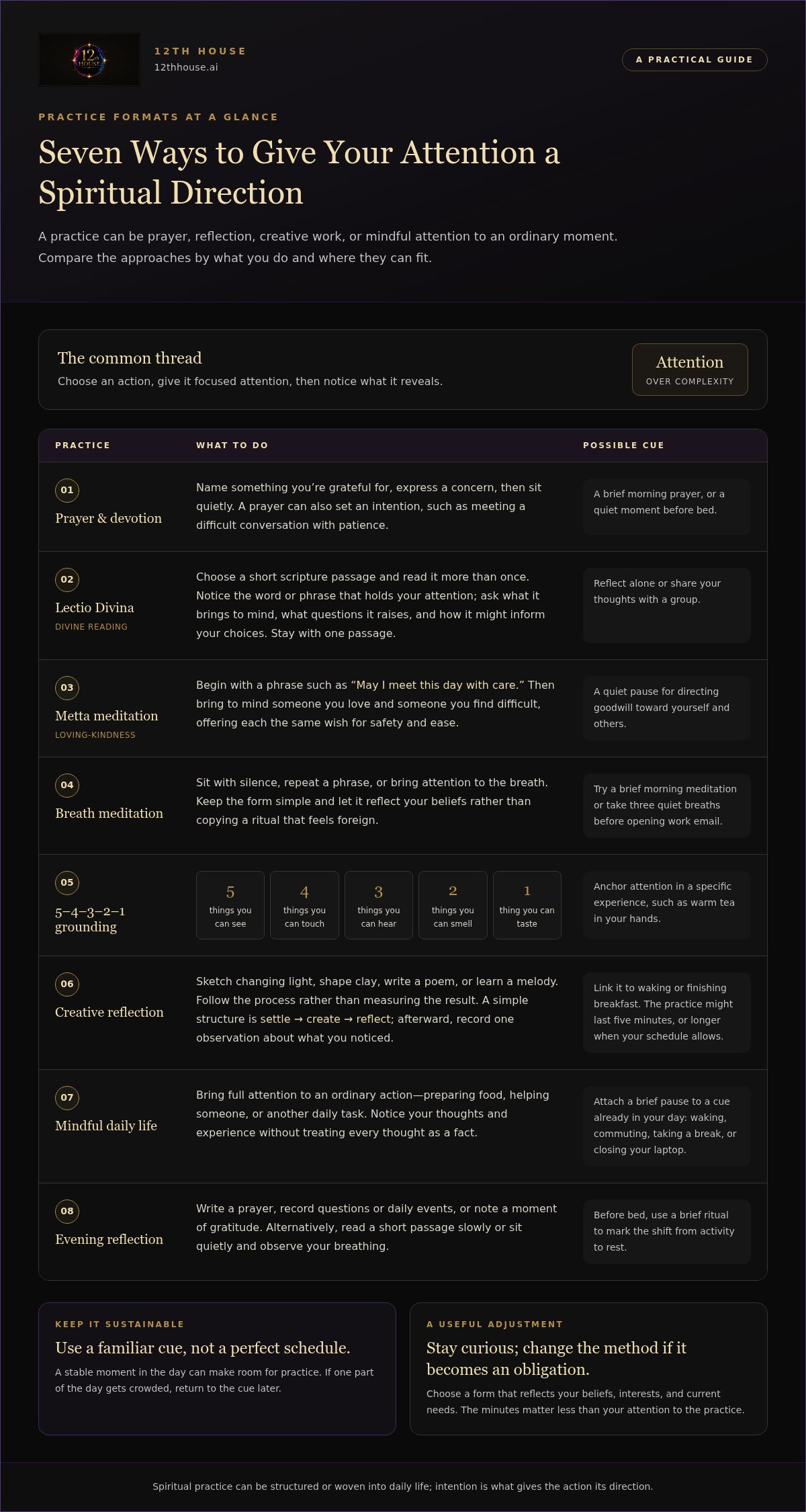
A spiritual practice gives your attention a deliberate direction through prayer, meditation, reflection, or service. It may be religious, rooted in a personal philosophy, or expressed through a mindful pause during an ordinary task. The defining feature is intention: choose an action, give it focused attention, then notice what it reveals.
If you’re new to spiritual practice, start with a short morning prayer, mindful breathing, or a brief meditation. Choose one action and link it to a familiar moment, such as sitting up in bed or preparing breakfast. A small, repeatable ritual offers a clear starting point without requiring an elaborate routine.
Scripture meditation offers a focused way to explore religious texts. Lectio Divina, Latin for “divine reading,” is another name for this practice. Choose a short passage, read it more than once, and notice the word or phrase that draws your attention. Ask what it brings to mind, what questions it raises, and how it might inform your choices. Stay with one passage instead of trying to cover many pages. You can reflect alone or share your thoughts with a group. The method isn’t about forcing a single interpretation; it creates room for attentive reading and an honest response.
Prayer and devotion can follow a simple structure: name something you’re grateful for, express a concern, then sit quietly. Meditation may involve silence, a repeated phrase, or attention to the breath. A brief morning prayer or guided meditation can help set an intention, such as meeting a difficult conversation with patience. Let the form reflect your beliefs rather than copying a ritual that feels foreign.
Metta meditation, also called loving-kindness practice, directs goodwill toward yourself and others. Begin with a simple phrase, such as “May I meet this day with care.” Then bring to mind someone you love and someone you find difficult, offering each the same wish for safety and ease. This practice makes compassion an active focus rather than an abstract value.
For mindfulness, try the 5-4-3-2-1 method: notice five things you can see, four you can touch, three you can hear, two you can smell, and one you can taste. Or observe a thought without treating it as a fact. These steps anchor attention in a specific experience, such as the sensation of warm tea in your hands.
Calming evening practices include writing a prayer, recording questions or daily events, and noting a moment of gratitude. Read a short passage slowly, or sit in silence and observe your breathing before bed. A brief ritual can mark the shift from activity to rest.
Common pitfalls include turning practice into a test of discipline, choosing a ritual that conflicts with your beliefs, or judging every thought that arises. Keep the method simple, stay curious, and adjust the practice if it starts to feel like an obligation instead of a meaningful act.
2. Creativity as a spiritual practice
A creative act can become a meditation when you give it your full attention. Sketch the changing light on a wall, shape clay, write a poem, or learn a melody. Follow the process rather than measuring the result. Notice your choices, the thoughts that surface, and how your feelings shift as you work. This focused engagement can connect you with purpose and meaning through direct experience, not abstraction.
Begin with curiosity. Choose something you want to explore, then allow yourself to make an imperfect first attempt. If you draw, select one object and study its outline before adding detail. If you write, describe a moment from your day without editing the first draft. If you play music, repeat a short phrase and listen to its tone. Each activity lets you notice how attention changes the experience.
To create a sustainable routine, link the creative act to a familiar moment in your day, such as waking or finishing breakfast. Keep materials in view: a notebook on the table, pencils beside your chair, or a guitar near its usual place. A flexible daily rhythm relies on a stable cue, not a rigid clock time. If the morning gets crowded, return to the same cue later in the day.
A spiritual practice might last five minutes each morning, or longer when your schedule allows. Choose a duration you can approach with attention, then follow a simple structure: settle, create, and reflect. A brief drawing or a few lines of journaling can feel meaningful when you engage deliberately. The minutes matter less than having a clear beginning and a moment to notice what the process stirred.
What benefits can research support? A Pew Research survey found that millennials feel as strong a sense of spiritual peace, well-being, and gratitude as their grandparents, despite being less attached to religion. That finding describes spiritual experience across generations; it doesn’t establish that a particular creative practice causes those feelings.
After creating, record one observation: “I felt focused when I mixed the blue and gold,” or “the melody brought up a memory.” These notes help you identify which forms of expression feel meaningful, rather than following someone else’s template. Revisit them when choosing your next practice. If you want a symbolic prompt for a creative ritual, Ask Lala AI Spiritual Guidance can help you explore a personal question through spiritual perspectives.
One contributor recommends staying open and curious while learning and exploring new ideas, allowing creative pursuits to deepen meditation and strengthen a connection with purpose.
3. Building a spiritual practice into a busy life
A full calendar doesn’t rule out spiritual practice. Look at the transitions already built into your day: waking, commuting, preparing food, or closing your laptop. Attach one deliberate act to an existing cue. For example, take three quiet breaths before opening your work email, or pause before lunch to notice your surroundings. This makes practice part of your day’s structure instead of something that competes with every other task.
Choose a duration that matches your actual schedule. A toolkit suggests considering whether a practice can fit into 5, 15, or 30 minutes daily. If the smallest window is realistic, use it consistently rather than designing a longer ritual you keep postponing. A five-minute break outside in the sunshine can create a clear pause. Notice the air, light, and sounds around you, then return to your next task with attention.
Existing responsibilities can also provide a framework. One contributor added 15 minutes a day to animal-care chores as spiritual practice. You might use a repeated task, such as washing dishes or walking a dog, to observe your thoughts and sensations. Silence and solitude don’t require physical separation from other people. A quiet moment beside a sleeping child or during a shared commute can still give attention room to settle.
A Zen saying recommends sitting in meditation for twenty minutes every day, or for an hour when someone is too busy. Read it as a challenge to examine your attention, not as a reason to overload your schedule. If a longer session is difficult to fit in, begin with the time you have and adapt the rhythm as your days change. The useful question is where practice can fit without becoming another source of pressure.
Try a simple transition ritual between work and home. One contributor described meditation as a way to move between those roles and manage stress. After closing a work session, sit quietly, take a mindful walk, or write down what you’re leaving behind. Then choose one intention for the next part of the day. This sequence gives the transition a beginning and an end.
Reading can fit into small spaces, too. Keep a book of spiritual reflection near your bed and read a short passage before sleep. Follow it with a gratitude note naming a person, meal, or useful moment from the day. If bedtime is unpredictable, use another reliable cue, such as making tea. The activity matters less than linking it to a moment you already encounter.
Build flexibility into your practice. On a crowded day, breathe quietly during a familiar chore; when time opens up, extend the practice with reflection or a walk. These daily spiritual practice ideas work best as adaptable patterns, not strict tests. Choose one cue, decide what action belongs there, and notice whether it supports attention in everyday life. Keep what helps and revise the rest.
4. Choosing practices that suit the individual
Start by defining what spirituality means to you. Write a few lines about the questions, values, or experiences that make life feel meaningful. Your answer might involve connection with nature, compassion toward others, religious devotion, or curiosity about consciousness. Use it as a compass, not a rulebook. A practice should help you engage with what matters, rather than imitate someone else’s ideal routine.
Next, consider your current interests, challenges, hopes, values, and visions. If you’re seeking calm during a demanding period, try quiet breathing or a reflective walk. If you want more connection, make attentive conversation with friends part of your practice. Someone drawn to learning might reflect on a spiritual text, while someone who needs movement may prefer dance. Match the activity to the need it serves.
You don’t need a religious affiliation to practice spirituality. Try mindful breathing, gratitude journaling, walking in nature, or making art with deliberate attention. For example, pause to notice the air and sounds outside, then write one line about what you observed. These practices use attention and reflection without requiring a particular belief system or religious framework.
Keep the first experiment small. A simple practice of 5 or 10 minutes a day can be easier to sustain than an elaborate ritual that feels difficult to repeat. Choose one activity, attach it to a familiar cue, and reflect afterward: Did it fit? Did it support the intention you set? Adjust the method based on your experience. Developing a practice is a process of testing and refinement, not a demand for perfect consistency.
Let your practice change with your circumstances. One contributor described dancing, playing video games, reading, and meditating as ways to navigate a painful period. That range shows how personal a practice can be: a contemplative activity may suit one moment, while an absorbing creative activity suits another. Talking with children can also become an everyday act of connection, changing as their interests and conversations develop.
For a positive starting point, choose one practice that feels interesting and relevant to your life now. Try it for a few days, then note what draws your attention and what feels forced. If you’re unsure where to begin, ask what you need more of right now: rest, courage, connection, or clarity. Choose a practice that supports that intention, and let your observations guide the next step.
The toolkit recommends choosing practices that fit a person’s current interests, challenges, hopes, values, and visions. It encourages people to reflect on what spirituality means to them and define it for themselves. Use those reflections to guide your choice of activity, rather than treating any single approach as right for everyone. If you pray, you might ask God for guidance about which spiritual practice to try first. Consider that question alongside what feels relevant in your life now, then begin with the option that seems most fitting. Your definition and choice can remain personal, and you can revisit them as your needs and priorities shift.
5. Making spiritual practices part of daily life
Include meditation, prayer, or mindfulness by linking each to an ordinary cue. Pause for a quiet breath before opening your laptop, say a brief prayer while preparing tea, or notice your steps during a walk. These small rituals bring attention into everyday routines, rather than reserving spiritual practice for a special room or hour.
To stay consistent, connect one chosen action to a moment that already happens each day. For example, make the bed while thinking of something you’re grateful for, then repeat the gesture tomorrow. The point isn’t to perform perfectly. It’s to create a recognizable pattern that can flex when your schedule changes.
Ordinary tasks can carry deeper meaning when you approach them consciously. Cleaning the kitchen offers familiar sensations to notice: warm water, the weight of a plate, the sound of dishes. Eating can become a check-in with yourself: pause before a meal, observe your emotions, and consider what nourishment means in that moment. The activity stays familiar; your attention shifts.
Use a simple sequence to turn a routine into reflection: choose a task, notice its sensations, and name one thing it brings to mind. Making the bed might prompt gratitude for rest. A commute might become a chance to observe the sky and the ground, noticing open space above and solid footing below. This sequence gives awareness a practical place in everyday life.
Gratitude can also shape interactions. Before replying to a message, notice the person behind it and consider one helpful response. During a meal, acknowledge the people or effort that brought it to the table. These gestures don’t require a new block of time. They make connection part of what’s already happening at home, work, or elsewhere.
Try a positive affirmation when a repeated task begins: “I can meet this moment with care,” or “I’m open to what I can learn.” If the words feel disconnected from your experience, choose a more honest phrase, such as “I’m practicing patience.” Precision matters. An affirmation should direct your attention, not deny what you’re feeling.
Build a flexible pattern rather than a flawless streak. Keep one practice for busy days, such as a mindful pause while washing a cup, and another for more spacious days, such as a purposeful walk. A longer spiritual practice once or twice a week can complement a basic daily ritual. Adjust the form as work, family, and energy shift.
If a personal question is shaping your routine, explore it through Ask Lala AI Spiritual Guidance. Use the reflection to identify one action you can carry into daily life, then observe how it feels in practice.
12Th House: Ask Lala AI Spiritual Guidance
12th House’s Ask Lala AI Spiritual Guidance can help you explore a personal question through spiritual perspectives. Turn to it when you want a prompt for reflection, or when you’re trying to connect a daily ritual with a larger question about meaning. Ask Lala answers personalized questions about charts, spells, and compatibility, giving you a framework to consider as you shape your own practice.
For a more specific lens, Astrology Birth Chart & Transit Analysis, Tarot Readings, and Numerology Reports offer other ways to explore spiritual themes. Use these tools to generate journaling questions or clarify which ideas you want to examine further. The practice remains yours to interpret and apply.
Visit 12thhouse.ai to explore Ask Lala AI Spiritual Guidance.
Let Your Practice Evolve With You
A meaningful routine isn’t a finished design. It’s a living relationship with your attention, shaped by what matters to you now. Treat daily spiritual practice ideas as experiments: choose one that feels relevant, notice how it fits your life, and refine it as your needs change. A practice can deepen without becoming more elaborate.
When you feel uncertain about what to explore next, start with the question beneath the uncertainty. Are you seeking clarity, a stronger sense of connection, or a way to approach change? Naming that intention can help you choose a useful direction. You can also use spiritual perspectives as prompts for reflection, keeping your judgment and experience at the center.
If you’d like a structured space to explore your questions, contact 12th House to explore. Take the next step at your own pace, and let your practice grow from honest attention.
Frequently Asked Questions
What does a spiritual practice look like?
A spiritual practice is an intentional action that helps you examine what matters and how you relate to it. Before making a difficult decision, for example, write down the values involved, sit quietly with the tension, then note what deserves your attention. A practice isn’t defined by a particular belief or setting. Its structure comes from returning to an action with awareness and using it to guide reflection or conduct.
What are short morning spiritual practices?
Try beginning the morning by naming one quality you want to bring into the day, such as patience or courage. As you get dressed, choose an action that expresses it, like listening fully during a conversation. You could also read a short passage, then write one sentence about how it applies to a current choice. These brief practices give your attention a clear direction before messages and tasks begin.


