

What if the most useful spiritual guidance doesn’t tell you what to do, but helps you see what matters more clearly? During uncertainty or change, it’s natural to look for a sign, a pattern, or a steadier point of view. Spiritual guidance for difficult times can offer a framework for reflection, but it shouldn’t ask you to surrender your judgment or replace practical help.
A spiritual practice may bring perspective, while vague advice or absolute predictions can leave you feeling less certain. This guide will help you use spiritual reflection with discernment: name what you’re experiencing, identify what you need, and consider a grounded next step. You’ll find practical prompts for separating feelings from decisions, ways to assess whether guidance is useful, and reminders of when to turn to trusted people or professional support. Treat each insight as information to consider, not an instruction you must follow.
Key Takeaways
- Use spiritual guidance for difficult times as a lens for reflection, not as an authority that decides what you should do.
- Choose a reflective practice, such as journaling, meditation, or prayer, to create space for noticing what matters to you.
- Distinguish open-ended guidance that preserves your choices from advice that relies on fear or guaranteed outcomes.
- Sort a difficult situation into observable facts, emotional responses, interpretations, and unanswered questions before choosing a next step.
- Explore digital spiritual tools as optional prompts, and turn to trusted people or professional support when your needs call for it.
What Spiritual Guidance for Difficult Times Can, and Cannot, Offer
Uncertainty, grief, transition, and stress can unsettle decisions that once seemed straightforward. In those moments, spiritual guidance for difficult times may offer a way to pause, consider what feels meaningful, and listen more closely to your own values. It can support reflection. It can’t guarantee an outcome, erase hardship, or make a difficult choice on your behalf.
Spiritual guidance is reflective support drawn from beliefs, symbols, practices, or trusted sources of meaning; it is not a substitute for professional care or practical assistance. That distinction matters. A spiritual practice may help you organize your thoughts, but it doesn’t diagnose health concerns, resolve legal or financial issues, or provide emergency help.
What people mean by spiritual guidance
The phrase can describe prayer, contemplation, meditation, symbolic systems such as astrology or tarot, or conversation with someone whose perspective you trust. The related practice of Spiritual direction offers one example of a tradition centered on reflection and spiritual life. People and traditions interpret these practices differently. No single belief system or ritual is necessary for reflection to be meaningful.
Consider what you want the practice to help you do. It might create a quiet interval before a conversation, give language to a feeling you haven’t named, or help you examine a recurring concern. Its value lies in the questions it opens, not in a claim that everyone should reach the same conclusion.
Support, certainty, and personal agency
Reflection can turn diffuse worry into more specific questions: What am I concerned about? Which values feel most important here? What options are available, and what information do I still need? Writing down the answers can help you identify what is known, what is uncertain, and what you can do next without pretending uncertainty has disappeared.
Keep your judgment in the process. A card, chart, prayer, or symbol can serve as a prompt for thought, but it isn’t proof of what will happen or an instruction you must obey. If an interpretation suggests a possibility, compare it with observable facts, your responsibilities, and the likely effects of each choice. You can consider the insight, set it aside, or seek another perspective.
Helpful guidance leaves room for questions and choice. Be cautious of advice that frightens you into acting, claims unquestionable authority, or promises guaranteed results. Spiritual reflection can sit alongside conversations with trusted people and professional support. Use it as one part of your decision-making, not the whole process.
How Spiritual Practices Can Create Space for Reflection
A practice can give your attention a simple structure when thoughts feel scattered. Writing, sitting quietly, praying, or reflecting on a symbol may help you notice what’s present and which questions need attention. These activities don’t control events or guarantee calm. Think of them as ways to observe and make meaning, not techniques for determining what must happen next.
A reflective practice can organize your questions without deciding for you. The right approach depends on your beliefs, cultural context, and comfort. There’s no need to adopt a practice that feels unfamiliar or interpret an experience in a particular way. If a method increases distress or makes you feel pressured to reach an answer, pause, adapt it, or choose another.
Choosing a practice that fits your beliefs
Keep the starting point low-pressure. In a journal, write what’s on your mind, what you know so far, and what you still need to understand. In quiet reflection or meditation, notice where your attention goes without forcing it to become still. Prayer may offer language for hope, grief, gratitude, or uncertainty if it belongs to your tradition. You can also sit with a question and let it remain unanswered for now.
Practical coping can sit alongside spiritual practice. Coping with difficult times, Ready.gov includes stress-management suggestions and points readers toward support such as faith-based organizations. Use any practice at a pace that feels manageable. You can stop if it becomes overwhelming.
Using symbolic systems as mirrors, not verdicts
Astrology, tarot, numerology, and Human Design offer interpretive frameworks. Their symbols can give you a fresh angle on a concern, but an interpretation is not evidence of what will happen. Treat it as a prompt: What does this bring to mind? Does it reflect something I already know, or raise a question worth examining? For a closer look at tarot as a reflective system, explore this Tarot Mastery guide.
Keep important decisions anchored in circumstances you can verify, your responsibilities, and the options available to you. Spiritual guidance for difficult times is most useful when it expands reflection without narrowing your choices. If a digital tool would help you explore a symbolic framework, 12th House offers digital spiritual and metaphysical resources at 12th House’s digital platform. Treat any output as material to consider, not a verdict or substitute for practical support.
How to Tell Helpful Spiritual Guidance from False Certainty
Helpful spiritual guidance invites you to reflect. It doesn’t claim unquestionable authority over your life or demand that you follow an interpretation without question. That distinction is central to using spiritual guidance for difficult times with discernment: a useful perspective can help you consider options, while false certainty tries to replace your judgment.
Responsible guidance leaves room for uncertainty and independent judgment. Notice how advice is framed. “This may be a useful question to explore” leaves you free to agree, disagree, or wait. “This will definitely happen” presents an interpretation as fact. Be especially cautious if someone uses fear, shame, urgency, or promises of guaranteed results to push you toward a decision.
Questions to ask before accepting guidance
Pause and test the message against your boundaries and circumstances. Ask yourself:
- Is this being offered as one possible interpretation, or as an absolute fact?
- Does it respect my values and leave me free to choose?
- Does it help me think clearly, or make me feel frightened or pressured to act now?
- What practical information or trusted perspective would help me assess this?
If the guidance creates urgency, give yourself space before acting where it’s safe to do so. A reading or symbol should not be the sole basis for urgent health, safety, legal, or financial decisions. For those concerns, consult an appropriate qualified professional and use reliable, situation-specific information. Reflection can help you clarify what to ask, but it can’t replace that expertise.
When spiritual reflection is not enough
Spiritual practices can be one source of meaning, not your entire support system. If you feel isolated or overwhelmed, consider telling someone you trust what’s happening and what kind of help would be useful. For persistent distress or specialized concerns, reach out to a licensed professional with relevant expertise.
If you or someone else is in immediate danger, contact local emergency services or a crisis resource in your area. Don’t wait for a spiritual interpretation to resolve an urgent situation. Choosing practical support doesn’t invalidate your beliefs; it’s a way to respond to the needs in front of you. Let reflection inform your questions, then match your next step to the facts, risks, and support available.
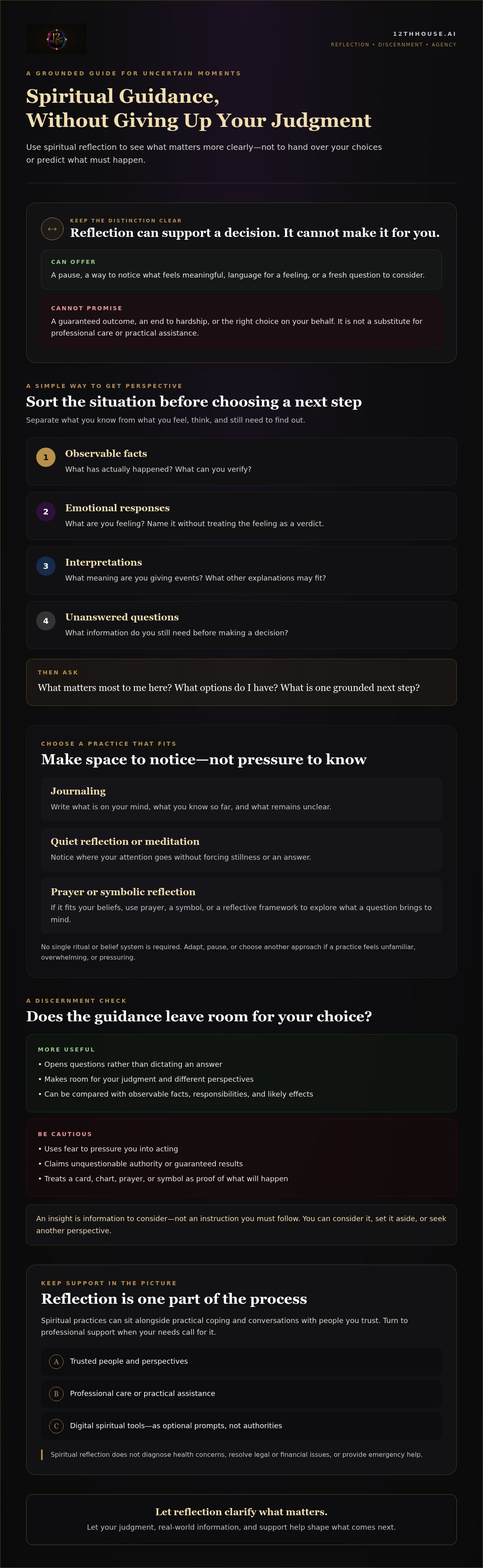
A Grounded Spiritual Reflection Practice for Difficult Moments
Use this short sequence when a concern feels too tangled to hold in your mind. The aim isn’t to force an answer. It’s to make a clear record of what’s happening, what you’re experiencing, and what you might do next. Spiritual guidance for difficult times can be most useful when reflection leads back to your own judgment and real-world circumstances.
A simple reflection sequence
- Name the concern. Write one direct question you need help considering, such as, “What do I need to understand before responding?” Keep it focused on what you can examine, rather than demanding certainty about the future.
- Separate the information. Note the observable facts, your emotional responses, your interpretations, and the questions that remain unanswered. For example, “The meeting was postponed” is a fact; “I feel anxious” is an emotional response; “This means I’m being rejected” is an interpretation. Labeling each can help you see what you know and what you’re assuming.
- Use one spiritual prompt. Pray, sit quietly, or draw on a symbol or reading. Ask what possibility or question it brings to mind. Treat the response as a perspective to consider, not a conclusion you’re required to accept.
- Choose a grounded next step. Identify one small action, such as gathering missing information, asking a trusted person for perspective, or arranging support. Check whether it aligns with your values, protects your safety, and fits the resources available to you. If no action is clear, deciding who to consult can be a meaningful next step.
Keeping reflection compassionate and bounded
Set a brief period for the exercise and decide how you’ll close it, perhaps by writing down your next step and putting the page away. If you notice yourself becoming more distressed, stop and shift toward something stabilizing or contact someone you trust. You don’t need to solve everything at once. One careful question is enough for now.
If an AI-based tool fits your beliefs and feels comfortable, you could use it to explore a question from another angle. The AI astrology assistant guide offers context for considering that kind of digital reflection. For personalized spiritual questions, explore Ask Lala AI Spiritual Guidance as an optional prompt. Use any response as material to reflect on, then make decisions based on your circumstances, values, and available support.
Exploring Digital Spiritual Guidance with 12th House
Once you have a practical way to reflect and assess guidance, a digital tool may offer another perspective to consider. 12th House is a digital membership platform for spiritual and metaphysical exploration. Its AI assistant, Lala, responds to personalized spiritual questions using the platform’s metaphysical tools. Treat a response as a prompt for inquiry, not an authoritative reading of your situation.
Using Lala and metaphysical tools for self-inquiry
Frame questions around what you want to understand, rather than asking a tool to decide what will happen. For example, try “What values do I want to honor as I consider this change?” instead of “Will everything work out?” The first invites reflection; the second asks for certainty no symbolic system or AI tool can guarantee.
12th House offers astrology, tarot, numerology, Human Design, and a metaphysical learning library. These resources approach reflection through different symbolic frameworks. An astrology tool might give you a chart-based lens to consider; tarot may offer imagery to interpret; numerology and Human Design provide other systems for exploring patterns and perspective. Their usefulness depends on how you engage with them, not on a promise of accuracy or a particular result.
As you explore, compare any interpretation with what you know about yourself and your real-life context. Ask whether it raises a question worth considering, aligns with your values, or conflicts with facts you can verify. The AI spiritual guide overview offers further context on using an AI-based spiritual tool. 12th House provides digital tools, not live human consultations or professional care. Its resources aren’t a substitute for clinical, legal, financial, or emergency support.
Choosing a next step that feels right
Match the kind of support to the need in front of you. Journaling may help you sort your thoughts; a trusted person can offer connection and perspective; a licensed professional can address persistent distress or specialized concerns. A digital tool may suit you if you’re looking for a structured way to explore spiritual questions. No single option fits everyone, and using a platform is entirely optional.
If structured digital reflection feels useful, explore 12th House’s spiritual tools. Use them at your own pace, keep your judgment in the process, and choose the kind of support that fits your circumstances. Spiritual guidance for difficult times can be one part of your reflection, while practical decisions remain grounded in your needs, available information, and trusted support.
Carry Reflection Into Your Next Step
Spiritual guidance for difficult times can help you pause, name what matters, and consider a situation from a new angle. Its value isn’t certainty. It’s the space to notice your feelings, separate facts from interpretations, and choose a next step that fits your values and circumstances.
Keep your agency at the center. Let spiritual practices and symbolic tools open questions, not dictate decisions. When a concern calls for practical, professional, or urgent support, reach for the appropriate help alongside reflection.
If a digital framework feels useful, 12th House offers Lala, an AI assistant for personalized spiritual questions, alongside digital access to astrology, tarot, numerology, Human Design, and a metaphysical library. These are optional tools for exploration, not definitive answers or professional care. Explore 12th House’s digital spiritual tools and use what supports your reflection.
You don’t need to map the whole path today. Begin with one honest question and one grounded step.
Frequently Asked Questions
What is spiritual guidance for difficult times?
Spiritual guidance for difficult times is a way to reflect on hardship through beliefs, practices, symbols, or trusted sources of meaning. Journaling, prayer, or considering a symbolic interpretation may help you clarify what concerns you and identify questions to explore. The meaning of a practice varies across people and traditions. Use approaches that respect your beliefs and boundaries, and remember that reflection can’t guarantee an outcome or replace practical support.
Can spiritual guidance help when you feel overwhelmed?
It may provide a structured pause to name what feels difficult and consider what matters most. You might write down the immediate concern, notice your feelings, and identify what information or support you need. Prayer or symbolic reflection may also help some people examine a situation from a different perspective. Experiences vary, and spiritual guidance isn’t mental health treatment. If distress persists or feels unmanageable, reach out to someone you trust or a qualified professional.
Is spiritual guidance the same as therapy?
No. Spiritual guidance may explore beliefs, meaning, values, or symbolic systems. Therapy is provided by a qualified mental health professional and can address psychological concerns. Some people choose both, but spiritual reflection shouldn’t be treated as a replacement for therapy. If distress persists, follows trauma, or affects daily life, consider speaking with an appropriately licensed professional. You can use spiritual practices for personal reflection while seeking care suited to your needs.
How do I find spiritual guidance that feels trustworthy?
Look for guidance that respects your choices, acknowledges uncertainty, and avoids fear-based pressure or promises of guaranteed results. Ask whether an interpretation is offered as a possibility or presented as unquestionable fact. You should be able to pause, disagree, or decline advice without being pushed. Before major health, safety, legal, or financial decisions, consult relevant qualified support and consider practical facts rather than relying on spiritual interpretations alone.
Can astrology or tarot tell me what will happen during a difficult time?
Astrology and tarot are interpretive systems, not guarantees of future events. Some people use them to consider themes, frame questions, or reflect on choices. If a reading resonates, ask what it helps you notice, then compare that perspective with observable facts and your own judgment. An interpretation doesn’t have to determine your next move. Avoid basing high-stakes decisions solely on a reading or symbolic message.
What should I do if spiritual advice makes me more anxious?
Pause the practice and give yourself permission to stop. Consider whether the advice used frightening language, claimed certainty, or pressured you to act quickly. You don’t have to keep engaging with an interpretation that feels unsafe or conflicts with your boundaries. Talk with someone you trust, and seek qualified support if anxiety continues or interferes with daily life. Reflection should help you consider your experience, not force you into distress.
Can an AI tool provide spiritual guidance?
An AI tool can respond to spiritual questions or offer prompts based on the information and systems available to it, but it isn’t a human spiritual counselor or professional care provider. 12th House’s Lala AI assistant responds to personalized spiritual questions alongside digital metaphysical tools. Treat its responses as material for reflection, compare them with your own judgment, and avoid relying on AI for urgent or high-stakes decisions.


