

Could a place that feels magical also make everyday life harder to navigate? A Neptune line astrocartography reading can point to themes of intuition, creativity, compassion, and spiritual longing. Neptune’s symbolism can also blur boundaries and practical details. If a map feels inspiring yet difficult to apply, examine that tension rather than explaining it away.
You’ll learn what a Neptune line may symbolize and how its angle can shift the focus: the Ascendant relates to identity, the Descendant to relationships, the Midheaven to public life and career, and the IC to home and inner life. Each offers a different lens, not a fixed forecast.
Use the map as a framework for reflection, not a guarantee that a location will transform your life. We’ll consider the possible gifts and challenges of each angle, then weigh astrological symbolism alongside practical needs such as work, housing, relationships, and support. The aim is not to let a compelling line make the decision for you. It’s to help you ask clearer questions before choosing what comes next.
Key Takeaways
- A Neptune line highlights symbolic themes in a location’s chart, not a guaranteed event or outcome.
- Compare the Ascendant, Descendant, Midheaven, and IC to see whether Neptune’s themes may relate more to identity, relationships, vocation, or home.
- With Neptune line astrocartography, consider both imaginative or compassionate possibilities and the risk of blurred boundaries or idealization.
- Assess a place through practical questions as well as astrology, and use accurate birth time and place for a personalized chart calculation.
- Explore planetary lines with 12th House astrocartography mapping, then use Lala to ask personalized chart questions without treating its guidance as certainty.
What Does a Neptune Line Mean in Astrocartography?
A city can look luminous on a map and still leave you wondering what that symbolism means in ordinary life. In Neptune line astrocartography, a Neptune line marks places where Neptune was angular in your birth chart. In astrological interpretation, those locations may bring Neptune themes into sharper focus. The line doesn’t promise a particular experience or tell you whether a city is right for you.
A Neptune line is a geographic reference point for exploring how Neptune’s symbolism may be emphasized in a location, not a factual prediction of what will happen there. Treat it as a lens for reflection, not a verdict about a place. The same symbolism can feel meaningful in different ways depending on your chart, circumstances, and choices.
What does Neptune symbolize in a location-based chart?
Astrologers associate Neptune with imagination, ideals, spirituality, compassion, sensitivity, and longing. Near a Neptune line, you might reflect on whether a location feels creatively stirring, emotionally permeable, or connected to a search for meaning. These are possibilities within an astrological framework, not universal effects. One person may find a setting artistically evocative; another may see its symbolism as an invitation to slow down and listen inward.
Neptune’s appeal has a counterpart: its symbolism can also point to fantasy, uncertainty, or blurred boundaries. Ask practical questions alongside intuitive ones:
- Am I responding to what I know about this place, or to an ideal I’ve built around it?
- Do I have clear limits in relationships, work, and spending?
- What information would help me see the situation more plainly?
These questions don’t cancel inspiration. They help you engage with it thoughtfully and distinguish an appealing idea from the details of daily life.
How does a Neptune line differ from a planet’s general meaning?
Astrocartography connects a natal chart with geography. It maps places where planets were positioned at key angles in the sky at the moment of birth, giving each planetary line a location-based emphasis. Neptune’s general symbolism supplies the vocabulary; the line suggests where astrologers might explore that vocabulary geographically. Its angle and the rest of the chart help refine the interpretation.
This differs from a transit, which describes current planetary movement in relation to a birth chart. A Neptune line also isn’t a complete reading of your natal chart. On its own, it can’t account for every planetary placement, personal history, or real-world condition tied to a move. For a clearer foundation, learn how the broader astrocartography mapping guide connects chart factors with place.
Keep the distinction clear: the map offers a structured symbolic question, not a decision. “What might Neptune invite me to notice here?” is more useful than “What will this city make happen?”
How the Neptune Line Changes Across the Ascendant, Descendant, MC, and IC
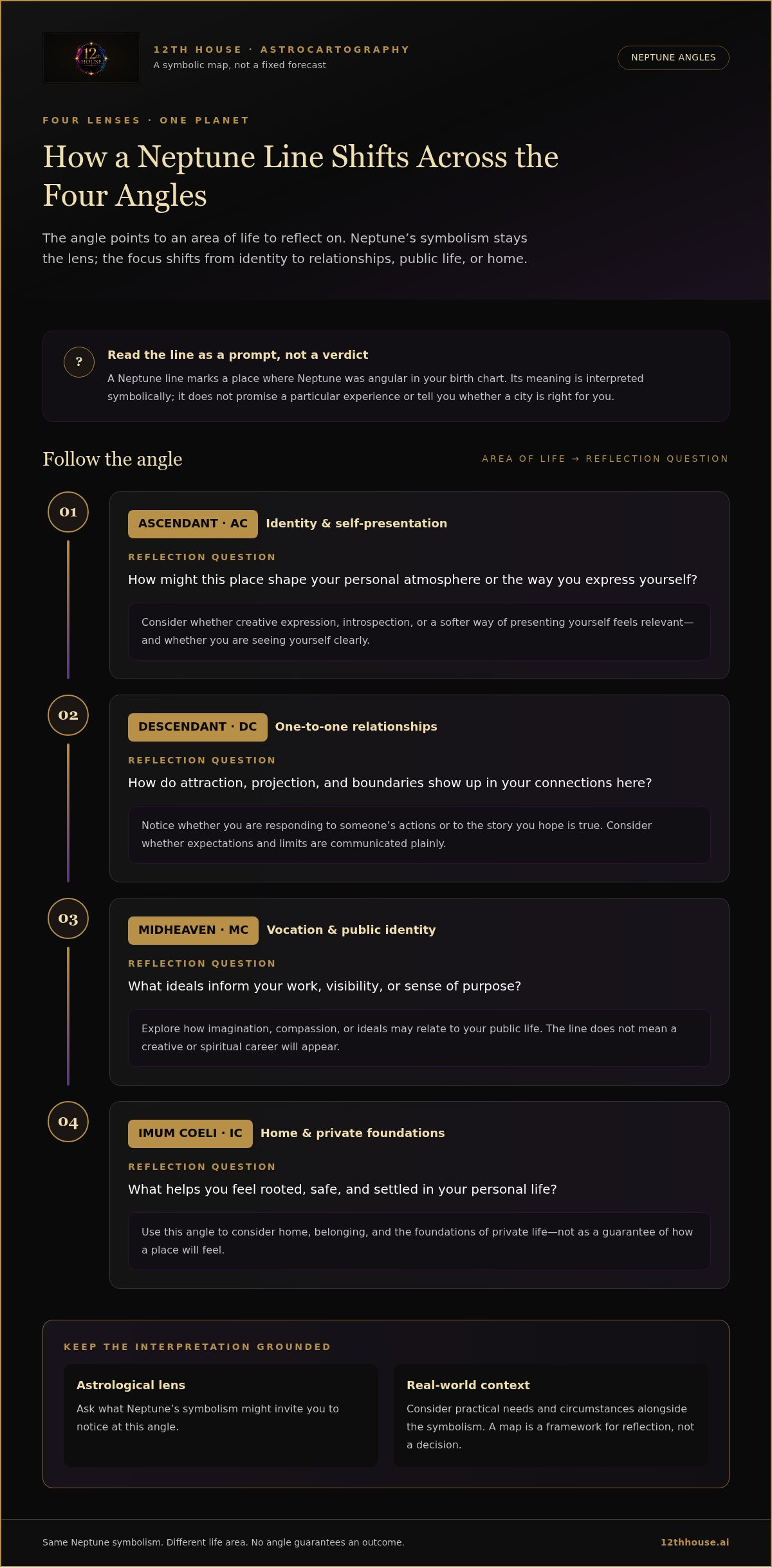
The angle gives Neptune a specific area of life to interpret. It doesn’t turn Neptune into a different planet or guarantee an outcome. Instead, it helps you frame a more precise question: might Neptune’s symbolism feel most relevant to how you present yourself, how you relate, what you pursue publicly, or where you feel at home?
An angular placement frames a planet-line interpretation by pointing to the area of life where its symbolism may become more noticeable. Use that frame as a prompt for observation, not a verdict about the city or your future there.
| Neptune angle | Area of life | Interpretive questions |
|---|---|---|
| Ascendant (AC) | Identity and self-presentation | How might this place shape your personal atmosphere or the way you express yourself? |
| Descendant (DC) | One-to-one relationships | How do attraction, projection, and boundaries show up in your connections here? |
| Midheaven (MC) | Vocation and public identity | What ideals inform your work, visibility, or sense of purpose? |
| Imum Coeli (IC) | Home and private foundations | What helps you feel rooted, safe, and settled in your personal life? |
Neptune Ascendant and Descendant lines turn attention toward identity and relationships. On an Ascendant line, consider the personal atmosphere you inhabit. Do you feel more drawn to creative expression, introspection, or a softer way of presenting yourself? Also notice whether you’re seeing yourself clearly or adapting too readily to the image others reflect back.
The Descendant shifts the lens to close interactions. Neptune symbolism here can prompt reflection on ideals, empathy, attraction, and interpersonal limits. Rather than assuming a place will bring a particular romance or relationship difficulty, ask: am I responding to someone’s actions, or to the story I hope is true? Are expectations and boundaries being communicated plainly?
Neptune Midheaven and IC lines bring the questions into public and private life. The Midheaven (MC) concerns vocation, visibility, and reputation. You might explore how imagination, compassion, or ideals inform your work and public identity. That doesn’t mean a creative or spiritual career will appear. The broader astrocartography map guide can help situate this angle within the map’s wider structure.
The IC points inward, toward home, belonging, and the foundations of private life. Reflect on what makes a place feel restorative or emotionally meaningful, while also considering the ordinary conditions that support a stable home. Test a quiet, dreamy image of life somewhere against daily needs, routines, and relationships.
To explore how these angles appear in your own chart, use 12th House astrocartography mapping to examine planetary lines and locations. Let the map sharpen your questions, then use lived experience and practical judgment to shape your choices.
Neptune Line Astrocartography: Inspiration, Ambiguity, and What to Weigh
A Neptune line can look alluring on a map, especially if you’re searching for creative renewal, deeper meaning, or a more compassionate way to live. In astrological interpretation, Neptune may bring these themes into focus, but it doesn’t guarantee inspiration, spiritual growth, or a particular emotional experience. Treat the symbolism as a prompt to observe, then compare that impression with what you actually encounter.
The sensitivity associated with Neptune may help you notice beauty or respond deeply to others. It may also make it harder to separate hope from evidence. That’s not a reason to fear a Neptune location. It’s a reason to bring curiosity and discernment to the reading. Your experience depends on the full birth chart and your real circumstances, not a single line in isolation.
When might a Neptune line feel creatively or spiritually compelling?
An artist might use Neptune symbolism to ask whether a place seems to invite more attention to music, images, dreams, or imaginative work. A caregiver might reflect on compassion and emotional sensitivity. Someone exploring spirituality could consider whether the location supports quiet, reflection, or a sense of connection. These are interpretive possibilities, not outcomes promised by a map.
Make the symbolism testable. Before visiting or moving, write down what you imagine the place might evoke. During your time there, record specific observations: which activities absorb you, where you feel at ease, and which parts of your day feel draining. Compare those notes with your initial expectations. The contrast can reveal whether your impression is grounded in experience or shaped mostly by an idealized picture.
Where can idealization or unclear expectations enter the reading?
Ambiguity can enter when a meaningful feeling becomes proof that a destination is “meant” for you. Intuition may help you notice what matters, but it doesn’t replace clear information. Ask what you know directly about the place, what you’re assuming, and what you still need to find out. A strong emotional response can be worth listening to without treating it as a final answer.
Bring daily-life needs into the same frame as symbolic appeal. Consider whether you can support yourself, maintain important relationships, and access the practical resources you rely on. If you’re considering a move, assess work prospects, finances, housing, and social support as separate factors. They don’t disprove an astrological reading; they help you understand the conditions in which your life there would unfold.
- Separate feeling from fact: Note which impressions come from direct experience and which come from expectation.
- Look for clear limits: Pay attention to agreements, responsibilities, and your capacity to give without overextending.
- Revisit your notes: Check whether your view changes after ordinary routines replace the novelty of a first impression.
A balanced Neptune line reading makes room for wonder without asking you to surrender judgment. Let the symbolism enrich your questions, then use lived experience and practical needs to consider what the place means for you.
How to Evaluate a Place on Your Neptune Line Before Making Plans
A compelling map can sharpen your curiosity, but it shouldn’t carry the weight of a major decision. Use this framework to explore what a Neptune line astrocartography reading might suggest while testing the idea against your chart, priorities, and the practical conditions of life in that place.
- Check your birth details. A personalized chart calculation depends on accurate birth time and birthplace. If the time is uncertain, note that before treating the exact line placement or angle as precise.
- Read more than one chart factor. Consider Neptune’s natal context and the relocated chart alongside the line. A single map feature can’t represent the full pattern of your chart or your personal circumstances.
- Clarify the map method. Line-proximity conventions vary by mapping method, so there isn’t one universal distance that defines a Neptune line’s influence. Note how your map treats nearby locations, and avoid turning a boundary into a hard rule.
- Name the symbolic question. Write down what the line brings up for you, such as creative focus, compassion, or a desire for a quieter life. Then separate that interpretation from practical questions about work, housing, finances, relationships, and support.
- Compare the place with your priorities. Ask whether the destination fits your responsibilities and the resources you need. If feasible, a visit or reversible trial period may help you gather firsthand experience, but neither is required to interpret the map.
What should you examine alongside the Neptune line?
Look at the whole natal chart and the relocated chart rather than assigning the city a single meaning. Then compare that reading with your actual priorities: What are you hoping to change? Which responsibilities would move with you? Who or what supports your daily life? For broader context on how chart factors relate to locations, use this astrocartography relocation reading guide.
How can you keep an astrology-led decision grounded?
Keep two written columns: symbolic questions and practical questions. The first might ask what the location evokes or which Neptune themes feel relevant. The second can cover income, housing, access to resources, relationships, and daily routines. Answer both honestly, and revisit them as you learn more about the place. Astrology can support reflection; it shouldn’t be the sole basis for a major move.
Use the map to generate questions, not pressure. 12th House astrocartography mapping gives you a way to explore planetary lines and locations in your chart. Let the symbolism inform your reflection while research and lived experience shape the decision.
Explore Your Neptune Line with 12th House Astrocartography Tools
Once you’ve considered what a Neptune line might symbolize and how a location fits your real-life priorities, explore the map in the context of your own chart. 12th House astrocartography mapping lets you examine planetary lines and locations as part of a personal chart, helping turn a broad idea into more focused questions.
The value isn’t in receiving a verdict about where to live. It’s in building a clearer interpretation: which angle is involved, what area of life it relates to, and how that symbolism connects with the rest of your chart. Then compare those reflections with practical factors such as work, relationships, resources, and support.
Turn the Neptune line into a focused chart inquiry
Rather than asking, “Is this city good for me?” frame a question that leaves room for context. For example: “How might Neptune’s angular placement relate to my chart?” Then narrow the inquiry to the part of life you’re considering. You might ask how Neptune symbolism could inform your reflections on vocation and public identity, or what questions to consider about relationships, self-presentation, or home life.
Lala, 12th House’s AI assistant, answers personalized questions about charts. Use a follow-up to clarify an interpretation or explore a specific angle, while keeping the response in its proper role: a prompt for reflection, not a guarantee about what a place will bring. The AI astrology assistant guide offers more context on asking personalized chart questions.
Use the map as a reflective instrument, not a verdict
Bring your questions to the map, then return to the evidence of your own life. If the symbolism suggests creative inspiration, consider what creative practice or support you’d need to make that meaningful. If it raises questions about boundaries, look at how you handle commitments and communication. This keeps the reading specific without assuming every Neptune theme will appear in the same way for every person.
Astrology can help you notice what you’re hoping for, what feels uncertain, and what deserves further thought. It can’t make the decision for you. Your priorities, responsibilities, firsthand experience, and practical research remain central to choices about travel or relocation.
Explore your own chart with 12th House astrocartography mapping. Use the map to deepen your inquiry, and keep your judgment in your own hands.
Let Your Next Questions Shape the Journey
A Neptune line can open a useful inquiry, but the meaning you build from it should stay connected to your aims and experience. Choose one question to carry forward: What am I hoping to find in this place, and what would help me assess that hope clearly? Let your answer evolve as you gather information and reflect on your priorities.
12th House brings astrocartography mapping and astrology chart analysis together for further exploration. You can also ask Lala AI personalized questions about your chart, using its responses as prompts for thought rather than fixed instructions. This gives you a way to examine Neptune line astrocartography with curiosity while keeping the final choice yours.
Explore your astrocartography with 12th House and take the next step at your own pace. Your map can help you ask better questions, and you remain the author of the decisions that follow.
Frequently Asked Questions
Is a Neptune line good or bad in astrocartography?
Neither by default. In astrology, a Neptune line offers a symbolic perspective, and how useful that perspective feels depends on your chart, circumstances, and what you’re seeking from a place. For example, someone exploring a creative retreat might find Neptune symbolism worth reflecting on, while someone prioritizing predictable routines may focus more on practical details. Assess the location’s real conditions alongside the chart rather than assigning the line a universal label.
Can you feel a Neptune line without living directly on it?
Astrologers may interpret places near a line as relevant, but there’s no single distance rule that applies to every map or method. A visit can offer a chance to observe your response without assuming the line caused it. If you’re curious, note what you expected to feel before arriving, then record concrete experiences during the trip. Comparing the two can help separate impressions from expectations, while keeping the interpretation personal rather than definitive.
What does a Neptune MC line mean for a career?
A Neptune Midheaven line may prompt reflection on ideals, creativity, compassion, and public identity in your working life. For instance, consider whether a role feels meaningful because of its actual duties or mainly because of the image you associate with it. Check the responsibilities, income, and day-to-day demands as well. The line doesn’t promise a particular profession or recognition; it can help you examine what you want your work to express.
Do you need an exact birth time for Neptune line astrocartography?
An accurate birth time is important for calculating angular lines and their locations as precisely as possible. If your time is approximate or unknown, the angle and map placement may be less certain, so treat fine-grained interpretations cautiously. Birthplace is also needed to calculate a personal chart. If you’re comparing two nearby destinations, uncertainty in birth details may matter more than when you’re exploring broad themes across a region.
Can a Neptune line predict what will happen if you move?
No. A Neptune line can’t establish that a move will lead to a specific event, relationship, career path, or emotional state. Use the symbolism to form questions, then gather independent information about the destination. For example, if you associate a location with creative possibility, investigate work options, living conditions, and the support you’d have there. The final decision should reflect your needs and evidence, not a promise inferred from a map.
What is the difference between a Neptune line and a Neptune transit?
A Neptune line shows a geographic relationship to your natal chart, while a Neptune transit describes Neptune’s current movement in relation to that chart. The line is used to compare locations; a transit is used to consider timing and changing astrological conditions. If you move during a Neptune transit, these are still distinct chart factors. Don’t assume one replaces the other or that either alone explains an experience.


