

What if a Pluto line doesn’t predict a crisis, but points to themes you may want to examine more closely? Pluto line astrocartography can sound intimidating, especially when descriptions present intensity as unavoidable. The map is better approached as a symbolic lens: it can prompt reflection on power, change, and what a place might bring into focus, without guaranteeing a particular outcome.
If you’re wondering what living or travelling near your Pluto line could mean, the details matter. A Pluto line’s emphasis shifts with its angle, so the same planet can speak to identity, relationships, career, or home and family. Knowing which angle you’re looking at makes a complex map easier to read and less likely to feel like a fixed verdict.
This guide explains Pluto’s core symbolism, distinguishes the Ascendant, Descendant, Midheaven, and Imum Coeli lines, and offers a grounded way to interpret them. You’ll learn to use the map as a structured starting point for personal exploration, then weigh its themes alongside practical factors such as your needs, plans, and circumstances. A line can invite a question; it can’t make the decision for you.
Key Takeaways
- Pluto line astrocartography maps where Pluto was angular in your birth chart, offering symbolic themes to explore rather than a fixed prediction.
- Read each angle through its life domain: identity, relationships, career, or home and family.
- Consider both the potential for depth and reinvention and the possibility of pressure or emotional intensity, without treating any outcome as certain.
- Before travel or relocation, clarify your question, inspect the map, compare it with your circumstances, and reflect on what feels relevant.
- Use 12th House astrocartography mapping as a structured starting point for exploring your personal location patterns.
What Does a Pluto Line Mean in Astrocartography?
A Pluto line marks a location where Pluto is angular in a natal chart. In plain language, Pluto held a prominent position in the sky from that place at the moment of your birth. Astrocartography uses birth data, including date, time, and place, to map where planets align with key chart angles around the world.
In a birth chart, a planet is called angular when it occupies one of four prominent positions: rising on the eastern horizon, setting on the western horizon, at the highest point in the sky, or at the lowest point beneath the horizon. Astrocartography projects those relationships onto a map. The result is a set of planetary lines, each interpreted through the planet and the angle involved. Astrocartography offers a foundational overview of the practice and its development. The broader framework also appears in Astrocartography: Mapping the Architecture of Your Spatial Intelligence.
A Pluto line describes a symbolic emphasis on themes associated with Pluto; it doesn’t guarantee a specific event or life outcome. Astrology is a system of interpretation, not a scientifically established way to predict what will happen in a particular place. A map can offer questions for reflection, but it can’t prove that a location will produce a crisis, transformation, or any other event.
Why Pluto is associated with transformation, power, and depth
In traditional astrological symbolism, Pluto is linked with transformation, power, control, boundaries, and material that has been hidden or pushed out of awareness. These themes can prompt questions about where you feel agency, what you’re ready to change, or which patterns deserve closer examination. They are interpretive prompts, not diagnoses or promises of personal change.
That distinction matters. A fear-based reading might claim a Pluto location must bring upheaval, danger, or loss of control. A more measured reading treats those ideas as possibilities within a symbolic vocabulary, not facts about a place. If questions of control feel relevant, for example, you might reflect on your boundaries and choices without assuming the location itself will create conflict.
What a line on an astrocartography map represents
Each planetary line marks places where that planet was positioned at a chart angle at the time of birth. The lines don’t show that a planet is physically closer to you there; they show how the birth chart’s geometry is associated with different locations. The angle adds another layer of interpretation, indicating which area of life astrologers might emphasize. Pluto’s symbolism, for instance, is read differently depending on whether its line relates to identity, relationships, public life, or home.
Read the map as a framework, not a verdict. In Pluto line astrocartography, the planet supplies symbolic themes, while the line’s angle shapes where you might direct your reflection. Your lived experience, intentions, and practical circumstances remain essential context.
How Pluto’s Four Astrocartography Angles Change the Interpretation
Pluto’s core symbolism stays consistent across the map. The angle changes the chart context, pointing toward the area of life an astrologer might focus on. A Pluto line in one location doesn’t carry a single meaning that applies identically to everyone or every circumstance. Use the angle to shape a question, not to forecast an event.
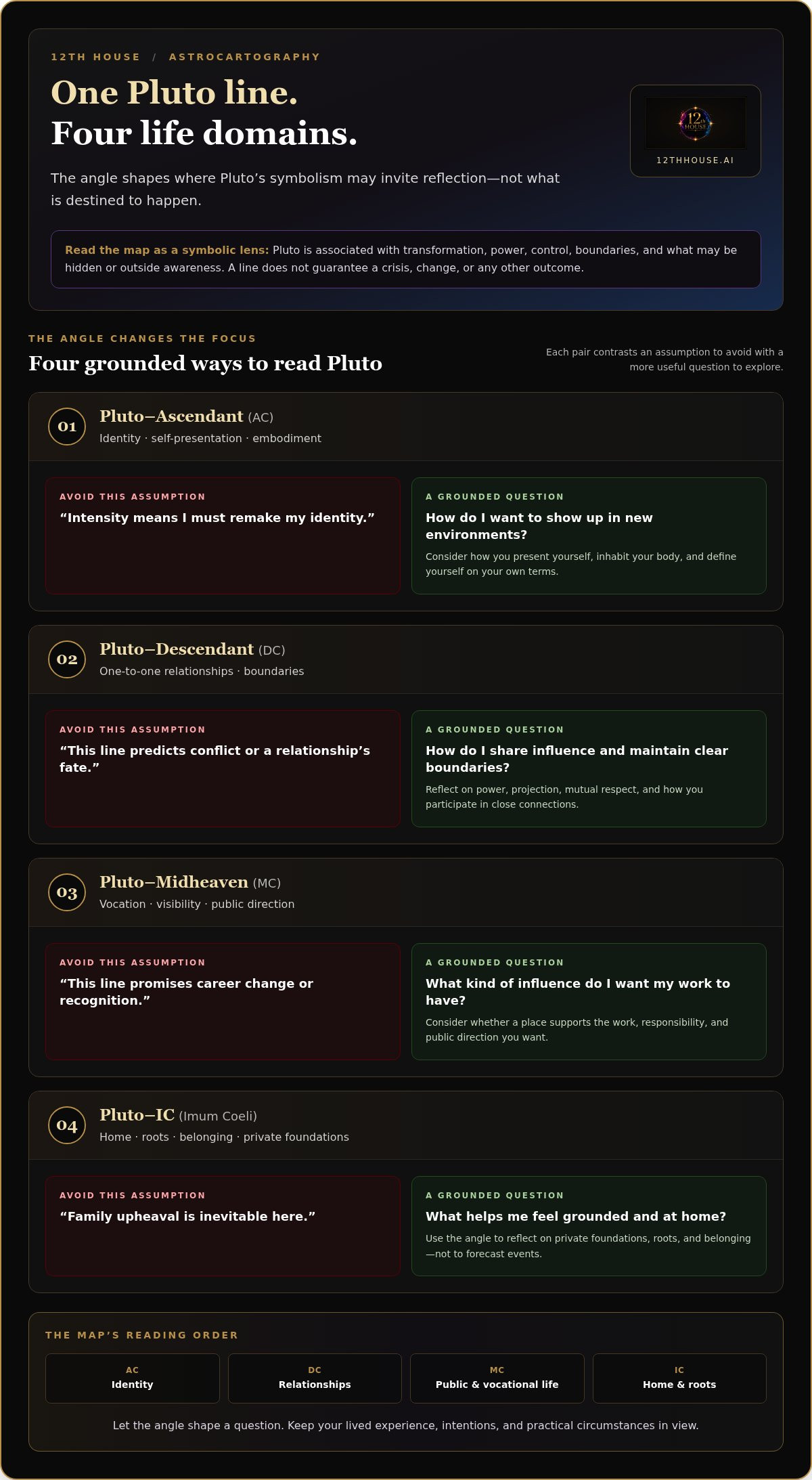
The table offers a practical starting point. Its reflective questions are prompts for your own inquiry, and the cautions help keep each interpretation in proportion.
| Angle | Life domain | Reflective question | Interpretive caution |
|---|---|---|---|
| Pluto-Ascendant (AC) | Identity, self-presentation, embodiment | How do I want to show up in new environments? | Intensity doesn’t mean your identity must be remade. |
| Pluto-Descendant (DC) | One-to-one relationships and boundaries | How do I share influence and maintain clear boundaries? | Don’t assume conflict or a particular relationship outcome. |
| Pluto-Midheaven (MC) | Vocation, visibility, public direction | What kind of influence do I want my work to have? | A line can’t promise career change or recognition. |
| Pluto-IC | Home, roots, belonging, private foundations | What helps me feel grounded and at home? | Don’t treat family upheaval as inevitable. |
The Ascendant turns Pluto’s symbolism toward identity, the Descendant toward relating, the Midheaven toward public and vocational life, and the IC toward private roots. These are interpretive emphases, not separate versions of Pluto or guaranteed outcomes.
Pluto-Ascendant and Pluto-Descendant: identity and relating
On the Ascendant, the focus is how you present yourself, inhabit your body, and enter unfamiliar settings. Consider: do I feel able to define myself on my own terms here? On the Descendant, attention shifts to one-to-one dynamics, projection, boundaries, and awareness of power. Ask what mutual respect looks like in your close connections. Neither angle predicts obsession, conflict, or a relationship’s fate; each offers a lens for noticing how you participate in interactions.
Pluto-Midheaven and Pluto-IC: vocation and roots
The Midheaven brings Pluto’s symbolism to vocation, public direction, visibility, and influence. You might reflect on whether a place supports the kind of work and responsibility you want to take on. The IC turns inward, toward private life, family roots, belonging, and emotional foundations. Questions about changing careers, moving, or revisiting family patterns may arise, but a map can’t establish that these changes will happen.
As you explore Pluto line astrocartography, use the angle to make your inquiry more precise, then compare the symbolic prompt with your own experience. Explore your individual map with 12th House astrocartography mapping as one reflective lens alongside the practical realities of a place.
Pluto Line Astrocartography: What the Common Interpretations Miss
Descriptions of Pluto lines can swing between extremes: a place will transform your life, or it will bring pressure and upheaval. Neither claim is something a map can establish. Astrology offers a symbolic framework for interpretation, but there’s no demonstrated causal link showing that a location produces a specific event. Pluto line astrocartography can help you examine themes, not certify what will happen.
Context matters. A line is only one part of a larger natal chart, and Pluto’s placement and relationship to other chart factors can shape how an astrologer reads its symbolism. Your plans and lived circumstances matter too. A move for a supportive job, for example, involves real-world conditions that deserve attention in their own right. Don’t let a single map line stand in for the full chart or for your own judgment.
Is a Pluto line always difficult or negative?
No. A line guarantees neither a difficult experience nor a positive transformation. Pluto symbolism can prompt reflection on pressure, control, and emotional intensity, but also on agency, discernment, and what you want to understand more deeply. Intensity is not the same as harm. A challenging feeling can be worth noticing without treating it as evidence that a place is dangerous or destined to cause upheaval.
A balanced reading considers possible openings alongside possible strains. These aren’t predictions or a universal scorecard. Use them to identify what you’d want to explore and what practical support might matter to you.
- Possible openings: reflection on boundaries, increased awareness of personal patterns, or a sense of reinvention.
- Possible pressures: heightened attention to control, emotionally demanding situations, or discomfort with uncertainty.
- Useful approach: consider what the symbolism brings up for you, while evaluating a place through its actual conditions and your needs.
The same theme can be experienced differently by different people. A focus on power, for instance, might invite one person to notice where they can make choices; another might find it raises questions about how they share influence. Neither response proves the line caused an event. It shows how a symbolic framework can prompt personal inquiry.
Why lived experience cannot prove a line caused an event
A personal essay about living near Pluto lines can offer a meaningful account of how someone interprets their experience. It can describe the atmosphere and questions that emerged for that writer. But one person’s story can’t establish planetary causation or tell you what you’ll experience in the same location.
Memory and expectation shape how we interpret events. Relationships, work, health, finances, and other practical circumstances shape them too. If a difficult period happens near a Pluto line, the timing alone doesn’t show that the line caused it. Treat the astrological reading as a hypothesis for reflection: notice whether it helps you ask useful questions, and stay open to explanations beyond the map.
A location isn’t universally good or bad because a Pluto line crosses it. Use the symbolism as one perspective among several, then make decisions based on your circumstances, priorities, and considered judgment.
How to Evaluate a Pluto Line Before Travel or Relocation
A Pluto line can be a prompt for inquiry, not a verdict on where you should live or travel. Use a clear sequence: define what you’re deciding, read the relevant line, place it in context, and assess real-world conditions separately. This keeps symbolic interpretation useful without letting it replace your judgment.
A grounded four-step reading process
- Clarify your question. Name the decision or reflection you’re considering. Are you weighing a short trip, a move, a work opportunity, or simply trying to understand a location on your map? A focused question helps you avoid searching for a sweeping prediction.
- Inspect the map. Note whether Pluto is associated with the location and which angle is involved. Use that angle to identify a broad life domain for reflection, such as public direction or private foundations. A line’s proximity can be one interpretive consideration, but don’t treat it as a strict universal boundary that determines where an influence begins or ends.
- Compare context. Consider the rest of your chart and your current circumstances before settling on an interpretation. Ask whether the Pluto themes feel relevant beyond this one line. Your plans, relationships, resources, and reasons for considering the place all shape what the decision means to you.
- Assess practical factors independently. Make a separate list of concrete advantages and concerns: housing, work, community, access to support, and your wellbeing. Don’t let an appealing or unsettling astrological reading erase practical information you need to make a sound decision.
Keep the two lists separate at first. If the symbolic reading suggests questions about control or change, record those as reflections. If the practical review raises concerns about affordability or isolation, record those as concrete considerations. Compare them later without confusing a metaphor with evidence about daily life.
Questions to ask before treating a line as guidance
Ask what the interpretation brings into focus, rather than what it predicts. Does it help you name a question you already had, or introduce a fear you hadn’t considered? Look for other context: does the same concern appear in your current life, your plans, or elsewhere in the chart? A trusted person can offer perspective, but the decision remains yours.
Try a brief journaling exercise. Write the location and your original question at the top of a page. Then make three columns: the Pluto symbolism you notice, what you know from practical research, and what remains uncertain. Finish with: What would I consider if I had never seen this line? Revisit your notes later. If the interpretation still resonates, treat it as a useful prompt, not proof or instruction.
Use 12th House astrocartography mapping to explore your personal location patterns as a structured starting point, then bring your own questions and practical priorities to the reading.
Explore Your Pluto Line with 12th House
You’ve learned how Pluto’s symbolism can be interpreted and why a line isn’t a forecast. The next step is personal: notice what the map brings into focus for you. Rather than searching for a destination that promises transformation, use your astrocartography map to explore how its themes relate to places and questions already present in your life.
Turn a map reading into a personal inquiry
Start with locations that have meaning to you, such as a place you’ve lived, visited, considered moving to, or feel curious about. If Pluto appears nearby, note the angle and the life domain it represents. Then compare the symbolism with what you actually know about that place. Does the question of identity, relationships, vocation, or belonging feel relevant, or does another explanation fit better?
Keep your observations concrete. You might write down:
- The location and the Pluto angle you’re exploring.
- The question the symbolism raises for you.
- Your memories or present-day associations with the place.
- Practical observations, such as work options, housing, community, and what supports your wellbeing.
Separate interpretation from observation. “I wonder how I’d build a sense of belonging there” is a useful inquiry. “This line means I’ll feel isolated” turns a symbol into a prediction. Let curiosity guide the reading, and let your own judgment shape what you do with it.
Continue exploring with a personalized chart and Lala
12th House offers Astrocartography Mapping to help you examine your personal location patterns. Use the map as a structured starting point: identify where Pluto’s themes appear in your geography, consider the relevant angle, and record the questions that arise. The purpose isn’t to find a single “right” place. It’s to develop a clearer language for reflecting on how different locations connect with your interests and lived experience.
For follow-up reflection, Ask Lala AI Spiritual Guidance lets you pose questions about your individual chart. You could ask what a Pluto angle traditionally symbolizes or how to think about its themes alongside your own priorities. Treat the responses as prompts for exploration, not authoritative predictions or instructions. Keep what helps you reflect and weigh it alongside the full context of your decision.
A thoughtful reading leaves room for both symbolism and choice. Note what resonates, what feels uncertain, and what you can verify through practical research. That distinction lets you explore Pluto line astrocartography without surrendering your agency to the map.
Explore 12th House’s astrocartography mapping and Ask Lala AI Spiritual Guidance to examine your personal map and the questions it raises.
Let Your Next Question Lead
Your next step doesn’t need to be a major move. Choose a place you’re curious about and ask what you hope to understand there. That question can help you engage with Pluto line astrocartography with intention, without asking the map to decide your future. Let your interpretation evolve as you learn more about yourself and the places you’re considering.
12th House offers astrocartography mapping for exploring personal location patterns, alongside Ask Lala AI Spiritual Guidance for follow-up questions about your chart. Use both as tools for inquiry, not as authorities that make choices on your behalf. Bring curiosity, keep your perspective, and let practical judgment remain part of the process.
Explore 12th House’s astrocartography tools and continue your personal exploration. Your map can open a question; you get to decide where that question leads.
Frequently Asked Questions
Can Pluto line influence be felt if I only visit a place briefly?
Astrocartography readers may consider a location’s symbolism during a short trip, but a visit doesn’t guarantee a particular Pluto experience. A work conference, family visit, and solo holiday create very different contexts. If a Pluto line appears near your destination, note what you expected before travelling, then compare that with what you actually experienced. The setting, purpose of the trip, personal chart, and ordinary events all shape your interpretation.
How long does a Pluto line’s influence last after leaving a location?
Astrocartography has no universally established timetable for how long a line’s significance lasts after you leave. Some astrologers focus on the time spent in or near a location; others may reflect on memories, relationships, or choices connected with it. If an experience stays meaningful, consider what it means to you now without assigning it a fixed duration or assuming Pluto must explain what happened.
What happens if two Pluto lines cross on an astrocartography map?
A crossing may bring two Pluto-related angular themes into the same area, depending on the chart and mapping method. It doesn’t establish that an experience there will be more powerful or difficult. Identify each angle separately, then consider its life domain. For example, a crossing involving a relationship-focused angle and a career-focused angle can prompt distinct questions about relating and vocation, rather than one dramatic prediction.
Can a Pluto line affect someone who doesn’t know astrology?
Someone doesn’t need to know astrology to have experiences they might later interpret through a Pluto-line framework. But an experience near a line doesn’t show that the line caused it. Someone might, for instance, discover the map after a major career decision and use it to reflect on that period. Treat the framework as optional: keep it if it helps you think clearly, and set it aside if it doesn’t.
Does a Pluto line mean I should avoid moving to that place?
No. A Pluto line alone isn’t a sound basis for rejecting a destination. If you’re considering a move, compare concrete details such as employment, housing costs, healthcare access, relationships, and available support. You might also ask what concern the astrological interpretation raises, then investigate that concern directly. If the map creates fear, pause before acting on it and discuss the decision with someone who knows your circumstances.
Can a Pluto line indicate career success?
A Pluto-Midheaven line is often interpreted through vocation, visibility, influence, and changes in professional identity, but it can’t guarantee promotion or recognition. If you’re weighing an opportunity, compare the role’s responsibilities, workplace conditions, development potential, and fit with your goals. Use the symbolism to ask what kind of authority or impact you want to pursue, then base your decision on the opportunity itself and your own reflection.
What if I can’t find a Pluto line near the place I live?
Not seeing a nearby Pluto line doesn’t make your home less meaningful or mean Pluto is absent from your birth chart. Astrocartography is one geographic way of looking at a chart, not a complete map of your identity or environment. You could compare other planetary lines or return to your natal chart for additional themes. Keep the scope modest: a missing Pluto line isn’t a sign that anything is lacking.


