

Can an algorithm make your birth chart feel more personal without asking you to trust it blindly? Astrology artificial intelligence can organize chart details, such as planetary placements and aspects, into readable interpretations. But a precise calculation isn’t the same as a certain prediction. When a reading feels uncannily specific, or conflicts with another interpretation, look at the chart context and reasoning behind it.
Your birth date, time, and location shape a natal chart. The harder question is how an AI uses those details, and whether its interpretation reflects your life or presents familiar astrological patterns with confidence. AI can help map symbolic connections, but your lived context and discernment give those connections meaning.
This guide explains what AI can and can’t do with astrology, how to assess a reading, and how to use digital guidance as a prompt for reflection rather than a verdict. We’ll look at birth-chart data, why interpretations differ, and how tools such as Lala AI can fit into a broader metaphysical learning practice. Bring your curiosity, and keep your judgment, too.
Key Takeaways
- Trace how your question and chart context shape an AI-generated interpretation, then use the explanation as a starting point for reflection.
- Assess astrology artificial intelligence readings by looking for specific chart connections, not just fluent language or statements that could apply to anyone.
- Use a simple review process: define your question, share relevant context, examine the reasoning, reflect, and make your own decision.
- Keep personal context focused. Avoid sharing sensitive details that aren’t needed to explore your question.
- Explore personalized chart questions with Lala AI within 12th House, a membership platform for metaphysical guidance and self-guided learning.
What Does Astrology Artificial Intelligence Actually Do?
Astrology artificial intelligence refers to digital tools that use computational systems to organize astrological information and generate interpretations, such as chat responses or chart summaries. These tools can help connect chart details to a question, but the usefulness of an answer depends on the context available and how you interpret it.
Astrology supplies a symbolic framework: signs, planets, houses, and the relationships between them. An AI interface organizes information and generates a response within that framework. A reading may sound direct and personal, but fluency alone doesn’t verify an astrological claim or establish that a prediction will happen.
AI astrology uses digital systems to organize astrological information and generate interpretations, not to guarantee prediction or personal truth. Treat the output as material to examine, not an instruction you must follow.
What information can shape an AI astrology reading?
A birth-chart interpretation may draw on birth details and chart placements. In astrology, planetary positions describe where planets are mapped in a chart; signs and houses provide symbolic categories for interpreting those placements. These are astrological concepts, not abilities unique to AI.
The information used depends on the tool and the question. A broad inquiry may receive a general response, while a birth-chart question benefits from relevant chart context. For example, a question about a recurring relationship pattern could prompt an interpretation of placements associated with relationships, if those placements are available. The response’s specificity depends on whether the relevant context is present, not simply on how personalized the wording sounds.
How is AI astrology different from a daily horoscope?
A daily horoscope is often written for a sign-based audience, so its message is broad by design. A question-led response can be more tailored if it draws on chart information beyond a sun sign and addresses the details of your inquiry. The key difference is the input: a conversational format alone doesn’t make a reading personal.
Compare the response with the context you provided. Does it refer to a chart placement or astrological concept relevant to your question, or could the same statement fit almost anyone? That check helps distinguish chart-informed interpretation from familiar, general language. For a closer look at conversational tools for metaphysical inquiry, explore this AI astrology assistant guide.
How AI Turns Astrological Symbols Into a Personalized Interpretation
A personalized reading takes shape through several elements. The astrology artificial intelligence tool doesn’t derive personal meaning from a question alone. Its response depends on the question, the chart context available, and the symbolic framework used to discuss that context. Think of the process as a sequence:
- Question: You set the subject and scope, such as a current transit or a recurring area of reflection.
- Chart context: Relevant birth-chart details or placements can help focus the interpretation.
- Symbolic framework: Astrological meanings provide a structure for relating placements and themes.
- Generated explanation: The tool presents a readable interpretation based on the information available to it.
- Reader reflection: You decide what resonates, what needs clarification, and what doesn’t fit your experience.
This sequence is a useful way to understand the exchange, not a guarantee that every tool handles each stage identically. A language model can produce fluent, coherent text without independently validating astrological claims. Treat a polished answer as an interpretation to inspect, not proof that its underlying reading is correct.
From a birth chart to a focused question
A specific question gives a reading a defined subject. Instead of asking, “What will happen during this transit?” try, “What themes might this transit invite me to examine in my work life?” The second question asks for an interpretive lens, not a promised event. Chart details and the astrological tradition being used can change that lens, so two readings may frame the same transit differently.
Birth-time precision can matter because some chart placements depend on the recorded time. A difference in time may affect placements used in an interpretation, depending on the chart and method. Not every question requires the same information. Before treating an explanation as specific to you, understand what chart context it uses.
Why context matters more than a confident-sounding answer
Astrological interpretation is symbolic, not an objective measurement of what will happen. A confident tone can make a response feel settled, but it can’t turn a symbolic reading into an established forecast. Missing or unclear context may lead to an answer that is broad, generic, or mismatched to your question.
Personalization depends on relevant context, not confident wording alone. Look for a clear connection between your question, the chart information used, and the themes in the explanation. If a response makes a leap, ask what placement or symbolic idea supports it. If it names no basis, treat the claim as a prompt to explore rather than a conclusion.
For a focused question about chart placements or transits, explore personalized astrology guidance with Lala AI. Use the interpretation as a structure for inquiry, then bring your lived context and judgment to deciding what meaning, if any, to take from it.
Is AI Astrology Accurate? A Framework for Testing the Reading
A fluent answer can still be inaccurate, irrelevant, or based on a mistaken assumption. Clear prose isn’t evidence that an interpretation reflects your chart or situation. Astrology is an interpretive practice, not a scientifically established method for predicting events. An AI reading may work as a symbolic prompt, but it shouldn’t be treated as a verified forecast.
Assess the reasoning, not just the tone. A chart-relevant explanation should respond to your question and connect its interpretation to the placements or themes it names. Compare “This transit may invite you to reconsider how you approach responsibility at work” with “A major change is coming.” The first offers a theme to examine; the second sounds dramatic but gives no clear chart basis or way to assess its relevance.
What makes an AI astrology answer feel genuinely personal?
Check whether the response answers your question or slips into general horoscope language. Look for a visible link between the chart context provided and the interpretation. Specificity is a useful quality signal, but it doesn’t prove a prediction will come true. A thoughtful answer should leave room for ambiguity rather than presenting one symbolic reading as the only possible meaning.
- Useful signal: The answer names relevant chart context and explains how it relates to your question.
- Warning sign: The answer relies on broad statements that could fit almost anyone, while sounding highly certain.
- Ask yourself: What astrological idea supports this interpretation, and does it fit the context I supplied?
Which claims should prompt a second look?
Pause when a reading makes absolute promises, uses fear to create urgency, or tells you to make a major decision immediately. Question claims that introduce chart details you didn’t provide or present speculation as established fact. These are reasons to examine the interpretation, not proof that every part of it is useless.
Relationship readings show why interpretation needs care. A compatibility reading may describe symbolic points of connection or tension, but it can’t establish how two people will behave or determine whether a relationship should continue. A birth chart compatibility guide can help you explore how relationship-chart themes are framed without treating them as a verdict.
Use this compact review before acting on an astrology artificial intelligence reading:
- Useful signal: It answers your question, identifies the context it uses, and explains its symbolic reasoning.
- Warning sign: It invents placements, guarantees an outcome, or uses fear or urgency to push a choice.
- Ask: What would change my view of this interpretation? What other meanings could these symbols support?
Give a reading consideration when its reasoning is traceable and its limits are clear. Keep what helps you reflect, and set aside claims that demand certainty without showing their basis.
How to Use AI Astrology Thoughtfully and Protect Your Context
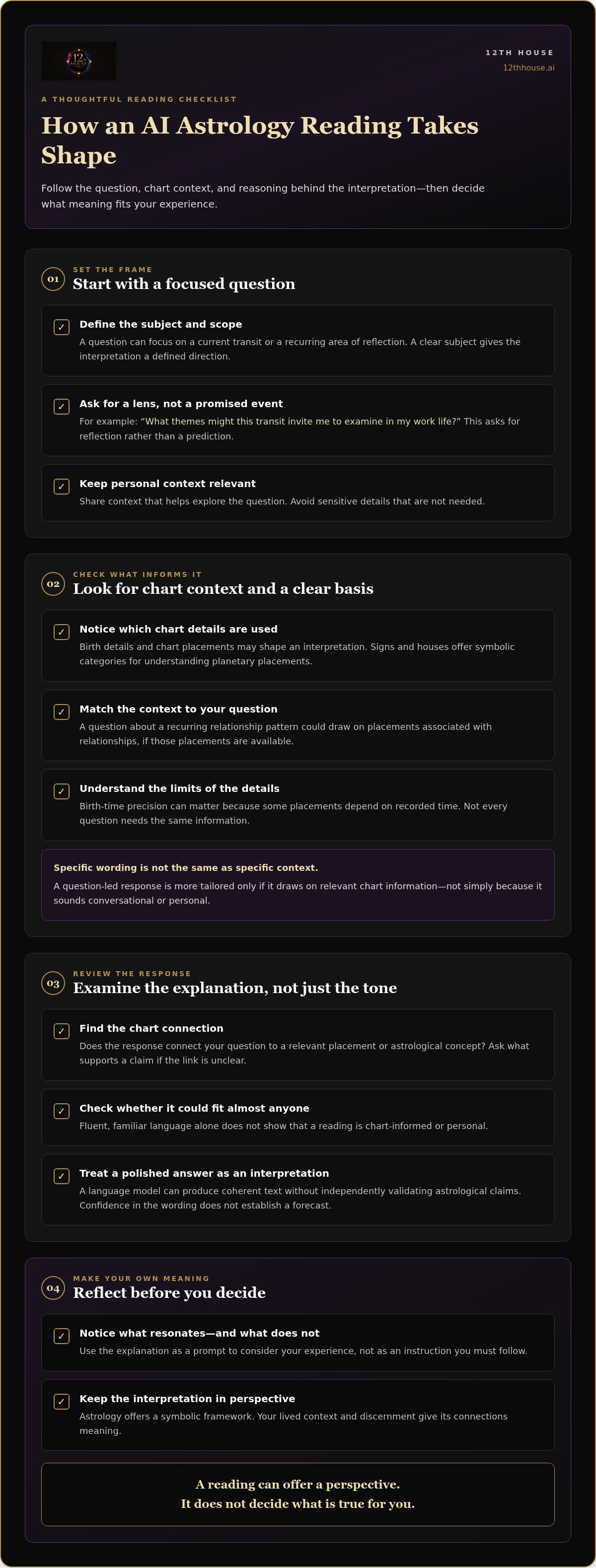
Use a reading as a reflective tool, not a verdict. A clear process can make responses more relevant while keeping your judgment at the center: define what you want to explore, share only useful context, examine the reasoning, reflect on what resonates, and make decisions independently. Astrology artificial intelligence can organize a line of inquiry, but it shouldn’t replace professional or high-stakes advice.
How to write a useful astrology AI prompt
Start with one focused question and identify the area of life or chart element you want to examine. Ask the tool to explain the astrological symbolism behind its response, then invite more than one possible interpretation. This creates room for nuance instead of treating a single generated answer as a guaranteed outcome.
For example, rather than asking, “What will happen to my career?”, try: “What themes might this transit suggest I reflect on in my work life? Explain the symbolism you’re using and note where the interpretation is uncertain.” The prompt sets a clear scope without asking AI to decide your future.
Review the answer in stages:
- Define the question: Keep it specific enough to guide the response.
- Provide relevant context: Share only the chart details needed to explore that question.
- Review the reasoning: Notice whether the answer explains how its symbolism connects to your inquiry.
- Reflect before acting: Consider what fits your experience and what might have another explanation.
- Decide independently: Use the reading as one perspective, not a substitute for qualified professional guidance or careful judgment on high-stakes matters.
What to consider before sharing birth information
Birth details can be personal information, so share them intentionally. Before entering them, read the tool’s stated data practices and understand how it describes handling the information you provide. Don’t assume a service has particular privacy protections simply because it offers personalized guidance.
- Check whether the tool explains what information it collects and how it may be used.
- Consider whether each detail is necessary for the question you want to ask.
- Avoid adding sensitive personal information that doesn’t help with the interpretation.
- If the tool’s data practices aren’t clear to you, pause before submitting personal details.
Return to the reading with discernment. A useful response can open a question for study, but it can’t make an important decision for you. For a broader setting to explore metaphysical questions and learning resources, explore a structured space for metaphysical study.
Explore Astrology Artificial Intelligence With 12th House and Lala
AI guidance is most useful when it gives you something to examine, not a conclusion to accept. 12th House brings this approach into a membership platform for metaphysical guidance and self-guided learning. Its Lala AI assistant answers personalized questions about charts, spells, and compatibility, giving you a way to explore symbolic ideas through focused inquiry.
A reading can offer language for considering a chart or question, but it can’t supply your lived experience or decide what an interpretation means in your life. Use astrology artificial intelligence as a structured aid for reflection and study. Keep your discernment active, especially when a response sounds certain about the future or touches a consequential decision.
How Lala fits into a broader metaphysical practice
Lala gives members a way to ask personalized questions within 12th House. Rather than treating an answer as a standalone verdict, use it as a prompt: What symbolism is being raised? What resonates with my experience? What would I like to explore further? These questions turn a generated response into an active study practice.
Membership includes unlimited Lala interactions, personalized data storage, and access to the metaphysical library. The library’s books, videos, and ritual frameworks offer self-guided learning resources alongside the AI tools. This broader setting lets you follow an idea beyond a single response, connect it with study materials, and develop your own understanding of the symbols involved.
Keep the roles clear. Lala can respond to questions about charts, spells, and compatibility. Its interpretation is material for your consideration, not an authority that replaces your judgment. The value comes from the inquiry you bring and the reflection you do with the answer.
Choose inquiry over prediction
Begin with a focused question. Instead of asking for a guaranteed outcome, ask what a chart theme might invite you to reflect on, or what symbolic perspective could help you examine a situation. Then read the response critically. Does it address your question? Can you follow the connection between the symbolism and the interpretation? What fits, and what doesn’t?
You remain responsible for the meaning you make and the decisions you take. Let a reading open a line of thought, then weigh it alongside your experience and any practical guidance relevant to the situation. The aim isn’t to hand over discernment. It’s to give reflection a clearer structure.
Explore personalized metaphysical questions within a wider learning environment with 12th House and Lala.
Let Your Next Question Open a New Path
The most useful next step isn’t to ask AI for certainty. Choose a question you’re ready to explore, then approach the response with curiosity and discernment. Astrology artificial intelligence can give your reflection a starting structure, but the meaning you make from it remains yours.
If you want to carry that inquiry into a wider practice, Lala answers personalized questions about charts, spells, and compatibility. Membership brings unlimited Lala interactions together with a metaphysical library, giving you room to continue exploring through self-guided study. Let each response lead to a better question, a new connection, or a moment of reflection, rather than a fixed prediction.
Your chart can offer a symbolic map. You decide how to read it and what, if anything, to do next. Explore 12th House and meet Lala, then bring your questions, judgment, and an open mind to the work ahead.
Frequently Asked Questions
Is astrology artificial intelligence accurate?
Accuracy depends on what you mean by accurate. Astrology artificial intelligence can generate an interpretation from available astrological information, but specific or polished wording doesn’t verify a prediction. Compare the response with the chart details and question you supplied, and see whether it explains the symbolism behind its conclusion. Astrology is an interpretive practice, not a scientifically established forecasting method, so use a reading for reflection rather than certainty.
How does artificial intelligence read an astrology chart?
An astrology tool may draw on the chart context available to it, apply an astrological framework, and generate an explanation related to your question. The exact process varies by tool, so there isn’t one universal method. The chart provides symbolic material; the AI system presents an interpretation of it. If an answer refers to a placement you don’t recognize, review the chart information it used before relying on the explanation.
Can AI interpret my birth chart without my exact birth time?
It may offer an interpretation, but its usefulness depends on which chart details and placements you want to explore. Some chart elements are more sensitive to birth time than others, so missing or uncertain timing can affect the interpretive frame. Don’t assume the result is complete or precise without that detail. Review what information the tool uses, and treat conclusions that depend on uncertain chart placements with appropriate caution.
What information should I share with an AI astrology tool?
Share only the information needed for your question, and treat birth details as personal information. If you want to explore a general theme, you may not need to include every personal circumstance surrounding it. Before submitting details, read the tool’s stated data practices so you understand what it says about handling information. Don’t assume a platform stores, protects, or deletes your data in a particular way unless its policy explains that.
Can AI astrology predict what will happen to me?
No AI-generated astrology reading should be treated as a guaranteed forecast. An interpretation may offer symbolic themes or possibilities to reflect on, but confident wording isn’t evidence that an event will occur. For example, a reading about a career transition can prompt you to consider your priorities, not establish that you’ll change jobs. Don’t base high-stakes decisions solely on an AI reading. Weigh practical information, relevant professional advice, and your own judgment.
What is the difference between an AI astrologer and a daily horoscope?
A daily horoscope is often written for a sign or broad audience, while an AI astrology tool may respond to a particular question using available chart context. The level of personalization depends on the tool and the information supplied. Neither format guarantees a correct prediction. Choose a horoscope for a general prompt; use a focused AI exchange to explore a specific question or chart theme.
Can I use AI astrology to understand relationship compatibility?
Yes, an AI tool can help explore compatibility themes when relevant chart information is available. For instance, you might use a reading to reflect on how each person approaches communication or emotional needs, then compare those ideas with your lived experience. An interpretation can’t determine whether a relationship will succeed or replace honest conversation. Treat chart symbolism as one lens, not a verdict, and make room for each person’s choices and circumstances.


