

What if a place marked by your Moon line doesn’t feel like home at all? Moon line astrocartography is associated with belonging, emotional security, and intuition, but that symbolism doesn’t promise instant comfort. What it may suggest depends on the line’s angle and how the Moon functions in your birth chart.
Online interpretations can make a personal map seem more certain, or more confusing, than it is. The Moon points to emotional needs and private patterns; an astrocartography map offers one symbolic way to explore how those themes might feel in a particular place. It can prompt useful questions, but it can’t make a relocation decision for you.
This guide explains Moon-line symbolism in plain language, then separates the four angles: Ascendant (ASC), Descendant (DSC), Midheaven (MC), and Imum Coeli (IC). You’ll learn how each shifts the emphasis toward self-expression, relationships, public life, or home and roots, and why a fuller reading considers your natal chart alongside the map. Use the framework as a reflective lens, not a guaranteed prediction.
Key Takeaways
- Read a Moon line as a location-based symbol in your birth map, not a forecast of what must happen there.
- Use the line’s angle to identify whether its themes may center on self-expression, relationships, public life, or home and roots.
- Interpret Moon line astrocartography in the context of your natal Moon sign and aspects, rather than relying on the line label alone.
- Follow a clear reading sequence: verify birth details, locate the line, identify its angle, add chart context, then reflect on what it raises for you.
- Let the map prompt questions about belonging and emotional needs; don’t treat it as a verdict on where to move.
What Is a Moon Line in Astrocartography, and What Does It Represent?
A Moon line marks a location associated with the Moon’s angular position in a person’s birth chart. In Moon line astrocartography, that placement is interpreted through themes commonly assigned to the Moon in astrology, including emotional needs, care, familiarity, memory, and belonging. The line offers a symbolic framework for reflection, not a guarantee that a place will feel nurturing or a forecast of what relocation will bring.
Astrocartography overlays a natal chart onto a world map to show where particular planets are associated with the chart’s angles. Its lines give astrological symbolism a geographical frame. For a general account of the system’s background and method, see Astrocartography. A Moon line is one planetary layer within that larger map, not a complete interpretation of a destination on its own.
What does the Moon symbolize in a location reading?
In astrological interpretation, the Moon is often associated with emotional rhythms, instinctive responses, care, and the conditions that help someone feel secure. Applied to a place, these symbols can raise questions about familiarity and belonging: What feels comforting here? What brings old memories closer to the surface? Where might you seek support or create a sense of home?
These are interpretive questions, not measurements of a location’s effect on a person. A Moon line doesn’t establish that a place will make someone happier, more sensitive, or better cared for. Instead, it can invite reflection on how the chart’s Moon symbolism relates to personal experience. You might consider what “home” means to you, how your emotional needs are changing, or how family ties shape your sense of belonging. The map itself can’t determine which response you’ll have.
Why does a Moon line appear on an astrocartography map?
The natal chart provides the framework for the map. In astrocartography, a planet’s relationship to an angular point is projected onto geography, producing lines associated with places where that planet is angular in the chart’s mapping system. A Moon line therefore represents a location-based expression of the natal Moon’s symbolism, rather than a new Moon placement created by moving there.
This distinction matters. The line doesn’t replace the birth chart or give the Moon one universal meaning for everyone. It identifies a planetary emphasis to interpret within the chart’s wider pattern. Other planetary lines appear on the same map, each carrying different astrological symbolism, and they may cross or sit near one another. The Moon line is one part of that layered picture.
Read the map as a symbolic model. It can help organize questions about emotional needs and belonging, but lived experience also depends on practical circumstances and personal choice. A line can suggest a theme to examine; it can’t promise comfort, ease, or a particular outcome.
How the Four Moon Line Angles Change the Interpretation
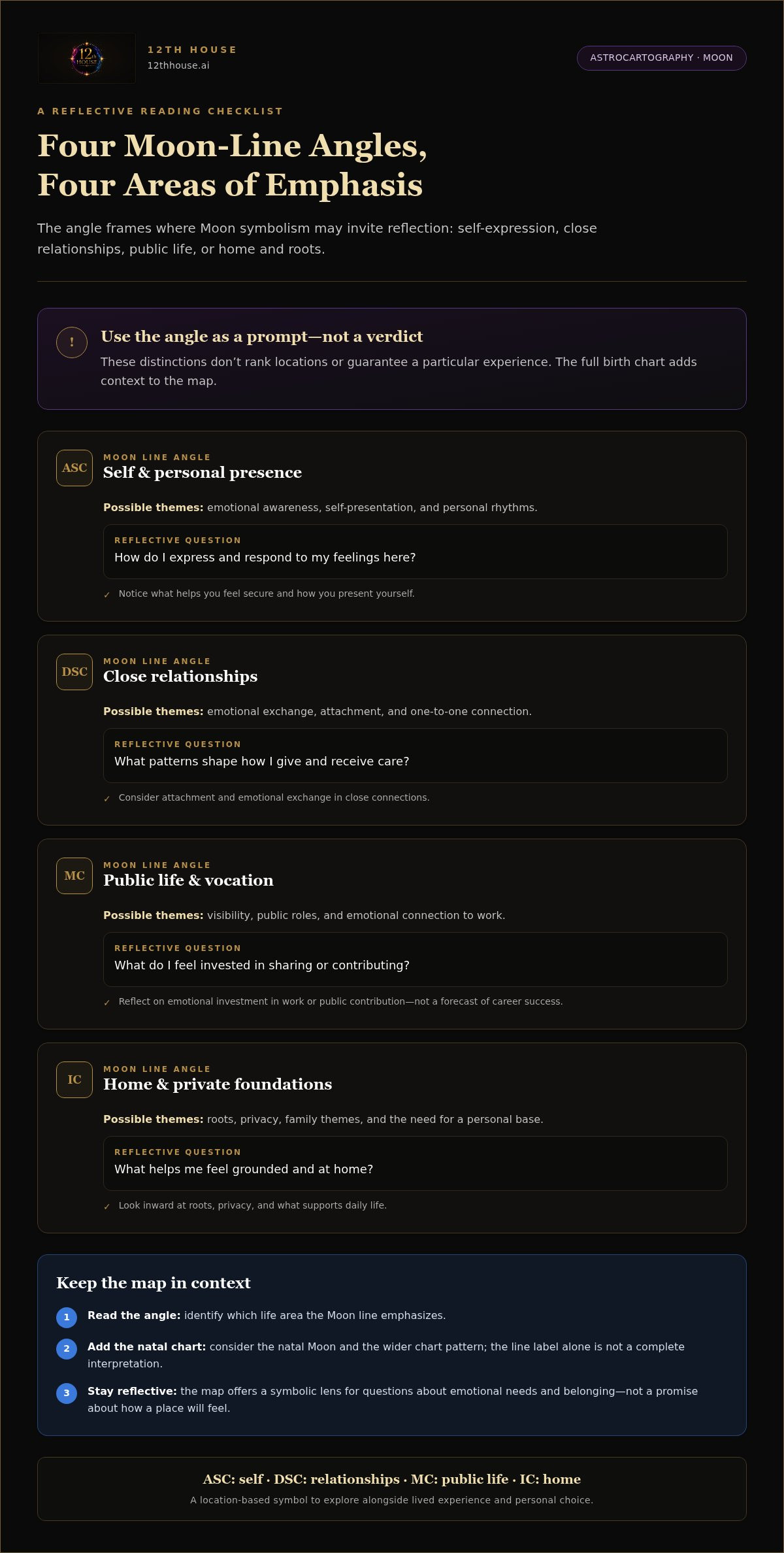
The angle changes the life area through which Moon symbolism is interpreted. It doesn’t rank locations or show that one place is objectively better for emotional well-being. In Moon line astrocartography, read the angle as a point of emphasis: it helps frame what to reflect on, while the full birth chart adds context.
| Angle | Life area | Reflective question | Possible Moon-line theme |
|---|---|---|---|
| Moon ASC | Self and personal presence | How do I express and respond to my feelings here? | Emotional awareness, self-presentation, personal rhythms |
| Moon DSC | Close relationships | What patterns shape how I give and receive care? | Emotional exchange, attachment, one-to-one connection |
| Moon MC | Public life and vocation | What do I feel invested in sharing or contributing? | Visibility, public roles, emotional connection to work |
| Moon IC | Home and private foundations | What helps me feel grounded and at home? | Roots, privacy, family themes, need for a personal base |
The ASC brings Moon themes into self-expression, the DSC into close exchange, the MC into public direction, and the IC into private foundations. These are interpretive distinctions, not promises of particular experiences.
Moon ASC and DSC: self-expression and close relationships
A Moon ASC reading focuses on how you present yourself and notice your emotional rhythms. It may prompt you to reflect on whether you feel more open about your needs or more aware of what helps you feel secure. Ask: How do I respond to my feelings in this place? The Moon DSC shifts attention to attachment and emotional exchange in close, one-to-one connections. Ask: How do I give and receive care in my relationships? Neither angle predicts who you’ll meet or what a relationship will become.
Moon MC and IC: public direction and private foundations
The Moon MC turns the lens toward vocation, visibility, and public roles. It can prompt you to consider how emotionally invested you are in your work or contribution, without forecasting career success. By contrast, the Moon IC is inward-facing: it brings themes of home, roots, privacy, and the personal base that supports daily life. Ask: Where do I feel rooted, and what makes that possible? Your natal chart helps shape how either emphasis may be understood.
Use the distinction to sharpen your questions, not to reach a verdict about a destination. To examine the angles on your own map, explore a personal astrocartography map as one part of a wider chart-based reflection.
What Shapes a Moon Line Beyond Its Angle?
The angle identifies the life area an interpretation emphasizes, but it doesn’t determine the whole reading. The same Moon line can carry different symbolic nuances in different natal charts because each chart describes a distinct arrangement of placements and relationships. A broad label such as “emotional sensitivity” is a starting point, not a complete account of what a particular place will mean to you.
How the natal Moon modifies a location reading
A map line is read in the context of the natal chart. Astrologers may consider the natal Moon’s sign, house, and aspects alongside its angular emphasis on the map. These chart factors form a wider interpretive structure. Without those details, assigning a particular emotional style or outcome based on the line name alone would be misleading.
Think of the map as showing where to direct attention, while the natal chart supplies more symbolic context. A Moon line may invite questions about care, security, memory, or belonging, but those themes won’t have identical significance for everyone. Chart context can help distinguish a general association from a more personal reading; it still doesn’t turn symbolism into a certain prediction.
Why personal experience may not match a generic Moon-line description
Astrological interpretations describe possible themes, not a uniform response shared by everyone who visits a location. Your expectations, relationships, personal history, and practical circumstances all shape what a place feels like. A move may bring new routines, work demands, or family connections, for example. Those real conditions matter alongside any symbolic reading.
Comfort, nostalgia, heightened sensitivity, or a desire for change may come to mind as possibilities associated with Moon symbolism. They aren’t guaranteed effects of being near a line. One person might find a place familiar; another might feel unsettled, or notice nothing that seems connected to the interpretation. A difference between the reading and your experience doesn’t mean you’ve read yourself incorrectly.
Use observation rather than one impression as your measure. If you spend time in a place connected to a Moon line, keep brief notes on what you notice and what else is happening in your life. You might record:
- Which situations feel comforting, unfamiliar, or emotionally significant.
- Whether those impressions shift with your routines, company, or circumstances.
- What practical features of the place may contribute to your experience.
Review your notes later instead of treating one memorable day as proof that the line “works” or doesn’t. This keeps the map useful as a reflective tool while leaving room for the complexity of lived experience. The value of Moon line astrocartography lies in the questions it helps you form, not in a promise that every symbolic theme will appear.
How to Read Your Moon Line Without Overinterpreting It
Use a consistent sequence to move from map symbols to useful reflection. This keeps Moon line astrocartography grounded in your chart and real circumstances, rather than letting one line make a relocation decision for you.
Start with birth details and the map's angle labels
Astrocartography calculations use your birth date, birthplace, and birth time. Time matters because it helps determine the chart’s angles, which shape where lines appear on the map. If your recorded time is uncertain, treat angle-based interpretations cautiously rather than assuming a universal margin of error. On the map, AC or ASC means Ascendant, DC or DSC means Descendant, MC means Midheaven, and IC means Imum Coeli.
- Verify your birth details. Review the date, location, and recorded time used to calculate your chart. Differences in birth-time accuracy can affect chart calculations, so note any uncertainty before interpreting angle labels.
- Locate the Moon line. Find the line marked with the Moon symbol or Moon label on your map. Read the map legend carefully, since symbols and abbreviations can vary between map formats.
- Identify its angle. Check whether the line is labelled ASC, DSC, MC, or IC. That label points to the life area associated with the Moon symbolism.
- Add chart context. Consider the natal chart alongside the map, rather than treating the line as a complete reading. The chart can help frame what the Moon’s symbolism means within your individual pattern.
- Reflect against experience. Ask what the location brings up for you, then compare that impression with everyday realities and practical needs.
Turn the symbol into a grounded reflection
Start with your own definitions. What does emotional security mean to you now? What helps you feel cared for, connected, or at home? Those answers may change with your circumstances, so don’t rely on a generic Moon-line description as a personal verdict.
Then bring in practical factors. Consider work, relationships, housing, access to support, and the day-to-day conditions you would encounter in a place. A symbolic prompt about belonging can be meaningful, but it can’t tell you whether a move is financially workable or safe. Astrology should not replace professional, financial, or safety-related advice.
If you’re considering a move, compare the map’s prompts with your lived experience and practical research before making a decision. Keep the interpretation open: note what resonates, what doesn’t, and what might be explained by circumstances outside astrology. For a structured look at your own map and chart, explore your personal astrocartography map.
Use Moon Line Astrocartography as a Tool for Self-Reflection
A Moon line can help you name questions about care, home, and emotional security. It can’t promise that you’ll belong somewhere, feel at ease, or experience a particular outcome. Let the symbolism open an inquiry, not close the decision. Your direct experience, material circumstances, and personal judgment remain essential parts of the picture.
Questions to ask before making a location decision
Before assigning meaning to a place on your map, pause over what you actually need from it. Do you want stronger community ties, more privacy, a familiar rhythm, or room to build a new sense of home? Then consider whether the location can support those needs in ordinary life, not only in an astrological reading.
- Emotional needs: What helps you feel secure, cared for, and connected at this stage of life?
- Practical requirements: What would work, housing, relationships, and access to support look like there?
- Personal perspective: What do your own experiences and trusted people reveal that the map can’t?
Keep these strands distinct. An astrological interpretation is one kind of reflection; a visit, conversations with people you trust, and practical research offer other forms of information. If it’s feasible, explore a place in a small, reversible way before making a major commitment. A short stay or a visit during an ordinary routine may show you more about daily life than imagining what the line might mean. No single test can settle every question, but a grounded process can help you make a choice with clearer eyes.
Continue exploring your personal astrocartography map
Moon symbolism is one layer of a wider astrocartography map. Other planetary lines bring different symbolic themes, while the natal chart provides context for interpreting them together. Exploring the full map can help you form more considered questions than relying on one line in isolation. Keep the same discipline: distinguish symbolic prompts from lived experience, and include practical realities in your assessment.
Use Moon line astrocartography as a reflective instrument, not a relocation verdict. A line can’t certify that a destination will offer comfort, belonging, or ease. It can help you notice what you hope to find, which emotional needs you want to honor, and what you should investigate beyond the map.
For a broader view of planetary lines and a personal map to explore, consider 12th House astrocartography mapping. Start with one question about what home means to you, then compare the map’s symbolism with what you learn about the place itself.
Let Your Questions Guide the Next Step
A location reading is most useful when it helps you clarify what you’re seeking, not when it tries to decide for you. Let Moon line astrocartography open a thoughtful inquiry: What kind of home, connection, or emotional rhythm do you want to cultivate? Then let experience and practical judgment shape what comes next.
12th House offers astrocartography mapping alongside astrology chart and transit analysis, giving you a way to explore your personal map within a broader chart framework. Treat the process as an invitation to learn, not a promise about where life will lead.
Explore astrocartography mapping with 12th House and take your next step with curiosity, care, and room for your own discernment.
Frequently Asked Questions
What does a Moon line mean in astrocartography?
A Moon line marks places where the Moon is emphasized at one of the chart’s angles in an astrocartography map. Astrologers associate this symbolism with themes such as emotional needs, care, and familiarity. For example, a map may label a line Moon IC, directing attention toward private foundations and home-related questions. The label describes an astrological framework, not a measurable geographic force or a guaranteed personal experience.
Is a Moon line in astrocartography good or bad?
A Moon line isn’t inherently good or bad. Its meaning depends on the chart context and on what you value in a place. A location that brings family connections or familiar routines to mind could feel supportive to one person and complicated to another. Instead of rating the line, consider what you hope to explore there and assess the location’s real-life conditions separately.
Can you feel a Moon line if you do not live directly on it?
Some astrological approaches consider nearby areas when interpreting a line, but there’s no universally established distance at which a Moon line should be expected to have an effect. Map formats and interpretive practices can differ. If you’re curious about a nearby location, treat the line as a prompt rather than evidence: note the distance shown on your map, visit if practical, and pay attention to your actual experience.
How accurate does my birth time need to be for a Moon line map?
There isn’t a universal acceptable margin of error for every map or chart calculation. Birth time can affect the chart’s angles, so an uncertain time may change how angle-based lines are calculated or interpreted. Use the time recorded on an official birth document if available, and mark it as approximate if it isn’t verified. Avoid treating a precise-looking map as exact when its input time is uncertain.
Does a Moon line mean I will feel at home in that location?
No. A Moon line can’t promise that you’ll feel at home, even if home and belonging are central themes in its interpretation. Your response may depend on relationships, housing, community, daily routine, and personal history. If a destination interests you, consider how it feels during an ordinary visit, not only during a memorable trip. Give your own experience more weight than an assumed outcome.
Do Moon lines change over time?
Your natal astrocartography map is based on your birth chart, so its lines don’t shift simply because you grow older or move. The way you interpret a line can change as your priorities and circumstances evolve. Astrologers may also examine time-based techniques, such as transits, but those are additional layers rather than a redrawing of the original natal map. Check which kind of map or timing method you’re viewing.
Is astrocartography scientifically proven?
Astrocartography is an astrological practice, not a scientifically established method for predicting how a location will affect someone. Its planetary lines can be used as symbolic prompts for reflection, but they shouldn’t be treated as evidence that a place will cause a particular emotional, relationship, or career outcome. If you use a map, pair its interpretations with direct observation and reliable practical information about the location.


