

What if the Sun line on your map points not to guaranteed success, but to a different way of meeting yourself in a particular place? Sun line astrocartography can prompt questions about identity, visibility, relationships, and belonging. The four angles aren’t interchangeable, and a line can’t promise fame, confidence, or a better life.
If you’ve looked at your map and wondered what a Sun line might mean for a move or a trip, start with the angle label. This guide explains the Sun’s symbolism and distinguishes its Ascendant, Descendant, Midheaven, and Imum Coeli expressions. Use each as a reflective lens, not a prediction. Then compare what the symbolism brings up with your actual experience, practical needs, and personal chart context before drawing conclusions.
Key Takeaways
- Learn how the Sun’s symbolism can take a different shape across the Ascendant, Descendant, Midheaven, and Imum Coeli.
- Use Sun line astrocartography to explore what a location may bring into focus, without treating the map as a promise of specific outcomes.
- Match each angle’s themes to your intentions, then use reflection questions to consider potential growth edges.
- Follow a grounded process for exploring a location, starting with clear intentions and accurate birth details.
- Use 12th House astrocartography mapping and Ask Lala to continue exploring your personal chart questions.
What Is a Sun Line in Astrocartography?
A Sun line in astrocartography is a geographic path marking places where your natal Sun aligns with one of the four chart angles at the moment of your birth. The map translates a birth chart into spatial symbolism, linking a planet’s position to locations around the world. A Sun line doesn’t mean a place will automatically make you successful, confident, or energized. It offers a way to reflect on where the Sun’s themes might feel more prominent.
What does the Sun represent in a location-based chart?
In astrology, the Sun is associated with identity, vitality, purpose, and conscious self-expression. A location-based chart applies that natal symbolism to geography. Instead of asking only how the Sun is described in your birth chart, you can consider where its position becomes angular on the map. The symbolism can prompt useful reflection, but it isn’t evidence that a place will cause a particular event or change your personality.
Think of the map as a symbolic overlay, not a verdict. If you’re weighing a move, a Sun line might prompt questions such as: Where do I want to express myself more openly? What kind of visibility or purpose am I seeking? Write down what you mean by those goals, then compare them with practical factors such as work, community, cost, and daily comfort. Those factors remain essential to the decision.
What does a Sun line show on the map?
A Sun line traces locations associated with the Sun’s angular position in your birth chart. The map marks four angle labels: ASC (also written AC), DSC (or DC), MC, and IC. Each label identifies a distinct chart angle, and each has a different interpretation. The lines shouldn’t be treated as interchangeable. The next section explains what those angles may symbolize.
Lines organize astrological meaning across geography. They can help you identify locations to examine more closely, but the map alone can’t describe the full experience of living or travelling somewhere. It doesn’t account for every detail of your natal chart, your circumstances, or the practical realities you’ll encounter there.
For a broader grounding in how planets and angles are projected onto a world map, explore this astrocartography mapping guide. It provides context for reading location-based astrology as a structured symbolic system. In Sun line astrocartography, the useful question isn’t “What is this place guaranteed to give me?” but “Which parts of my identity or direction might I want to explore here?” Keep that distinction in view as you compare the four angles.
Sun Line Astrocartography: How the Four Angles Differ
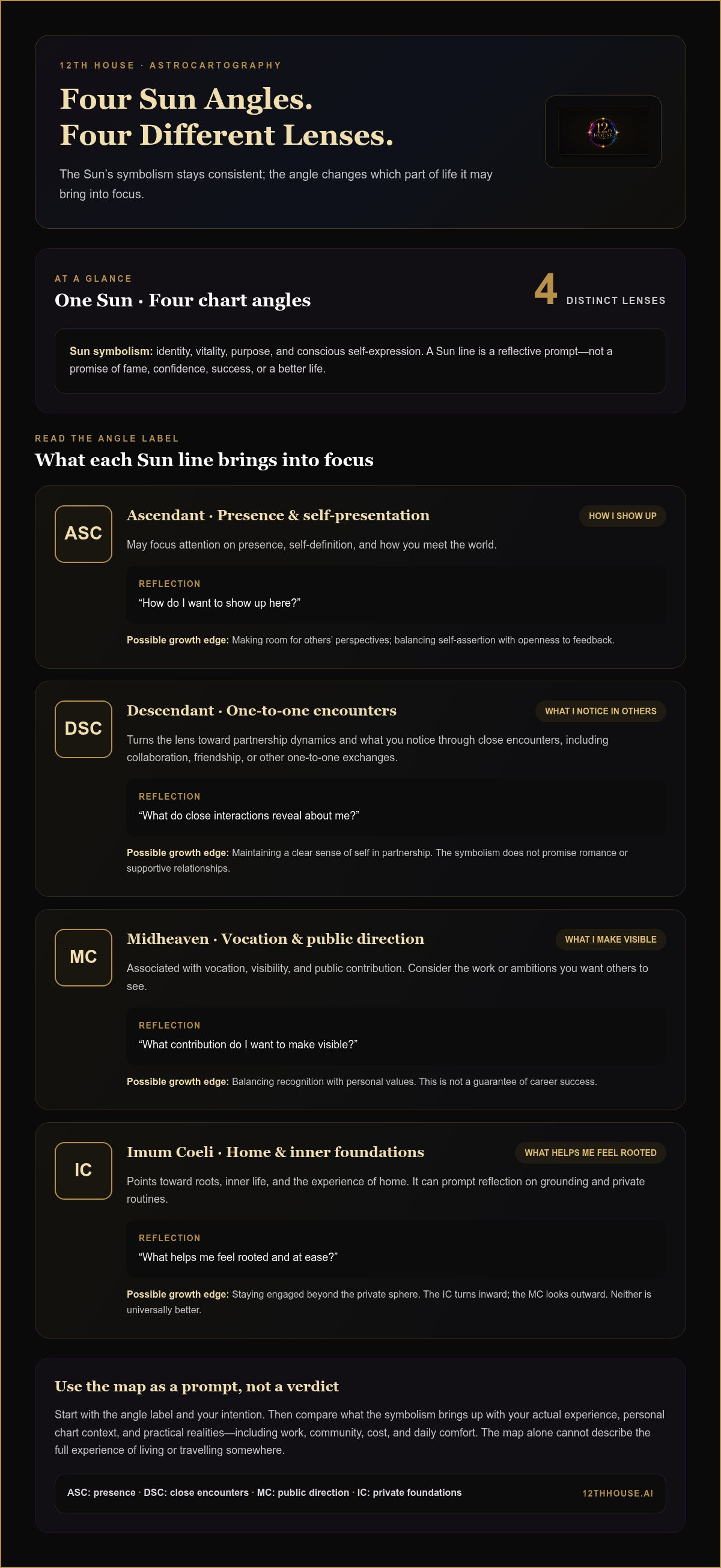
The Sun’s core symbolism stays consistent across the map, but its angle changes the area of life it may bring into focus. The angle changes where the Sun’s themes meet your life: through your presence, close encounters, public direction, or private foundations. Use the comparison below to connect each line with an intention, not to rank locations or predict what will happen there.
| Angle | Symbolic focus | Useful reflection question | Possible growth edge |
|---|---|---|---|
| ASC | Presence and self-presentation | How do I want to show up here? | Making room for others’ perspectives |
| DSC | One-to-one encounters | What do close interactions reveal about me? | Maintaining a clear sense of self in partnership |
| MC | Vocation and public direction | What contribution do I want to make visible? | Balancing recognition with personal values |
| IC | Home life and inner foundations | What helps me feel rooted and at ease? | Staying engaged beyond the private sphere |
Sun ASC and DSC: identity in relation to others
ASC (Ascendant): This angle can focus attention on presence, self-definition, and how you meet the world. An ASC location may prompt you to notice whether you feel encouraged to take initiative or express yourself more directly. Ask: What parts of myself do I want to bring forward here? The growth edge may be balancing self-assertion with openness to feedback.
DSC (Descendant): This angle turns the lens toward partnership dynamics and what you notice through close encounters. That could include collaboration, friendship, or other one-to-one exchanges, but the symbolism doesn’t promise romance or supportive relationships. Ask: What do my interactions here help me recognize about how I relate? The reflection is about your patterns, not a forecast of who you’ll meet.
Sun MC and IC: public direction and private foundations
MC (Midheaven): The MC is associated with vocation, visibility, and public contribution. Consider it if you’re exploring how a place might relate to your ambitions or the work you want others to see. Ask: What kind of contribution feels meaningful to make here? This isn’t a guarantee of career success. It’s a way to examine your direction and relationship with recognition.
IC (Imum Coeli): The IC points toward roots, inner life, and the experience of home. It may prompt reflection on what makes a place feel grounding or how you want to shape your private routines. Ask: What would help me build a more nourishing foundation here? MC looks outward toward public life; IC turns inward. Neither is universally better. National Geographic’s coverage of astrocartography describes how travellers use planetary lines to think about destinations and personal aims, a useful reminder to start with your own intention.
Use the four angles to frame distinct questions, then compare your answers with the practical conditions of each place. To explore your personal map in context, use 12th House astrocartography mapping as a structured starting point.
Which Sun Line Fits Your Goals? Compare the Symbolism
Start with the question you’re actually asking. Are you exploring how you present yourself, what you want from close connections, the direction of your work, or the feeling of being at home? In Sun line astrocartography, an angle can help organize that inquiry. It can’t tell you which place is objectively best or guarantee that you’ll reach a particular goal.
Use this comparison as a reflection aid. Choose the theme that fits your intention, then test it against your circumstances and experience.
- Self-expression, ASC: Consider this angle if you’re reflecting on presence, confidence, or how you want to meet new environments. Ask what you’d like to express more freely, rather than expecting a location to transform your personality.
- Partnership, DSC: Explore this symbolism if your question concerns collaboration or one-to-one connection. Reflect on the qualities you bring to relationships and what you want to notice in close encounters. A DSC line doesn’t promise romance, compatibility, or new partnerships.
- Public direction, MC: Turn to this angle if you’re thinking about vocation, visibility, or contribution. Ask what work feels meaningful to make more visible. The symbolism can frame your ambitions, but it doesn’t predict recognition, promotion, or career success.
- Private grounding, IC: Consider this angle when you’re exploring belonging, home life, or inner foundations. Ask what routines and surroundings help you feel settled. An IC line can’t guarantee that a place will feel like home.
Match a Sun-line angle to the question you are asking
Let your intention guide the interpretation. If you’re seeking identity exploration, begin with the ASC and examine how you want to show up. For professional direction, use the MC to consider visibility and contribution. If belonging or connection is central, reflect on IC themes of home and DSC themes of close encounters. These are distinct lenses, not promises about what you’ll find.
Make the question specific enough to guide your research. Instead of asking, “Will this place make me successful?” try, “What kind of contribution do I want to build here, and what would support it?” For connection, ask, “What does a nourishing relationship look like in my daily life?” Precise questions give the symbolism a practical role without letting it make the decision for you.
What a Sun line cannot promise
Astrology offers symbolic interpretation, not evidence-based prediction. A Sun line doesn’t guarantee fame, confidence, career advancement, recognition, a fulfilling relationship, or a sense of belonging. Even within an astrological framework, a Sun-line interpretation is one part of a broader chart; other chart factors may shape how its themes are read. Your lived circumstances matter, too.
Bring the map into conversation with practical needs: work options, finances, health, community, relationships, and your own experience of a location. If you can visit, pay attention to ordinary days, not only how the symbolism sounds. A map can help you frame questions and compare possibilities. Ground the decision in reflection and real-world evidence.
How to Explore a Sun-Line Location Before Making a Decision
A map can generate a compelling story about a place. Before letting that story shape a move or trip, use a clear process to separate symbolic interpretation from practical judgment. Accurate birth details, especially the recorded birth time, help create a personal map to explore. Treat what the map suggests as questions to investigate, not a forecast.
- Clarify your intention. Name what you hope to explore before looking at the line. Are you considering self-expression, professional direction, partnership, or a stronger sense of home? Write down what you want in concrete terms. “A more fulfilling career” is a starting point; the type of work, daily rhythm, and support you need make the intention more useful.
- Identify the angle. Locate the Sun line and note whether it’s associated with the ASC, DSC, MC, or IC. Use that angle’s symbolism to frame a question related to your intention. Don’t treat a label as a final answer about the place or what will happen there.
- Explore the location in context. Research the realities of visiting or living there. Consider work opportunities, housing, finances, community, health needs, and personal responsibilities independently of the chart. For broader context on how astrocartography maps connect planetary positions with geography, start with the astrocartography mapping guide.
- Reflect on your experience. If a visit is practical, record your expectations beforehand. During and after your time there, note what you observe: your routines, energy, interactions, and sense of comfort. Compare those notes with your original questions, rather than searching only for events that confirm the map’s symbolism.
- Reassess the decision. Weigh your reflections alongside practical information and personal priorities. Ask what changed, what remains uncertain, and what you’d need to learn next. A Sun line can inform your exploration without serving as the sole reason to relocate or travel.
Build a reflective test for the location
Keep the exercise simple. Before a visit, write down what you hope to notice and what would make the trip worthwhile regardless of astrology. Afterward, record both expected and unexpected impressions. These observations can clarify what you value in a place, but they’re personal reflection, not proof that a Sun line caused an outcome.
Keep the chart in proportion to real-world factors
Let the map sit beside, not above, practical research. A location may resonate symbolically while presenting challenges around housing, work, health, community, or responsibilities. Assess those factors on their own. Use 12th House astrocartography mapping to explore your Sun line in personal chart context, then bring that interpretation into the wider decision framework you’ve built.
Explore Your Sun Line with 12th House Astrocartography
A map identifies a Sun-line location; your chart and your question give that line personal context. 12th House astrocartography mapping offers a structured way to explore location-based astrology through your own chart. Use it to continue the inquiry from the earlier sections: which Sun angle appears, what theme does it suggest, and how does that theme relate to the intention you defined before considering a place?
Keep your role active. A map can organize the symbolism, but your interpretation should stay connected to what you’re actually weighing. If your intention is to explore professional direction, for example, ask what contribution you hope to make in a new location. If you’re thinking about home, consider what belonging and daily grounding mean to you. Neither question turns the line into a forecast.
Move from a map line to a personal question
Once you’ve identified the Sun angle, shape the interpretation into an open question about your own chart. You might ask, “What could this angle invite me to reflect on in relation to my goals?” Then compare the answer with the intention you recorded earlier. Does it offer a useful perspective, or reveal a different question worth considering?
Ask Lala, 12th House’s AI spiritual guidance assistant, can answer personalized questions about charts and metaphysical topics. Use its guidance to support reflection, not as an oracle or a substitute for your own judgment. Weigh the symbolism against your experience, priorities, and practical knowledge of the location.
Continue the inquiry with structured tools
Interpretation often opens a second question. You may want to explore how the Sun’s placement fits into your broader chart, or clarify what you mean by visibility, connection, or a sense of home. Ask Lala lets you continue asking personalized questions as you work through those themes. Treat each response as a prompt to think with, rather than a fixed instruction about where to go or what will happen.
The metaphysical library offers resources for self-guided learning, while membership provides ongoing access to AI guidance and the library. Together, these tools support a continuing process: map the location, examine the symbolism, ask a more precise question, and decide what deserves further attention. They don’t remove the need to assess work, finances, housing, health, relationships, and the realities of daily life. They help you bring the chart into that broader consideration.
Keep your original intention beside the interpretation. If the symbolism feels relevant, use it to sharpen your questions. If it doesn’t fit your experience or practical needs, you’re free to set it aside. Explore your astrocartography map with 12th House and continue your inquiry with your chart and goals in view.
Let Your Next Question Guide the Map
Choose one question to carry forward. What would you like to understand about your relationship with visibility, purpose, connection, or home? Let that question shape how you explore Sun line astrocartography, while leaving room for your actual experience to challenge or refine your interpretation.
For a personal next step, 12th House offers astrocartography mapping to explore location symbolism in your chart. Ask Lala provides AI spiritual guidance for personalized chart questions, and membership includes ongoing access to a metaphysical content library for continued self-guided learning. Use these tools to deepen your inquiry, not to outsource your judgment or turn a symbolic map into a promise.
Explore your astrocartography map with 12th House, then bring curiosity, discernment, and your own priorities to what you discover. The map can open a door to reflection; you decide what deserves a place in your life.
Frequently Asked Questions
What does a Sun line mean in astrocartography?
A Sun line marks locations associated with the natal Sun meeting one of the chart’s four angles. In Sun line astrocartography, astrologers interpret the Sun through identity, vitality, expression, and purpose, while the angle shapes which theme is emphasized. To read your map, note the angle label beside the line, then consider what that theme brings up for you. It’s a symbolic framework, not a claim that geography determines your experience.
Is a Sun line in astrocartography good for career?
It may be relevant to career reflection if the line is associated with the Midheaven, an angle astrologers connect with vocation and public direction. Treat that as a prompt to examine what kind of work or contribution you want to pursue, not as a sign of guaranteed advancement. Compare the location’s symbolism with actual job options, income needs, and the working environment you prefer before making plans.
Can a Sun line affect relationships?
Astrologers often interpret a Sun Descendant line through partnership and one-to-one encounters, but it can’t promise that a relationship will begin or improve. Use the symbolism to clarify what you want from connection. You might ask whether you’re seeking shared projects, emotional closeness, or a wider social circle. Then assess relationships as they develop through communication, boundaries, and circumstances, rather than assuming a location will supply a particular person or outcome.
How close do you need to be to a Sun line?
There isn’t one universally agreed distance that defines a Sun line’s influence. Start by checking how the map places the line in relation to the specific city or region you’re considering. If you use a particular distance range to guide your interpretation, state that method and apply it consistently. Avoid treating a nearby line as a precise measure of how strongly you’ll experience a theme, especially when comparing different maps or interpretations.
Do I need an exact birth time to find my Sun line?
Accurate birth details, including birth time, matter because astrocartography maps depend on the natal chart’s angles. If your recorded time is approximate, the angle placements and mapped paths may also be less certain. Keep that uncertainty visible in your interpretation: use the map to generate questions, not to declare that one precise city carries a definitive meaning. If possible, consult a reliable birth record before making detailed location comparisons.
Does living on a Sun line guarantee confidence or success?
No. Living on a Sun line doesn’t guarantee confidence, fame, career progress, or any other specific outcome. Consider it a symbolic lens, then compare its themes with what you actually experience. For instance, a place may feel creatively stimulating but still be unsuitable because of work, housing, or personal responsibilities. Use the chart to support reflection, and base major travel or relocation decisions on practical research and your own observations.


