

You don’t need to master every Human Design mechanic before exploring your family’s patterns. Understanding my family’s Human Design composite starts with seeing how individual BodyGraphs interact: a connection chart maps how energies combine. It can show defined and undefined centers, channel dynamics, and the composite’s Type and Authority, but it cannot determine whether a relationship will succeed or fail.
When family interactions feel confusing, it’s natural to look for patterns beneath them. A composite chart can help you notice where the household’s energy feels consistent, where emotions or pressure may be amplified, and how different decision-making approaches meet.
This guide explains the mechanics without treating the chart as a verdict. You’ll learn how defined and undefined centers shape the shared field, what Types and Strategies may reveal about interaction, and how Profiles add context to each person’s role. Use these patterns as a framework for observing family dynamics with greater clarity and fewer assumptions.
Key Takeaways
- Read the connection chart as a map of shared mechanics, including channels and center patterns, rather than a verdict on whether relatives are compatible.
- Notice which centers remain open in the composite; they can point to areas where family members may amplify or absorb influence from one another.
- Compare Profile dynamics person by person, and use differences as clues to what each family member may need from the group.
- Observe how each person’s Type and Strategy shape interaction, then use those patterns to approach everyday decisions with more awareness.
Profile compatibility and composite chart mechanics
You don’t need to learn every symbol first. Read the family chart as a map of how individual mechanics interact. A useful starting point for understanding my family's Human Design composite is to notice patterns without turning them into labels.
Reading a Family Connection Chart
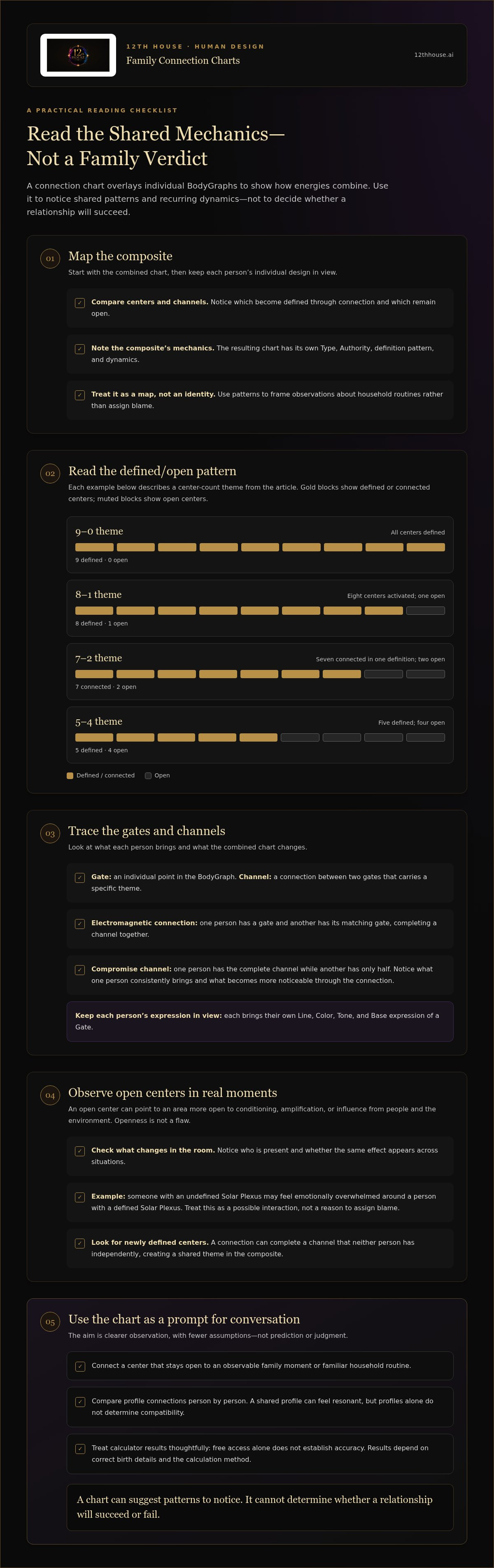
A Connection Chart overlays individual BodyGraphs to show how two people’s energies combine in a relationship. For a family, compare members’ charts to see which centers and channels become defined through connection. The resulting chart has its own Type, Authority, definition pattern, and dynamics. These features describe shared mechanics, not a fixed family identity. A 9-0 theme means all centers are defined; a 5-4 theme means five are defined and four are open. Use those patterns to frame observations about household routines, rather than assigning blame for a family dynamic.
Channels and Gates in the Composite
Gates are individual points in the BodyGraph, while a channel connects two gates and carries a specific theme. To interpret them, note which gates each person has and what changes in the combined chart. An electromagnetic connection forms when one person has a gate and another has its matching gate, completing a channel together. Each person brings their own Line, Color, Tone, and Base expression of that Gate. A compromise channel occurs when one person has the complete channel and another has only half. These mechanics can help identify recurring pulls or tensions without treating them as proof of incompatibility.
Using the Chart for Awareness
Use the chart to observe patterns, not predict whether a relationship will succeed. Compare profile connections individually; sharing a profile can feel resonant, but profiles alone don’t determine compatibility. An 8-1 theme activates eight centers and leaves one open, while a 7-2 theme has seven connected centers in one definition and two open centers. Online calculators may be free, but free access alone doesn’t establish accuracy. Results depend on correct birth details and the calculation method. For understanding my family's Human Design composite, treat the chart as a prompt for conversation, not a verdict.
Centers that remain undefined
In a family composite chart, centers may be defined or undefined depending on how family members’ individual charts interact. This distinction can help you notice where the group experiences a more consistent pattern and where energy from one another or the environment may be amplified. Read the composite as a map of shared dynamics, not as a replacement for each person’s individual nature.
A center becomes newly defined when the connection completes a channel that neither person has independently. For example, one family member may have one gate and another its matching gate, creating an electromagnetic connection. Together, those gates can define a center in the composite chart. The group may then experience a shared ability or theme that does not appear the same way in either individual chart. Notice when this pattern arises, perhaps during a family decision or a familiar household routine.
Undefined centers point to areas that may be more open to conditioning, amplification, and influence from people or the environment. That openness isn’t a flaw. It’s a prompt to pay attention: notice whether one family member’s presence changes how others experience that center. For instance, someone with an undefined Solar Plexus may feel emotionally overwhelmed around a person with a defined Solar Plexus. The chart suggests a possible interaction, not a reason to assign blame.
Compromise can also shape how a family experiences a defined center. In a compromise channel, one person has the complete channel while another has only half. Notice the difference between what one person consistently brings and what becomes more noticeable through the connection. This distinction can clarify attraction, recurring tension, or why a pattern feels stronger together than it does alone.
To use this map, identify each center that stays open in the composite, then connect it to an observable family moment. Ask what changes in the room, who is present, and whether the same effect appears across situations. For a separate perspective on personal chart patterns, Astrology Birth Chart & Transit Analysis can complement this reflection without treating Human Design centers as a diagnosis.
Compatibility of Types and Profiles
Human Design Types and Profiles describe different layers of family interaction. Read them as tendencies, then compare them with what you observe in daily life.
Type Interactions in Families
Type interactions show how different Strategies and decision-making approaches meet within a family. A Manifestor can inform Generator relatives about plans, giving them something concrete to respond to. In relationships, a Projector’s Strategy is to wait for an invitation before sharing insights. Each person’s Authority describes their individual decision-making process; it does not make one relative responsible for choosing for everyone. Notice how these mechanics shape a specific exchange, such as planning a family outing.
Profile Compatibility Examples
Profile compatibility is a map of orientations, not a score for a harmonious relationship. A Line 1 and Line 4 pairing can combine knowledge-building with network connection. A Line 2 and Line 5 pairing may reveal gifts that the Line 2 person doesn’t see in themselves. Line 2 often needs substantial alone time, while Line 4 is energized by social engagement. In a family, agreeing on space and connection can help these different needs coexist.
A 3/5 profile is associated with experimentation and trial-and-error learning, so relatives may benefit from treating mistakes as part of discovery. A 2/4 profile combines solitude with a network orientation. These examples offer ways to examine specific dynamics, whether between a parent and child or between siblings. Assess each profile connection individually, rather than assuming shared lines or a particular pairing guarantee ease.
Limits of Family Readings
Human Design family readings are interpretive tools, not genetic explanations or fixed judgments about relatives. A connection chart can describe relationship mechanics, but it cannot determine whether a relationship will succeed or fail. A Profile label can also oversimplify someone if it replaces listening to their preferences and observing their behavior. Use the framework to raise questions, then compare its ideas with real interactions.
Criticism is useful when it keeps interpretation precise. Treat a chart as a symbolic lens, not proof that a family member must behave a certain way. For example, a Line 2’s withdrawal can be considered alongside that person’s own communication about needing space, rather than automatically read as rejection.
Energy types and strategies
In a family connection chart, Type and Strategy describe interaction patterns, while each person retains an individual way of making decisions. Consider both levels before interpreting compatibility.
The composite chart has its own Type and Authority, describing the shared energetic pattern without replacing anyone’s individual design. Ask how that pattern appears in an ordinary family moment, such as choosing a weekend plan. Does one person’s approach set the pace, or does the group wait for another member’s response? These observations connect abstract chart mechanics to everyday family dynamics.
Strategy can offer a practical lens for communication. For example, a Manifestor can inform Generator relatives about plans, giving them something to respond to. That doesn’t mean every family decision must follow the same script. Instead, notice whether sharing a plan changes the exchange, or whether an invitation creates a clearer opening for someone to share insight. A Projector’s Strategy involves waiting for an invitation before sharing insights in relationships, so timing may matter in family conversations.
Authority adds another layer. An individual’s Authority concerns their own decision-making process; the composite chart’s Authority describes the connection’s mechanics. Don’t use the group chart to override anyone’s personal choice. During a family decision, give each member room to express their position, then notice where agreement or conflict emerges. This distinction keeps shared patterns separate from personal agency.
Compatibility isn’t a simple match between Types. A magnetic pull or a feeling of dominance may describe how an interaction feels, but neither proves that a relationship is harmonious or difficult. Consider the context: who brings an idea, who responds, and whether the same pattern appears in different situations. This offers a grounded way to examine family dynamics without turning a chart into a verdict.
To explore individual Type and Authority patterns alongside the family map, explore Human Design Profiles and compare what each person’s chart brings to the connection.
12Th House: Ask Lala AI Spiritual Guidance
12th House’s Ask Lala AI Spiritual Guidance can help you explore questions that arise while reflecting on family dynamics. Use it when a chart pattern raises a personal question about compatibility, a family interaction, or how different chart elements fit together. Ask Lala answers personalized questions about charts, spells, and compatibility, giving you a way to continue your exploration through focused prompts.
For a closer look at individual designs, Human Design Profiles can add context to a family connection chart. Astrology Birth Chart & Transit Analysis, Tarot Readings, and Numerology Reports offer other perspectives for reflection, each with its own symbolic framework. Treat these tools as ways to organize your inquiry, not as substitutes for observing how relatives communicate and make decisions.
Explore Ask Lala AI Spiritual Guidance at 12thhouse.ai when you’re ready to continue.
Carry Your Observations Into the Next Conversation
To continue understanding my family's Human Design composite, bring one observation into daily life. Choose a recurring interaction, notice what each person contributes, and stay curious about what changes when you respond differently. A chart can offer language for reflection, but your family’s lived experience gives that language meaning.
If your chart raises a question, Ask Lala offers a way to ask personalized questions about charts and compatibility. Astrology Birth Chart & Transit Analysis and Tarot Readings can bring additional symbolic perspectives to your reflection. Choose the lens that helps you form a clearer question, then consider how it relates to your actual relationships.
Explore spiritual guidance at 12th House when you’re ready to continue. Let each insight open a conversation, not close one. A more attentive question can be a meaningful beginning.
Frequently Asked Questions
Do I need to understand the mechanics first?
No. You can begin with a practical question about a family interaction and learn chart symbols as they become relevant. For example, ask why planning a shared activity feels easy with one relative but tense with another. Then use the chart to explore possible patterns. This keeps the interpretation connected to real experience without requiring prior technical knowledge.
What is a Connection Chart in Human Design?
A Connection Chart combines two individual Human Design charts to explore relationship dynamics. In a family, you might compare a parent’s chart with a child’s to reflect on how each approaches communication or decisions. It offers a symbolic framework for considering their interaction, not a complete account of either person’s character or family history.
Whose charts can I use?
You can compare charts for family members whose relationship you want to understand, such as siblings, a parent and child, or partners who share a home. Begin with one pair and one recurring situation, such as disagreements about household plans. A focused comparison can be easier to interpret than combining everyone’s details at once. Then consider how other relationships contribute to the wider family atmosphere.
What is a Human Design composite chart for a family?
A family composite chart combines individual chart information to explore patterns within a family group. It can help you form questions about shared routines, communication, or differing needs at home. For instance, notice whether family members approach a regular household decision in different ways. Use that observation as a starting point for reflection, not as a label that defines your family.
How do you create a Human Design composite chart for family members?
Start with individual Human Design charts for the family members you want to compare. Bring them together in a connection or composite view, then examine the combined pattern alongside each person’s chart. If your family includes several members, look at important pairings as well as the group view. This can help you see whether a dynamic belongs to one relationship or recurs across the household.
What birth date, time, and location are needed for a family Human Design chart?
Use each person’s birth date, birth time, and birth location to generate their individual chart before making a family comparison. Keep each person’s details correctly matched, since mixing records can lead to a misleading comparison. A family chart draws on the individual charts, so the combined reading depends on the information entered for every family member included.


