

Human Design can be a lens for self-reflection in therapy, not a verdict on who you are. When explaining Human Design to your therapist, describe it as a system that draws on astrology, the I Ching, Kabbalah, quantum physics, and genetics to map patterns in a BodyGraph. Its concepts may give you language for experiences you want to explore, while your perspective and your therapist’s remain part of the conversation.
It’s reasonable to want your therapist to understand a framework that feels meaningful to you without asking them to accept it as fact or let it define your care. Focus on how its ideas relate to your lived experience: what resonates, what doesn’t, and what you’d like to examine together.
This article explains key Human Design concepts, offers practical ways to introduce them in a session, and shows how they can support reflection without replacing your therapist’s clinical approach. You’ll have a clear, grounded way to bring the subject into the room.
Key Takeaways
- Describe Human Design as a reflective framework, not a diagnosis or fixed definition of who you are.
- Use your Type, Strategy, and Authority as prompts to notice how you approach choices and respond to situations.
- Bring a specific pattern or question to therapy so you and your therapist can explore what it means in your lived experience.
- Keep your own perspective central: notice what resonates, what doesn’t, and what you want to understand more deeply.
Energy Types, Strategy, and Authority in client work
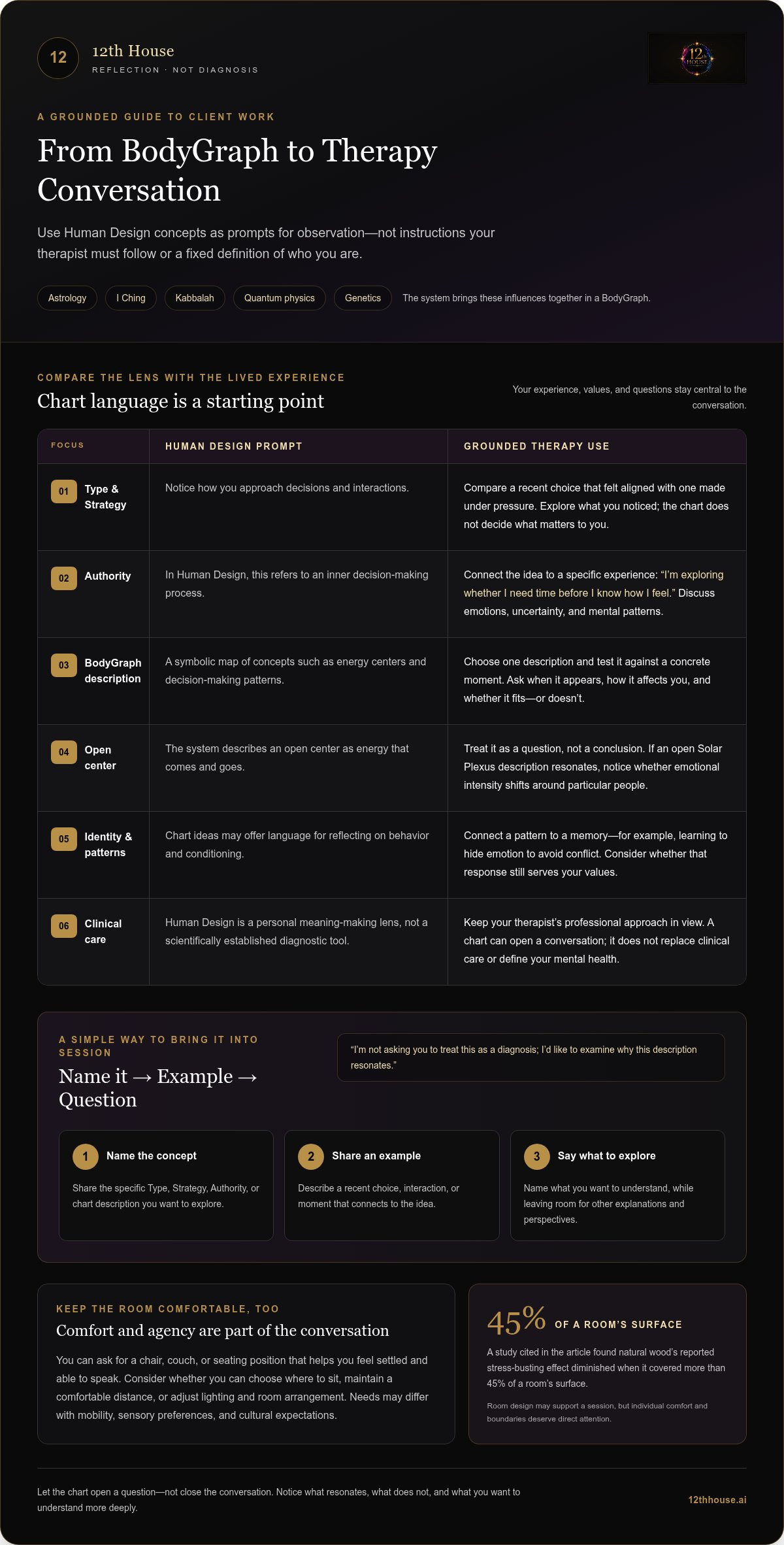
Present your Human Design Type, Strategy, and Authority as prompts for observation, not instructions your therapist must follow. These terms offer a framework for noticing how you approach decisions and interactions. For example, describe a recent choice that felt aligned, then compare it with a decision you made under pressure. Your perspective and values remain central. The chart can open a conversation, but it doesn’t decide what matters to you.
In Human Design, Authority refers to an inner decision-making process. Explain what the concept means to you, then connect it to a specific experience: “I’m exploring whether I need time before I know how I feel.” This gives your therapist a concrete starting point for discussing emotions, uncertainty, and mental patterns. A BodyGraph can offer language for reflection, while therapy helps you consider how those ideas fit your life.
Keep the discussion focused with three steps: name the concept, share an example, and say what you want to explore. You might add, “I’m not asking you to treat this as a diagnosis; I’d like to examine why this description resonates.” Your therapist can accompany your inquiry without providing a blueprint for your life. A respectful exchange leaves room for both your own understanding and professional perspective.
The therapy room itself also shapes comfort and agency. Ask for a chair, couch, or seating position that helps you feel settled and able to speak. Furniture should suit the client’s body, mobility, and preferences rather than assume one arrangement works for everyone. A study cited in the research found natural wood’s reported stress-busting effect diminished when it covered more than 45% of a room’s surface. Design can support a session, but your comfort and boundaries deserve direct attention.
Notice practical details, such as whether you can choose where to sit, maintain a comfortable distance, and adjust the room’s lighting or arrangement. These choices can matter for people with different mobility needs, sensory preferences, or cultural expectations. Therapists also bring personal histories and reactions into the room; acknowledging those responses can help keep your values in focus. Human Design is one possible lens, not an authority over your experience.
What is Human Design, anyway?
Human Design is a symbolic framework for interpreting personality and behavior through a BodyGraph. It isn’t a scientifically established diagnostic tool, so treat its descriptions as ideas to explore, not evidence about your mental health.
Understanding the Human Design Framework
The system draws on astrology, the I Ching, Kabbalah, quantum physics, and genetics. Its BodyGraph maps concepts such as energy centers and decision-making patterns into an individual chart. When reviewing a description, look for a specific behavior you recognize, then consider when it appears and how it affects you. For example, does a chart description of emotional sensitivity fit how you feel in particular relationships, or not?
Exploring Conditioning and Personal Identity
Human Design-informed reflection can explore how conditioning shapes the person we believe ourselves to be. Family expectations, cultural roles, and past relationships may influence what feels acceptable or familiar. In a session, connect a chart idea to a concrete memory: perhaps you learned to hide emotion to avoid conflict. Ask whether that pattern still serves your values. The aim is not to label your identity, but to distinguish learned responses from choices you want to make now.
Discussing Human Design Without Diagnostic Claims
Keep the distinction clear: Human Design offers a personal meaning-making lens, while therapy addresses your concerns through your therapist’s professional approach. You might say, “This description resonates, and I’d like to explore why,” rather than treating a chart as a diagnosis or explanation. That wording leaves room for your therapist to consider other perspectives, and for you to decide what feels accurate. A Human Design Profile can provide a chart reference for personal reflection.
Therapists also have personal reactions during sessions. Their histories or assumptions can shape how they respond, so a therapist may name a reaction and distinguish it from professional judgment. You can ask what they mean, share how their response affects you, and bring the conversation back to your needs. This keeps both perspectives visible without expecting either person to be infallible.
Using Human Design for self-reflection and pattern recognition
Use a BodyGraph to examine experiences, not as proof of why they happened. Choose a description that catches your attention, then test it against a specific moment. For example, if a pattern suggests you absorb other people’s emotions, recall a recent conversation. What did you feel before, during, and afterward? This keeps reflection grounded in observable details instead of turning chart language into a fixed story about yourself.
A simple record can make the comparison clearer. Note the situation, your response, and what followed. Then ask whether the same sequence appears in other contexts, such as family conversations or work decisions. In Human Design, an open center is described as energy that comes and goes. Treat its meaning as a question to investigate, not a conclusion. If a description of an open Solar Plexus resonates, consider whether your emotional intensity shifts around particular people.
- Choose one concept. Write down the exact chart description you want to explore.
- Recall an event. Record what happened, who was present, and what you noticed in yourself.
- Look for repetition. Compare the event with another experience, without forcing them to match.
- Bring a question. Ask what else might explain the pattern and what you want to understand.
In therapy, share the story behind a pattern, not just its chart label. For instance, explain what happened when you agreed to a request despite feeling uncertain. Your therapist can help examine the needs, beliefs, and relationships involved. Human Design adds a lens; your lived experience remains the material. If a description doesn’t fit, that mismatch is useful information too. It can clarify which parts of the framework feel meaningful and which don’t.
Keep the process open-ended. A chart may offer language for noticing a habit, but reflection asks what that habit means in your life. Track the context, your feelings, and the choices available to you. This turns symbolic ideas into questions you can explore, revise, or set aside as your understanding develops.
Human Design-informed therapy
Human Design can be a reflective lens in therapy, not a treatment method or authority over your care. Its value lies in helping you describe experiences and consider patterns.
Using Human Design in Therapy
If you want to include it, a BodyGraph can be a starting point for exploring your story. A chart description might prompt discussion about emotional responses, relationships, or decisions. Your therapist brings psychology and clinical understanding to the conversation, helping you examine what fits your experience. Human Design should not replace the therapeutic work of listening, clarifying concerns, and supporting your growth.
Considering Psychology’s Perspective
Human Design chart interpretations are not psychological diagnoses or clinical findings. Psychology examines behavior, emotion, and relationships through professional frameworks; a chart can offer personal meaning, but it doesn’t establish why a pattern occurs. In sessions, distinguish what the system suggests from what you’ve observed and what your therapist understands clinically. This lets you explore the framework without confusing symbolic language with psychological assessment.
Preparing Questions for Therapy Sessions
Bring questions that invite collaboration: “Can we explore why this description resonates?” or “How might this idea connect with my relationships?” You can also ask whether your therapist is comfortable discussing Human Design and how they would keep your goals central. These questions make room for both perspectives and help define the framework’s role in sessions.
Ground mental-health decisions in your needs, symptoms, and therapeutic discussion rather than following a chart alone. Treating a BodyGraph as a fixed instruction could narrow your choices or distract from concerns that need attention. Don’t use a Human Design interpretation to replace professional care or change a care plan without discussing the decision with your therapist.
For a structured chart reference to bring into personal reflection, explore a Human Design Profile. Use its concepts to prepare questions, then let your lived experience guide the conversation.
12Th House: Ask Lala AI Spiritual Guidance
12th House offers Ask Lala AI Spiritual Guidance for exploring personal questions about spiritual frameworks and chart meanings. If you’re preparing for therapy, use it to clarify which Human Design concepts you want to discuss and shape them into questions grounded in your own experience. A Human Design Profile can also give you a chart reference for continued reflection.
Keep the roles distinct: spiritual tools can support your inquiry, while therapy remains the space to discuss mental health with your therapist. Bring forward ideas that feel useful, and set aside those that don’t fit your experience. The goal is clearer reflection, not a prescribed answer.
Visit 12th House to explore Ask Lala AI Spiritual Guidance.
Carry Your Curiosity Into the Next Conversation
If you’re explaining Human Design to your therapist, let curiosity guide the conversation rather than seeking agreement. Choose the idea you most want to examine, and stay open to what your lived experience reveals. You can revise your interpretation as you learn more about yourself.
For spiritual reflection beyond the therapy room, 12th House offers Ask Lala AI Spiritual Guidance, Astrology Birth Chart & Transit Analysis, and Tarot Readings. These tools can help you explore questions and organize your thoughts, while therapy remains focused on your care and personal goals.
Explore Ask Lala AI Spiritual Guidance as you shape your next questions. Bring forward what resonates, leave what doesn’t, and trust yourself to keep learning.
Frequently Asked Questions
So… Why Does This Matter?
A framework you find meaningful can shape how you describe your experiences and choices. Sharing it gives your therapist another way into what you want to understand. For example, discuss a Human Design idea that affects how you interpret conflict, then focus on the real situation behind it. This keeps the conversation connected to your concerns instead of centered on proving the system right.
What is Human Design and how does it work?
Human Design is a self-reflection system that maps concepts into a personal chart called a BodyGraph. It draws on astrology, the I Ching, Kabbalah, quantum physics, and genetics, and describes nine energy centers. Readers use chart terms to consider patterns in decision-making, relationships, and behavior. The chart offers an interpretive framework, not a clinical assessment. Compare its descriptions with specific experiences instead of treating them as fixed facts.
How can I explain Human Design to my therapist?
If you’re explaining Human Design to your therapist, start with why it matters to you. Name a concept, then give a recent example: “This description made me think about how I react to feedback at work.” Explain what you hope to explore, such as a recurring response or a decision. This gives your therapist context and a practical focus without requiring them to share your beliefs about the system.
What are the five Human Design Types and their strategies?
Human Design names five Types: Manifestor, Generator, Manifesting Generator, Projector, and Reflector. Their strategies are commonly described as informing, responding, responding and informing, waiting for recognition or invitation, and waiting through a lunar cycle, respectively. Use these as prompts specific to the system, not instructions that override your judgment. For instance, notice how “responding” feels in a real choice, then consider whether the label clarifies your experience.
What are Human Design authority and profile?
In Human Design, Authority describes a proposed inner decision-making process, while Profile describes recurring themes in how a person engages with life. They’re distinct chart elements: one focuses on how a choice is approached, the other on a broader pattern of self-expression. If you discuss either in therapy, bring an example from a decision or relationship. Ask what the concept helps you notice instead of using it to make the choice for you.
How might a therapist respond to a client's Human Design beliefs?
Your therapist may ask what Human Design means to you, which parts feel useful, and how it connects with your current concerns. They may also distinguish your personal interpretation from clinical approaches used in therapy. If you feel dismissed or misunderstood, describe the impact and clarify what you hoped to discuss. A specific example, such as a chart idea that helped you name a recurring conflict, can make your perspective easier to understand.


