

A Human Design chart can prompt reflection, but it can’t tell you what your spouse feels. Using human design to improve communication in marriage means treating the chart as a lens, then asking directly, listening without interruption, expressing what you need, and setting boundaries around difficult conversations. If conflict persists or escalates, seek support beyond the chart.
You may already sense that the same disagreement can mean different things to each of you. Change begins when you stop expecting your partner to read your mind and get curious about how you each communicate. Turn Human Design insights into practical questions, more attentive listening, clear boundaries, and a thoughtful next step when conversations keep breaking down.
Key Takeaways
- Use Human Design as a reflection tool, then ask your partner directly what they feel and need instead of trying to infer it.
- Listen for both the words and emotions behind them; reflect back what you heard before responding.
- Agree on boundaries for difficult conversations, including when to pause and return to the discussion.
- When conflict persists or escalates, recognize when a couples counselor may offer support beyond personal reflection tools.
1. Asking rather than assuming what a partner feels
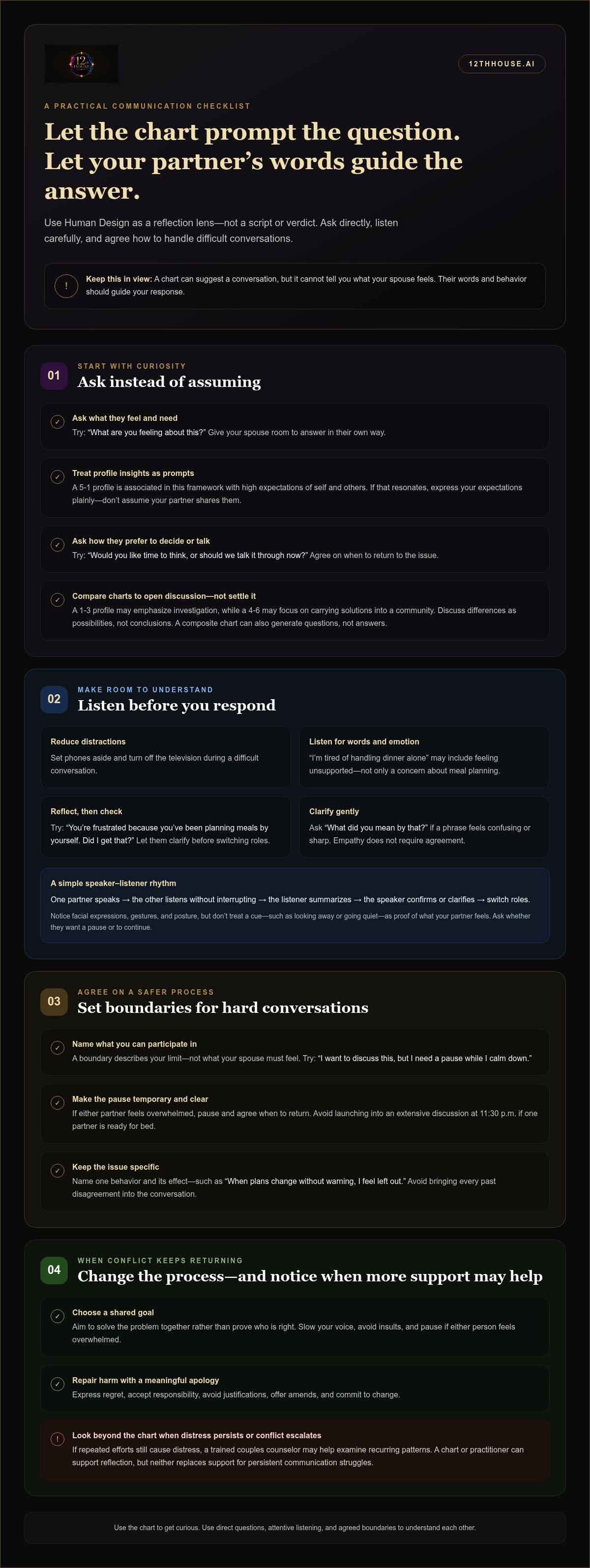
Use Human Design as a prompt for curiosity, not as a script for your spouse. A 5-1 profile, for example, is associated in this framework with high expectations of self and others. If that pattern resonates, express those expectations plainly instead of assuming your partner shares them. Ask, “What are you feeling about this?” Then give your spouse room to answer in their own way.
Authority and decision-making styles can influence how partners approach a choice or difficult conversation. Treat each person’s process as something to ask about, not infer from a label. A practical step is to ask, “Would you like time to think, or should we talk it through now?” Then agree on a moment to return to the issue. Avoid starting an extensive discussion at 11:30 p.m. if one partner is ready for bed.
To compare Human Design charts, look at each partner’s profile and decision-making approach side by side, then discuss where they seem to differ. A 1-3 profile may emphasize investigation, while a 4-6 profile may focus on carrying solutions into a community. A relationship composite chart can be another reflection tool, but use it to generate questions, not conclusions about either person.
Make the chart practical with a simple sequence: name the issue, describe your feelings, ask an open question, and check what the answer means. If your partner says, “I need space,” clarify whether they mean a quiet evening or a pause before continuing the argument. This approach responds to actual needs and reduces the risk of acting on assumptions instead of your partner’s own thoughts.
Human Design labels can create conflict if either spouse treats a profile as a fixed verdict. Use the system for reflection, not as scientific proof of what someone feels or will do. Let each person correct your interpretation. A profile may suggest a conversation, but your partner’s words and behavior should guide your response.
2. Listening to understand your partner
In a tense conversation, listening means more than waiting for your turn to respond. Notice both your partner’s words and emotional tone. If they say, “I’m tired of handling dinner alone,” the issue may include feeling unsupported, not just meal planning. Pause before defending yourself. Give their words room to land, then reflect the concern you heard.
Try a speaker-listener approach: one partner speaks while the other listens without interrupting. The listener summarizes the message, then asks whether they understood correctly. For example: “You’re frustrated because you’ve been planning meals by yourself. Did I get that?” The speaker can clarify before you switch roles. This structure gives each person a chance to share, rather than turning the conversation into a competition for airtime.
- Limit distractions: Set phones aside and turn off the television during a difficult conversation.
- Track emotion: Notice whether your partner sounds hurt, worried, or angry, rather than responding only to facts.
- Reflect first: Restate the main point before offering advice or explaining your own view.
- Clarify gently: Ask, “What did you mean by that?” when a phrase feels confusing or sharp.
Empathy doesn’t require agreement. You can say, “I see why that felt dismissive,” while still explaining your own perspective afterward. Notice facial expressions, hand movements, and posture alongside speech. If your partner looks away or goes quiet, don’t treat that cue as proof of what they feel. Ask whether they need a pause or want to continue.
Build a regular listening practice instead of waiting for an argument. One couple’s example is setting aside an hour each week for a judgment-free conversation called “Bae Sesh.” Use that time to discuss what felt supportive, what strained the relationship, and what each person would prefer next week. Keep the exchange balanced: listen to understand, summarize accurately, and respond to the meaning your partner intended.
Seeking help for persistent or escalating conflict
When the same conflict returns despite repeated conversations, change the process, not just the wording. Set a shared goal, such as solving the problem together rather than proving who is right. Describe one specific behavior and its effect: “When plans change without warning, I feel left out.” Stay focused on that issue instead of bringing every past disagreement into the conversation.
Respond gently by slowing your voice, avoiding insults, and asking for a pause if either partner feels overwhelmed. Return to the conversation when you can both participate. Think of talking like a tennis match: each person speaks, listens, and sends the conversation back. An apology can help repair harm when it expresses regret, accepts responsibility, avoids justifications, offers amends, and commits to change. These strategies support conflict management without turning your spouse into an opponent.
How can couples find a qualified Human Design relationship coach or practitioner? Look for someone who explains their approach, describes relevant relationship experience, and treats chart interpretations as prompts rather than verdicts. Ask how they handle a difference between a chart reading and a partner’s own account. A practitioner can support reflection, but persistent communication struggles or escalating conflict that causes distress may call for support from a trained couples counselor.
A chart cannot resolve conflict for you. If repeated efforts still cause distress, discuss what support would feel acceptable to both partners. A counselor can help couples examine recurring patterns, while ending the relationship may also warrant honest consideration. If an argument intensifies, pause rather than forcing an immediate answer. Agree on a time to resume talking, and return to the shared goal: addressing the problem without attacking each other.
4. Setting and respecting boundaries
A clear boundary names what you can participate in, not what your spouse must feel. Try: “I want to discuss this, but I need a pause while I calm down.” Either partner can request a temporary stop when an argument starts to build, then return when both can speak more steadily. This protects emotional space without treating a pause as rejection or using silence to punish.
Be honest about your feelings instead of saying “I’m fine” and expecting your partner to decode the truth. For example, say, “I feel hurt and need a little time before we talk.” Your spouse’s feelings are valid even when they differ from yours. Respect means acknowledging the emotion without declaring one person right and the other wrong. Human Design can prompt reflection on different needs, but it shouldn’t override what your partner says they need.
Boundaries and compromise work together when both people help shape the agreement. If nightly calls are difficult because of changing schedules, agree to talk by phone every other night and text on the other days. Make the arrangement specific: decide what counts as a check-in and how to signal when one person needs more conversation. Revisit the agreement if it stops supporting a healthy relationship.
In charged moments, name the limit and offer a next step: “I can’t continue while we’re raising our voices. Let’s take a break and return to this conversation.” A boundary should make your capacity clear, while leaving room to discuss a workable solution. To reflect on how your Human Design profile may shape your communication needs, explore your communication patterns.
A temporary stop gives emotions room to settle, making it easier to return to the issue with more focus. Treat the pause as a shared way to lower the intensity, not as a verdict on the concern itself. Both partners can feel differently about the same moment; accept those feelings as valid without sorting them into right and wrong. That recognition leaves room for each person to speak and be heard.
12Th House: Ask Lala AI Spiritual Guidance
12th House offers Ask Lala AI Spiritual Guidance for exploring personalized questions about Human Design charts and compatibility. Use it when you want a structured reflection prompt before discussing communication patterns with your spouse. A Human Design Profile can help you examine each partner’s chart, while Astrology Birth Chart & Transit Analysis, Tarot Readings, and Numerology Reports offer other reflective lenses.
These tools can support self-inquiry, but they don’t replace direct conversation or trained couples counseling when conflict persists or escalates. Bring a specific question, such as how different decision-making styles may shape a disagreement, and use the response to guide your own reflection. For a personalized spiritual perspective, contact 12th House.
Let the next conversation begin with curiosity
A more connected marriage isn’t built from a perfect chart. It grows through the choices you make after noticing a pattern: staying curious, speaking honestly, and allowing your partner’s experience to differ from your own. Using human design to improve communication in marriage can be a reflective starting point, while understanding takes shape in the relationship itself.
If you’d like to continue that personal inquiry, 12th House offers Ask Lala AI Spiritual Guidance, Astrology Birth Chart & Transit Analysis, and Tarot Readings as distinct tools for reflection. Bring a question about the patterns you’ve noticed, then decide what insight feels useful in your real conversations. These practices can inform self-understanding, while ongoing or escalating conflict may call for support beyond spiritual tools.
Explore Human Design with 12th House and take your next step with care and intention.
Frequently Asked Questions
What is Human Design and how are the five types, strategies, and authorities defined?
Human Design is a system for interpreting a personal chart through type, strategy, and authority. Its five types are Generator, Manifesting Generator, Projector, Manifestor, and Reflector. Strategies describe approaches to interaction, such as responding, informing, or waiting for an invitation. Authority refers to the chart’s decision-making guidance, with forms such as emotional, sacral, splenic, and lunar authority. The system offers a symbolic framework for reflection.
How can spouses use Human Design types to communicate more effectively?
Spouses can treat type descriptions as hypotheses to explore through conversation, not rules to impose. For example, a partner who prefers time before committing might appreciate receiving plans early, while the other can ask when they’ll revisit the decision. Couples using human design to improve communication in marriage can compare what feels supportive with what works in practice, then adjust their shared approach without treating either type as more valid.
How do Human Design profiles and centers influence relationship dynamics and communication?
Profiles describe paired role themes in Human Design, while centers represent areas the system associates with different kinds of energy and expression. In chart interpretation, a defined center is understood as more consistent, while an open center is understood as more variable or receptive. A couple might use these distinctions to discuss where each feels steady or influenced, then compare those interpretations with lived experience instead of assuming a chart explains every disagreement.


