

A 15-minute difference in recorded birth time can matter in an astrology chart, especially for the Ascendant and house cusps, but it won’t automatically change your rising sign. Whether a 15-minute birth time difference matters depends on how quickly those chart points move around the moment of birth.
It’s understandable to connect birth timing with the first moments of a newborn’s life. But the astrological birth time and the medical milestones around labor describe different things: the newborn Golden Minute is the first 60 seconds after birth, while the transition to the second stage of labor happens before birth and can last 15 minutes to an hour. This guide separates those timelines, explains which chart placements may shift, and shows why a small change in the recorded time can affect one chart more than another. You’ll leave with a clearer framework for understanding birth time, chart precision, and the limits of what a 15-minute difference can tell you.
Key Takeaways
- A 15-minute shift can move chart angles and house cusps; the chart’s location and the positions near a cusp shape the effect.
- A different rising sign is possible when the recorded time is near a sign boundary, but a time difference doesn’t automatically change the sign.
- Separate astrology’s birth timestamp from medical timing: the Golden Minute is the first 60 seconds after birth, while transition to the second stage occurs before delivery.
- Trace the recorded time to the earliest reliable birth documentation you can access, and note whether it may have been rounded.
Which astrology chart placements or house cusps can shift in 15 minutes?
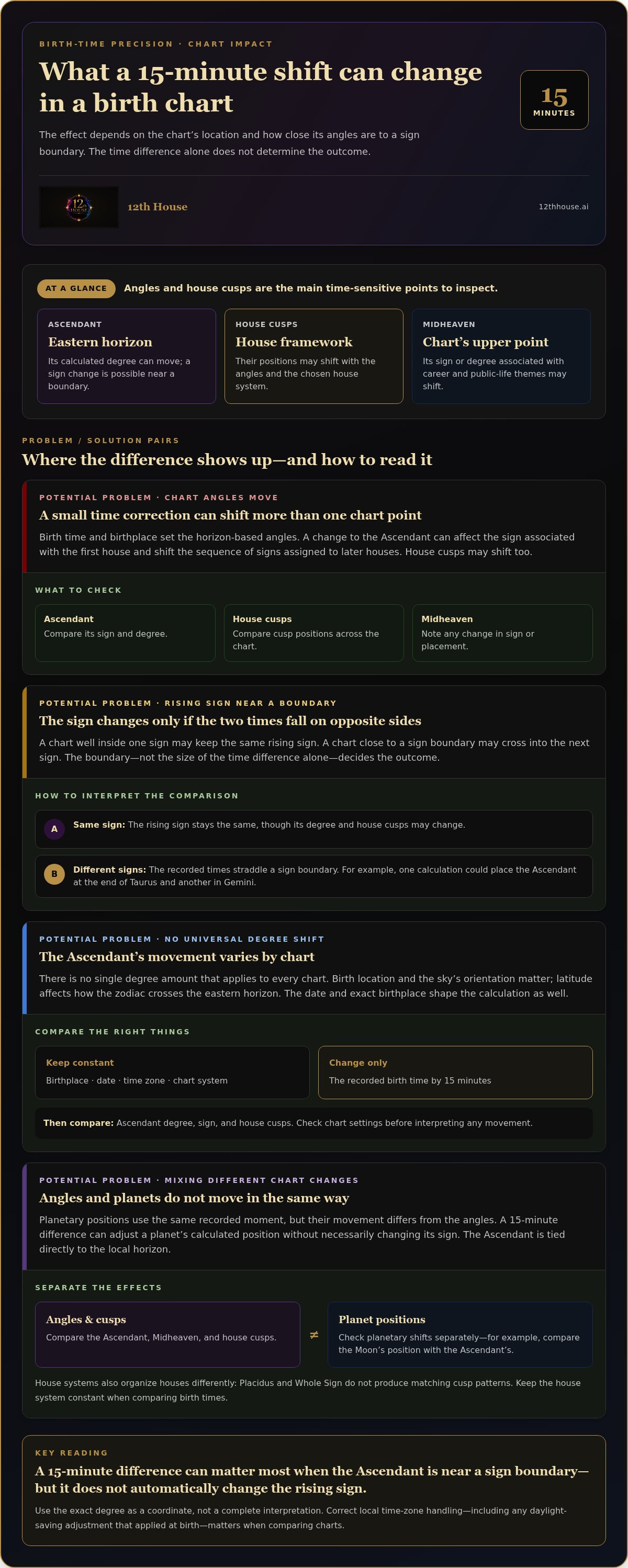
In an astrology chart, the birth time and birthplace set the horizon-based angles. The Ascendant marks the eastern horizon, while the Midheaven marks the chart’s upper point. These angles anchor the house framework, so a 15-minute adjustment can shift their calculated positions. House cusps may shift with them, depending on location and the chosen house system.
The Ascendant and Midheaven deserve close attention when you compare two birth times. A change to the Ascendant can affect the sign associated with the first house and shift the sequence of signs assigned to later houses. The Midheaven may shift as well, changing the sign or degree associated with career and public-life themes. A chart near a cusp is more sensitive to a small time correction than one with placements well within a sign.
- Ascendant: Check whether the rising point changes sign or degree.
- House cusps: Compare cusp positions across the full chart.
- Midheaven: Note whether its sign or placement changes.
- Planet placements: Separate angle changes from planetary shifts.
Planetary positions use the same recorded moment, but their movement differs from the angles. A 15-minute difference can adjust their calculated positions without necessarily changing a planet’s sign. For example, compare the Moon’s chart position with the Ascendant’s: the latter is tied directly to the local horizon. This distinction helps identify which chart features changed because of the time.
House systems also shape the comparison. Placidus and Whole Sign organize houses differently, so their cusp patterns won’t match. Keep the birthplace and house system constant when comparing charts, and change only the birth time. Then note which angles, cusps, and placements move. This isolates the effect of the time difference instead of mixing in other chart settings.
How much can the ascendant change in 15 minutes?
There’s no single degree amount that applies to every chart. The Ascendant’s movement depends on the birth location and the sky’s orientation at that moment. A 15-minute time adjustment can move its calculated degree, but the size of that shift varies. Treat any fixed “degrees per 15 minutes” rule with caution.
Latitude matters because it affects how the zodiac crosses the eastern horizon. The same time adjustment can produce different Ascendant movement in New York and in a location closer to the equator. The date and exact birthplace also shape the calculation. For a meaningful comparison, keep those details constant and change only the recorded birth time.
The most useful measure is not simply the degree difference. Check whether the Ascendant stays in the same sign, approaches a sign boundary, or crosses into another sign. A shift within the same sign changes the degree and may alter house cusps. A shift across a boundary changes the rising sign and can reorganize the chart’s house framework.
- Keep fixed: birthplace, date, time zone, and chart system.
- Change: the recorded birth time by 15 minutes.
- Compare: Ascendant degree, sign, and house cusps.
Time-zone handling also matters. A chart calculation must use the local civil time correctly, including any daylight-saving adjustment that applied at birth. An incorrect setting can create a larger discrepancy than the recorded 15-minute difference. Compare chart settings before interpreting movement.
So, how much can the Ascendant change? Enough to matter near a sign boundary, but the degree shift depends on the chart’s location and calculation details. Read the exact degree as a coordinate, not as a complete interpretation. The Ascendant’s sign, house position, and relationship to other chart factors provide the wider structure.
Can a 15-minute birth time difference change a person's rising sign?
Yes, if the two recorded times fall on opposite sides of a rising-sign boundary. The Ascendant is calculated from birth time and place, so the same 15-minute adjustment won’t produce the same result everywhere. A chart well inside one sign may retain its rising sign; a chart close to a boundary may cross into the next.
Picture a hypothetical chart calculated for 8:00 and 8:15 at the same birthplace. If the Ascendant remains in Taurus in both calculations, the rising sign stays Taurus, though its degree and house cusps may change. If one calculation places it at the end of Taurus and the other in Gemini, the rising sign changes. The boundary, not the size of the time difference alone, decides the outcome.
To assess your chart, compare two calculations using the same date, birthplace, time zone, and house system. Change only the birth time, then check the Ascendant’s sign and degree in each result. This controlled comparison helps distinguish a genuine sign shift from one caused by different chart settings.
- Same sign: The rising sign remains unchanged, though the chart angles can move.
- Different signs: The recorded times straddle a sign boundary.
- Different settings: Recalculate with matching location and time-zone details.
One person reported that their twins’ certificates showed a one-minute difference. That account doesn’t establish how often records vary, but it illustrates why the source and precision of a recorded time matter when comparing charts.
So, does a 15-minute birth time difference matter for your rising sign? It matters most when the Ascendant sits near a sign boundary. If both calculations show the same sign, read the degree and house changes separately rather than treating them as a new rising sign.
How can I find or verify my exact birth time in the United States
Start with the document closest to the birth. A hospital birth record may include a recorded time, while the details on a state birth certificate can vary. Check the actual document instead of assuming it includes the time. If it doesn’t, contact the hospital where you were born and ask about records that may show the delivery time.
Use a sequence that keeps the evidence clear:
- Review family records: Check a baby book, announcement, or note written near the birth.
- Inspect the birth certificate: Look for a time field, not only the birth date and place.
- Contact the birth hospital: Ask whether a record with the delivery time can be located.
- Compare accounts: Note whether relatives remember an exact time or an approximate one.
Separate firsthand documentation from later recollection. A written entry such as “2:14 a.m.” gives a more precise chart input than “around two.” But a written time may still have been rounded or copied from another source. Record where each time came from, who supplied it, and whether the source presents it as exact or approximate.
Preserve the original time format and birthplace details. Note whether a record says morning or evening, and identify the city and state. These details help prevent a chart calculation from mixing local birth information with a different time setting. Don’t adjust the recorded time just to make a chart interpretation feel familiar.
If sources disagree, keep each documented time as a separate possibility rather than blending them. Compare the chart calculated for each time, holding the birthplace and other settings constant. Focus on whether the Ascendant or house cusps change. This traces the difference to the birth-time entry instead of assumptions about what the chart should show.
Once you have a time and its source, an astrology birth chart analysis can help you interpret how that recorded time shapes the chart. Keep the source beside your notes, so the chart’s foundation stays visible.
12Th House: Ask Lala AI Spiritual Guidance
12th House: Ask Lala AI Spiritual Guidance offers a reflective space to explore questions about birth-time uncertainty and your chart. If you have competing recorded times, use the distinction between chart calculation and personal interpretation to frame what you want to understand.
With Astrology, you can explore how birth details shape your chart’s structure. Ask Lala offers another way to explore the themes and questions that arise as you compare possible times. These tools support spiritual inquiry, but the original birth record remains the source for its recorded time.
Visit 12thhouse.ai to explore spiritual guidance and chart analysis.
Let your chart become a starting point
Whether a 15-minute birth time difference matters is one question; what you do with the uncertainty is another. Let the chart guide inquiry, not pressure you into a fixed story about who you are. A birth time is a coordinate for interpretation, while your lived experience gives that interpretation context.
If you want to explore the symbolism further, 12th House offers Ask Lala AI Spiritual Guidance and Astrology Birth Chart & Transit Analysis. Tarot Readings can offer another reflective framework when you’re considering what a chart question means for your present choices. Each offers a different way to examine meaning, without replacing the records that inform your birth time.
Bring your question, the birth-time details you have, and the themes you want to understand. Contact 12th House for support and continue your exploration with care and curiosity.
Frequently Asked Questions
Does a 15-minute difference in birth time change an astrology birth chart?
A fifteen-minute difference changes the chart’s calculated time, but not every placement changes signs. Compare two charts using the same birthplace and settings, with one time recorded a quarter-hour later. Look for differences in angles, house cusps, and planetary degrees. If you’re studying a planet’s sign, check that placement directly rather than assuming the entire chart has transformed.
Does a 15-minute birth time difference affect Vedic astrology charts or predictions?
A fifteen-minute difference can affect a Vedic chart if the adjusted time changes the calculated ascendant or related chart factors. Vedic astrology has its own interpretive framework, so a Western chart comparison won’t answer the Vedic question. Keep the birth location and calculation method consistent, then compare the specific factors used for the reading. Prediction themes also depend on interpretation, not birth time alone.
How accurate does birth time need to be for an astrology reading?
The useful level of precision depends on what the reading examines. A reading focused on broad planetary placements may be less sensitive to small time changes than one centered on angles or houses. Share the time as recorded and describe its source, such as a birth document or family recollection. That context helps frame the chart interpretation without presenting an estimate as exact.


