
Astrological compatibility can open a conversation, but it can’t decide the future of your relationship. To learn how to talk to your partner about astrology, share what a chart might suggest and compare it with how you communicate, care for each other, and handle differences. Your lived experience matters more than any sign pairing.
It’s natural to wonder whether your signs match, especially when astrology gives language to patterns you already notice. The useful question isn’t whether a chart guarantees success. It’s whether exploring it helps you understand each other with more clarity and care.
Here, you’ll learn how to discuss six kinds of astrological relationship patterns, use birth charts as a starting point, and talk about values, boundaries, and emotional support. Keep curiosity at the center: astrology can frame the conversation, while your choices shape the relationship.
Key Takeaways
- Use astrological patterns to open a curious conversation about how you relate, not to issue a compatibility verdict.
- Explore chart placements together and connect their symbolism to real experiences and relationship needs.
- Make space to name what matters to each of you, including boundaries and the support you want during difficult moments.
- Keep your choices grounded in how you treat each other; a chart can offer perspective, but it can’t decide your future.
1. 6 Types of astrological relationships: How do you and your partner match up?
Start with your experience, not a verdict about your partner’s sign. Say, “I’ve noticed astrology gives me language for patterns I’m trying to understand. Would you explore one with me?” Explain what astrology helps you examine, such as affection, conflict, or feeling understood. Then invite your partner’s perspective without asking them to adopt yours.
Astrology uses seven traditional planets to explore relationship dynamics. The Moon and Venus can prompt reflection on emotional needs and affection, while Mars relates to action and desire. Mercury offers a lens on communication, Jupiter on philosophy, and Saturn on boundaries. Ask which kinds of affection each of you enjoys giving and receiving. One partner, for example, may value verbal appreciation while the other feels cared for through practical help.
Sun-sign patterns can offer a broad starting point, not a full relationship reading. A model may consider six signs around your own, then look at the distance between signs: harmonious signs are 120 degrees apart, while conflicted signs are 90 degrees apart. Partners with the same sign may recognize admired traits and faults in each other. Adjacent signs may balance when one prefers to lead and the other to follow. Signs two apart can revisit unresolved disagreements; signs three apart may expose different viewpoints. Four signs apart can share empathy, while five signs apart may need loyalty. Opposite signs can bring magnetism and self-awareness.
Use these themes to ask what each of you wants from a relationship. Does someone prefer stability or spontaneity, ease or challenge, adoration or the chance to adore? Mercury offers another prompt: air signs may prize exchanging ideas, while fire signs may communicate with direct enthusiasm. Treat these as questions to compare with real behavior, not labels to assign.
Compare a chart’s suggestion with a specific moment in your relationship. If one partner wants reassurance after conflict and the other needs space, discuss how to respect both needs. That turns astrology into shared reflection on relationship patterns, not a judgment about who is compatible.
2. Using birth charts to understand partners
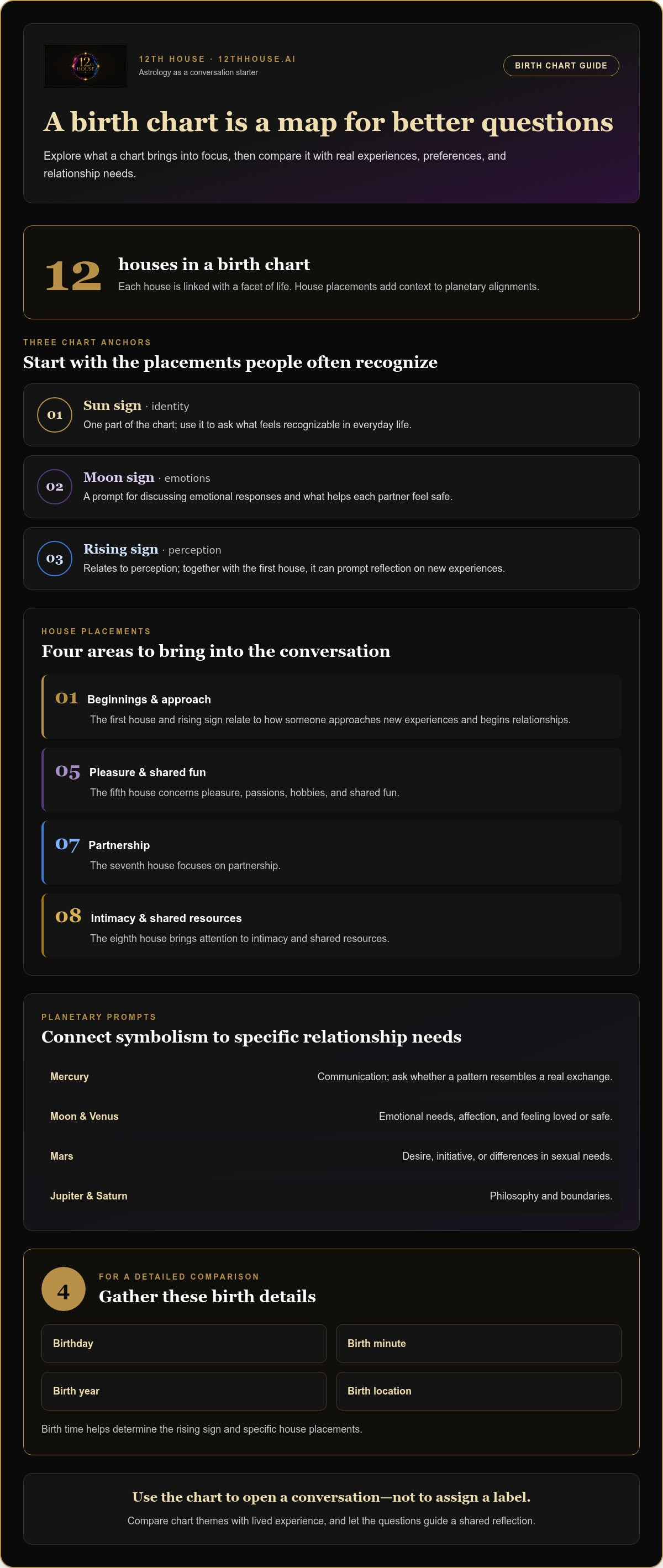
A birth chart maps planetary placements across 12 houses, each linked with a facet of life. The Sun sign describes identity, the Moon sign relates to emotions, and the rising sign concerns perception. Learning how to talk to your partner about astrology can begin with asking which chart descriptions feel recognizable in everyday life. That keeps the conversation grounded in personal experience.
House placements add context to planetary alignments. The first house and rising sign relate to how someone approaches new experiences and begins relationships. The fifth house concerns pleasure, passions, hobbies, and shared fun. The seventh house focuses on partnership, while the eighth brings attention to intimacy and shared resources. Use each house as a prompt about a real preference, such as how you like to spend time together.
Treat specific placements as prompts, not fixed personality labels. A Scorpio Sun, for example, points to one part of a chart, while the Moon describes another layer: emotional responses. If you discuss Mars, connect its symbolism to desire, initiative, or differences in sexual needs. Moon and Venus placements can prompt conversation about what helps each partner feel emotionally safe and loved.
Compare both charts, then choose one theme to discuss, such as communication, emotional needs, or how each of you approaches commitment. Mercury placements are associated with communication; Mercury in a fire sign is linked with more impulsive conversation. If you’re thinking about how to talk to your partner about astrology, ask whether that pattern resembles a specific exchange, then invite your partner’s perspective.
Birth time helps determine the rising sign and specific house placements. For a detailed comparison, gather each partner’s birthday, birth minute, birth year, and birth location. Discuss what the charts bring into focus rather than treating planetary alignments as instructions. A useful reading gives you specific questions to explore, such as what helps each person feel heard during conflict.
3. Exploring values, boundaries, and emotional support
Set astrology charts aside and name the values shaping your relationship. Each of you can write down what matters, then share a moment when an interest felt dismissed. For example, say, “When you laughed at my chart reading, I felt silly sharing something meaningful.” This explains the impact without labeling your partner as uncaring. Listening respectfully doesn’t require either person to adopt astrology.
Set a boundary around astrology-based advice by agreeing on when it’s welcome and when it isn’t. You might say, “I’m open to discussing chart themes, but I don’t want a placement used to make decisions for me.” Clarify which choices belong to each person and how flexible each boundary feels. Also name values you consider incompatible, such as honesty or shared responsibility.
If astrology comes into a disagreement, return to the specific decision and its real-world effects. Avoid raised voices, cursing, or threats. Pause if either of you can’t listen calmly. Then explain what hurt, ask your partner to describe their perspective, and agree on a way to listen. “Sorry you feel that way” can dismiss the concern, so describe what you understand and what you’ll do differently.
Emotional support also calls for clear language. Ask, “What helps when your feelings feel unwieldy: quiet company, practical help, or time alone?” Then explain what you need when you’re hurt and how you prefer to hear difficult feedback. One partner, for example, may want direct words, while the other needs a gentle opening. Agree on a signal to pause and a time to return to the discussion.
Use astrology to discuss these needs, not as a substitute for consent or accountability. If a chart interpretation conflicts with a stated boundary, honor the boundary. If you feel hurt, tell your partner what happened and what repair would help. What matters is whether both of you can listen, respect differences, and make choices together.
4. Compatibility as potential rather than certainty
A zodiac comparison can prompt a question, but it can’t decide who you should date or marry. Avoid stereotyping by treating each placement as a prompt: “Does this description fit your experience, or not?” A Scorpio placement, for example, doesn’t prove someone is jealous, secretive, or intense. Ask your partner how they see themselves, then listen to the answer.
Astrology offers a symbolic framework, not a verdict on a relationship’s future. No combination of personality types is destined to succeed or fail, and a study discussed in the article found no star-sign combination more likely to marry or remain married longer. Keep that distinction in mind so a chart doesn’t outweigh how you treat each other in daily life.
Mercury placements can suggest different communication styles, but you don’t need compatible Mercury signs to communicate well. Try a practical test: choose a recent misunderstanding and compare what each of you meant, heard, and needed. If one partner spoke quickly while the other needed time to process, agree on a pause and a clear time to return to the discussion.
Keep behavior accountable. If someone says, “I’m blunt because I’m an Aries,” separate the astrological explanation from its impact. You might respond, “Your honesty matters, and those words hurt. Can you tell me directly without insulting me?” A sign can offer context for reflection, but it doesn’t excuse disrespect, broken agreements, or ignored boundaries.
Before using a horoscope to make a relationship decision, name the real factors involved: trust, shared values, emotional safety, and each person’s choices. Ask whether the chart helps you notice a pattern or replaces a conversation you need to have. Then decide together what evidence from your actual relationship matters most.
For a structured way to examine chart placements and relationship themes, explore Astrology Birth Chart & Transit Analysis.
12Th House: Ask Lala AI Spiritual Guidance
12th House’s Ask Lala AI Spiritual Guidance offers a space to explore questions that arise while discussing astrology with your partner. Turn to it when you want to reflect on a chart pattern, clarify what you’re feeling, or shape a thoughtful question before bringing it into conversation.
For a closer look at planetary placements and timing, Astrology Birth Chart & Transit Analysis offers a chart-focused perspective. Tarot Readings and Numerology Reports provide other symbolic frameworks for personal reflection. Use these tools to organize your thoughts, not to make decisions for your partner or replace an honest conversation between you.
Visit 12th House to explore spiritual guidance that supports your own reflection.
Let the Conversation Become a Practice
The next step isn’t to settle whether your charts agree. Notice what happens when you make room for each other’s perspectives. Choose a question you’ve been avoiding, then approach it with curiosity and a willingness to listen. That’s how to talk to your partner about astrology in a way that supports connection instead of turning symbolism into a verdict.
If you want a reflective space before your next conversation, 12th House offers Ask Lala AI Spiritual Guidance, Astrology Birth Chart & Transit Analysis, and Tarot Readings. Use these tools to clarify your own questions and explore symbolic perspectives, while keeping decisions rooted in mutual respect and honest dialogue.
Explore astrology with 12th House, and take your next conversation one thoughtful question at a time.
Frequently Asked Questions
6 Types of astrological relationships: How do you and your partner match up?
A Sun-sign comparison can frame six sign relationships around your own sign, but it doesn’t capture the full chart. Make the exercise specific: each partner writes down one description that feels accurate and one that doesn’t. Compare your answers, then choose a real relationship question to explore, such as how you make decisions together. Your experiences are part of the interpretation.
How to discuss differing beliefs about astrology in a relationship?
Agree on how astrology fits into shared decisions before a disagreement arises. One partner, for example, might enjoy choosing a date using planetary timing, while the other prefers practical considerations. Decide together whether astrology is a personal reflection tool, a shared activity, or neither. That agreement gives you room to hold different beliefs without turning every choice into a debate.
How to talk to a partner who dismisses astrology as pseudoscience?
Ask what your partner means by “pseudoscience” before defending astrology. They may be questioning predictive claims or reacting to feeling judged by a horoscope. You can explain that astrology has personal meaning for you without asking them to treat it as scientific evidence. Then invite a specific conversation about what you find useful, such as reflecting on recurring choices.
How to talk about astrology respectfully when one partner is skeptical?
Keep the invitation optional and use plain language instead of chart terminology. Try, “Would you be open to hearing what this placement brings up for me?” If your partner declines, don’t treat that as a test of love. You can still discuss the underlying subject directly, such as needing more quiet time or wanting clearer plans for weekends.
Can astrology conversations improve communication in a relationship?
Yes, astrology can offer a shared prompt for discussing needs, as long as both partners can participate honestly. Use a chart interpretation to begin, then ask, “What would help you feel understood during a disagreement?” The practical value comes from listening and responding to the answer. If astrology distracts from the issue, set it aside and address the issue directly.


