

What if the most useful answer to “Will I get the job?” isn’t a yes or no? A will I get the job tarot spread can offer a clearer map of the situation: what you bring to the opportunity, what may be shaping the process, and where you still have agency. The cards can’t guarantee a hiring decision, but they can help you examine the question from more than one angle.
Waiting for an employer’s response can make every detail feel loaded with meaning. A single-card pull may seem too simple for a decision shaped by timing, fit, and factors you can’t see. This guide gives you a repeatable five-card layout and a grounded way to interpret each position, even if you’re new to tarot.
You’ll learn how to frame your question, lay out the cards, and read their symbols in relation to your application rather than as fixed predictions. Then you’ll turn the reading into practical next steps, such as preparing for a follow-up, reflecting on the role’s fit, or deciding where to focus your job search. Let the spread sharpen your perspective, not make the decision for you.
Key Takeaways
- Use the will I get the job tarot spread to explore distinct parts of your application instead of reducing a complex decision to a single yes or no.
- Give each of the five cards a focused position so its symbolism connects to a specific part of your question.
- Read supportive, challenging, or unclear cards in context. Their meaning depends on the position and your real circumstances.
- Translate a useful insight into one practical step you control, while leaving the hiring decision itself open.
- Continue your reflection with digital tarot guidance or personalized spiritual questions through 12th House.
What a Will I Get the Job Tarot Spread Can, and Cannot, Tell You
A job tarot spread is a structured layout for reflecting on an application, interview, or hiring question. Each card occupies a defined position, giving you a framework for considering a different part of the situation instead of treating a single symbol as a final verdict. Tarot has a long and varied history, including use in games and divination. This overview of the history of tarot cards offers useful context for the symbolic practice.
A job tarot spread is a tool for reflection, not a reliable prediction of an employer’s decision. The cards can’t reveal a hiring manager’s private thoughts, internal discussions, or final choice. They can, however, prompt you to examine your preparation, hopes, concerns, and options with more structure.
Waiting can make silence feel significant, but a delayed reply, a brief interview, or a strong intuitive impression doesn’t prove that you will or won’t receive an offer. Keep the distinction clear: a reading explores your perspective; the hiring process determines the outcome.
When to Use a Job Tarot Reading
Use a reading when you can name the question beneath the headline. You might pull cards after an interview to reflect on how you presented your experience, before applying to consider whether the role aligns with your priorities, or during a waiting period to identify what remains within your control.
Make the question specific. Instead of asking only, “Will I get the job?”, try, “What should I understand about my application?” or “What can I do while I wait for a decision?” A focused question gives each card a clearer interpretive function. The will I get the job tarot spread is most useful when it helps clarify an uncertainty, not when it becomes a substitute for action.
Keep practical steps in motion. Follow up professionally when appropriate, prepare for another conversation, and continue exploring suitable roles. A reflective reading can help you decide what to focus on, but it can’t send the follow-up email or keep your search active for you.
Why a Job Reading Is More Than a Yes-or-No Answer
Hiring is shaped by variables beyond your influence: the employer’s needs, the strength and experience of other applicants, budget, and timing. Even a well-qualified candidate can’t know how those factors will resolve. A yes-or-no answer can flatten that complex process into a certainty the cards can’t establish.
A spread creates room for a more useful inquiry. One card might invite you to recognize a strength you brought to the interview; another might surface a concern worth addressing, such as an unclear example in your application. A third could point toward a choice you can make, like preparing a concise follow-up or redirecting energy toward another opportunity. Treat these as prompts to test against real circumstances, not instructions to accept automatically.
Look for perspective, not confirmation of an offer. If a card feels encouraging, ask what concrete evidence supports that interpretation and what action would make sense either way. If it feels difficult or ambiguous, resist turning it into a rejection prediction. Let the reading sharpen your attention, then leave the employer’s decision where it belongs: outside the spread and outside your control.
How to Lay Out a Five-Card Will I Get the Job Tarot Spread
This five-card layout is one practical way to organize a career reading, not a universal tarot rule. Its structure gives each card a distinct role, so the reading becomes a focused reflection rather than five disconnected meanings. The will I get the job tarot spread works best when you treat the positions as prompts and relate them to what you know about the role and your application.
The Five Card Positions and Their Questions
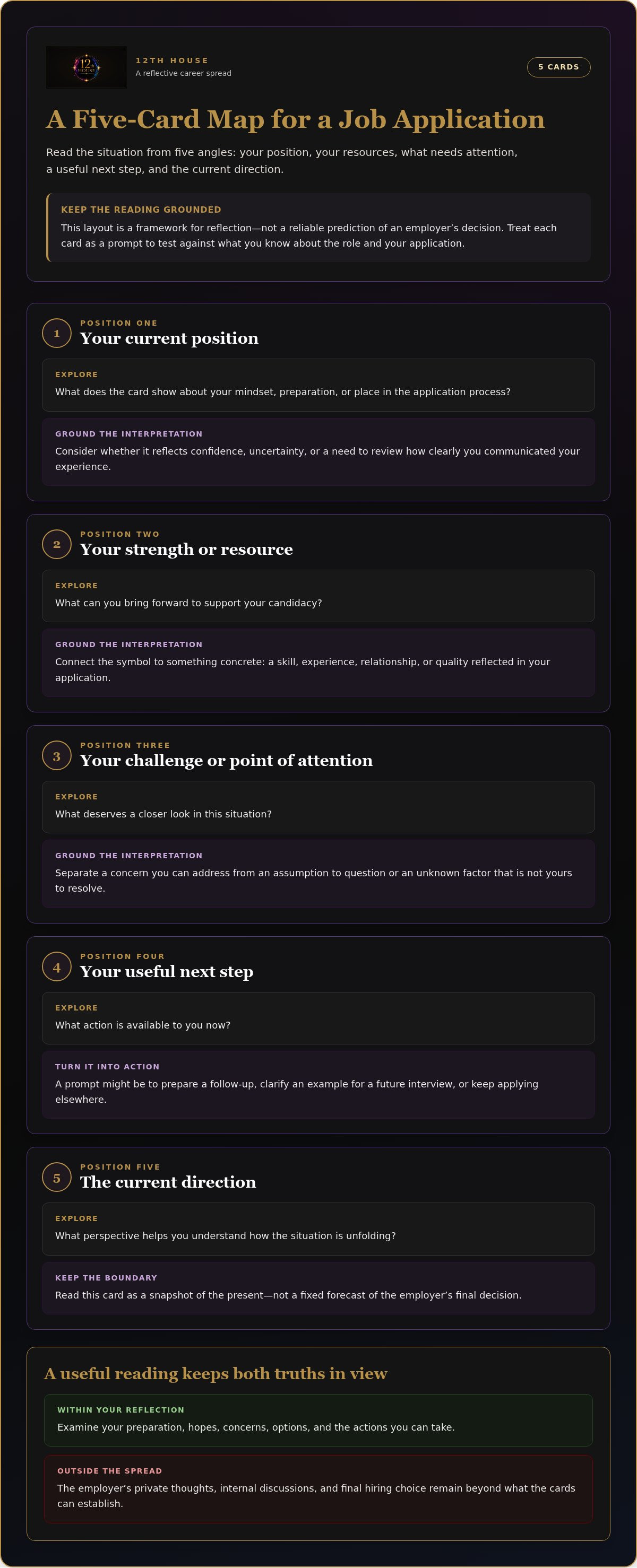
Lay the cards from left to right, drawing one card for each position. The sequence moves from your present perspective toward a useful response and the situation’s current direction. The five positions are your current position, your strength, your challenge, your next step, and the situation’s current direction.
- Your current position: What does this card show about your mindset, preparation, or place in the application process? It might reflect confidence, uncertainty, or a need to review how clearly you’ve communicated your experience.
- Your strength or resource: What can you bring forward? Consider a skill, experience, relationship, or quality that could support your candidacy, then connect the symbol to something concrete in your application.
- Your challenge or point of attention: What deserves a closer look? This could be a concern you can address, an assumption to question, or an unknown factor that isn’t yours to resolve.
- Your useful next step: What action is available to you now? The card might prompt you to prepare a follow-up, clarify an example for a future interview, or keep applying elsewhere.
- The current direction: What perspective helps you understand how the situation is unfolding? Read this as a snapshot of the present, not a fixed forecast of the employer’s final decision.
Prepare the Question and Draw the Cards
Choose a calm setting and settle on one clear prompt before shuffling. For example: “What should I understand about the current direction of my application, and how can I respond thoughtfully?” Write the question down. Keeping its wording visible helps you interpret the cards in relation to the same inquiry instead of shifting the question to fit each symbol.
Shuffle in a way that feels comfortable, focusing on the prompt. When you’re ready, draw five cards and place them left to right in the order above. If a card falls out while shuffling, you can return it to the deck. Consistency matters more than assigning special meaning to an accidental draw.
Decide before you begin whether you’ll read upright cards only or include reversals. Either approach can work. If you include reversals, use that approach for all five cards and record each card’s orientation. Note the question, card names, first impressions, and any real-world evidence that supports your interpretation. You can revisit these notes later without relying on memory to reshape the reading.
If you’d like a digital companion for your own interpretation, explore 12th House tarot readings as another way to reflect on a career question.
How to Interpret Job Tarot Cards Without Forcing a Yes or No
Begin with the card’s assigned position, not a memorized keyword. The same card can suggest a resource in one position and a concern in another. A card’s position and the circumstances around it shape its meaning. In a will I get the job tarot spread, symbolism becomes useful when it prompts a grounded question about your application, rather than a verdict about an employer’s choice.
Read Each Card Through Its Position
Read the position’s question first. Then notice the card’s imagery, suit, number, and your personal associations. Ask what detail catches your attention and how it might relate to what you already know, such as the experience you emphasized or a question the interviewer asked. A symbol can suggest a line of reflection, but it shouldn’t outweigh concrete information from the application process.
Use this as a flexible lens, not a scorecard. A supportive card can point to a strength worth expressing; a challenging one can highlight something to examine. An ambiguous card may reflect mixed feelings or limited information, rather than an outcome waiting to be decoded.
| Reading tone | Reflective interpretation |
|---|---|
| Supportive | Notice a resource, skill, or quality you can bring forward. Ask how it appeared in your application. |
| Challenging | Identify a concern or obstacle to consider. Separate what you can address from what you can’t control. |
| Ambiguous | Allow for incomplete information or more than one possible reading. Avoid filling the gap with a prediction. |
A difficult card doesn’t automatically mean rejection or failure. For example, if a card associated with scarcity appears in the strength position, it might prompt you to consider how resourcefulness or persistence supports your candidacy. In a challenge position, it could invite you to examine where you feel underprepared. Neither interpretation confirms what the employer will decide. Test each possibility against your actual experience.
Interpret the Spread as a Connected Pattern
Once you’ve considered each card separately, look across the layout. Repeated suits, recurring images, or contrasts between positions can suggest a shared theme. Several Swords cards, for instance, might invite attention to communication, analysis, or worry. Treat that pattern as a prompt to review how you’ve presented your thinking, not evidence of what an interviewer thinks.
Keep two columns in your notes: What the cards prompt me to consider and What I know from the application. The first may include a question about your confidence or a possible next move. The second might include the role’s stated requirements or feedback you received. Comparing the columns helps distinguish insight from assumption.
Resist cherry-picking only reassuring cards, and don’t let one unsettling image make a feared outcome feel inevitable. Weigh all five positions, including the practical next-step card. The spread can organize your reflection and reveal choices worth considering. It can’t establish whether an offer is coming.
After a Job Tarot Spread: Turn Reflection Into Action
A useful reading should leave you with something more solid than a feeling. Turn each insight worth keeping into one observable action you can take, then separate that action from the hiring result you can’t control. The will I get the job tarot spread can help you organize your thinking; it can’t confirm an offer or set the employer’s timeline.
Use a brief record to keep interpretation connected to evidence and follow-through:
- Card: Name the card and the position it occupies.
- Interpretation: Write what it suggests in relation to that position.
- Evidence: Note a real detail from your application, interview, or the role that supports or complicates the interpretation.
- Chosen action: Identify one specific step you’ll take, or state clearly that the matter is outside your control.
For example, if a card prompts you to revisit communication, review your interview notes and identify one answer you’d make clearer next time. That’s actionable. “The employer will call tomorrow” isn’t: it’s a prediction you can’t verify or control.
Build a Grounded Follow-Up Plan
Translate the reading into a small task list, not a demand to act on every symbol. If a card raises preparation, rehearse a concise example of your relevant experience. If it points to uncertainty, write down what you know and what remains unanswered. For follow-up, use the employer’s stated timeline and the tone of your previous communication to guide when and how you reach out.
Keep your search moving while you wait. Save roles that fit, tailor another application, or make time to speak with a professional contact. Continuing to apply isn’t a rejection of the reading; it’s a practical response to an outcome that remains uncertain. Let the cards inform your choices without treating them as confirmation that an offer is coming.
Use a Reading to Regain Perspective
Before making a major career decision, pause and journal about what the spread brought into focus. Did it reveal a priority you’d overlooked, a strength you want to communicate more clearly, or a concern that deserves a practical check? Compare the interpretation with your notes and the role’s actual requirements. A few lines of reflection can help you distinguish a considered choice from a reaction to waiting.
For broader tarot foundations that can support your own interpretive practice, explore Tarot Mastery: A Professional Guide to Spiritual Clarity. If you’d like a digital companion for a personalized spiritual question, explore 12th House tarot guidance as another point of reflection.
Continue Your Tarot Reflection With 12th House
A career reading can be one point in a longer practice of self-inquiry. The value isn’t in asking the same question until a preferred answer appears. It’s in noticing how your perspective changes as you take action, learn more about the role, or hear back from the employer. Let the cards help you organize those reflections while you remain the person making decisions.
Explore the Question Beyond the Spread
Return to your notes when something changes, such as receiving an interview invitation, getting feedback, or deciding that a role no longer fits. Instead of repeating the original question, identify what the new information brings up. You might ask what matters most to you in the next opportunity or what you want to communicate more clearly. This gives each reflection a distinct purpose.
Over time, a journal can reveal patterns that one reading can’t show. You may notice that certain concerns arise whenever you weigh stability against growth, or that your confidence shifts after you review your experience. Treat those patterns as material for consideration, not instructions. The cards can frame questions; your values, evidence, and circumstances guide the choice.
Choose a Digital Tool for Further Reflection
If you want to continue exploring a personal question, 12th House offers digital tarot readings and Lala, an AI assistant for personalized spiritual questions. These tools can complement your own interpretation, giving you another way to examine a theme or articulate what you’re seeking. For a wider perspective on AI-supported spiritual inquiry, read The Digital Sage: Why an AI Astrology Assistant is Your New Metaphysical Architect.
Keep your process intentional. Before seeking another reading, write down what has changed since your last reflection and what you hope to understand now. If nothing has changed, you may have enough to work with already. Your career choices don’t need to wait for a card to authorize them.
The will I get the job tarot spread is a starting framework, not a promise about what comes next. Use it to notice your priorities, clarify your questions, and stay attentive to the choices available to you. When you’re ready to continue that reflective practice, explore 12th House’s digital tarot and spiritual guidance tools at your own pace.
Carry Your Insight Into the Next Career Step
The question “Will I get the job?” may not have an answer you can access today. What you can choose is how to use this pause: decide what you want from your next role, keep your plans moving, and stay open to information as it arrives. Let the will I get the job tarot spread support that process without letting it make the decision for you.
A reading can be a point of reference, not a verdict. Return to your notes when something changes, and ask whether your interpretation still fits the facts and your priorities. If it leads to a practical step, take it. If it only creates pressure to predict the outcome, set the cards aside and focus on what’s in your hands.
To continue exploring a personal spiritual question, try 12th House’s digital tarot readings and metaphysical tools. Move forward with curiosity, clear judgment, and confidence in your ability to choose your next step.
Frequently Asked Questions
Can I do a will I get the job tarot spread before an interview?
Yes. A will I get the job tarot spread can help you organize your thoughts before an interview, as long as you don’t treat it as a forecast of the panel’s response. For example, if a card draws your attention to communication, choose a project story that shows how you solved a problem and practice explaining your contribution. Let the reading complement role research and preparation, not replace them.
How soon can I repeat a job tarot spread?
There’s no universal waiting period. Rather than drawing again right away, wait until something changes, such as an interview, a message from the employer, or a decision about whether to pursue the role. Before repeating the spread, write down what’s new and frame a different question. For instance, shift from asking about the application’s direction to asking what you want to clarify if you’re invited to a second interview.
Do I need to know tarot to use a job spread?
No. You can begin without memorizing card meanings. Look closely at the image, note the detail that stands out, and write down your first association before checking a guidebook. Then ask how that association relates to the card’s position and the job situation. For example, a card that suggests movement might prompt you to consider whether the role involves change or travel, rather than assuming it predicts a quick offer.
Should I use reversed cards in a job tarot spread?
Reversals are optional. Some readers use them to explore blocked, inward, or developing aspects of a card; others read every card upright and rely on the spread position for nuance. Choose your method before drawing so you don’t change the rules to fit a preferred answer. If reversals add confusion, leave them out. You can still explore complexity through the card’s imagery and its relationship to the rest of the spread.
What if the cards in my job reading seem contradictory?
Contradictory cards can point to competing priorities or different parts of the situation, rather than a single outcome. A card suggesting confidence in one position and uncertainty in another might reflect strong qualifications alongside nerves about a particular interview topic. Keep both observations in view. Instead of forcing them into a prediction, write down what each card asks you to consider and identify one question that would help you assess the real situation.
Can I ask tarot about a specific job offer instead of an interview?
Yes. Frame the question around your decision, such as what you need to consider before accepting the offer, rather than asking the cards to choose for you. You might use the reading to reflect on priorities like growth, stability, or work environment. Then compare those reflections with the offer’s actual terms and your circumstances. If something important remains unclear, gather the information you need before making a commitment.


