

What if decision paralysis isn’t proof that you’re bad at choosing, but a sign that you’re relying on a process that doesn’t work well for you? If you’ve wondered, “why can't I make decisions human design,” this system offers a different lens: your mind can compare options, while your Inner Authority points to how you may best process a choice.
It makes sense to want certainty, especially when a decision feels consequential or someone is pressing you to answer now. Human Design doesn’t promise perfect choices or remove uncertainty. It offers a framework for observing your own patterns, rather than treating every decision as a test you have to pass.
In this guide, you’ll learn how Human Design explains decision difficulty, what the seven Inner Authority types suggest about decision-making, and how to identify yours in your chart. You’ll also try a grounded experiment: use your Authority with one everyday choice, notice what happens, and reflect without judging the outcome. The aim isn’t to hand your choices over to a chart. It’s to build self-awareness and find a process you can test in real life.
Key Takeaways
- Explore why can't I make decisions human design through the system’s lens on choice, uncertainty, and decision paralysis.
- Learn how your BodyGraph is used to identify Inner Authority, a framework for exploring how you process decisions.
- Compare the Authority types and notice which decision cues may be useful to observe in your own life.
- Try a simple decision-making experiment that records your context and reflections without labeling choices as right or wrong.
- Use a Human Design Profile and Lala to explore chart details and ask follow-up questions, while keeping the decision in your hands.
Why Can’t I Make Decisions? Human Design’s Lens on Choice
You compare the options, make a list, ask someone you trust, then replay the choice again. What if you choose badly? What if there’s a better option you haven’t considered? If you’re asking, “why can't I make decisions human design,” start by separating the experience of feeling stuck from the explanation you may give it.
Decision paralysis is everyday language for getting so caught up in weighing options, seeking certainty, or fearing regret that choosing becomes difficult. It can show up in a low-stakes moment, like deciding what to order, or around a consequential choice, such as changing jobs. The more pressure you put on finding the perfect answer, the harder it can be to hear what you actually prefer.
How too many choices can create decision inertia
Indecision often has several moving parts. You might be balancing practical needs with family expectations, comparing imperfect options, and imagining the cost of each mistake. Even a manageable choice can feel immovable when every factor seems equally urgent. That hesitation doesn’t mean one chart feature explains your choices or that something is wrong with you.
Some uncertainty is ordinary. If distress around decisions is persistent, intense, or interfering with daily life, a spiritual framework isn’t a substitute for support from a qualified mental health professional. Human Design can be a tool for reflection, not a way to diagnose the cause of distress.
What Human Design means by decision-making Authority
Human Design uses the term Inner Authority for a decision-making process associated with a person’s chart. Within the system, different chart configurations are linked to different cues, such as waiting for emotional clarity or noticing a responsive gut feeling. These are concepts to explore, not instructions that override your circumstances or personal judgment.
The Human Design system combines ideas from several traditions into a symbolic framework. Its chart can provide a structured language for noticing patterns, but it isn’t a clinical instrument or a proven method for predicting which choice will work out. Treat Authority as a hypothesis to test against your lived experience, not an objective verdict.
A useful starting point is to notice what happens before you commit. Do you keep gathering opinions because you want someone else to remove the risk? Are you trying to decide at the height of excitement or worry? Or have you already sensed a preference, then talked yourself out of it? These observations won’t diagnose your decision pattern. They give you specific details to compare with the Authority described in your chart.
This article will help you identify that chart-based process and try it with a real decision. Choose a manageable situation, observe the cue your Authority describes, and record what you notice. Don’t grade the result as correct or wrong. The aim is to learn whether this framework helps you understand your decision habits while keeping responsibility for the choice firmly with you.
How Human Design Connects Your BodyGraph to Inner Authority
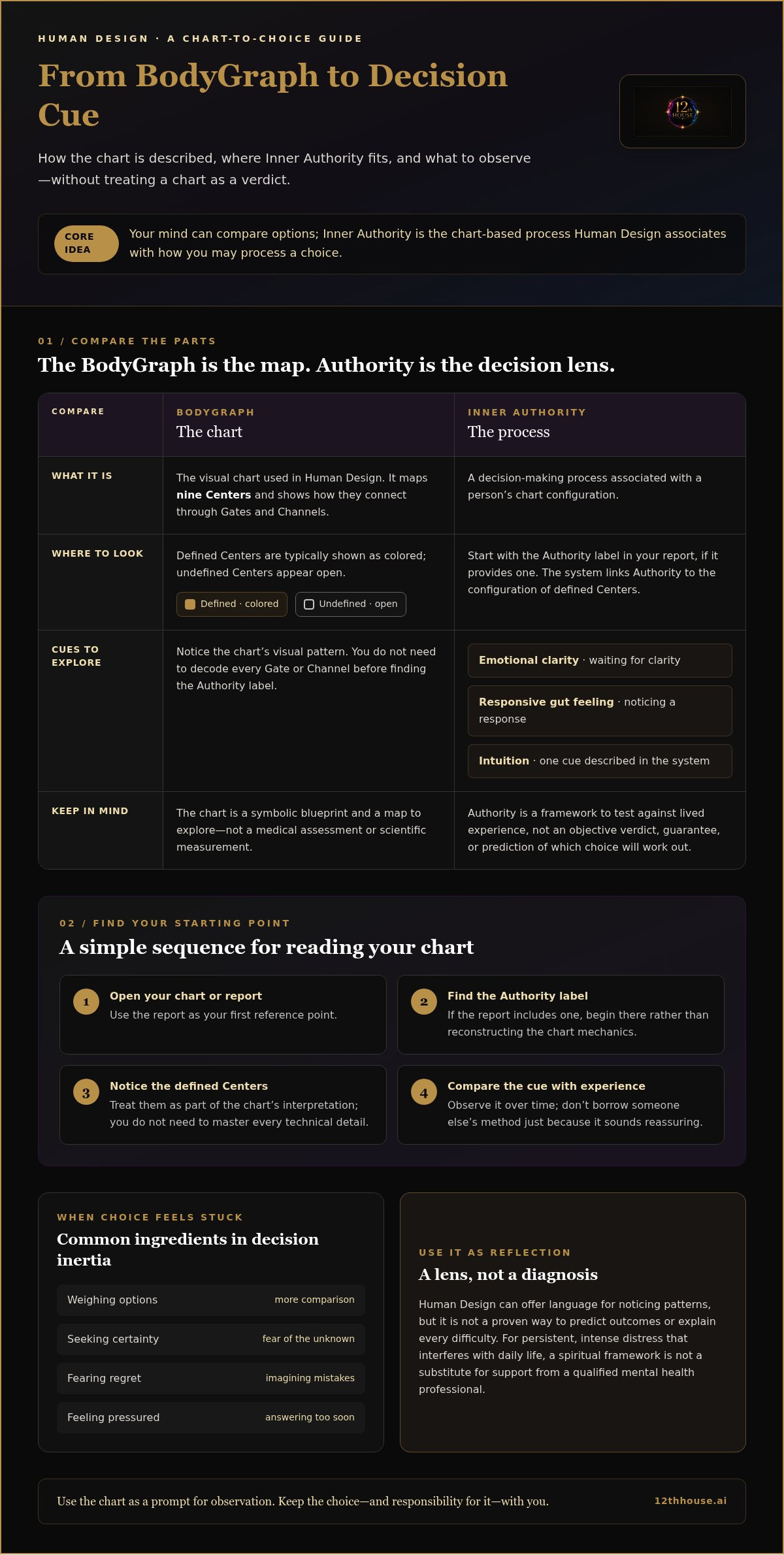
Your BodyGraph is the visual chart used in Human Design. It maps nine Centers and shows how they connect through Gates and Channels. Within the system, these patterns are interpreted as a symbolic blueprint, not as a medical assessment or scientific measurement. Its practical purpose here is to give you a map to explore, not a verdict about who you are or what you must choose.
Human Design links Inner Authority to the configuration of defined Centers in a chart. In this system, the pattern of defined Centers is used to assign an Authority and its associated decision cues. That chart-based interpretation is one reason the answer to “why can't I make decisions human design” isn’t a single rule that applies to everyone.
Where to find Inner Authority in a Human Design chart
Start with the report itself. If it includes an Authority label, use that as your first reference point. Then look at the BodyGraph’s Centers: defined Centers are typically shown as colored, while undefined Centers appear open. You don’t need to decode every Gate or Channel before finding the label. A Human Design chart guide can help you become familiar with the visual structure as you explore your own chart.
Personalized charts are generated from birth details, so enter your information carefully and use the details you trust. If your report already provides an Authority, begin there rather than trying to reconstruct its mechanics from scratch. A Human Design Profile can also bring chart information together in a form you can review at your own pace.
Why one decision method does not fit every chart
Human Design describes multiple Authorities, each associated with a different process. One person’s chart may point toward waiting for emotional clarity; another’s may emphasize a responsive gut cue or a moment of intuition. For a deeper overview of the different approaches, explore understanding your Inner Authority. The key is to identify the label that applies to your chart, not borrow someone else’s method because it sounds reassuring.
Use this simple sequence to orient yourself:
- Open your Human Design chart or report.
- Find the Authority label, if the report provides one.
- Note the defined Centers as part of the chart’s interpretation, without trying to master every technical detail.
- Read the decision cue associated with that Authority, then compare it with your experience over time.
A chart label offers a framework for reflection, not a guarantee of certainty or a promise that a particular choice will work out. Keep your circumstances, values, and practical responsibilities in view. If you want to explore your chart details in a structured way, a Human Design Profile can serve as a reference point; the interpretation and the decision remain yours.
Human Design Authority Types: Compare the Decision Cues
Human Design doesn’t give everyone the same decision rule. Its seven Authority types describe different cues to observe, from allowing emotional clarity to emerge to noticing an immediate intuitive response. Use the comparison below as a first orientation, then follow the Authority shown on your chart. If you’re asking “why can't I make decisions human design,” this distinction matters: a cue that fits one chart may not fit yours.
| Authority | Human Design cue | Reflective practice |
|---|---|---|
| Emotional | Clarity develops over time across an emotional wave. | Revisit the choice when your emotional intensity has shifted; avoid deciding at a high or low. |
| Sacral | A response to something concrete, often described as a gut response. | Notice your response to a clear option or question without forcing a signal. |
| Splenic | An immediate, quiet intuitive cue in the moment. | Notice what arises initially, then reflect on whether you’re adding fear or analysis afterward. |
| Ego | Willingness or desire may be central to the decision process. | Ask what you genuinely want or feel willing to commit energy to. |
| Self-Projected | Your perspective may become clearer as you speak and hear yourself. | Talk through the choice and listen for what sounds aligned with you. |
| Mental | Reflection with a sounding board or in a fitting environment. | Talk through the options with someone who can listen without deciding for you. |
| Lunar | A longer-cycle process of observing a decision over time. | Use your chart’s guidance to explore how this process applies to you. |
Emotional, Sacral, and Splenic Authority
Emotional Authority is not a demand to wait until every feeling disappears. Human Design describes an emotional wave, so the practice is to give significant choices time and notice whether your perspective changes. Sacral Authority is framed as response: it’s about noticing a reaction to what’s in front of you, not manufacturing a sensation. Splenic Authority, by contrast, is described as an immediate intuitive cue. These are distinct ideas, not interchangeable versions of “trust your gut.”
Ego, Self-Projected, Mental, and Lunar Authority
Ego Authority is associated with willingness or desire, not simply choosing whatever feels easiest. Self-Projected Authority involves speaking and hearing your own perspective. Mental Authority uses reflection with a sounding board; thinking aloud is not a universal rule for every Authority. The other person’s role is to listen, not make the choice. Lunar Authority is described as a longer-cycle process. Check your chart for how that label applies rather than borrowing another person’s instructions.
These cues are prompts for observation, not guarantees of certainty or correct outcomes. Start with your chart’s Authority, then note what the process feels like in an ordinary decision. You don’t need to force a signal or treat a moment of hesitation as proof that you’re using your chart incorrectly.
A Practical Human Design Experiment for Your Next Decision
Use your Authority as a prompt for observation, not an order to obey. To explore “why can't I make decisions human design” in your own life, test the process with a reversible, low-stakes choice first. The aim is to notice how you decide, not to prove the chart right or force certainty.
Test the process on a low-stakes choice first
Choose something ordinary, such as what to cook or which free-evening activity to try. Avoid starting with a major relationship, financial, health, or career decision. Then move through these steps:
- Define the choice. Write the question in one sentence, such as, “Do I want to take a walk or stay in and read?”
- Name the stakes. Note what could realistically happen and whether the choice is easy to change later.
- List what you know. Record the options and any practical information still missing, such as the weather, time available, or cost.
- Consult your chart. Find the Authority cue associated with your chart. Use it as a reflection prompt, not an instruction or prediction.
- Observe and record. Note the context, the cue you noticed, what you chose, and what influenced the choice.
Keep real-world factors in the picture. A symbolic cue doesn’t replace a deadline, safety consideration, budget, or responsibility to another person. If a decision is urgent or high-stakes, prioritize reliable information and appropriate professional advice. Human Design can sit alongside that information; it shouldn’t displace it.
Review what helped without demanding certainty
Afterward, write a brief reflection. Did waiting help you notice a change in perspective? Did responding to a clear option feel useful? Did speaking aloud help you hear your own priorities? Record what happened without scoring the decision as correct or wrong. A choice can be thoughtful even when circumstances don’t unfold as hoped.
Separate the process from the outcome. For example, if you chose an activity and later the weather changed, that doesn’t automatically mean your decision cue failed. Ask instead whether the experiment helped you identify what mattered, notice outside pressure, or stop circling the same options. Those observations are the data you’re gathering about your own habits.
If the exercise creates pressure, confusion, or a reason to postpone indefinitely, adjust it. Make the question smaller, use the chart language more lightly, or pause the experiment. The framework should support reflection, not become another test you can fail. Repeat with different everyday choices only if it remains useful, and let your notes reveal patterns over time rather than drawing conclusions from one result.
To explore the chart details behind your experiment, review a personalized Human Design Profile and use it as a reference, while keeping the final choice yours.
Use Your Human Design Profile to Explore Decision Patterns
A chart label can point you toward a question, but it can’t explain every choice in your life on its own. A personalized Human Design Profile gives you a way to review chart details related to Authority and consider how they may connect with your experiences. Treat it as a reference for exploration, not a verdict about your character or a promise that decisions will become effortless.
Turn a chart label into a useful question
Start with one pattern, not every chart detail at once. If your report names an Authority, ask: “What does this process mean in my chart, and how might I notice it in a specific decision?” Then compare the idea with your own observations. Does it help you identify what you value, or does it add pressure to find a particular cue? Keep the question open. Your experience matters more than making yourself fit a label.
For example, if you tend to revisit choices, explore that pattern in one context, such as choosing how to spend free time. Notice what influences you: a need for more information, concern about others’ expectations, or a cue described by your Authority. Avoid collecting more chart labels as a substitute for applying one idea. The useful insight is the one you can examine in real life while preserving your judgment.
Continue exploring with 12th House
12th House offers Human Design Profiles, Lala for personalized questions about metaphysical topics, and membership access to a metaphysical library and personalized data rooms. These resources can support self-guided study: review a chart detail, look up a concept, then ask a focused follow-up question. For a closer look at AI-guided metaphysical learning, read the AI astrology assistant guide.
Lala can help you explore what a term means or how an Authority concept is described within Human Design. It doesn’t make the decision for you. You remain responsible for weighing practical facts, personal values, and the needs of anyone affected by your choice. If you’re still wondering “why can't I make decisions human design,” use the chart to develop a question for reflection, not to demand certainty from yourself.
Keep the process simple: return to one chart detail, connect it to one decision pattern, and note what you learn. Explore 12th House as a self-guided resource for continuing that inquiry at your own pace. The value lies in thoughtful exploration, not in expecting a chart or tool to guarantee the right outcome.
Let Your Next Choice Become an Experiment
You don’t need to solve every decision pattern before making your next choice. Pick one small decision and approach it with curiosity: What information do I need? What pressure can I set aside? What does my own process reveal? If you’re still asking “why can't I make decisions human design,” let the question open an inquiry rather than become a judgment about yourself.
Keep your agency at the center. A Human Design chart can offer language for reflection, but it can’t guarantee certainty or choose on your behalf. Use what resonates, question what doesn’t, and stay attentive to practical realities. Progress may look less like never hesitating and more like meeting hesitation with a little more awareness.
If you’d like a self-guided space to continue, explore Human Design Profiles, ask Lala personalized questions about metaphysical concepts, or learn through the membership library. These resources can support your inquiry while the decisions remain yours. Explore 12th House’s Human Design tools and resources, and take the next step at your own pace.
Frequently Asked Questions
Can Human Design help me make decisions?
Human Design may help you examine how you approach choices, but it can’t guarantee an outcome. Treat its concepts as prompts for self-reflection, not rules. For example, after deciding whether to accept a social invitation, you might note what influenced you: genuine interest, a wish to please, or concern about missing out. If you’re searching “why can't I make decisions human design,” use the framework to observe your habits, then make your own call.
What if I cannot find my Inner Authority in my Human Design chart?
Look for an Authority label in the chart summary or report before trying to interpret the visual chart yourself. If the label is missing or unclear, avoid guessing from a single Center; the system interprets the BodyGraph as a whole. Check that the birth details entered match the information you intended to use. If you still can’t locate the label, pause and explore the chart later rather than applying a decision method at random.
Does Human Design mean I should ignore logic when making decisions?
No. Keep facts and reasoning in the process. For example, before accepting a job offer, compare the role, compensation, commute, and written terms. You can then use an Authority concept as a separate reflection prompt, such as noticing whether you feel rushed or need time to consider. For medical, legal, financial, or safety decisions, use reliable information and appropriate qualified advice. A chart shouldn’t replace evidence or professional guidance.
Should I wait before making every decision if I have Emotional Authority?
No. The time you allow can depend on the decision’s impact and deadline. Choosing what to eat for lunch doesn’t call for the same process as signing a lease. With a consequential choice, take reasonable time to review the terms and notice whether your perspective shifts, while keeping the actual deadline in view. If waiting would create a serious practical problem, prioritize the information and timing the situation requires.
Can my Human Design Authority change over time?
In Human Design, Authority is derived from the chart calculated using birth information, rather than treated as a mood that changes with each decision. Your interpretation of its terms may develop as you learn and reflect. If two charts show different Authorities, compare the birth details and chart information you used before drawing conclusions. A change in understanding doesn’t necessarily mean the decision process assigned by the chart has changed.
Is Human Design a scientifically proven way to make decisions?
No. Human Design is a spiritual and self-reflection framework, not an established scientific method for predicting which decision will succeed. You can still evaluate whether its language helps you notice a preference or examine your timing, but personal usefulness doesn’t demonstrate universal validity. Keep practical evidence central, and don’t use a chart to replace qualified support for consequential matters. You’re free to test an idea, keep what serves you, and set aside the rest.


