
An online astrology prediction can miss the mark when birth details are incomplete, the reading relies on broad, prewritten interpretations, or individual chart factors aren’t considered together. Understanding why online astrology can be inaccurate starts with one key distinction: astrology describes tendencies and themes, not certain future events. Even a difference of a few minutes in birth time can change the ascendant and house positions in a chart.
It’s reasonable to expect a personal reading to feel specific, especially when it addresses relationships, work, or an important decision. But a familiar-sounding prediction isn’t necessarily precise. The method behind the reading, the details used to calculate the chart, and the way its symbols are interpreted all shape the result.
This article explains how automated readings and general horoscopes can lose nuance, why accurate birth information matters, and how chart structure affects interpretation. You’ll also learn to use astrology as a framework for reflection and direction while keeping your own judgment central to important choices.
Key Takeaways
- Read predictions as interpretations of chart patterns, not fixed outcomes; the same planetary period can play out differently for different people.
- Look beyond an app’s polished wording: automated interpretations may miss the context and chart relationships that make a reading personal.
- Accurate birth details support chart calculations, while interpretation still depends on how the chart’s elements are considered together.
- Use astrology to explore recurring themes and clarify questions, while keeping practical judgment central to important decisions.
- Notice when broad statements feel uniquely precise; reflection, selective memory, and confirmation bias can shape how a prediction resonates.
Why do astrological predictions fail at times?
Astrology predictions interpret planetary placements and transits, but readings vary with chart structure and interpretation. A prediction may describe a theme without reliably identifying a specific real-world event or personality.
Generic and Personalized Readings
A generic reading uses broad sign-based language, while a personalized reading interprets an individual birth chart and its connected factors. The distinction matters because one Sun sign cannot represent every placement or life circumstance.
People with the same zodiac sign can have different personalities and experiences because their charts include more than their Sun signs. Different Moon signs, ascendants, houses, and planetary aspects, for example, create distinct symbolic patterns.
A daily horoscope written for everyone with one sign has little personal chart context. A tailored reading can consider birth placements, current transits, and the question being explored. Even so, astrologers may weigh the same placements differently, particularly when they prioritize different themes or interpret symbolism through different traditions.
That variation helps explain why one astrologer may emphasize career timing while another focuses on relationships. Compare the reasoning and chart factors behind each interpretation, not just its headline prediction.
Biases and Vague Horoscope Wording
The Barnum effect helps explain why people may treat general descriptions as uniquely personal; confirmation bias can reinforce that impression. A resonant sentence can feel like evidence even when it applies to many readers.
Vague horoscope wording leaves room for readers to supply their own details. A line such as “a change at work may test your confidence” could fit a new project, a difficult conversation, or a routine shift. The prediction can feel specific when a reader connects it to a remembered event.
Confirmation bias draws attention to matches and gives less weight to misses. If a reading mentions both opportunity and tension, a reader may recall the opportunity and overlook the tension. To assess a prediction, identify its claim, timeframe, and what outcome would count as a miss. A statement that fits any result is difficult to test.
Prediction Methods and Their Limits
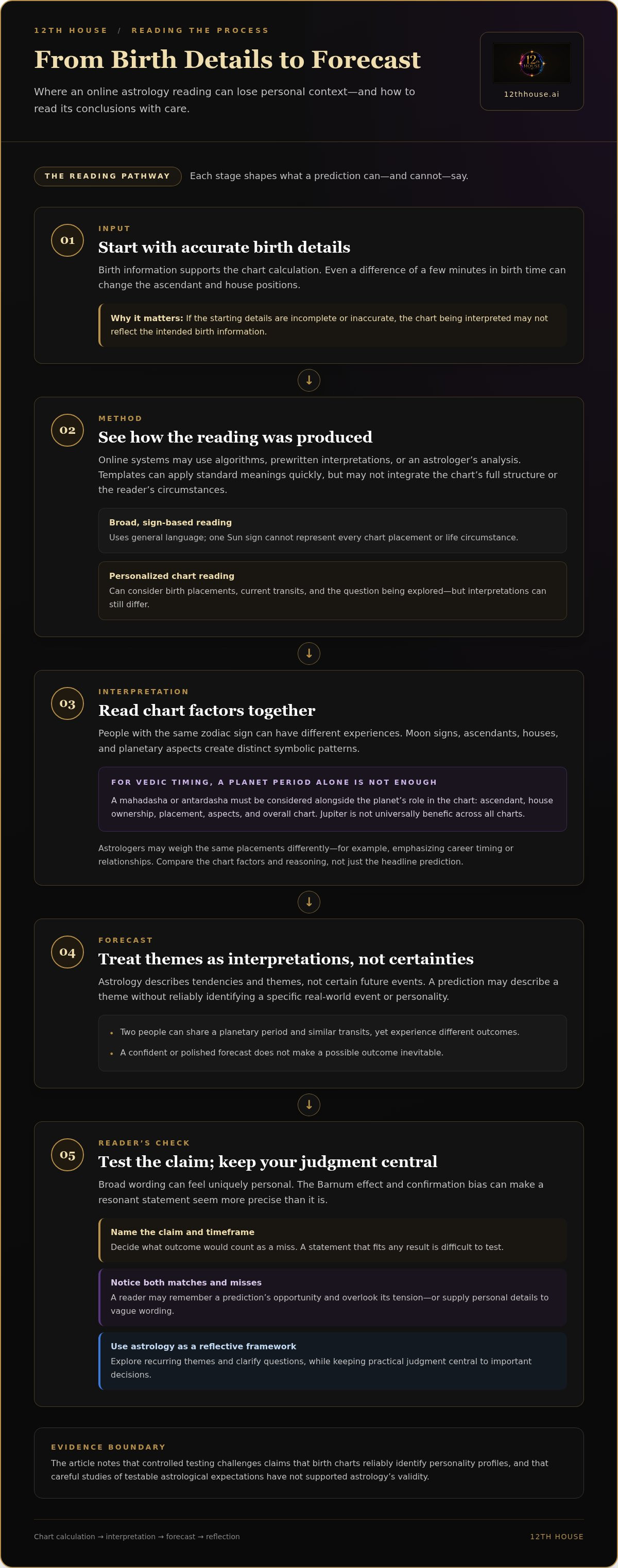
Online astrology systems may generate predictions using algorithms, prewritten interpretations, or astrologers’ analysis. The method matters: templates can apply standard meanings quickly but may not integrate the chart’s full structure or the reader’s circumstances.
In Vedic astrology, a common error is treating a planet’s mahadasha or antardasha as sufficient evidence for an outcome. A planet’s role also depends on the ascendant, house ownership, placement, aspects, and the overall chart. Jupiter, for example, isn’t universally benefic across all charts.
Misreading even one factor can shift the narrative. Two people can share a planetary period and similar transits, yet experience different outcomes. Controlled testing also challenges claims that birth charts reliably identify personality profiles. Carlson’s double-blind astrology test appeared in Nature, 318:419-425; careful studies of testable astrological expectations have not supported astrology’s validity.
These limits help explain why online astrology can be inaccurate: chart calculation, interpretation, and prediction are separate steps. Examine each rather than treating a confident forecast as a settled event.
Online Astrology: Is It Safe Or Not?
Online astrology’s safety depends on its interpretation, data practices, and the decisions you make afterward. A useful reading clarifies a question without taking control of your choices.
Some astrology apps use algorithms and prewritten interpretations to turn chart placements into predictions. This can make readings quick, but a template may not account for a person’s circumstances or the details behind a question about work, relationships, or change. Other readings involve astrologers, whose interpretations can still differ because astrology relies on symbolic judgments rather than one universally applied method.
Paid online astrology readings can make unsupported or misleading claims; paying doesn’t establish a prediction’s accuracy. In the US, consumer protections may apply to deceptive commercial claims, but protections and available remedies depend on the claim and circumstances.
Personalization starts with context. A prediction about a career shift means little without knowing whether you’re considering a new role, returning to work, or building skills. A responsible reading should distinguish symbolic interpretation from verifiable fact, explain the reasoning behind its conclusions, and avoid presenting a possible outcome as inevitable. Be cautious of language that pressures you to act quickly or treats fear as proof.
Privacy deserves as much attention as interpretation. An astrology app may request birth details, an email address, or access to device features. Some apps may use personal information for targeted advertising or share it with third parties. Before entering details, review the app’s privacy policy and terms, limit information to what the reading needs, and disable permissions you don’t use. If an app doesn’t explain its data practices, you have less information to judge how it handles your details.
Preparing can make a reading more useful without determining its outcome. Name the question you want to explore, separate known facts from assumptions, and decide what kind of reflection would help. For example, ask what patterns might shape a job decision rather than asking an app to guarantee a specific offer. Clear questions give an astrologer or algorithm a more defined focus, but they don’t make a symbolic interpretation certain.
Keep your agency in the foreground. A reading can offer language for examining possible outcomes, but your actions, circumstances, and other people’s decisions also shape what happens. Use astrology as one reflective lens, not a replacement for practical planning or professional advice about serious health, legal, financial, or mental health concerns. For a structured way to explore a personal question, consider online spiritual guidance as a prompt for reflection, not a substitute for your judgment.
Accurate birth information and horoscope calculations
A birth chart is calculated from birth date, time, and place, then interpreted through a particular astrological system. Errors in those inputs can alter the chart itself, while interpretation shapes what its patterns are understood to mean.
Birth Details and Chart Calculations
Birth details provide the coordinates for a chart, so their accuracy matters to the calculated placements. Online astrology apps use birth date, time, and birthplace to generate charts and predictions.
A difference of a few minutes in birth time can change the ascendant and house positions. In Vedic astrology, exact birth details are also needed to determine the Moon sign. If you’re unsure of the recorded time, a chart calculated from an estimate may produce different house placements than one based on the exact time.
Online Kundli calculations are usually accurate when the entered birth information is correct, but calculation and interpretation are distinct. Correct inputs establish the chart’s framework; they don’t ensure that every astrologer will weigh its placements in the same way.
Automated Horoscope Accuracy
An automated horoscope applies software calculations and stored interpretations to chart information. This can produce consistent calculations, but a reading’s usefulness depends on both the entered details and how its text connects chart factors.
For example, a career-change prediction may draw on one placement without explaining how other houses or current transits affect the interpretation. A relationship forecast may describe compatibility patterns yet leave out emotional nuance and individual personality. Treat each forecast as an interpretation of selected chart factors, not a complete account of your circumstances.
Birth information can influence readings about love, career, and finances because each topic is interpreted through relevant chart placements and houses. A relationship reading, for instance, may describe patterns in connection, but it can’t capture every interaction between two people. Career readings may highlight themes or favorable periods, while choices, skills, and workplace conditions shape the outcome.
Financial predictions need similar care. A chart may frame tendencies around security or risk, but it can’t replace a budget, current financial information, or practical planning. If an automated forecast offers a definite outcome without explaining which placements support it, look for the reasoning rather than relying on its confident tone.
To make a reading more useful, enter the most accurate date, time, and birthplace available, then note which details are exact and which are estimates. Compare the chart’s calculated placements with the interpretation. This distinction can show whether a mismatch begins with the chart inputs or with the meaning assigned to them.
Astrology as guidance rather than certain event forecasting
Astrology is most useful as a symbolic framework for examining tendencies, potentials, and limitations. A birth chart can offer perspective on recurring patterns, but it doesn’t establish a fixed event calendar. A reading might identify a period for reassessing career priorities, for example, without proving that a particular job offer will arrive. This distinction keeps interpretation separate from certainty.
Consider a career question. An astrologer might examine the 10th lord when exploring a possible job change, then interpret its condition within the whole chart. That analysis can frame themes around ambition, responsibility, or timing. It cannot establish that a specific employer will make an offer. Interviews, qualifications, available roles, and personal decisions also shape the outcome.
The same boundary applies to relationships. A chart reading can describe patterns of connection, tension, or compatibility. It can’t determine another person’s choices or settle whether a relationship will last. Treat the interpretation as a prompt: Which dynamic feels familiar? What conversation or boundary could change the pattern? Those questions turn symbolic language into reflection and action.
Use a prediction by turning it into a question you can examine. If a reading highlights financial caution, review spending habits and upcoming obligations rather than treating a loss as inevitable. If it suggests a favorable period for career growth, identify practical steps such as updating a résumé or pursuing training. The chart offers a lens; planning provides the structure.
Astrology’s symbolic method also limits how its claims should be presented. It isn’t universally accepted as science, and broad interpretations don’t function like verified forecasts. A specific claim about marriage, a diagnosis, or a market outcome requires evidence beyond planetary symbolism. Keep medical, legal, and financial decisions grounded in qualified advice and real-world information.
Personal agency remains central. Two people can encounter similar astrological themes and respond differently through their choices, effort, relationships, and circumstances. A transit described as challenging could prompt one person to revise a plan and another to carry on unchanged. Neither response is inevitable. The reading offers a perspective for considering options, not a command to follow.
That perspective is strongest when an interpretation names its limits and explains its reasoning. Ask which chart factors support a theme, what practical choices remain open, and what evidence outside astrology matters. For example, weigh a career reading alongside your skills, workplace conditions, and goals. Treat astrology as one tool for self-understanding, while letting lived facts guide consequential decisions.
How do the Barnum effect and confirmation bias make astrology seem accurate?
The Barnum effect describes how broad descriptions can feel uniquely personal. A horoscope might say, “You value connection but need time alone.” Many people recognize both tendencies, then connect the wording to a recent moment with a friend or family member. The statement feels precise because the reader supplies the personal details it leaves open.
Confirmation bias shapes what happens next: people notice evidence that supports a belief and discount details that challenge it. If a forecast predicts opportunity and tension, someone who receives a job offer may remember the opportunity more clearly than an unresolved conflict. The prediction then seems accurate, although only part of its message matched events.
Astrology readings often use themes such as change, confidence, intimacy, or responsibility. These themes matter, but they appear across everyday life. “A conversation could shift your perspective” might fit a partner’s comment, a manager’s feedback, or a friend’s advice. A reader’s current concern guides which event feels like the forecast’s intended meaning.
Selective memory can reinforce this effect over time. Someone may recall a horoscope that seemed to describe a difficult Monday but forget several readings that didn’t match the week. Sharing a striking prediction with a friend can strengthen the memory, while an unremarkable miss rarely gets discussed. Repeated exposure makes memorable matches easier to recall than misses.
Pattern recognition adds another layer. People naturally connect events and look for meaning, especially during uncertainty. If a reading mentions “new responsibilities” before someone starts managing a project, the sequence can feel significant. Yet the phrase may also fit caregiving, household tasks, or a change in routine. Timing and interpretation help create the perceived connection.
Test a prediction by writing down its exact wording before events unfold. Record the timeframe, the outcome it claims, and what would count as a mismatch. For example, replace “career change is coming” with a defined claim about a specific work event and period. Later, compare your record with what actually happened, including details that didn’t fit.
This method doesn’t require dismissing astrology. It separates a useful prompt for reflection from a claim treated as proof. Ask whether a reading gives clear criteria, whether several outcomes could fit its wording, and whether you’re remembering misses as carefully as matches. To explore chart themes with a more structured interpretation, explore Astrology Birth Chart & Transit Analysis.
12Th House: Ask Lala AI Spiritual Guidance
12th House offers Ask Lala AI Spiritual Guidance for exploring personal questions through a reflective, metaphysical lens. Turn to it when a prediction leaves you seeking perspective, or when you want to examine a theme without treating it as a fixed outcome. For chart-specific questions, Astrology Birth Chart & Transit Analysis offers a focused way to explore birth-chart placements and transits. Tarot Readings and Numerology Reports provide other symbolic frameworks for reflection.
Bring a clear question, such as which recurring pattern you want to understand or which choices deserve closer attention. Use the response to organize your thoughts, compare interpretations with lived experience, and keep practical judgment central. Guidance can open a line of inquiry; your decisions remain yours.
Visit 12thhouse.ai to explore Ask Lala AI Spiritual Guidance.
Use Astrology as a Starting Point for Your Next Question
Let a reading open a question, not close the case. When you consider why online astrology can be inaccurate, the next step is deciding what kind of insight would actually help. Are you looking for a deeper chart interpretation, a new symbolic perspective, or space to reflect on a recurring concern?
12th House offers Ask Lala AI Spiritual Guidance, Astrology Birth Chart & Transit Analysis, and Tarot Readings. Each can support a different kind of exploration, from chart-based themes to a focused reflective prompt. Bring your curiosity, keep your judgment active, and choose the lens that fits the question you’re holding.
Explore spiritual guidance from 12th House, and take your next step with clarity and intention.
Frequently Asked Questions
Astrology: Is it scientific?
Astrology is a symbolic system, but it isn’t universally accepted as science. Scientific claims need clear methods and results that can be tested and independently checked. A personal reading may feel meaningful as reflection, but that resonance alone doesn’t establish that planetary positions cause or predict events. Keep the categories distinct: symbolism can support meaning-making, while scientific conclusions require evidence that meets testable standards.
Does astrology involve the scientific community?
Researchers have examined astrological claims, but studying a claim doesn’t establish it as scientifically valid. For example, S. Carlson conducted a double-blind test of astrology, published in Nature, volume 318, pages 419-425. This kind of work applies controlled methods to specific claims. It differs from interpreting a chart for personal reflection, which relies on symbolic frameworks and subjective judgment.
Does astrology rely on evidence?
Astrology readings rely on chart calculations and interpretive traditions; this isn’t the same as empirical evidence that predictions work reliably. A personal anecdote, such as a horoscope seeming to fit a relationship event, can illustrate an experience but can’t establish a general rule. To evaluate a claim, look for clearly defined outcomes, recorded misses as well as matches, and results others can independently assess.
Does astrology use testable ideas?
Astrology can be tested when it makes a specific claim with a defined outcome. For example, a claim that chart readers can match birth charts to personality profiles can be assessed by comparing their matches with chance under controlled conditions. By contrast, “change is coming” has no clear boundary or timeframe. If almost any outcome can count as confirmation, the prediction isn’t meaningfully testable.
What scientific evidence exists for or against astrology’s accuracy?
Controlled tests and studies of testable astrological expectations have not supported astrology’s validity. S. Carlson’s double-blind test appeared in Nature, volume 318, pages 419-425. That finding addresses testable claims, not whether someone finds symbolic reflection personally meaningful. When assessing accuracy, separate a reading’s usefulness as a prompt from evidence that its predictions reliably identify personality traits or future events.
How does birth time or location affect chart calculations, and what can go wrong?
Birth time and birthplace help determine chart positions, so an incorrect entry can produce a different chart. A difference of a few minutes may change the ascendant and house positions. For example, entering a rounded time instead of the recorded time can shift the house framework used in an interpretation. Check that the birthplace and time zone match the birth record, especially when comparing charts.
How consistent are different astrologers’ interpretations of the same birth chart?
Interpretations can vary because astrologers may prioritize different placements, aspects, or chart themes. One reader might focus on a career question, while another emphasizes relationships. To compare readings, note which chart factors each reader uses and how they connect them to the conclusion. A difference in emphasis doesn’t necessarily mean the chart calculation changed; it may reflect different interpretive choices.
How do online horoscope algorithms generate personalized readings, and what are their limitations?
Online systems can use entered birth details to calculate chart placements, then connect those placements to stored interpretations or algorithmic rules. A reading may feel personalized because it refers to a chart factor or selected topic. Its limits depend on how much context the system uses and how its rules combine chart details. Before relying on a forecast, see whether it explains the reasoning behind its specific claim.


