
What if the pattern isn’t written in the stars, but mapped there as a prompt for closer self-understanding? If you keep asking, “why do I attract the same type of partner astrology,” you may be looking for a reason familiar relationship dynamics keep resurfacing. That repetition can feel discouraging, especially when your chart seems to offer conflicting clues. Astrology can help you examine the pattern without declaring it inevitable.
Your birth chart is more than your Sun sign. Astrologers often study the Descendant and 7th House alongside Venus, the Moon, Mars, and Juno to explore attraction, emotional needs, desire, and commitment. These placements offer symbolic perspectives, not a verdict on whom you’ll love or what a partner will do.
In this guide, you’ll learn what these chart factors can suggest, how to hold their meanings without turning them into rigid rules, and which practical questions can help you make more conscious choices. Use astrology as a map for reflection, then bring what you learn into real-world boundaries, communication, and decisions.
Key Takeaways
- Start with specific relationship dynamics you’ve experienced. A recurring pattern isn’t proof that you attract one fixed type of person.
- Explore chart factors such as the Descendant, Venus, the Moon, Mars, and Juno as complementary perspectives, not a single explanation.
- Ask “why do I attract the same type of partner astrology” as an invitation to reflect, not a search for a fated answer.
- Compare chart symbolism with observable behavior, and consider other explanations before drawing conclusions.
- Use what you learn to clarify your boundaries and choices, then revisit your chart alongside your lived experience.
Why do I attract the same type of partner? Start with the pattern, not fate
Recognizing the same uneasy rhythm in different relationships can be frustrating. The people may look different on paper, yet you find yourself waiting for reassurance, taking responsibility for every plan, or hesitating to raise a concern. Asking “why do I attract the same type of partner astrology” can be a way to seek perspective, but start by defining what is actually repeating.
A recurring relationship pattern is a dynamic that shows up more than once, not proof that you’re destined to attract one fixed kind of person. You might repeatedly pursue partners who need more space, or find that both people avoid naming what they want. That describes an interaction, not a diagnosis of either person. It also leaves room to ask what you notice, prefer, and choose as a relationship unfolds.
A chart can suggest themes to examine; the choices people make in relationships shape how those themes are lived. Astrology offers a symbolic lens, not a clinical explanation or verdict about your character, your partner, or your future. Treat its language as a framework for inquiry, then compare it with what actually happens between you.
What does “the same type of partner” actually mean?
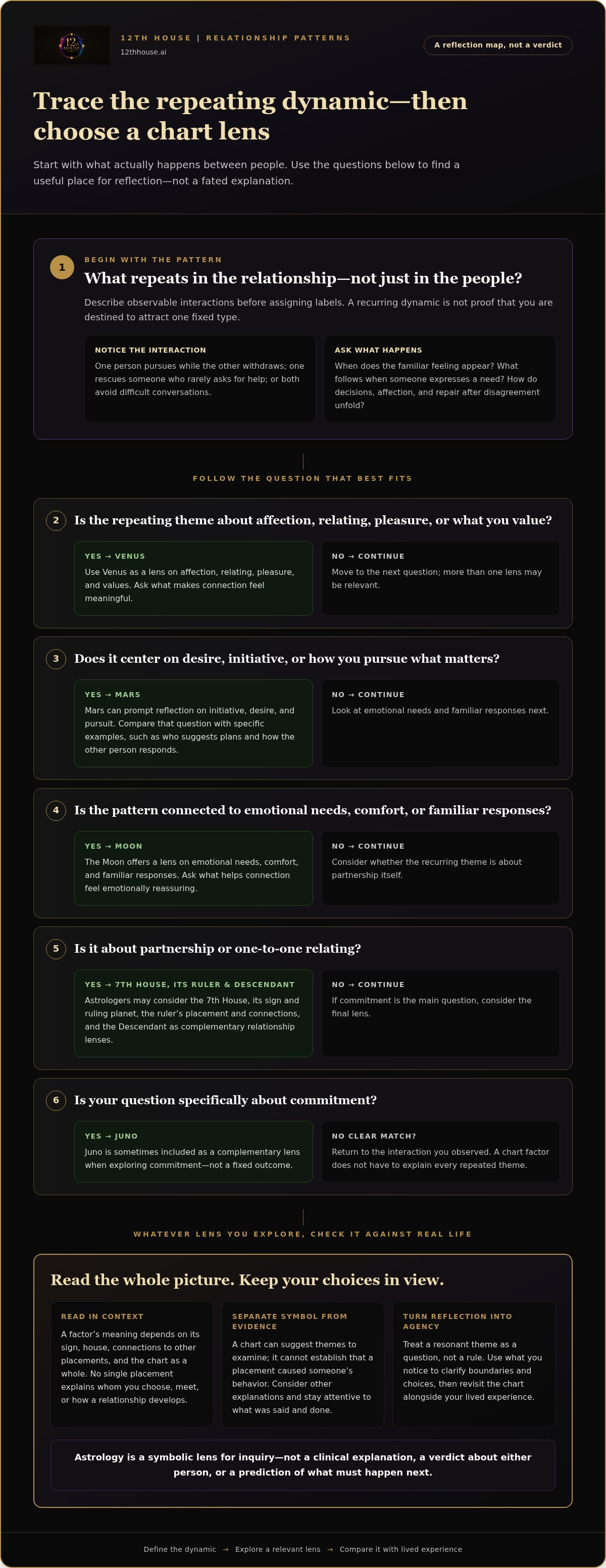
“Type” often points first to surface traits: a familiar style, profession, temperament, or way of communicating. But the similarity may sit deeper in the relationship’s structure. Notice whether you tend to pursue while the other person withdraws, rescue someone who rarely asks for help, or keep the peace by avoiding difficult conversations. These are neutral examples, not assumptions that every repeated dynamic is harmful.
Compare how relationships feel and unfold, not only the labels you’d give the people in them. Ask: When does the familiar feeling appear? What happens after one person expresses a need? How do decisions, affection, and repair after disagreement take shape? Specific observations give you a clearer pattern to reflect on than broad labels like “unavailable” or “too intense.”
Can astrology explain a relationship pattern without making it destiny?
Astrologers interpret birth-chart placements as symbols and themes. Natal astrology uses an individual’s birth chart as its interpretive framework; the overview of Natal Astrology and Birth Charts provides context for that tradition. A chart reading can help you form questions about how you approach closeness or commitment, but it can’t establish that a placement caused a particular partner to behave a certain way.
Keep symbolic reflection distinct from psychological explanations. Learned relationship templates, personal history, and coping strategies may offer other ways to understand familiar responses. These frameworks aren’t interchangeable, and a chart can’t confirm someone’s history. You can consider both while staying attentive to evidence in your own life. Comparing two people’s charts is a separate inquiry from examining your individual relationship patterns; birth chart compatibility addresses that distinction.
Hold each interpretation lightly. If a chart theme resonates, use it to generate a question, not to excuse behavior or predict what must happen next. Then return to the relationship itself: what was said, what was done, and what choices remain available to you?
Which birth-chart placements can illuminate your relationship patterns?
No single placement explains whom you choose, whom you meet, or why a relationship develops as it does. Astrologers read chart factors together, then interpret them in relation to a specific question. A recurring dynamic around closeness, for example, may call for a different inquiry than a pattern around conflict or commitment.
Astrologers commonly examine Venus, Mars, the Moon, the seventh house and its ruler, the Descendant, and sometimes Juno as complementary relationship lenses, not fixed outcomes. The meaning of any one factor depends on its sign, house, connections to other placements, and the chart as a whole. An isolated placement or a single sign-based description can flatten a more complex picture.
Venus, Mars, and the Moon: attraction, desire, and emotional needs
Venus offers one lens on affection, relating, pleasure, and what you value. Mars can describe initiative, desire, and how you pursue what matters. The Moon points toward emotional needs, comfort, and familiar responses. These symbols may help you ask what makes connection feel meaningful or how you respond when you want something. None identifies a guaranteed partner archetype.
Read the three together, and keep your lived experience in view. If you notice that you often initiate plans, for instance, Mars might prompt reflection on how you express desire, while Venus and the Moon could open questions about what feels reciprocal or emotionally reassuring. Then compare those questions with specific examples: who suggests plans, how the other person responds, and whether the arrangement works for you. These are possibilities to explore, not conclusions a placement can make for you.
The seventh house and its ruler: partnership themes in context
In traditional astrology, the seventh house is associated with partnership and one-to-one relating. Astrologers may consider its sign, the planet that rules that sign, and the ruler’s placement and connections elsewhere in the chart. Together, these provide context for reflecting on relationship themes; they don’t predict marriage, identify a future partner, or dictate what a partnership must look like.
House placements depend on birth information and the chart system used, so the same chart can be organized differently across systems. The Descendant, the point opposite the Ascendant at the seventh-house cusp, is also considered in this area. Some astrologers include Juno as another symbol for reflecting on commitment and partnership agreements. Each factor adds a perspective, not a verdict.
Keep the distinction clear: an individual birth chart explores your own symbolic framework, while synastry compares two people’s charts to consider how their placements interact. Synastry in Relationship Astrology describes this comparative approach. For a broader view of personalized chart exploration, 12th House offers Astrology tools that you can use to reflect on your chart and relationship questions while keeping your own observations central.
To explore these symbols as a structured reflection practice, use 12th House astrology tools to consider your chart and relationship questions while keeping your own observations central.
Astrology versus lived experience: how to read repeating themes without overclaiming
A chart can offer a symbolic vocabulary for reflection. A relationship’s observable behavior offers a record of what actually happened. Your interpretation connects those two, but it isn’t the same as either one. Keeping the lenses separate helps you explore “why do I attract the same type of partner astrology” without treating a symbolic resemblance as proof of what caused a pattern.
For example, an astrologer might associate a chart placement with a need for emotional security. That theme could prompt you to ask whether you seek reassurance in relationships. It cannot establish that a partner is unreliable, explain their motives, or show that the placement caused a particular dynamic. Look for concrete details: what was said, what happened next, and whether actions matched words.
| Lens | Useful question | What it cannot establish |
|---|---|---|
| Chart symbolism | What relationship theme might I reflect on? | The cause of a dynamic or what another person will do |
| Observable behavior | What did each person say or do? | Someone’s private motives without further evidence |
| Personal interpretation | What meaning am I making of this experience? | That my interpretation is the only possible one |
What astrology can suggest, and what it cannot prove
Astrology is a meaning-making framework some people use for self-reflection. Traditional interpretations associate chart placements with particular themes, but those associations aren’t verifiable facts about an individual’s character or future. A placement can’t prove that someone is loyal, emotionally unavailable, or destined to repeat a behavior. Keep the claim proportionate: “This symbolism raises a question for me” is more grounded than “My chart explains why this happened.”
A chart should never excuse disrespect or erase agency. No placement makes hurtful conduct acceptable, obliges you to stay, or removes anyone’s responsibility for their choices. Use the symbolism to sharpen your questions, not to override what you know from experience. If a reading conflicts with clear behavior, give the behavior its proper weight.
How relationship templates add a different perspective
Another lens focuses on early experiences and familiar coping styles. People may recognize patterns in how they seek closeness, respond to uncertainty, or manage disagreement. This psychological reflection and astrological symbolism ask different kinds of questions; they don’t have to compete, and neither should be used to declare a definitive cause from limited information.
Try holding both as inquiries. A chart theme might lead you to notice a tendency to seek stability; reflection on learned templates might help you consider where that response feels familiar. Then compare each idea with specific experiences and allow for other explanations. If relationship distress feels persistent or difficult to manage, consider seeking support from a qualified mental health professional. Reflection can open a door; it doesn’t require you to diagnose yourself.
Investigate recurring relationship dynamics with your chart
Begin with what happened, not with a chart label. If you’re asking “why do I attract the same type of partner astrology,” build a brief record of relationship experiences first. That gives you something specific to compare with chart symbolism and helps keep interpretation separate from observation.
Build a relationship-pattern map before opening the chart
Choose more than one relationship and describe actions in neutral language. For instance, “I usually sent the first message after a disagreement” is more precise than “I always choose avoidant partners.” Include moments that don’t fit the pattern, too. Exceptions matter: they can reveal where the dynamic changes or show that separate relationships shouldn’t be forced into one explanation.
Connect chart themes to questions you can act on
Once you have examples, select one or two relevant chart factors rather than trying to interpret everything at once. Treat each factor as a prompt for an open question about your needs, communication, or boundaries. A useful interpretation should help you observe more clearly, not replace evidence or dictate what you should do.
- Record specific moments. Note what happened before, during, and after a meaningful interaction. Include your words and actions, the other person’s observable response, and the context. Avoid guessing at motives.
- Name the repeated dynamic. Look across your notes for a sequence. Do you tend to raise concerns only after they build up? Do you take the lead on making plans, or wait for the other person to initiate? Describe the pattern as an interaction, not a fixed identity.
- Track your response. Write down what you felt and what you did next. For example, after plans changed, did you ask for clarity, stay quiet, or offer to reorganize everything? This connects the relationship dynamic to choices you can examine.
- Choose a chart theme to explore. Select a placement that relates to your question, such as Venus for values in relating or the Moon for emotional needs. Ask what the symbolism brings to mind, but don’t treat that association as evidence of why the interaction occurred.
- Consider another interpretation. Could timing, communication habits, different expectations, or a one-off circumstance explain the example? Note what supports your idea and what doesn’t. Keep exceptions visible rather than making every experience fit the same theory.
- Write one grounded question. Carry a question into future relationships, such as, “Can I express what I need before I feel resentful?” or, “Do our actions around making plans feel mutual?” Make it open enough to guide observation, not confirm a prediction.
For another perspective on relationship questions, AI love readings can offer related context. You can also bring a personal chart question to Ask Lala for intuitive insight. Keep your notes, interpretation, and choices at the center of the process.
Turn astrological insight into more conscious relationship choices
A chart interpretation earns its place when it helps you make a more considered choice in real life. The question “why do I attract the same type of partner astrology” can open reflection, but it doesn’t need to end with one definitive explanation. Revisit your chart notes alongside what you actually experience: how you feel, what you ask for, how the other person responds, and what you decide to do.
Keep the record open. An interpretation may clarify a preference you hadn’t named, or it may feel less accurate as you notice new details. Either response is useful. Let experience refine the reading rather than changing your experience to fit the reading.
Keep the interpretation curious, specific, and grounded
Return to your original question and mark what still feels relevant, what remains uncertain, and what you’ve learned since you first considered it. Separate insights about your own preferences from claims about another person. “I value direct communication” describes something you can know and act on; “their chart means they can’t communicate” assigns a fixed label that the chart cannot establish.
Let new experiences complicate the picture. If a familiar theme appears, note the details. If it doesn’t, record that too. Over time, this helps you distinguish a useful symbolic prompt from an assumption you may have carried into the relationship. The aim isn’t to prove your chart right. It’s to understand your responses and make room for choices that reflect what matters to you.
Choose a reflective space that supports continued exploration
12th House brings Astrology and related metaphysical tools together in organized online rooms for personal exploration. Ask Lala offers real-time intuitive answers and energetic insight, giving you another way to explore a question you’re holding. Keep that exploration reflective: an intuitive perspective is not a promise about how a relationship will unfold.
The Book & Video Library provides a protected online reader for books, videos, teachings, notes, and transcripts. You can use its learning materials to deepen your understanding, then return to your own notes and lived experience. Structure can support inquiry, but your observations and decisions remain central.
Let the chart be one part of an ongoing practice: reflect, observe, and adjust your understanding as life gives you more information. If you’re ready to continue that personal inquiry, explore 12th House and its metaphysical tools at your own pace.
Carry your insight into the next relationship
You don’t need a final explanation before you can choose differently. Keep the question “why do I attract the same type of partner astrology” open enough to evolve as you notice what feels mutual, what fits your values, and where you want to respond in a new way. A chart can accompany that process, but your lived experience remains part of the evidence.
For continued exploration, 12th House brings Astrology and related metaphysical tools together in organized online rooms. Ask Lala offers real-time intuitive answers and energetic insight, giving you a way to explore a personal question while keeping your own judgment central.
Let curiosity guide the next step, not pressure to find a single answer. Explore 12th House and continue your chart-based reflection. Each thoughtful choice can help you build relationships with greater clarity and intention.
Frequently Asked Questions
Which astrology placements are associated with repeating relationship patterns?
Astrologers often consider Venus, Mars, the Moon, the seventh house, its ruler, and the Descendant when reflecting on relationship themes. Some also include Juno. These factors aren’t a checklist that identifies one cause. If you’re asking “why do I attract the same type of partner astrology,” start with the specific dynamic you’ve noticed, then consider which chart symbols might offer useful questions about your needs, communication, or expectations.
Can astrology predict the kind of partner I will attract?
No, a birth chart can’t specify whom you’ll meet or predict a future partner’s behavior. Astrologers may interpret chart patterns as symbolic themes, but those themes aren’t guarantees. For practical decisions, look at how someone acts over time. For example, if consistency matters to you, notice whether plans and communication are dependable rather than using a sign or placement as a substitute for getting to know the person.
Do I need an exact birth time to explore relationship themes in astrology?
Not for every kind of chart reflection, but an accurate birth time matters for calculating the Ascendant, Descendant, and houses. Without it, interpretations involving the seventh house or chart angles may be less dependable. You can still explore placements that don’t rely on house positions, while noting the limit. If your birth time is uncertain, treat house-based interpretations as tentative instead of building a firm conclusion on them.
Is birth chart compatibility the same as understanding my relationship patterns?
No. Exploring your own chart focuses on your individual symbols and recurring questions; compatibility, often called synastry, compares two people’s charts. For instance, you might reflect on how you approach closeness in your chart, then separately explore how your placements interact with a partner’s. Neither comparison can determine whether a relationship will work. Communication, shared expectations, and each person’s actions remain essential parts of the picture.
Can two people with the same zodiac sign have completely different relationships?
Yes. A shared Sun sign doesn’t mean two people have identical birth charts, relationship preferences, or experiences. Their Moon, Venus, Mars, house placements, and connections between planets may differ, as can their values and circumstances. Even people with very similar charts make their own choices. Use Sun signs as one small piece of astrological language, not as a complete account of someone’s behavior or capacity for partnership.
Is astrology scientifically proven to explain why I choose certain partners?
No. Astrology isn’t scientifically established as a causal explanation or dependable prediction of partner choice. Some people use it as a symbolic framework for reflection, but that’s different from scientific evidence. If you explore a chart, compare its interpretations with specific experiences and remain open to other explanations, including personal history and circumstances. Don’t use a placement to diagnose yourself, label someone else, or replace support that would help you.


