

If you’ve wondered, “why am I so tired human design,” you may be trying to reconcile how you feel with what you’ve heard about your type. That mismatch can be confusing, especially when descriptions sound certain. Human Design can offer a symbolic framework for reflecting on energy, but it can’t explain persistent exhaustion.
Your experience is real, even if it doesn’t fit a chart description. Human Design may prompt you to notice patterns in how you use energy, respond to demands, and make decisions. It can’t diagnose fatigue, and feeling tired isn’t proof that you’re living against your design.
Here, you’ll learn what Human Design may suggest about energy, where interpretation ends, and how to observe your own patterns without turning them into a verdict. We’ll also cover practical next steps, including when ongoing, new, or severe fatigue deserves attention from a healthcare professional. Use the chart as a prompt for inquiry, not a substitute for care.
Key Takeaways
- Human Design describes energy through a symbolic framework. It isn’t a clinical measure or explanation for fatigue.
- The five types and other Bodygraph elements offer perspectives for reflection, not a fatigue diagnosis.
- If you’re asking “why am I so tired human design,” distinguish chart language from everyday factors such as sleep, workload, stress, and routine changes.
- Notice when tiredness appears, record the context, compare it with your chart, and reassess over time.
- A Human Design profile can provide a structured reference for self-reflection, while persistent fatigue calls for appropriate health support.
Why am I so tired? What Human Design can, and cannot, explain
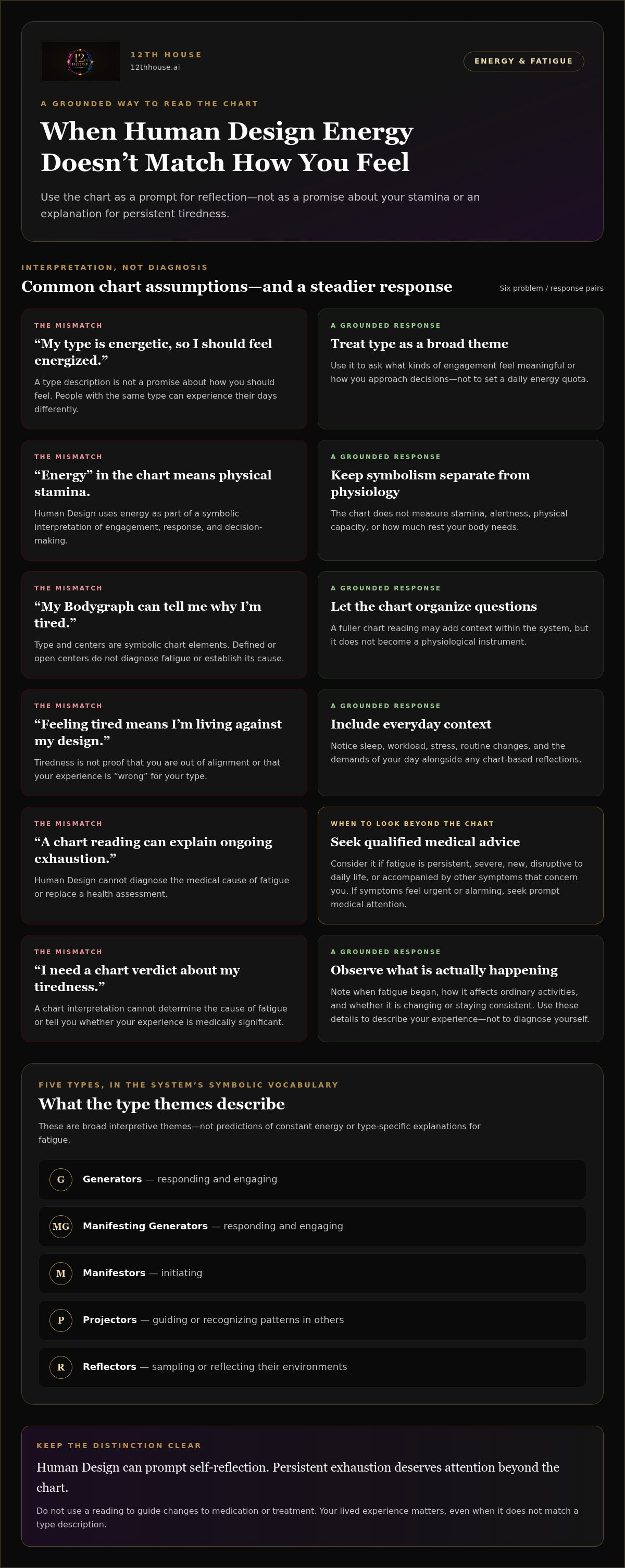
You may have heard that your type is associated with consistent or abundant energy, yet still wake up tired, struggle through the afternoon, or need more recovery than expected. If you’re searching “why am I so tired human design,” start with this distinction: a type description is not a promise about how you should feel.
Human Design uses “energy” as part of a symbolic framework for interpreting decision-making, engagement, and activity. Its Human Design system combines several traditions and maps a person through chart elements, including type and centers. The chart may offer prompts for self-observation, but it isn’t a clinical measurement of stamina, alertness, or physical capacity.
Human Design can frame symbolic self-reflection. It cannot diagnose the medical cause of fatigue.
What does Human Design mean by energy?
In Human Design, “energy” refers to an interpretation of how a person engages, responds, or makes decisions within the system. It doesn’t mean constant stamina, a fixed daily energy level, or uninterrupted motivation. Type descriptions are broad chart elements, not universal predictions. Two people with the same type may experience their days differently, and one person’s capacity can vary with circumstances.
That distinction matters when familiar labels seem to contradict your experience. A chart may prompt questions about which activities feel engaging or how you approach commitments. It can’t tell you how much rest your body needs, and it shouldn’t be used to judge whether your tiredness is “correct” for your type. Treat the language as an interpretive lens, not a rulebook.
When tiredness deserves attention beyond a chart
Fatigue can have many possible causes, and a chart can’t determine which, if any, applies to you. Consider seeking qualified medical advice if tiredness is persistent, severe, new, disruptive to daily life, or accompanied by other symptoms that concern you. A Human Design reading isn’t a substitute for health assessment, and it shouldn’t guide changes to medication or treatment.
Keep your observations specific. Note when the fatigue began, how it affects ordinary activities, and whether it is changing or staying consistent. These details can help you describe your experience when seeking care, but they aren’t a way to diagnose yourself. If symptoms feel urgent or alarming, seek prompt medical attention rather than waiting for a chart interpretation.
You can explore your relationship with commitments or patterns of engagement through Human Design while leaving questions about persistent exhaustion to qualified health professionals. The chart can be a prompt, not a verdict. Your lived experience deserves attention even when it doesn’t match the energy language associated with your type.
How Human Design maps energy through type and the Bodygraph
Human Design doesn’t reduce its energy map to a single label. Type is one entry point into a larger chart, and its descriptions belong to the system’s symbolic vocabulary, not to physiology or measurable health. A type may offer a lens for reflecting on how you engage with activity, but it can’t calculate your stamina or explain why you feel depleted.
The system describes five types: Generators and Manifesting Generators are associated with responding and engaging; Manifestors with initiating; Projectors with guiding or recognizing patterns in others; and Reflectors with sampling or reflecting their environments. These are broad interpretive themes, not prescriptions. Uma Girish’s overview of the five Human Design energy types provides further context for how the system describes them. None predicts that someone will always feel energetic or identifies fatigue as a type-specific condition.
What type can suggest, and what it cannot predict
Type may give you a starting question: What kinds of engagement feel meaningful? How do you tend to approach decisions? It can’t tell you how much sleep you need, set a daily energy quota, or predict how you’ll feel after a demanding week. If you’re asking “why am I so tired human design,” don’t treat a type description as an explanation. Your experience is more specific than a category.
For example, two people who share a type might have different work demands, routines, and responses to exertion. Their charts may provide a common symbolic reference point, but they don’t establish identical needs or outcomes. Read type language as a prompt to observe yourself, not a universal rule for how you ought to function.
How the Bodygraph adds context to an energy reading
The Bodygraph is interpreted through multiple elements, including centers, which the system assigns different symbolic meanings. Centers may be shown as defined or open, but those chart features shouldn’t be translated into a diagnosis or a direct claim about someone’s physical energy. A single center, like a type label, doesn’t establish why a person feels tired.
A fuller interpretation considers how chart components relate to one another within Human Design’s framework. That added context may make reflection more nuanced, but it doesn’t turn the Bodygraph into a physiological instrument. The chart can help organize questions about your patterns. Sleep, physical exertion, health conditions, and other real-world factors require observation beyond its symbolism.
To explore the framework further, use Human Design types and their energetic architecture as a guide to the system’s vocabulary, and keep chart interpretation separate from conclusions about health. A Human Design profile can serve as a structured reference for personal reflection, not a fatigue assessment.
Why an energetic Human Design type can still feel tired
A type associated with energy doesn’t require you to feel energized all the time. Human Design describes patterns symbolically; it doesn’t set a minimum level of stamina or predict how much recovery you’ll need. Energy-related type descriptions do not predict an individual’s fatigue.
This matters because ideas about Projector burnout and Generator energy can sound like fixed rules: Projectors must conserve themselves, while Generators and Manifesting Generators should always have energy for what they enjoy. These ideas may prompt useful questions about work and engagement, but they can’t account for workload, health, responsibilities, or circumstances on their own.
Projector, Generator, and Manifesting Generator: avoid one-size-fits-all rules
Human Design’s type language may offer a lens for reflection, not a forecast. A Projector label can’t establish that someone’s tiredness is burnout, just as a Generator or Manifesting Generator label can’t prove that fatigue comes from ignoring a response. For a fuller overview of the system’s type framework, explore Human Design types and their energetic architecture.
Consider two people with the same type and very different weeks. One may be managing a demanding workload, while the other has more room to rest. Their type is the same, but that label doesn’t describe the full context of either person’s life. The nine energy centers in Human Design add further symbolic elements to the chart, but these also aren’t measures of physical capacity or explanations for exhaustion.
Being engaged is not the same as never feeling tired
In Generator-focused descriptions, engagement might be expressed through ideas such as focus, presence, or a pleasing rhythm. These are examples of how the system talks about experience, not diagnostic criteria or proof of unlimited physical or mental capacity. You can be interested in a project and still feel tired after concentrating for hours, meeting a deadline, or spending a physically demanding day on your feet.
Separate the signals. Enjoyment describes your response to an activity; exertion describes what it asks of you; recovery is what you need afterward. They can coexist. Even meaningful activity can require substantial effort, and enjoyment doesn’t cancel out the effects of a packed schedule or interrupted rest. Following a Human Design strategy or authority is not a guarantee against exhaustion.
Human Design interpretation: May invite reflection on engagement, decisions, and patterns described by type.
Everyday observation: Records what you did, how demanding it felt, and when tiredness appeared.
Useful boundary: A chart can offer symbolic context, but it can’t tell you the cause or severity of fatigue.
If you’re wondering “why am I so tired human design,” use the chart to form questions, not to dismiss what your body is telling you. A Human Design profile can provide a structured reference for self-reflection, and you can explore personalized chart questions with Lala, 12th House’s AI assistant.
A grounded way to explore tiredness through Human Design
Reflection works best when it begins with what you can observe, not with a chart-based conclusion. If you’re asking “why am I so tired human design,” use the framework to generate questions while keeping everyday context and health concerns in view. This four-step process can help you notice patterns without treating them as proof of a cause.
Track the pattern before interpreting it
Keep a dated note when tiredness stands out. Record how it affects your day and what was happening around it, without trying to diagnose yourself. A log can make your experience easier to describe, but it can’t determine a medical cause. There’s no required tracking period; seek advice sooner if symptoms are concerning.
- Notice the pattern. When did the tiredness begin? Does it come and go, or is it present most days? Note whether it changes your ability to work, study, manage daily tasks, or take part in activities that matter to you.
- Record the context. Make brief observations about sleep, workload, stress, routine changes, and physical or mental demands. Note any accompanying symptoms, too. These details are information to share with a qualified health professional, not clues that let you diagnose yourself.
- Consult the chart as a prompt. After recording your lived experience, consider whether Human Design language raises useful questions about engagement, decisions, or commitments. Keep chart interpretations separate from your health notes and from conclusions about what caused the fatigue.
- Reassess without forcing a match. Review your observations and ask what you know, what remains uncertain, and whether the fatigue is changing or disrupting your life. If it persists or concerns you, prioritize medical advice over further chart interpretation.
Use the chart as a reflective prompt, not a verdict
Compare your experience with chart language gently. Does a description help you notice how you approach demands, or does it simply fail to fit? Which activities hold your attention, and what happens to your capacity afterward? Are there pressures or routine changes that deserve attention outside the chart? You don’t need to make your experience conform to a type description.
Keeping two records may help: one for concrete observations, such as sleep and symptoms, and another for Human Design reflections. That separation makes it easier to distinguish symbolic interpretation from evidence about health. A profile can help organize chart questions, but it can’t explain or treat persistent fatigue.
If tiredness is ongoing, severe, new, disruptive, or accompanied by other concerning symptoms, seek qualified medical advice. Don’t use a chart reading to change medication or treatment. For a structured way to explore chart questions as reflection, explore your Human Design profile through 12th House.
Use a Human Design profile for reflection, not a fatigue diagnosis
Human Design can give you a structured language for considering how you make decisions and relate to engagement. It can’t establish why you feel tired, explain persistent fatigue, or treat it. Keep that boundary clear. A chart may help you examine your experience, but it doesn’t replace attention to your health or advice from a qualified medical professional when symptoms are ongoing or concerning.
What a Human Design profile can contribute
A Human Design profile can bring the system’s concepts together as a reference for personal exploration. You might use it to consider whether descriptions of decision-making or engagement resonate with your observations. Treat agreement as a prompt for further reflection, not scientific evidence. A profile can’t identify the cause of tiredness or tell you what care you need.
If you’re still asking, “why am I so tired human design?” let the profile help you frame questions rather than supply a verdict. You could reflect on which commitments feel engaging, where you may be overextended, or what recovery means in your lived experience. Keep those reflections separate from health conclusions. Resonance can be personally meaningful without establishing a physical cause.
12th House offers Human Design profiles through its digital membership platform, alongside metaphysical tools and learning resources. Approach a profile as a map of the system’s ideas, not a measure of your body’s energy. You remain the interpreter of your experience. If the framework feels useful, explore it with curiosity; if it doesn’t fit, you don’t need to force a match.
Bring a focused question to Lala
Lala is an AI assistant that provides personalized responses to questions about charts and related subjects. Keep your question within that scope: “How is this chart concept traditionally interpreted?” is more appropriate than asking what medically causes fatigue. An AI response can help you explore Human Design language, but it can’t assess symptoms or provide a medical diagnosis.
Use the framework if it supports thoughtful self-reflection, and set it aside when you need health guidance. Persistent, severe, new, or disruptive fatigue deserves appropriate medical attention, not an increasingly elaborate chart interpretation. Your chart doesn’t have to account for every part of your life, and your well-being doesn’t depend on making its language explain everything.
If you’d like to explore your chart through this reflective lens, explore Human Design tools with 12th House. Bring a question about the system, stay open to what does and doesn’t resonate, and prioritize health concerns appropriately.
Choose your next step with clarity
The question “why am I so tired human design” can open a meaningful reflection, but it doesn’t have to explain everything that’s happening. Let curiosity about your chart sit alongside attention to your day-to-day experience. If fatigue persists or disrupts your life, prioritize health support; symbolic insight can remain a separate practice.
12th House brings Human Design profiles, Lala for personalized chart questions, and membership access to a metaphysical library together in a digital platform. Use these resources for learning and self-reflection, not to diagnose fatigue.
Explore Human Design tools with 12th House and bring one open question to your chart exploration. You can honor both your interest in the framework and your lived experience. Let the first guide reflection, and the second guide the care you seek.
Frequently Asked Questions
Is Human Design able to explain why I am always tired?
No. If you’re asking “why am I so tired human design,” the chart can’t identify the cause or rule out health concerns. It can help you reflect on how you relate to activity, but it can’t assess your body. Before interpreting a chart, consider what has changed in your routine and how tiredness affects specific tasks. If it’s persistent or concerning, discuss those details with a qualified healthcare professional.
Can Projectors feel energetic and still get tired?
Yes. A Projector can feel absorbed in a conversation or focused on a task and still need rest afterward. Rather than judging your experience against type expectations, note what the activity involved, how long it lasted, and how you felt later. That gives you a clearer picture of your own pattern than the type label alone. If tiredness continues to interfere with daily life, seek medical advice.
Why am I tired if I am a Generator in Human Design?
Being a Generator doesn’t mean you’ll feel energetic every day. An activity can hold your interest while still involving long hours, sustained concentration, or physical effort. For example, enjoying a project doesn’t guarantee you’ll feel rested after working late on it. Notice the difference between liking what you’re doing and having capacity for it. Don’t assume your Generator type identifies the reason you feel tired.
What happens if my Human Design type does not match my energy levels?
Nothing has gone wrong. A mismatch between type language and your experience doesn’t prove you’ve misunderstood the chart or failed to follow it correctly. Write down what the description suggests, then separately describe what you notice in daily life. You can leave the question unresolved. If low energy is new, persistent, or limiting your usual activities, focus on health guidance rather than forcing a chart-based explanation.
Can an open center in my Bodygraph cause fatigue?
No center in a Bodygraph can establish a medical cause of fatigue. If a center’s description catches your attention, use it to form a question about your experience, such as whether certain settings feel demanding. Treat the answer as personal reflection, not evidence about your health. Don’t use a center interpretation to explain away symptoms; discuss ongoing tiredness or changes in functioning with a qualified healthcare professional.
When should I talk to a doctor about feeling tired?
Seek medical advice if tiredness is persistent, severe, new, worsening, or interfering with everyday activities. Before an appointment, you might note when it began, what tasks have become difficult, and any accompanying symptoms or recent changes. These details can help you communicate clearly, but they won’t diagnose the problem. A Human Design interpretation can’t rule out health conditions or determine the source of fatigue.


